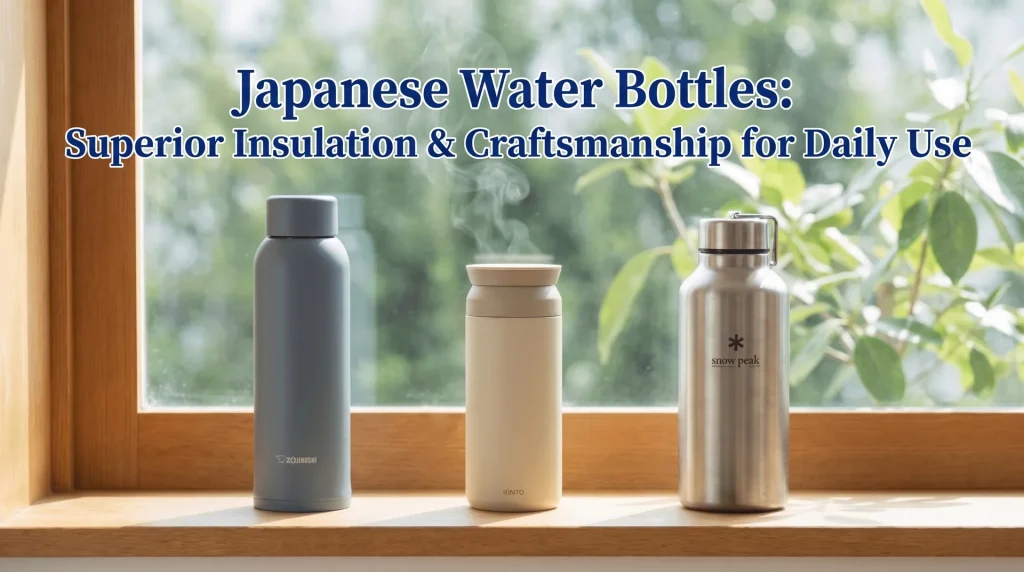
The five Japanese water bottle brands most worth buying are Zojirushi, Tiger, Thermos Japan, Snow Peak,
and Hario — the makers behind Japan's mahobin ("magic bottle") vacuum-insulation tradition, each
with a specific made-in-Japan line worth seeking out.
The short version: for everyday commuting, get a Thermos Japan or Tiger vacuum bottle from their
made-in-Japan lines; for ultralight outdoor use, get Snow Peak's titanium bottle from
Tsubame-Sanjo; for glass, get Hario.
Japan invented the modern insulated-bottle culture — the Japanese word for thermos is mahobin, literally
"magic bottle" — and brands like Zojirushi, Tiger, and Thermos Japan have been perfecting vacuum insulation for
over a century. Hot tea poured in the morning is still genuinely hot by evening.
One thing most guides won't tell you: a Japanese brand name doesn't guarantee a Japanese-made
bottle. Many popular models are produced overseas. This guide compares Japan's major bottle brands,
then picks the specific models that are actually manufactured in Japan — and explains how to choose between them.
Quick Reference: Water Bottle Types at a Glance
| Type | Capacity | Insulation | Best for |
|---|---|---|---|
| Direct-Drink | 350–600ml | Excellent vacuum insulation | Commuting, school, sports |
| Cup-Pour | 300–500ml | Optimized for heat retention | Coffee, tea, emergency prep |
| One-Touch | 400–800ml | Excellent vacuum insulation | One-handed use, outdoors |
| Screw-Cap | 500ml–1L | Highest seal rating | Hiking, long outings, emergencies |
Why Carry Your Own Bottle? Japan's Insulated Bottles Go Beyond Keeping Drinks Hot
The reusable bottle has come a long way from the heavy, clunky canteen of school field trips. Today it's a daily-carry essential — part fashion item, part practical tool, part emergency kit.
Your Bottle as a Preparedness Tool
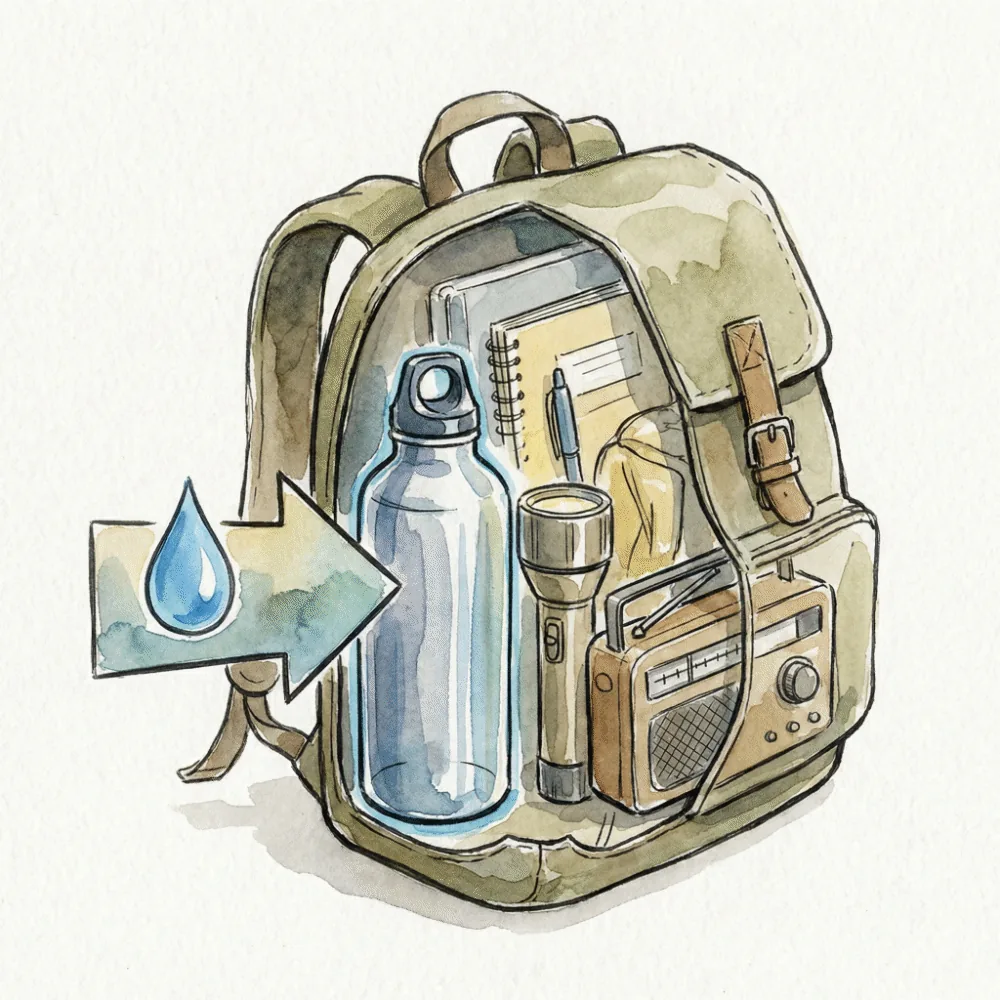
Carrying a water bottle every day is, quietly, a form of disaster preparedness.
A full 500ml bottle means half a day's drinking water if you're caught away from home in an emergency.
In summer heat, it's your front line against heat exhaustion. In a winter blackout, a thermos full of hot water
is the difference between staying warm and shivering through the night.
Japan's vacuum-insulation technology is among the best in the world: hot water poured in the morning stays
genuinely hot by evening. That performance is just as valuable in a crisis as on your daily commute.
Did you know: In Japan, a thermos is a "magic bottle"
The everyday Japanese word for an insulated bottle is mahobin (魔法瓶) — literally "magic bottle." When vacuum flasks first arrived in Japan around a century ago, keeping water hot all day with no fire seemed like actual magic, and the name stuck. The companies that grew up around that "magic" — Zojirushi and Tiger, both founded in Osaka in the early 1900s — are still the world's benchmark for insulation performance today.
5 Japanese Water Bottle Brands: Who Makes What
Five names dominate the Japanese bottle world, and each has a distinct personality. Here's the landscape before we get to specific picks:
- Zojirushi (象印, Osaka, est. 1918): The elephant-logo brand best known overseas for rice cookers. Its stainless mugs are famous for razor-thin walls, ultralight weight, and lids that disassemble completely for cleaning. Brand profile →
- Tiger (タイガー魔法瓶, Osaka, est. 1923): Zojirushi's century-old rival. Known for rugged build quality and a certified made-in-Japan production line — increasingly rare in this category.
- Thermos Japan: The brand that started it all globally — and today Thermos K.K. is a Japanese company (part of the Taiyo Nippon Sanso group). Its Japan-market lineup is the volume leader, with select models still made in Japan.
- Snow Peak (Tsubame-Sanjo, Niigata): The premium outdoor brand. Its titanium bottles are made in Japan's metalworking capital and carry outdoor-grade durability with almost no weight. Brand profile →
- Hario (Tokyo, est. 1921): "The King of Glass." If you prefer glass over metal — for taste purity or cold-brew tea — Hario's heatproof glass bottles are made in its own Japanese glass factory. Brand profile →
The catch: brand nationality is not manufacturing origin. Most mass-market models from the big brands — including many Zojirushi and Thermos bestsellers — are produced in Thailand, Malaysia, or China to Japanese specs. They're still excellent bottles. But if "made in Japan" is the point, you have to pick specific models, which is exactly what the next three sections do.
Did you know: The vacuum flask wasn't invented for tea
The vacuum flask was invented in 1892 by Scottish chemist James Dewar — to store liquefied gases in his laboratory, not drinks. German glassblowers commercialized it under the name "Thermos" (from the Greek thermē, heat). Japan imported the idea, made it a household essential, and then spent a hundred years quietly out-engineering everyone at it. That's why "Japanese thermos brands" is a search term in the first place.
Japanese Water Bottle Brand ①: Zojirushi — The Osaka Original
Zojirushi is where Japan's vacuum-bottle industry effectively begins. Founded in Osaka in 1918 as
the Ichikawa Brothers Trading Company, it started by manufacturing the glass liners that went inside vacuum
flasks — the core component of the technology — and built everything else on top of that.
That origin still shapes the products. Zojirushi's stainless mugs are known for exceptionally thin walls, very
low weight for their capacity, and lids that come apart completely so every surface can be cleaned. The elephant
logo is better known overseas for rice cookers, but insulation was the founding business.
- Founded
- 1918, Osaka
- Known for
- Thin-walled lightweight stainless mugs; fully disassemblable lids; the original glass-liner heritage
- Made-in-Japan note
- Zojirushi keeps high-end production at its domestic factories in Osaka Prefecture, but many mass-market bottles are produced overseas to Japanese specs — check the model, not the brand
Japanese Water Bottle Brand ②: Thermos Japan — Slim, Simple, Easy to Clean
The answer to "I hate cleaning my bottle" isn't always a high-tech lid mechanism.
Sometimes it's the opposite: a bottle so well-built and so thoughtfully simple that cleaning takes thirty seconds
and lasts a decade.
Thermos Japan JNY Series — Slim Carry Mug, Made in Japan
Thermos has been synonymous with vacuum insulation in Japan for decades, and the JNY series is the brand at its most refined: an ultra-slim profile that slips into any bag pocket, a one-touch flip lid, and insulation that genuinely holds temperature through a full commute. Made in Japan, with the kind of polished interior finish that makes cleaning straightforward and prevents odor buildup. No unnecessary complexity — just a bottle that works, day after day.
- Material
- SUS304 stainless steel (18/8)
- Made in
- Japan
- Best for
- Commuting, desk use, everyday hot/cold carry
- Capacity
- 350ml / 500ml
- Price range
- $30–$50
Japanese Water Bottle Brand ③: Tiger Corporation — Japan-Made Thermos Line
When something is used every single day, quality in the details matters more than anywhere else.
Tiger Corporation — one of Japan's founding thermos manufacturers — still produces select models domestically, and
the difference shows in every interaction.
Tiger Thermos — Made in Japan Vacuum Insulated Bottle
Founded in Osaka, Tiger Corporation has been perfecting vacuum insulation for over a century. Their "Made in Japan" certified line is manufactured and inspected entirely within Japan — a distinction that's increasingly rare even among premium brands. The drinking lip is shaped for a smooth, natural pour, refined over decades of iteration. Clean lines, honest construction, and insulation that keeps hot drinks genuinely hot through a full workday.
- Material
- SUS304 stainless steel (18/8)
- Made in
- Japan
- Best for
- Daily commuting, coffee, tea
- Capacity
- 360ml / 480ml
- Price range
- $45–$60
Japanese Water Bottle Brand ④: Snow Peak Titanium — Built in Tsubame-Sanjo
If you want to cut pack weight without sacrificing durability — or if you're sensitive to the faint metallic taste
that stainless steel can leave — titanium is the answer.
Lighter than stainless, stronger than aluminum, corrosion-proof, and hypoallergenic. And when it's made in
Tsubame-Sanjo, the craftsmanship matches the material.
Snow Peak Aurora Bottle (Titanium) — Ultralight & Made in Tsubame-Sanjo
Snow Peak's titanium bottles are manufactured right in Tsubame-Sanjo, combining outdoor expertise with metalworking precision. The Aurora Bottle pairs the extreme lightness of titanium with incredible durability, making it the ultimate everyday carry for both urban commutes and backcountry trails. It carries Snow Peak's lifetime product guarantee. No metallic aftertaste, corrosion-proof, hypoallergenic — the best choice for those who want pack-light performance every day.
- Material
- Pure titanium
- Made in
- Tsubame-Sanjo, Niigata, Japan
- Best for
- Hiking, backpacking, everyday ultralight carry
- Capacity
- 800ml
How to Choose a Japanese Water Bottle That Lasts for Years
When cheap imported bottles fill every shelf, choosing Japanese-made is a deliberate decision — and the payoff is
durability and thoughtfulness that you feel every time you pick the bottle up.
Here's what to look for when making that choice.
Three Things That Separate Japanese Bottles from the Rest
- Material quality — titanium or high-grade stainless:
Japanese manufacturers are selective about the metals they use. Titanium in particular is lightweight, rust-proof, and leaves zero metallic aftertaste — ideal if you're particular about how your drinks taste. - Simple structure = easier cleaning, fewer breakdowns:
Fewer moving parts means less to go wrong and less to scrub. Japanese bottles are typically designed with long-term use in mind — simple enough to stay clean, robust enough to never need replacing. - Craftsman-level finishing:
The smoothness of the drinking lip, the polish on the interior — these invisible details affect how drinks taste and how easily stains come off. The care applied to what you can't see is precisely where Japanese manufacturing earns its reputation.
Frequently Asked Questions
What are the best Japanese water bottle brands?
Zojirushi, Tiger, and Thermos Japan for insulated stainless; Snow Peak for titanium; Hario for
glass.
Zojirushi and Tiger are the century-old Osaka rivals that define the category, Thermos Japan leads in volume and
variety, Snow Peak makes the premium titanium bottles in Tsubame-Sanjo, and Hario covers heatproof glass. If you
specifically want a bottle manufactured in Japan, check the model — Tiger's made-in-Japan certified line and Snow
Peak's titanium bottles are the safest picks.
Can I put sports drinks in a regular stainless bottle?
Only if the bottle is labeled "sports drink compatible" — otherwise avoid it.
Sports drinks contain salt, which can accelerate corrosion if the interior has any micro-scratches.
Many recent models from Tiger and Zojirushi are sports-drink safe, but older bottles and budget imports often are
not.
If you do use one, rinse it with water immediately after finishing — don't let the drink sit.
Can I wash my insulated bottle in the dishwasher?
Only if it's explicitly labeled "dishwasher safe" — most are not.
Heat and harsh detergents can strip the protective coating on the base, peel exterior paint, and — most critically
— damage the vacuum layer that makes the insulation work.
That said, some recent Thermos and Zojirushi models now support full dishwasher washing for all parts. If
dishwasher convenience matters to you, make it a selection criterion from the start.
My bottle has developed a bad smell. How do I remove it?
Use oxygen-based bleach for organic stains, citric acid for mineral buildup.
Tea and coffee staining: dissolve oxygen bleach (not chlorine bleach) in warm water and soak for 30 minutes.
White powdery deposits or gritty residue (calcium scale): soak with citric acid or diluted white vinegar.
Never use chlorine bleach (standard kitchen bleach) — it reacts with stainless steel and causes rust.
How long should a good insulated bottle last?
Replace it when the insulation stops working, not on any fixed schedule.
A drop can damage the vacuum layer, destroying insulation performance. The signs: the outside of the bottle feels
warm when you fill it with hot water, or it sweats when filled with cold water.
Gaskets and other rubber seals wear out separately — replace them every year or so to keep the bottle hygienic,
and you can extend the bottle's life considerably.
Can I put milk or café au lait in my bottle?
Generally no — it's a safety issue, not just a cleaning one.
Dairy spoils quickly in a sealed container. As it ferments, gas builds up inside, which can make the lid
impossible to open — or cause the contents to spray when you do open it.
Drink milk-based drinks immediately, or use a bottle specifically designed and rated for dairy — a small number of
specialty models exist for this purpose.
My bottle's insulation has gotten noticeably worse. Can it be repaired?
If the vacuum layer is broken, the bottle cannot be repaired — replacement is the only
option.
A hard impact can rupture the vacuum between the bottle's inner and outer walls, and once that happens, the
insulation is gone permanently. "The outside gets hot" and "condensation is forming" are the telltale signs.
However, replacement lids, gaskets, and seals are available for most Japanese brands through official parts
channels — replacing those components costs a fraction of a new bottle and often extends service life by years.
Final Thoughts: Find the Right Bottle and Make Every Sip Count
It's just a water bottle — except it isn't.
When you use something every single day, small annoyances compound fast. A lid that's awkward to open. A bottle
that's impossible to clean properly. Insulation that gives up after a year.
A well-made Japanese bottle removes all of that friction. Thermos Japan's slim JNY that disappears into a bag
pocket. Tiger's made-in-Japan thermos, refined over a century in Osaka. Snow Peak's Tsubame-Sanjo titanium that
weighs almost nothing and lasts forever.
Find your bottle, and daily hydration stops being a chore and starts being something you quietly look forward
to.

Tsubame-Sanjo Camp Gear: Beyond Snow Peak — 4 Japanese Brands
Nanbu Tekki: Japan's Cast Iron Kettles, Skillets & Where to Buy