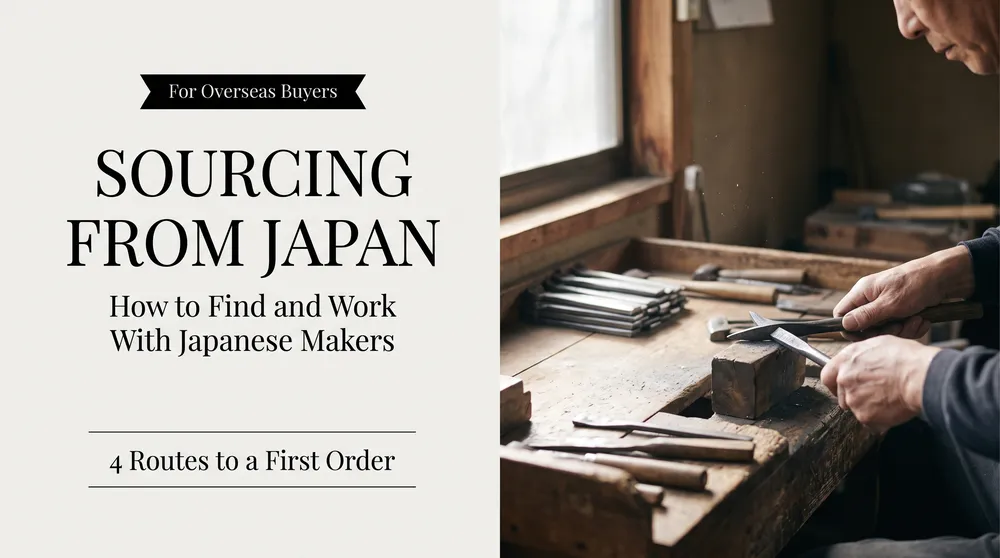
Sourcing from Japan usually fails for one reason: most Japanese makers are small workshops that do not
sell abroad, do not answer English email, and are not listed on any B2B platform. Finding them is not
the hard part. Getting them to say yes is.
This guide explains how Japanese manufacturing is actually structured, what overseas buyers most often get wrong
when they approach a Japanese maker, and the realistic routes to an OEM, wholesale or distribution agreement.
We write it from a specific position. MADE in JAPAN.JP is an independent media covering Japanese-made
products — we are not a manufacturer, a trading company, or an agent for any brand. Overseas buyers
contact us every week because they found a maker through our articles and assumed we were the maker. This guide is
what we tell them.
Quick Reference: Four Routes into Japanese Manufacturing
| Route | Best for | Typical obstacle |
|---|---|---|
| Direct to the maker | Buyers who already know exactly which workshop they want | No English contact; email simply goes unanswered |
| Japanese trading company (shosha) | Large, repeat-volume orders | Minimums are far above what most independent brands can commit to |
| Trade fairs in Japan | Discovering makers you did not know existed | Requires travel, timing and follow-up in Japanese |
| Introduction through a media or intermediary | Small to mid-size buyers, first orders, unfamiliar categories | Quality varies; many intermediaries take a cut from the maker |
1. Why Japanese Makers Are Hard to Reach
The Japanese products that overseas buyers want are rarely made by the companies whose names they know. Behind a famous brand there is usually a workshop of five to thirty people in a regional town, and that workshop is the one that actually holds the technique.
Most of them have never sold outside Japan
A knife forge in Sanjo, a leather atelier in Tokyo, a textile mill in Wakayama — these businesses often run at capacity on domestic orders alone. Exporting means new paperwork, currency risk, and questions they have never been asked before. Not replying is not rudeness. It is frequently the safest answer available to them.
Production is layered, and the layers are invisible from outside
Japanese manufacturing is heavily specialised. One workshop forges, another grinds, another fits handles, another finishes. A brand you approach may not control the step you actually care about. Asking "can you make this?" without knowing which layer you are talking to is why so many enquiries stall.
Regions matter more than company size
Sanjo and Tsubame (Niigata) for forged blades and metalwork. Seki (Gifu) for cutlery at scale. Sakai (Osaka) for single-bevel professional knives. Echizen (Fukui) for forged blades and lacquer. Imabari (Ehime) for towels. Kurume (Fukuoka) for vulcanised footwear. Naming the right region in your first message signals that you have done your homework — and it changes how you are read.
2. 5 Mistakes Overseas Buyers Make
These are drawn from the enquiries we actually receive. Almost every stalled negotiation contains at least one of them.
① Opening with price
A first email that leads with unit cost and target margin reads, to a Japanese workshop, as a request to be cheap. Lead with what you admire about the product and where you intend to sell it. Price comes later, and it comes better.
② Asking for a quote without a quantity
"Please send your wholesale price list" is unanswerable for a workshop that makes to order. State an indicative quantity, a first-order size and a rough timeline, even if provisional.
③ Assuming MOQ is negotiable in the first message
Minimums in Japan often reflect a physical production batch, not a sales policy. Pushing on MOQ before any relationship exists reads as a lack of understanding of how the item is made.
④ Requesting heavy customisation up front
Full OEM — your design, your specification — is a large commitment for a small workshop. Many will accept a standard product with your logo, or a colour and material variation, long before they will accept a new mould or a new pattern. Start with the smallest change that still makes the product yours.
⑤ Treating silence as rejection
Japanese businesses tend not to send a refusal. Silence often means "we do not know how to answer this yet." A clearer, shorter second message — in Japanese if possible — reopens more doors than people expect.
3. OEM, Private Label and Wholesale: What Is Realistic
These three words are often used interchangeably by buyers, but they mean very different things to a Japanese maker — and they have very different chances of being accepted.
Wholesale — the most likely yes
You buy the maker's existing product and resell it. Nothing about production changes. If you are approaching a Japanese workshop for the first time, this is almost always the right opening request.
Private label — possible, case by case
The existing product carries your name or logo. Feasibility depends entirely on the finishing process; stamping a logo into leather is a different conversation from engraving a blade.
Full OEM — the hardest, and the slowest
Your specification, produced by them. This usually requires tooling, sampling, and a volume commitment that makes the setup worthwhile. It is not impossible — we receive genuine OEM enquiries regularly — but it is rarely where a first relationship should start.
Exclusive distribution — ask later, not first
Country exclusivity is the request we see most often and the one that stalls most often. A maker who has never exported has no basis to judge whether you are the right partner for an entire market. Prove the first orders, then ask.
4. What We Do — and What We Do Not Do
We are an independent media, not a trading company. That shapes what we can honestly offer.
What we can do
Identify which makers actually fit what you are looking for, contact them in Japanese, explain who you are and what you are proposing in terms that make sense to a Japanese workshop, and hand the relationship over. We also explain the business customs on both sides so neither party misreads the other.
What we do not do
We do not handle customs clearance, freight forwarding, or payment collection. We are not an importer of record. For those functions you will need a forwarder or a trading company, and we will say so rather than pretend otherwise.
Our fee comes from you, never from the maker
We charge the overseas buyer. We never take a cut out of the Japanese maker's price. This is the
part of how we work that we care about most, so it is worth explaining why.
Japanese workshops are already being squeezed. A weak yen has made their work cheap to the rest of the world, and
a great deal of it was underpriced to begin with. Putting an intermediary margin on the maker's side would push
that down further — and we are not willing to be the reason a craftsman earns less.
These workshops are how the craft survives. A forge in Sanjo, a weaving mill in Wakayama, an
atelier in its fourth generation — if they cannot make a living, the technique is not passed on. And once a
technique stops being passed on, it does not come back. We would rather a maker be paid properly and still be
working in a hundred years than take a few percent out of their price today.
So our fee, when there is one, is agreed with you before anything begins.
What that means for you in practice
This is not only a matter of principle — it changes the deal you get.
The maker's quote is the maker's quote. Nothing is added to it and nothing is quietly removed
from it. What you are told is what the workshop is paid.
We have no incentive to push volume onto a workshop that does not want it. If a maker is not
ready to export, or the order would damage the quality you came for, we will say so — because we do not earn more
by talking them into it.
And the makers know it. That is frequently the reason a workshop agrees to talk to an overseas
buyer at all. An introduction from someone who is not profiting from them is a very different conversation from a
cold approach by a broker.
Have a specific maker or category in mind?
Tell us the product, the market you sell into, and a rough first-order size. If we think it will not work, we will say so before you spend time on it.
Sourcing, OEM & Wholesale Inquiry5. Frequently Asked Questions
Can you introduce me to any Japanese manufacturer?
Only ones we have actually covered and can speak about honestly.
We do not maintain a general supplier database. If the category is outside what we cover, we will say so rather
than make an introduction we cannot stand behind.
What is a typical MOQ for a Japanese workshop?
It varies far too much to give a single number — and that variation is the point.
A small atelier may accept ten pieces because that is one production run. A factory with tooling may need
several hundred. The relevant question is not "what is your MOQ" but "what is one batch for you," which is a
question workshops can actually answer.
Do Japanese makers speak English?
Assume not, and be pleasantly surprised.
Larger brands often have an export contact. Regional workshops usually do not. This is the single most common
reason an enquiry never receives a reply — not disinterest, but the cost of answering in a language the recipient
does not use.
How long does it take to get a first order shipped?
Months rather than weeks, and longer for anything customised.
Handwork does not scale on demand, and many workshops are already booked. Build the lead time into your launch
plan rather than negotiating against it.
Is "Made in Japan" legally defined?
The label refers to where substantial transformation took place, not where every component
originated.
A product can be legitimately Japanese-made while using imported raw material. If country of origin matters for
your market's labelling rules, confirm the specific process steps with the maker rather than relying on the
phrase alone.
What does your support cost?
It depends on how much is involved, and it is agreed with you before anything starts.
An introduction to a maker we already know is a different amount of work from sourcing across a category,
translating a specification, and supporting a negotiation. What does not change is that the fee comes
from the buyer side, never as a cut taken out of the maker's price.
6. Final Thoughts: Approach the Workshop, Not the Market
The buyers who succeed in Japan are rarely the ones with the biggest orders. They are the ones who make it obvious
that they understand what they are buying — the region, the process, the reason the price is what it is.
A Japanese workshop is generally not trying to maximise volume. It is trying to keep doing good work for another
generation. Show that you are useful to that goal, and doors open that no purchase order would have
opened.
Japanese Kitchen Knives: Best Types & Brands (2026 Guide)
Japanese Wallets: The 7 Best Leather Brands, Compared