Japan has an entire premium category for shower heads — ultra fine bubble heads
that inject bubbles small enough to be measured in nanometres, sold on the claim that they clean
pores and cut water use at the same time.
Every Japanese guide to them ends with the same reassurance: they fit almost any Japanese
bathroom with no plumbing work. That is true, and it is the one sentence that does not
travel.
Japanese shower heads use a different thread standard from American ones. It is not
a serious obstacle — a small adapter solves it and costs almost nothing — but you need to know
before the parcel arrives, so that is where this guide starts.
Quick Reference: Will It Fit, and Is It Worth It?
| Where you live | Your fitting | What you need |
|---|---|---|
| Japan | G1/2 hose | Nothing. Unscrew, screw on |
| United States / Canada | 1/2" NPT arm | A G1/2 female → NPT 1/2" male adapter. Around $10 |
| Europe / UK / Australia | G1/2 hose, usually | Often nothing — same standard. Check your hose end |
| This is a plumbing question, not an electrical one. These heads have no power supply — they run on water pressure alone. | ||
Will One Fit Your Shower? The Thread Question
Short answer — yes, everywhere, but Americans need a $10 adapter and should order it at the same time.
The two standards
- Japan uses G1/2, also written BSPP — a parallel thread. The threads do not seal anything; a rubber washer inside the fitting does. This is also the European, British and Australian standard, which is why a Japanese head usually screws straight onto a European hose.
- The United States uses 1/2" NPT — a tapered thread. It seals by the threads themselves wedging together, which is why American plumbing uses PTFE tape rather than washers.
They are not interchangeable. The thread angles differ and one is tapered while the other is not — forcing them together will either fail to seal or damage the fitting.
The fix is trivial and cheap
A G1/2 female to NPT 1/2" male adapter is a small brass or stainless fitting that costs around ten dollars. It screws onto your American shower arm and presents a G1/2 thread for the Japanese head.
Order it with the shower head, not afterwards — otherwise you will have an expensive object and a wet weekend. Use PTFE tape on the NPT side and the supplied washer on the G1/2 side.
Two more things to check before ordering
- Hand shower or fixed head? Japan is overwhelmingly a hand-shower-on-a-hose country, and these heads are designed for that. On an American fixed arm they will work, but you lose the handheld use most of the marketing assumes.
- Water pressure. These heads generate bubbles by forcing water through fine apertures, which restricts flow. In a low-pressure bathroom the result can be a weak shower, and that is true in Japan as well — Japanese listings warn about it for apartments. If your shower is already feeble, this will not help.
- Some Japanese hoses use maker-specific connectors (the large domestic bathroom manufacturers each have their own). If you are buying a head plus hose set rather than a head alone, check what the hose ends in.
Why Japanese — Ultra Fine Bubbles and Water Saving
The category exists because Japan combines two things: a bathing culture that treats
the shower as skincare, and a domestic market that pays close attention to
water bills. A product that claims both sells extremely well there.
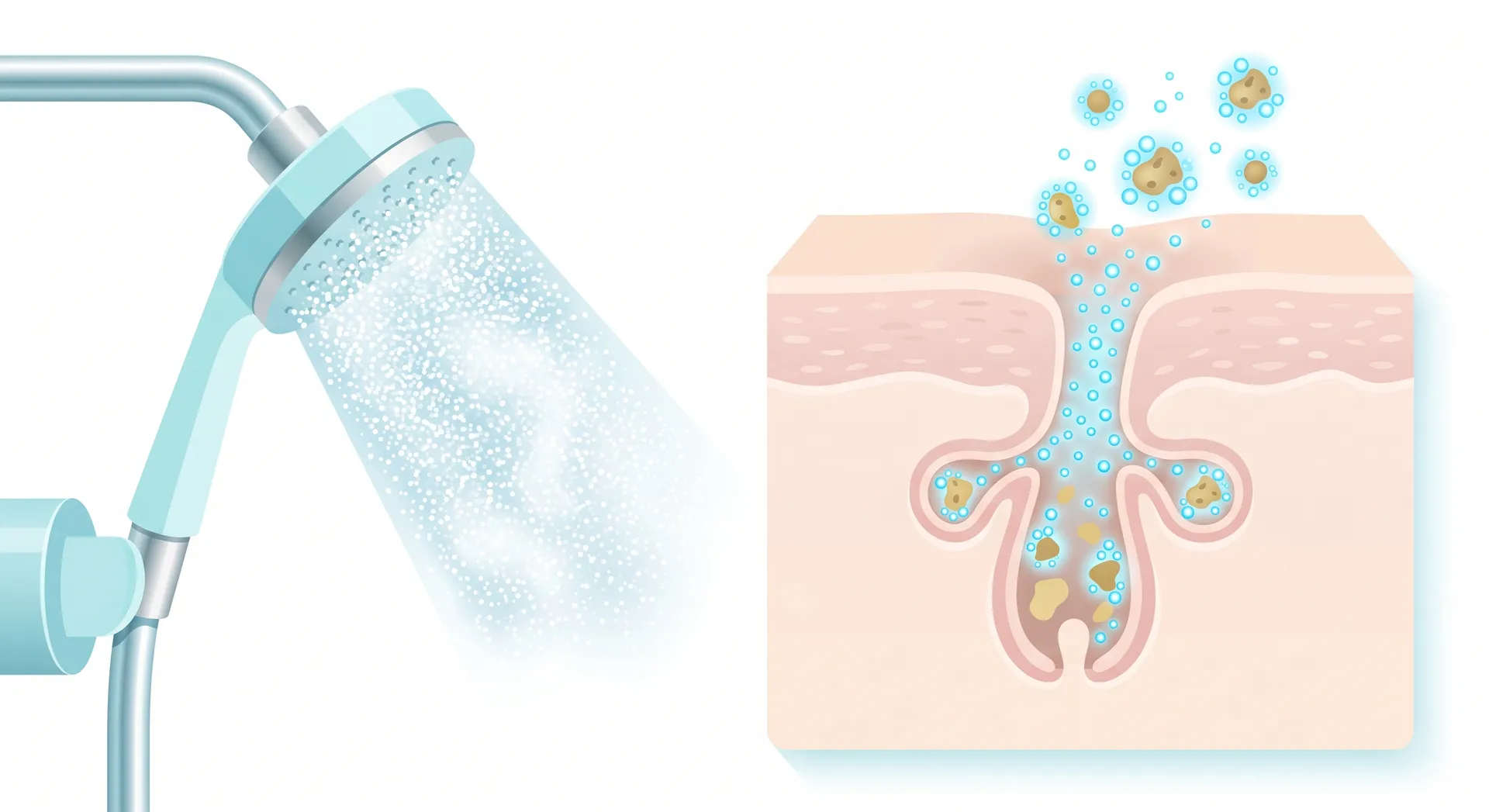
The technology is real even if the marketing outruns it. Bubbles are graded by size, and the
size determines what they can physically do.
| Bubble type | Behaviour | What it is for |
|---|---|---|
| Millibubble | Visible, rises and pops immediately | The white water in an ordinary aerated shower |
| Microbubble | Milky appearance, rises slowly | Feel and warmth. Visible as cloudy water |
| Ultra fine bubble | Too small to see. Stays suspended in the water | Small enough to enter a pore, which is the actual claim |
The honest position on the beauty claims: the physics of very small bubbles entering small openings is not controversial, and manufacturers do publish testing. Whether that translates into visible skin improvement for you is a different question, and the marketing language around this category is enthusiastic.
The water saving, on the other hand, is straightforward. These heads restrict flow through fine apertures and add air, so less water leaves the head per minute while the spray still feels full. Japanese makers commonly claim savings in the region of a third to a half — arithmetic rather than biology, and easy to verify with your own water bill.
Chlorine removal is a separate feature
Many Japanese heads add a filter cartridge that removes residual chlorine from the supply. This is a genuinely different feature from bubble generation, it is the one people with sensitive skin usually notice most, and it is a consumable — the cartridge needs replacing on a schedule.
Before buying a filtered model, check whether replacement cartridges are obtainable in your country. A filter you cannot replace turns into a flow restriction after a few months.
What to Buy
Availability is the weak point. This is a category built for the Japanese domestic market, and the two best-known brands are not set up for international retail.
ReFa Fine Bubble — the one with a global brand behind it
MTG's ReFa is a Japanese beauty-device brand with more international presence than most in
this category, and its shower heads combine ultra fine bubbles with several spray
modes — including a mist setting that is the one people buy it for.
Build quality and finish are noticeably better than the mid-market, which matters for an
object you handle every day.
- Technology
- Ultra fine bubble, multiple spray modes
- Thread
- G1/2 — adapter needed in the US
- Power
- None. Water pressure only
- Availability
- Best international presence of the Japanese brands
- Price range
- $200–$350
Perfect for: Someone buying one of these from abroad who wants the lowest chance of trouble.
Takagi and SANEI — the practical domestic choices
Takagi and SANEI are plumbing fixture manufacturers rather
than beauty brands, and it shows: less marketing, more attention to flow rate, filtration and
replacement parts. Considerably cheaper than the beauty-brand heads and often
the ones Japanese households actually fit.
Filter cartridge availability outside Japan is the thing to check before
buying a filtered model from either.
- Made by
- Plumbing fixture manufacturers, not cosmetics companies
- Strength
- Value, water saving, serviceable parts
- Watch for
- Can you get replacement cartridges where you live?
- Price range
- $60–$150
Perfect for: Anyone whose main interest is the water saving and the chlorine filter rather than the beauty claims.
Mirable — famous in Japan, difficult abroad
Mirable, made by Science, is the brand that created this category in Japan and the
one most people mean when they mention Japanese shower heads. It is sold through a controlled
domestic distribution network with authorised dealers.
That controlled distribution is exactly why buying one from abroad is risky — see
the next section. Authorised international channels are limited, and the brand's own guidance in
Japan warns against unauthorised sellers.
Counterfeits Are a Real Problem Here
Japanese buyers ask about this often enough that it is a standard FAQ on domestic guides, and the situation is worse for anyone buying from another country.
The conditions that produce counterfeits are all present: a high price, a strong brand, controlled distribution that keeps supply tight, and a product whose performance is difficult to assess in the first thirty seconds of use.
- Buy from an authorised seller or the maker's own store. For the premium brands, marketplace listings from unknown sellers are the risk.
- An unusually low price is the signal. These products are not discounted heavily; if it is half price, that is the information.
- Check the warranty and serial registration. Genuine units come with documentation, and the maker can confirm it.
- A counterfeit is not merely worse — it may be a plain shower head. Bubble generation is invisible by definition, so there is nothing to see and no obvious moment where you catch it.
If the brand you want has no authorised route to your country, buy a different brand. Takagi and SANEI are less exciting and much harder to fake profitably.
Descaling and Filter Changes
A microbubble head works by pushing water through very small apertures. Anything that blocks those apertures destroys the effect, and limescale does exactly that.
- Wipe the face weekly and let the head drain rather than leaving it holding water.
- Descale monthly in hard water. Soak the face in diluted citric acid or white vinegar, then rinse thoroughly. Do not use anything abrasive on the nozzle plate.
- Replace filter cartridges on schedule. An exhausted chlorine cartridge is no longer filtering and is now just restricting flow.
- Weak spray is usually scale, not a fault. Descale before concluding the head has failed.
- Keep the washer. The rubber seal in a G1/2 fitting is what stops leaks — if it drips after installation, the washer is missing, damaged or misaligned.
Done properly these last for years. Neglect the descaling and the expensive feature is the first thing to stop working, long before anything visibly breaks.
Frequently Asked Questions
Will a Japanese shower head fit my American shower?
Yes, with a cheap adapter. Japanese heads use G1/2 (BSPP) parallel threads sealed
by a washer; American shower arms use 1/2" NPT tapered threads. They are not interchangeable, but a
G1/2 female to NPT 1/2" male adapter costs around ten dollars.
Order the adapter at the same time as the head.
Does it need electricity?
No. Microbubble shower heads generate bubbles mechanically, using the water pressure already in your pipes. There is no power supply, no battery and no voltage question — which makes them one of the easier Japanese products to bring home.
Will it work with low water pressure?
Not well. These heads produce bubbles by forcing water through fine apertures,
which restricts flow — in a low-pressure bathroom the result is a weak shower.
Japanese listings carry the same warning for apartments. If your shower is already weak,
this will make it weaker.
Do the beauty claims hold up?
The physics is reasonable; the marketing is enthusiastic. Bubbles small enough to
enter a pore are a real thing and manufacturers publish testing, but whether you will see a
difference in your skin is another matter.
The water saving is much easier to verify — it is arithmetic, and it shows up on
a bill.
Should I get a model with a chlorine filter?
Only if you can buy replacement cartridges where you live. The filtration is the
feature people with sensitive skin notice most — but the cartridge is a consumable with a service
interval.
An unreplaceable exhausted filter is just a flow restrictor. Check parts
availability before you buy.
How do I avoid buying a fake?
Buy from an authorised seller, and treat a low price as a warning rather than a
bargain. The premium brands use controlled distribution, which is exactly why
counterfeits appear on marketplaces.
Bubble generation is invisible, so a fake is difficult to detect by using it. If
there is no authorised route to your country, choose a different brand.
Final Thoughts: Buy the Adapter First
This is a plumbing purchase, not an electrical one — no voltage, no transformer, no warranty voided by a wall socket. Just a thread standard that differs from the American one, and a ten-dollar part that resolves it.
Be sober about which claim you are buying. The water saving is arithmetic and verifiable. The chlorine filter is the feature sensitive skin actually notices. The beauty claims are plausible and enthusiastically marketed — treat them as the bonus rather than the reason.
And if your shower is already weak, save your money. A head that works by restricting flow cannot fix a pressure problem, and no amount of Japanese engineering changes that.
Japanese Skincare: Sunscreen, Sake Lees, Rice Bran
Japanese Hair Brushes: Pig Bristle vs Wild Boar