Japan is home to over 100 distinct pottery regions — plus multiple lacquerware traditions — making Japanese
tableware one of the most richly varied in the world, and one of the most confusing to navigate.
The best way to start is with a core set: a rice bowl, a soup bowl, a tea cup, and a mid-size plate (around
5–7 sun).
Begin with neutral tones — white, off-white, or black — that work with any dish, and gradually add seasonal colors
and patterns over time.
This guide covers material (lacquerware vs. ceramics), sizing (the sun measurement system), and regional
origin — giving you a systematic foundation to choose the pieces that are truly right for you.
Quick Reference: Lacquerware Finishes & Regions at a Glance
| Region / Type | Finish Character | Durability | Price Range |
|---|---|---|---|
| Wajima-nuri (Ishikawa) | Honkataji solid base + ground silica. Maximum toughness. | ◎ Decades or longer | From ~$200 (single soup bowl) |
| Yamanaka-nuri (Ishikawa) | Wood-turner's region. Beautiful grain, ultra-thin bodies. | ○ Good | $35–$200 |
| Echizen-nuri (Fukui) | Japan's largest lacquerware region. High-quality production at scale. | ○ Good | $20–$130 |
| Urethane-coated pieces | Synthetic paint finish. Many are dishwasher-safe. | △ Moderate (5–10 years) | $8–$35 |
1. The Two Categories of Japanese Tableware: Lacquerware vs. Ceramics
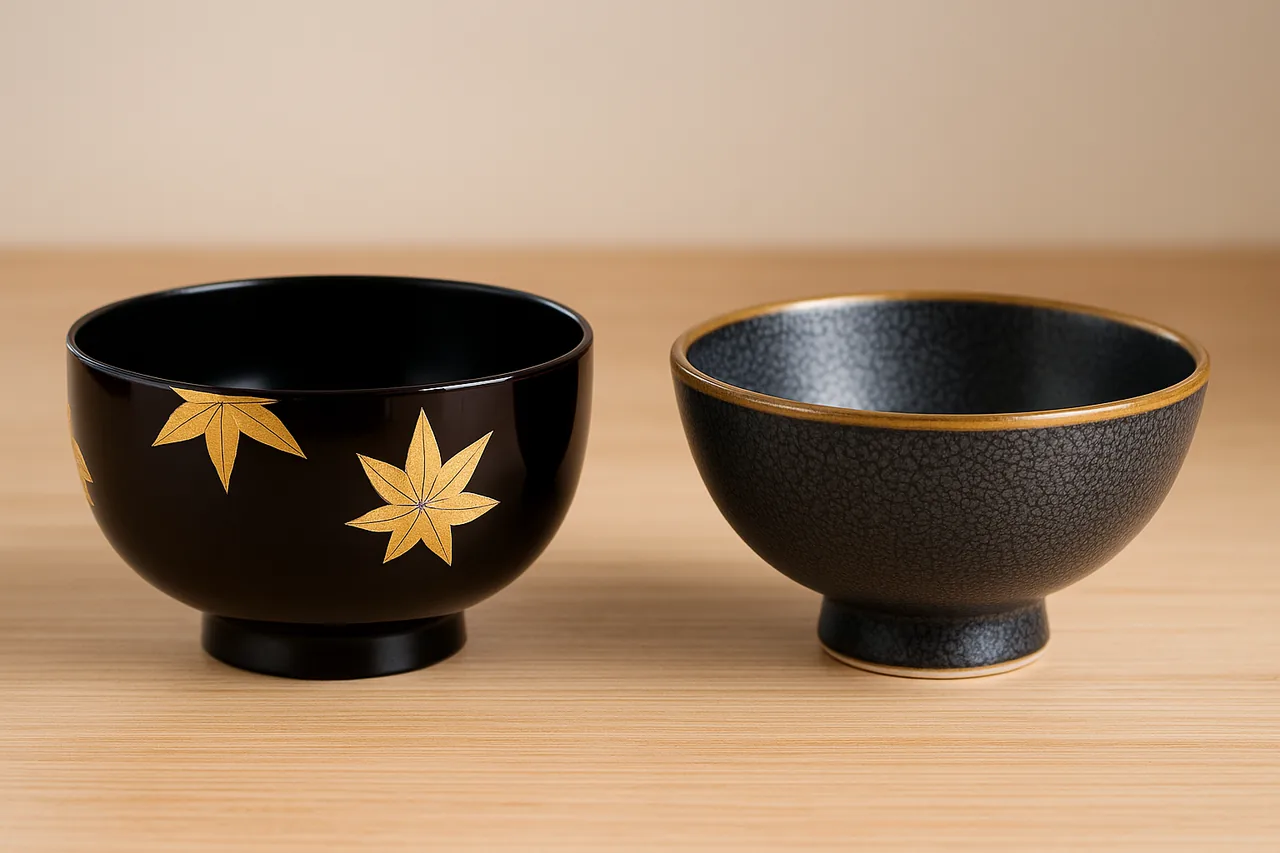
Japanese tableware divides into two fundamental families — lacquerware (shikki) and ceramics (tōjiki) — each with distinct functions and a different role at the table.
| Feature | Lacquerware (e.g., soup bowls, jubako) | Ceramics (e.g., plates, rice bowls) |
|---|---|---|
| Core Material | Natural wood body, coated with layers of urushi lacquer | Clay (stoneware) or pottery stone (porcelain) |
| Functional Strengths | Excellent heat retention · very lightweight · lustrous, refined appearance | High durability · earthy warmth (stoneware) · refined beauty (porcelain) |
| Ideal For | Soup bowls, rice bowls, festive jubako boxes, wa-modern table settings | All everyday meals — from rustic home cooking (stoneware) to elegant presentation (porcelain) |
| Care Notes | Sensitive to dryness; no direct sunlight or dishwasher | Stoneware: porous — watch for mold if stored damp. Porcelain: tough and stain-resistant. |
For summer dishes and desserts, consider adding glassware to the mix — the cool transparency adds a refreshing seasonal contrast to lacquer and ceramics alike.
2. Lacquerware in Depth: Japan's Three Major Regions
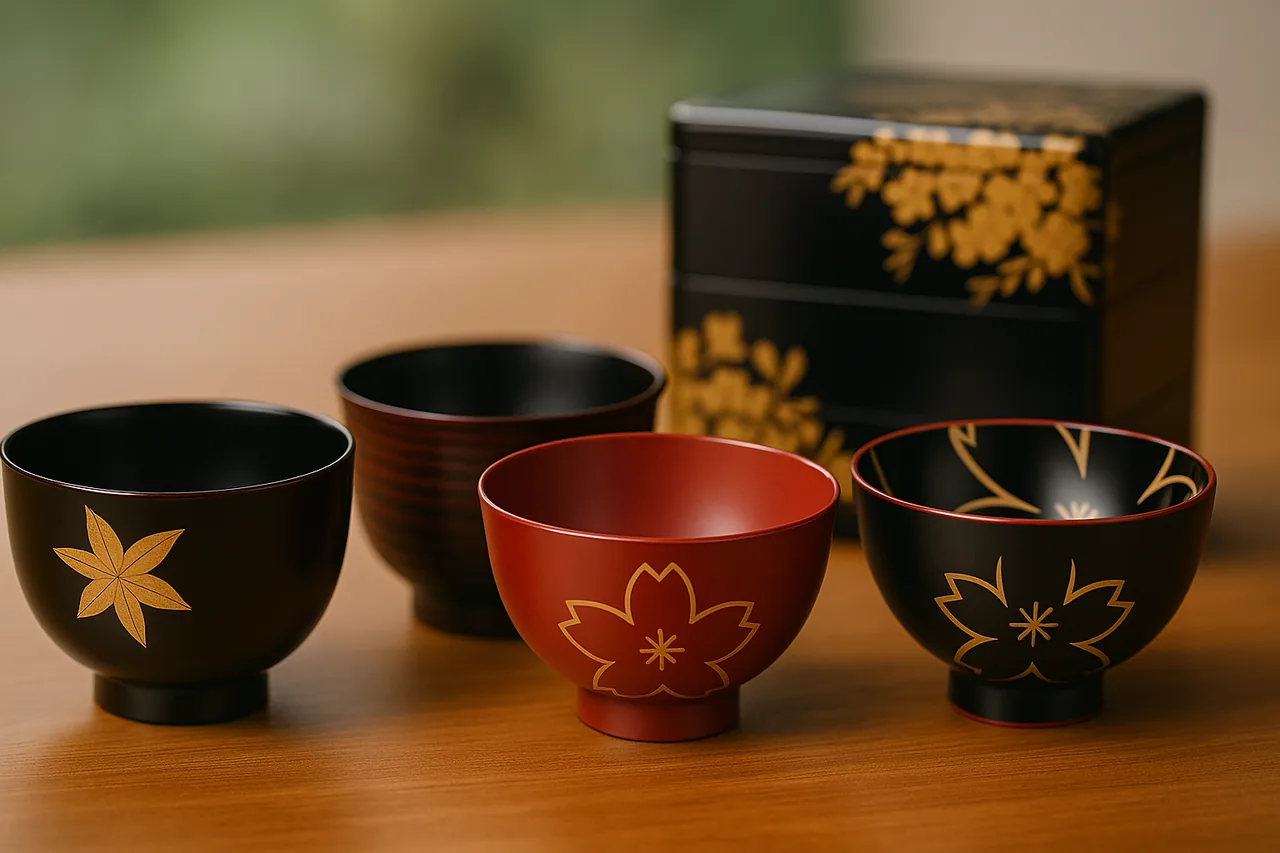
Japanese lacquerware has developed through a division of specialist labor — from the wood-turner who shapes the body to the decorator who applies maki-e gold-powder painting. Each major region has refined a distinct set of skills, with real differences in durability and price.
Wajima-nuri (Ishikawa Prefecture): Supreme Durability & Artistry
Wajima-nuri involves more production stages than any other lacquerware tradition. Its defining technique — honkataji (true solid ground) — mixes rice starch paste with ground silica (diatomaceous earth) to build an exceptionally resilient base before any lacquer is applied. The result is extraordinarily tough and beautiful.
- Highlights: Unmatched durability; rich surface decoration in maki-e (gold-powder painting) and chinkin (gold inlay).
- Best for: Lifelong gifts, high-formal celebratory tableware, heirloom pieces.
Byakudan — Handmade Urushi Lacquerware Miso Soup Bowl with Lid
A handcrafted urushi lacquer soup bowl with lid — made in Japan using natural urushi lacquer over a wood body, the combination that defines true hon-lacquerware. The lidded form keeps miso soup warm and evokes the quiet formality of the Japanese table at its best.
View on AmazonYamanaka-nuri (Ishikawa Prefecture): The Art of Wood Turning
Yamanaka's great specialization is kiji-hikimono — lathe-turning wood bodies to extraordinary thinness. The technique for turning along the vertical grain is considered among the finest in the world. The result is soup bowls with a smooth, satisfying feel at the lip and a feather-light weight in the hand. Many designs are contemporary and easy to live with daily.
- Highlights: Beautiful forms shaped by master wood-turners; range includes affordable synthetic-resin options.
- Best for: Light, smooth-lipped daily soup bowls; modern designs for contemporary homes.
IPPINKA Yamanaka Lacquerware Soup Bowls — Pair (Dishwasher Safe)
A pair of Yamanaka-nuri urushi soup bowls — crafted using the region's celebrated ultra-thin wood-turning technique, with a dishwasher-compatible urushi finish for modern households. Experience the feather-light quality that makes Yamanaka the benchmark for daily lacquerware.
View on AmazonEchizen-nuri (Fukui Prefecture): Practicality & Modern Versatility
Originally developed as furnishings for samurai households and temples, Echizen-nuri has evolved into Japan's largest-volume lacquerware tradition — and a leader in commercial kitchen supply. It strikes the best balance of price and durability outside of Wajima, and is particularly progressive in developing dishwasher-compatible models.
- Highlights: Simple, practical designs; active R&D into dishwasher-safe finishes for modern lifestyles.
- Best for: Everyday lacquerware use without fuss; buyers specifically looking for dishwasher compatibility.
Matsuya Lacquerware — Echizen Dishwasher-Safe Nesting Bowl (Black)
An Echizen-nuri lacquer bowl by Matsuya Lacquerware Shop — tough enough for everyday use and rated dishwasher-safe, a genuine rarity in authentic urushi lacquerware. Practical Echizen craftsmanship from Fukui, made in Japan.
View on Amazon3. Ceramics in Depth: Key Pottery Regions & Their Character
Japanese ceramics divide into porcelain (made from pottery stone) and stoneware (made from clay). The difference in raw material produces very different looks, textures, and care requirements.
Porcelain: Arita-yaki (Imari-yaki), Hasami-yaki
Fired at very high temperatures, porcelain vitrifies into a glass-like hardness that is extremely durable and non-porous — meaning no risk of staining or mold. Its translucent white body gives it a refined, luminous quality.
- Highlights: Beautiful white body with a smooth, semi-transparent feel; light and thin.
- Best for: Frequent dishwasher and microwave users; those who prefer clean, modern design.
Stoneware: Mino-yaki, Mashiko-yaki, Kasama-yaki
Fired at lower temperatures, stoneware retains the texture and warmth of the clay. Its porous surface has a reassuring roughness in the hand and a sense of organic life that porcelain cannot replicate. Because it absorbs moisture, it benefits from initial seasoning (me-dome) and needs to be stored fully dry.
- Highlights: Warm, tactile quality; thick-walled and weighty; enormous variety of glazes and surface treatments.
- Best for: Those who value the warmth and irregularity of handmade craft; fans of folk-art aesthetic.
4. Practical Buying Guide: Size, Color & Building a Collection
With so many options, here are the concrete principles for building a Japanese table that is both beautiful and genuinely usable.
Step 1: Choose by Use and Size
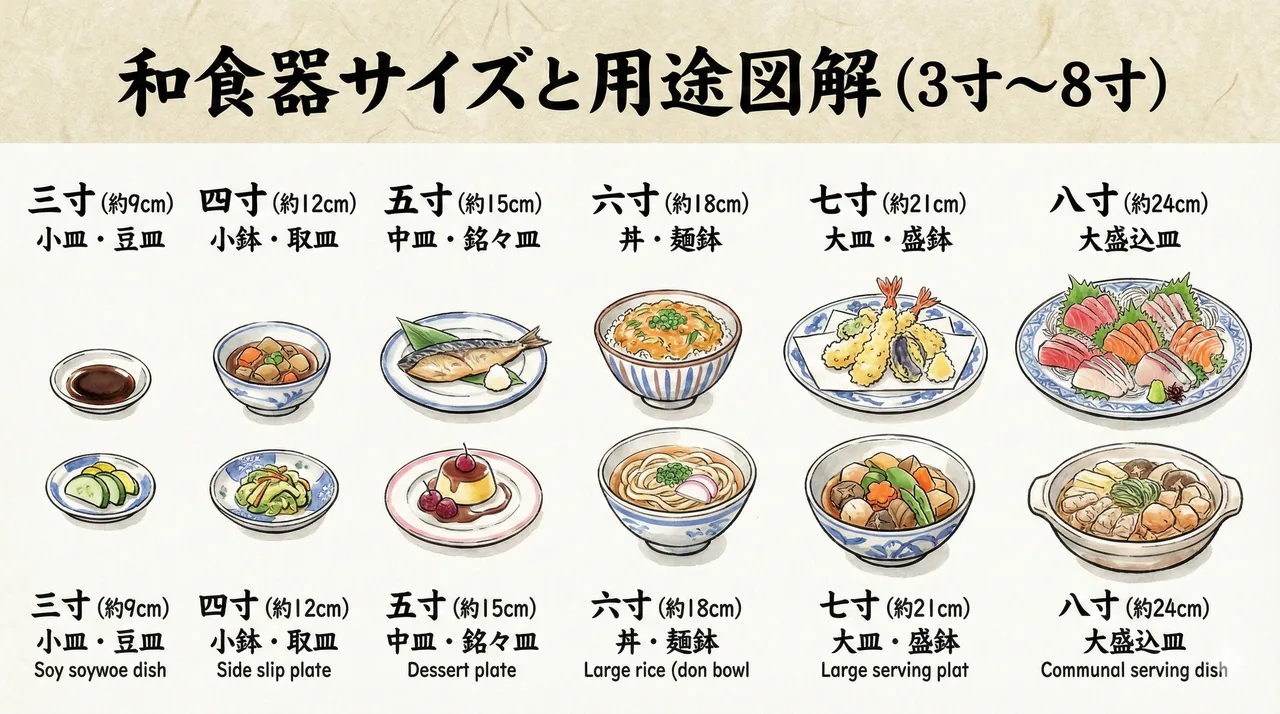
Japanese tableware is traditionally measured in sun (approx. 3 cm / 1.2 in per unit). Use these as a starting guide:
- 3 sun (~9 cm / 3.5 in): Soy sauce dish, condiment plate, small snack plate.
- 4 sun (~12 cm / 4.7 in): Side dishes, sweets, small appetizers.
- 5 sun (~15 cm / 5.9 in): Sharing plate, side dish plate. The most versatile size — start here.
- 6 sun (~18 cm / 7 in): Bread plate, medium-size serving, cake plate.
- 7 sun (~21 cm / 8.3 in): Main course plate, pasta, one-plate lunches.
- 8 sun (~24 cm / 9.4 in+): Large serving dish, shared family-style plates, curry or rice bowl.
Step 2: Choose by Color — How Do You Want Your Food to Look?
The color of a dish frames the food on it. Build from the foundation outward:
- White / off-white: The most forgiving base color — enhances any dish and pairs with everything. Start here.
- Black / indigo / navy: Adds depth and a sense of occasion. Creates beautiful contrast with ingredient colors.
- Patterned / seasonal: Pale spring tones, warm autumn colors; traditional patterns like seigaiha (wave) and ichimatsu (checkerboard) work across all seasons without feeling fussy.
Step 3: Build Intelligently — Tips for Buying Over Time
A random accumulation of pieces rarely coheres into a table. Apply these principles as you build your collection:
- Start with the main plate: Choose your primary dinner plate (7 sun) first, then select smaller side and sharing plates that complement it.
- Match materials: Grouping stoneware with stoneware — or porcelain with porcelain — gives the table visual coherence without effort.
- Dishwasher users: Look for "dishwasher-safe" labeling and choose simple porcelain pieces without gold or silver decoration, which are the most durable.
- Buy by region or artisan: One of the unique pleasures of Japanese tableware is building a collection from a specific region (Arita, Mino, Mashiko) or discovering a single potter whose work speaks to you and adding pieces one by one.
5. Lacquerware Care: The Basics & What to Avoid
Lacquerware is more resilient than it looks — handled correctly, it will outlast every other piece on your table. The key rules are simple.
Things to Strictly Avoid
- Dishwasher / drying machine: Lacquerware is vulnerable to heat and dehydration — both will peel and crack the finish.
- Direct sunlight: UV exposure causes the lacquer to discolor and deteriorate. Store in a cabinet or away from windows.
- Prolonged soaking: The wood body absorbs water, causing the lacquer to lift. Wash promptly and dry immediately with a soft cloth.
- Abrasive sponges or scrubbers: These scratch the surface and dull the gloss. Use a soft sponge or cloth only.
Frequently Asked Questions
What is the real difference between genuine urushi lacquerware and urethane-coated imitations?
The raw material, durability, price, and feel are all fundamentally different.
Genuine hon-urushi lacquerware uses natural tree sap (urushi) over a wood body — it grows more resistant and more
beautiful with each layer added, and can be used for decades. Its surface has a distinctive warmth and depth that
synthetic finishes cannot replicate.
Urethane-coated pieces apply synthetic paint to a plastic body — easier to clean and dishwasher-safe, but with a
lifespan of roughly 5–10 years. Despite a similar appearance at a glance, the two are worlds apart in material,
longevity, and feel.
Can I use lacquerware in the microwave?
For genuine hon-urushi lacquerware, no — microwave use is forbidden.
Microwave heat causes the urushi coating to discolor and peel. The temperature differential across the wood body
can also cause cracking.
Urethane-coated pieces at the budget end of the market may be microwave-safe — always check the product labeling
before use.
Can urushi lacquer cause an allergic skin reaction?
Fully cured lacquerware sold as a finished product will not cause a reaction.
Urushi allergy occurs from contact with nama-urushi — raw, uncured lacquer sap. Products sold as finished
lacquerware have been fully dried and cured; ordinary daily use will not trigger a reaction in the vast majority
of people.
If you have known sensitivity to urushiol (the active compound in urushi and poison ivy), consult the manufacturer
before purchasing.
How do I tell porcelain from stoneware?
Check the unglazed foot ring on the bottom of the piece.
Stoneware has a rough, earthy, slightly grainy foot ring with a matte surface that is slightly porous. Tap it —
the sound is dull and low.
Porcelain has a white, smooth, hard foot ring. Hold it up to light — a thin piece will transmit a faint glow. Tap
it — the sound is clear and bright. Both types are easy to distinguish by feel and sound once you know what to
look for.
What should I buy first if I'm starting a Japanese tableware collection from scratch?
Start with three pieces: a soup bowl, a rice bowl, and a 5-sun (15 cm) plate.
These three items appear at nearly every Japanese meal and will transform how your table looks and feels more than
anything else.
For the soup bowl, choose a lacquer piece (or wooden bowl) for its heat retention. For the rice bowl and plate,
durable Arita-yaki or Mino-yaki porcelain in white or black is a safe, versatile start. Simple neutral tones work
with any food and give you a foundation to build on.
Is Japanese tableware a good gift for someone from outside Japan?
Yes — it is one of the most universally appreciated Japanese gifts.
The hand-painted decoration of Arita-yaki and the deep gloss of Wajima-nuri lacquer carry an unmistakably Japanese
quality that resonates with people from any background. Chopstick rests paired with a set, or personalized
engraved pieces, are especially popular.
Lacquerware — being light and robust — travels particularly well as a carry-on gift. For ceramic pieces, ensure
careful packaging for the journey.
Go Deeper: Curated Recommendations & Gift Guides
Now that you have the material and regional foundations, explore specific brand recommendations and gift-giving guidance for Japanese tableware and lacquerware.
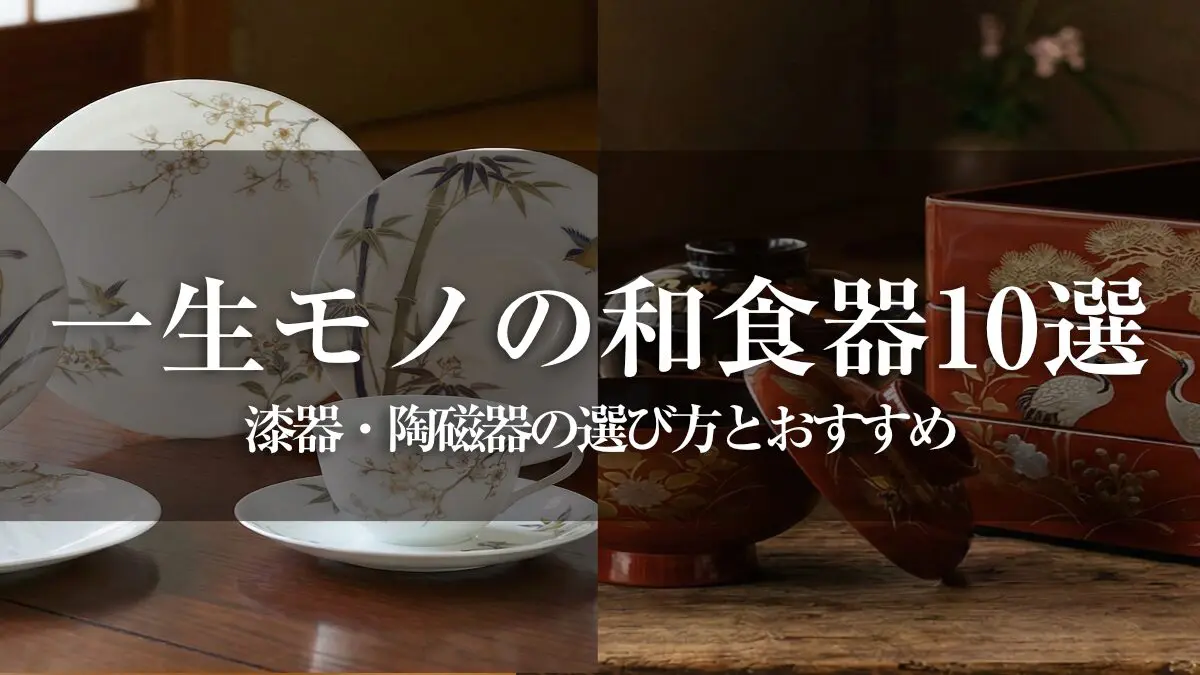
Japanese Tableware Ranking: 10 Lifetime-Quality Brands — Wajima, Arita & Beyond

Gift Guide: Premium Japanese Lacquerware & Tableware — 10 Picks for Weddings & Special Occasions
