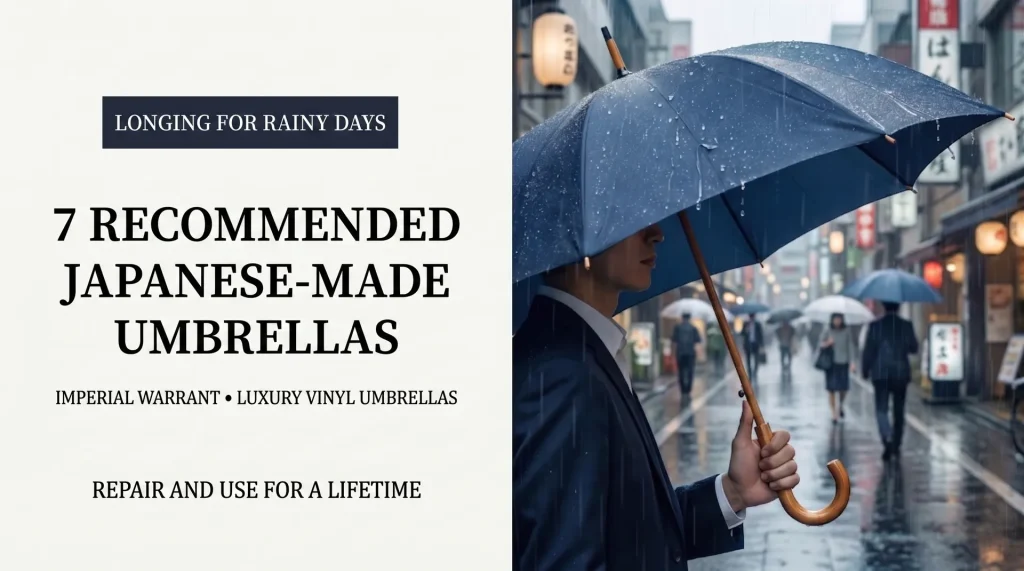
The seven Japanese umbrella brands most worth buying are Maehara Koei Shoten (Tombo Yougasa), White Rose,
Komiya Shoten, Makita Shoten, Ramuda, WAKAO, and Shinsaibashi Miyatake — workshops using Koshu-ori woven
fabric and hand-tensioned ribs, built to be repaired rather than replaced.
People spend serious money on shoes, bags, and outerwear — and then carry a convenience-store
umbrella.
A Japanese-made umbrella changes that equation. When you open one built by a craftsperson who
tensioned the canopy to its limit, the sound is different — a clean, drum-like snap. The rain
hits the Koshu-ori woven fabric and beads off in sheets. The handle, often natural maple or
bamboo, settles into your grip over years of use.
These are umbrellas worth having repaired. This guide covers what makes Japanese umbrella
craft distinctive and profiles seven brands — from Imperial Household suppliers to the
company that invented the vinyl umbrella.
Quick Reference: Umbrella Fabric Comparison
| Material | Water Repellency | Weight | Durability |
|---|---|---|---|
| Polyester | High, long-lasting | Light | High |
| Nylon | High, vivid colour | Light | Moderately high |
| Cotton (cloth) | Lower — absorbs moisture | Heavy | Medium |
| Natural fibre | Low — needs coating | Heavy | Long-lasting with care |
1. What Sets Japanese Umbrellas Apart: Tension and Koshu-ori Weave
The gap between a mass-produced umbrella and a Japanese craft umbrella comes down to two things: how tight the canopy is stretched, and what the fabric is.
The sound changes: a craftsperson's tension
A skilled umbrella maker stretches the canopy to the edge of what the ribs can hold — calculating
the flex of each spoke and pulling until the fabric is drum-tight.
When you open an umbrella tensioned this way, it snaps into shape with a clean, resonant sound.
That tension is what makes the silhouette beautiful and what makes rain sheet off the surface
rather than sitting on it.
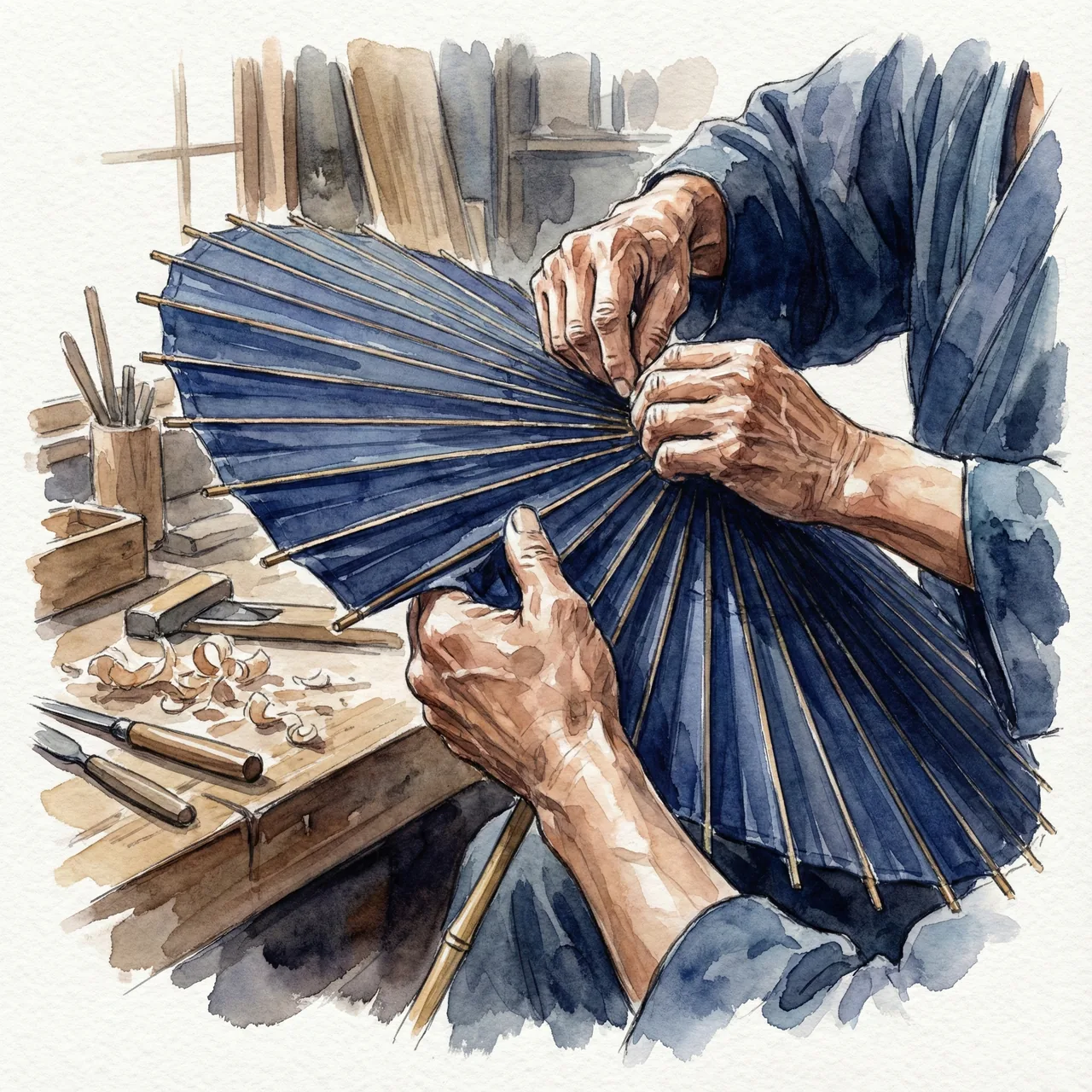
Water beads off: Koshu-ori (甲州織) woven fabric
Koshu-ori is a densely woven fabric from Yamanashi Prefecture, made with yarn dyed before weaving
(yarn-dyed, not printed). The result is a three-dimensional depth that printed fabric can't replicate —
and a surface that sheds water in sheets with a single shake.
Patterns woven into Koshu-ori don't fade the way printed designs do. The colour comes from inside
the thread.
2. Rib Count & Material — The Circle-Perfect "16-Rib" Difference
The number of ribs determines both the umbrella's shape and its structural integrity.
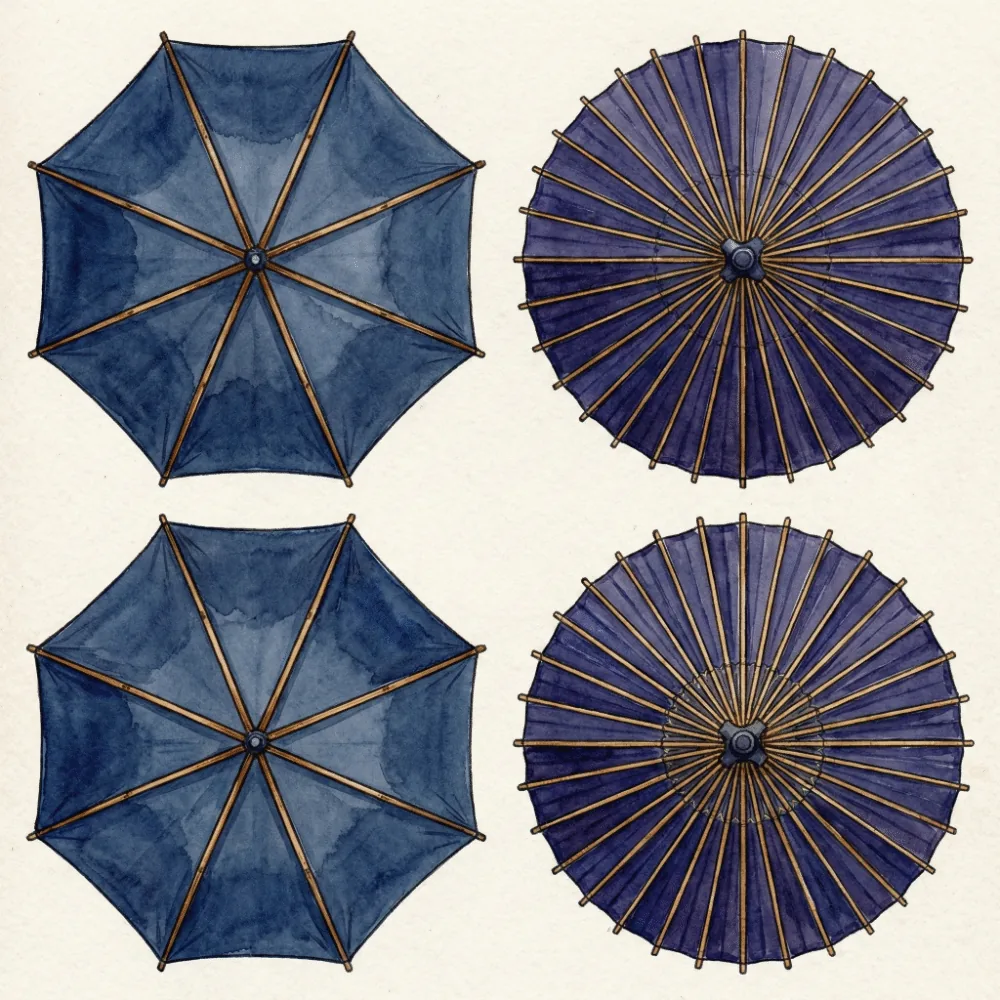
16 ribs — the signature of a Japanese luxury umbrella
Standard umbrellas use 8 ribs. The segments between ribs form flat panels that create an octagonal silhouette
when viewed from above — functional, but visually coarse.
16 ribs halve the panel width, dramatically reducing the flat segments and creating a dome that
approaches a true circle. This is the geometry of a traditional Japanese oil-paper umbrella (wagasa)
translated into modern construction.
More ribs also distribute wind load across more connection points, making the umbrella structurally stronger in
gusts. Carbon-fiber rib options have brought 16-rib umbrellas within a weight range that women carry comfortably
all day.
3. 7 Japanese Umbrella Brands Worth Knowing
From formal long umbrellas to the brand that invented the vinyl umbrella — Japanese umbrella making covers more ground than you'd expect.
Maehara Koei Shoten (Tombo Yougasa) — Imperial Household Supplier
Founded 1948. The pinnacle of Japanese umbrella craft. Known by the trade name "Tombo Yougasa," Maehara supplies the Imperial Household. Their signature 16-rib construction gives the open canopy the graceful circular profile of a traditional Japanese parasol and makes it significantly more wind-resistant than the standard 8-rib design. Handles are natural wood — maple or cold-season bamboo — and conform to the hand over years of use.
- Founded
- 1948, Tokyo
- Signature
- 16-rib construction — rounder canopy, superior wind resistance
- Best for
- Those who want the finest Japanese umbrella craft; long-term daily use
View the Maehara Koei Shoten brand profile
Visit Official Site →White Rose — Inventors of the Vinyl Umbrella, Done Seriously
White Rose invented the vinyl umbrella. Their premium "Catelle" and "Enyuu" series are nothing like the disposable kind: they include a reverse-vent valve that allows wind to pass through without inverting the canopy in typhoon-level gusts. A clear canopy means unobstructed sightlines in heavy rain — the reason politicians use them at outdoor speeches.
- Based in
- Japan
- Signature
- Reverse-vent valve — prevents canopy inversion in strong wind
- Best for
- Rainy-city commuters; those who value visibility and storm performance
View the White Rose brand profile
Visit Official Site →Komiya Shoten — Koshu-ori Colour Craft, 90 Years in Higashi-Nihonbashi
Komiya's "Kasane" (layered) series uses Koshu-ori fabric where the outer and inner colours differ — when open, the inner colour reflects onto the face. Craftspeople wrap each spoke joint in fabric by hand. A full repair service is available, making this an umbrella you can maintain indefinitely.
- Based in
- Higashi-Nihonbashi, Tokyo
- Known for
- Kasane (layered) two-tone Koshu-ori canopy; hand-wrapped spoke joints
- Best for
- Those who want colour depth and craft detail; repair-minded buyers
View the Komiya Shoten brand profile
Visit Official Site →Makita Shoten — Woven Patterns, Not Printed
Makita began as a fabric mill at the foot of Mt. Fuji. Their Jacquard weaving technology produces patterns with dimensional depth that print cannot achieve — colours woven into the thread that won't fade. The "Sai" series (vegetables and botanicals as motifs) is modern enough to wear with both kimono and Western clothing.
- Based in
- Yamanashi Prefecture
- Known for
- Jacquard-woven Koshu-ori; colour is in the thread, not on the surface
- Best for
- Those who want design depth and patterns that age without fading
View the Makita Shoten brand profile
Visit Official Site →Ramuda — Tokyo Elegance for Suit Weather
From Ichihara-sha in Nihonbashi, Ramuda's reputation is built on tension: their open silhouette is exceptionally clean. Koshu-ori regimental stripe patterns are the house signature, making them a natural gift for professionals. Popular as a business gift that signals genuine attention to quality.
- Based in
- Nihonbashi, Tokyo
- Known for
- Regimental stripe Koshu-ori; clean open silhouette from precise tensioning
- Best for
- Daily business commuting; corporate gifting
WAKAO — Bamboo Handle Specialists, Asakusa, Tokyo
WAKAO's signature is the cold-season bamboo (kan-chiku) handle — bent from natural bamboo, with nodes you can feel in the grip. Slim and light models are a particular strength. Men's folding umbrella designs are unusually elegant for the category.
- Based in
- Asakusa, Tokyo
- Known for
- Kan-chiku bamboo handles with natural nodes; slim and light folding models
- Best for
- Those who want a distinctly Japanese feel in the hand; lightweight everyday carry
Shinsaibashi Miyatake — Curated Selection from Across Japan
An Osaka-based specialty umbrella retailer carrying umbrellas from craftspeople and manufacturers across Japan. Rain umbrellas, parasols, cane umbrellas, short umbrellas, and commercial-grade options are all covered. Monogramming, gift wrapping, an ID registration system for lost umbrellas, and repair enquiries are all available.
- Based in
- Shinsaibashi, Osaka
- Known for
- Curated multi-brand selection; full service including monogramming and repairs
- Best for
- Buyers who want to compare many Japanese makers in one place
View the Shinsaibashi Miyatake brand profile
Visit Official Site →4. Visiting Komiya Shoten: Tokyo's Umbrella Showroom
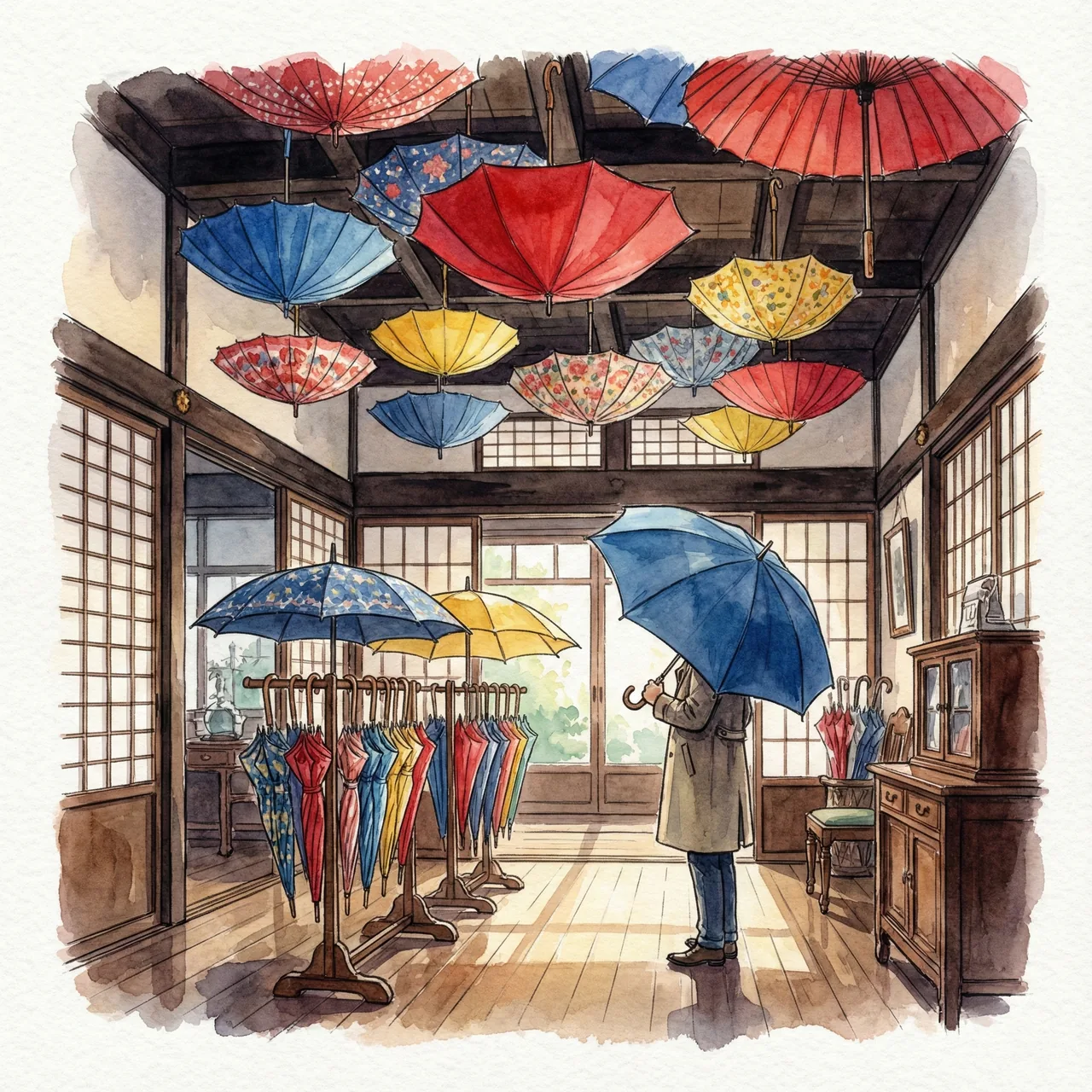
The showroom you visit on a rainy day on purpose
Komiya Shoten's flagship showroom sits in Higashi-Nihonbashi, Tokyo's wholesale district.
What to expect:
· Staff knowledgeable enough to act as umbrella sommeliers — they'll match length, weight,
and colour to your needs and preferences.
· An adjacent workshop where repair consultations are welcome.
· The experience of opening dozens of umbrellas and learning the difference — a skill that
changes what you notice forever after.
5. Frequently Asked Questions
The water-repellent coating has worn off. Can it be restored?
Yes — a hair dryer is usually enough.
Water-repellent coatings (fluororesin) lose effectiveness as the molecules become disordered
from friction and dirt. Gentle heat realigns them. Hold a hair dryer 10 cm from the canopy
on a low setting and move it slowly across the fabric. The beading effect typically returns.
If that doesn't work, a commercial waterproofing spray applied after cleaning will restore it.
Can a broken rib be repaired?
Yes — all the brands covered here support repairs.
Rib replacement, canopy re-tensioning, and handle replacement are all available from the
makers or their authorised repair points. This is the central advantage of buying a Japanese
craft umbrella over a mass-market one: it can be maintained indefinitely.
How should I dry it after use?
Shade-dry, partially open — not fully extended.
Direct sun fades fabric and degrades the coating. Drying fully open puts unnecessary tension
on the ribs and canopy. Partially open (loosely furled) in a shaded spot is the correct
position.
Is a Japanese umbrella a good gift?
One of the better practical gifts — widely appreciated.
A superstition exists that gifting an umbrella suggests "cutting ties," but it coexists with
the umbrella's traditional auspicious meaning in Japan (the open shape widens outward, a
symbol of expanding fortune). In practice, a quality umbrella is welcomed as a gift for
retirement, birthdays, and formal occasions. Several brands offer paulownia wood gift boxes.
Long umbrella or folding — which to choose?
Ideally both, for different uses.
A long umbrella is more durable and better in strong wind or heavy rain — ideal for daily
commuting. A folding umbrella is portable and handles unexpected showers, but the folding
mechanism puts more stress on the ribs over time.
Japanese folding umbrellas are made to tighter tolerances than mass-market versions, so the
durability gap is smaller than you'd expect.
Does rib count matter?
More ribs means more wind resistance and a rounder silhouette.
Standard umbrellas have 8 ribs. Japanese craft umbrellas often have 12 or 16. More ribs
distribute canopy tension more evenly, making the open shape more circular and making the
umbrella much harder to invert in wind.
The trade-off is weight: 16-rib umbrellas are noticeably heavier. For most uses, 12 ribs
is the practical sweet spot.
I'm afraid I'll leave a good umbrella somewhere. Should I even bother?
An interesting thing happens when you own something you genuinely care about: you stop leaving it
behind.
The psychology of disposable items — "it doesn't matter if I lose it" — works in reverse with objects you value. A
good umbrella becomes part of your awareness in the same way your phone does.
If you're still worried, attach a small luggage tag with your contact information to the handle, or add a
distinctive tassel that makes it instantly recognizable in an umbrella stand.
Men's vs. women's — what's the difference?
Primarily canopy diameter and total weight.
Men's umbrellas typically have a 60–65 cm rib length; women's 55–60 cm. Women's models often use lightweight
carbon ribs to reduce arm fatigue over a long day out. There's no rule against a woman choosing a larger men's
model if she prefers the coverage.
Can I use it as a walking stick?
Please don't — the shaft isn't designed for vertical load bearing.
Umbrellas are engineered for lateral rain loads, not for the downward force of someone leaning on them. The center
shaft will bend or snap, often in a way that damages the whole mechanism.
Treat your umbrella as weather protection — it will last far longer.
Final Thoughts: An Umbrella Worth Opening
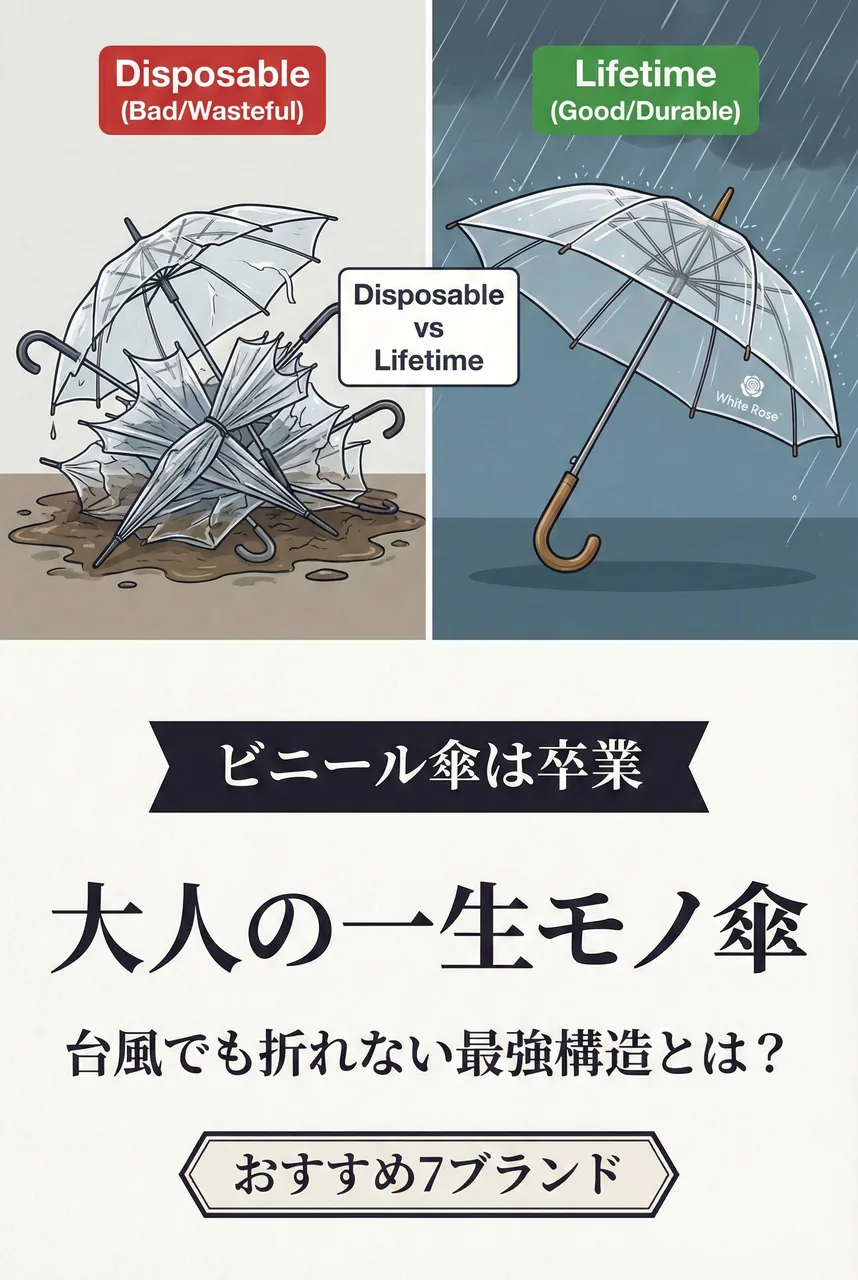
A well-made umbrella is one of the few daily objects where the quality is obvious in the
first moment of use. The snap when it opens. The sound of rain on a properly tensioned
canopy. The way water runs off instead of pooling.
Any of the seven brands here will deliver that experience. Start with Maehara or White Rose
if you want something immediately iconic. Komiya or Ramuda if you're buying for a
professional context. WAKAO or Makita if design and lightness are the priority.
Buy one, have it repaired when needed, and use it for twenty years.
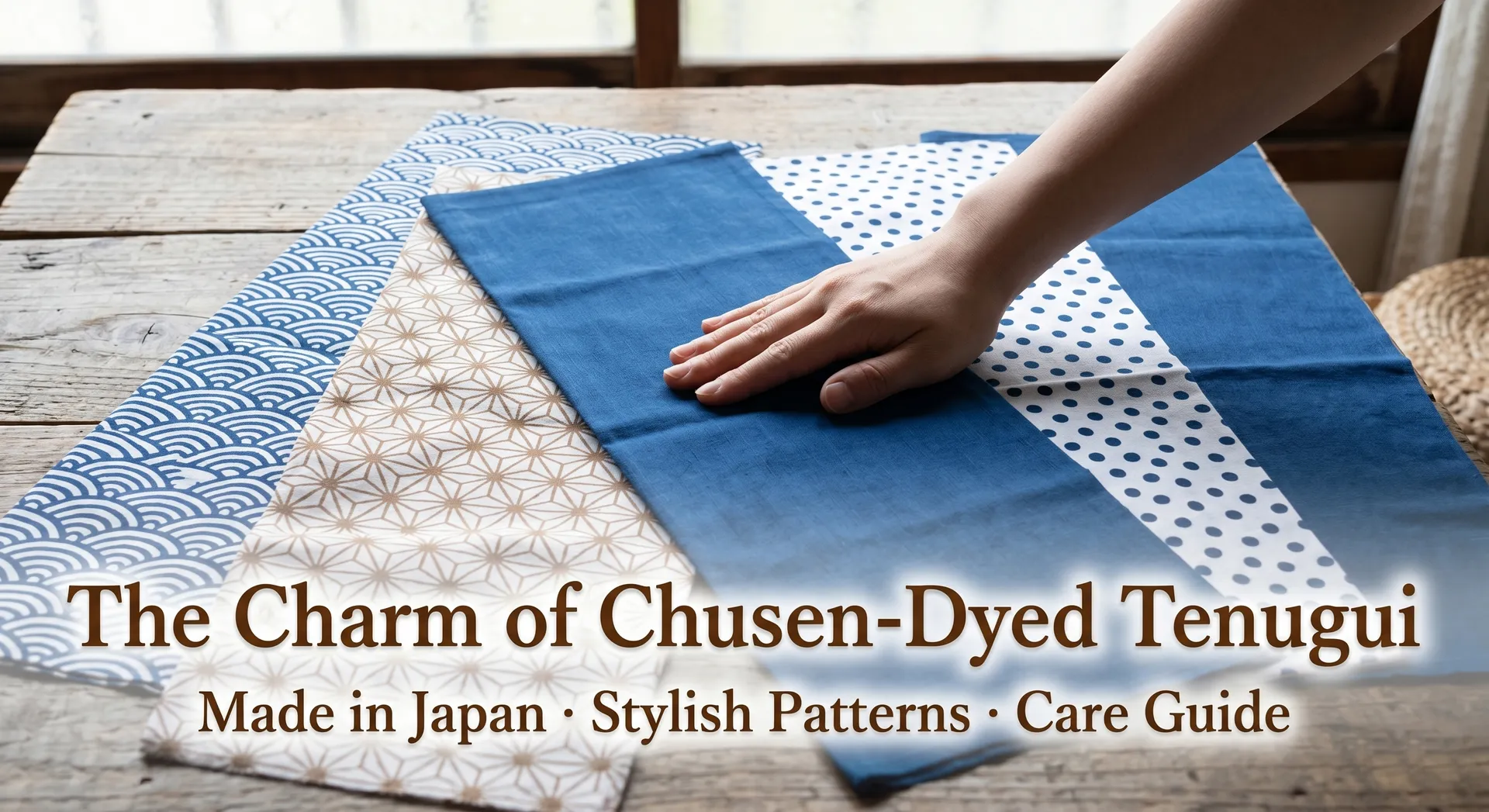
Tenugui: Japan's Versatile Cotton Cloth Explained
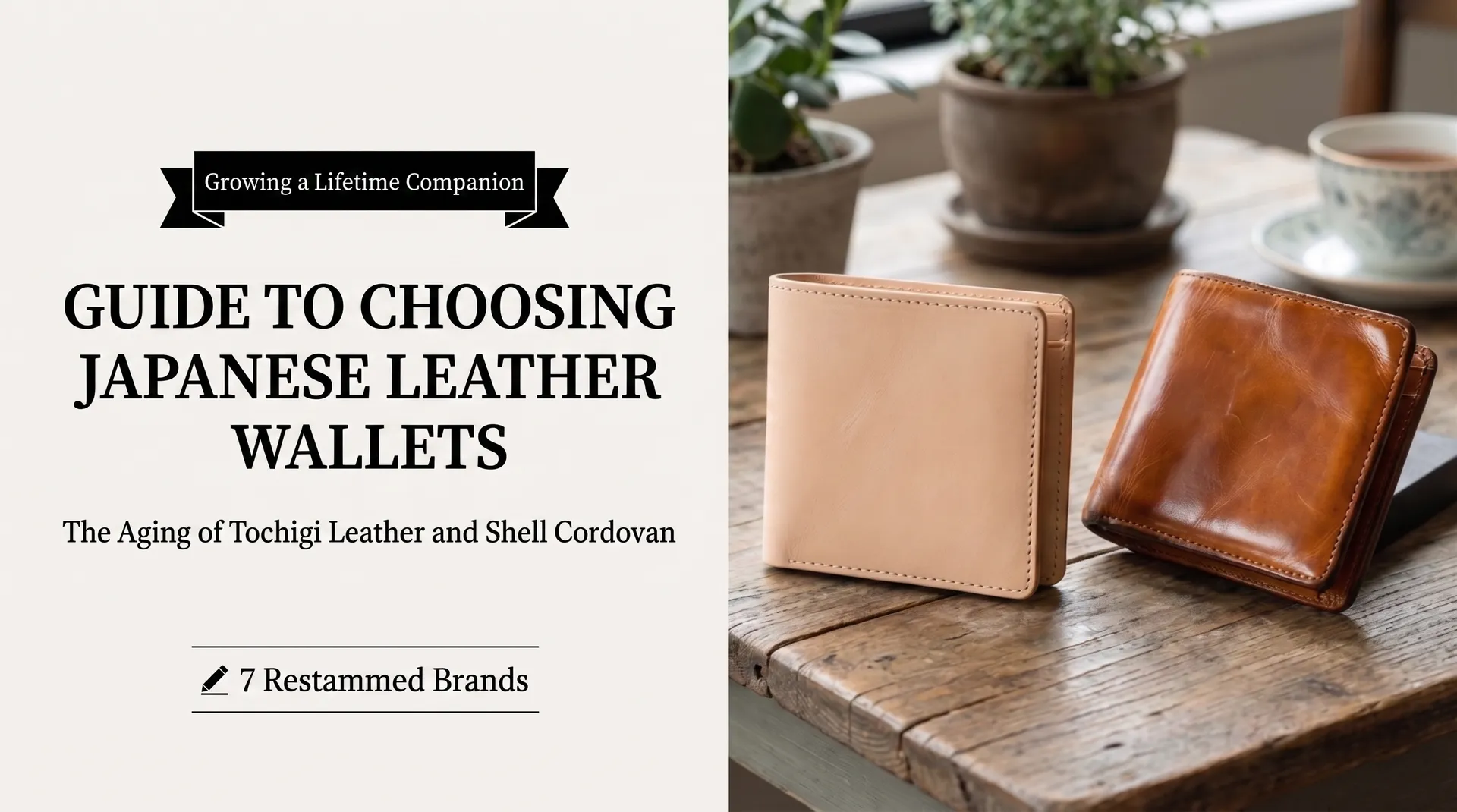
Japanese Leather Wallets: Tochigi, Bridle, and Cordovan