"I tried to erase a line and the paper just crumpled."
"It only smudges — it doesn't actually erase anything."
If that's your experience with erasers, you've been using the wrong kind. Don't dismiss this as a trivial problem.
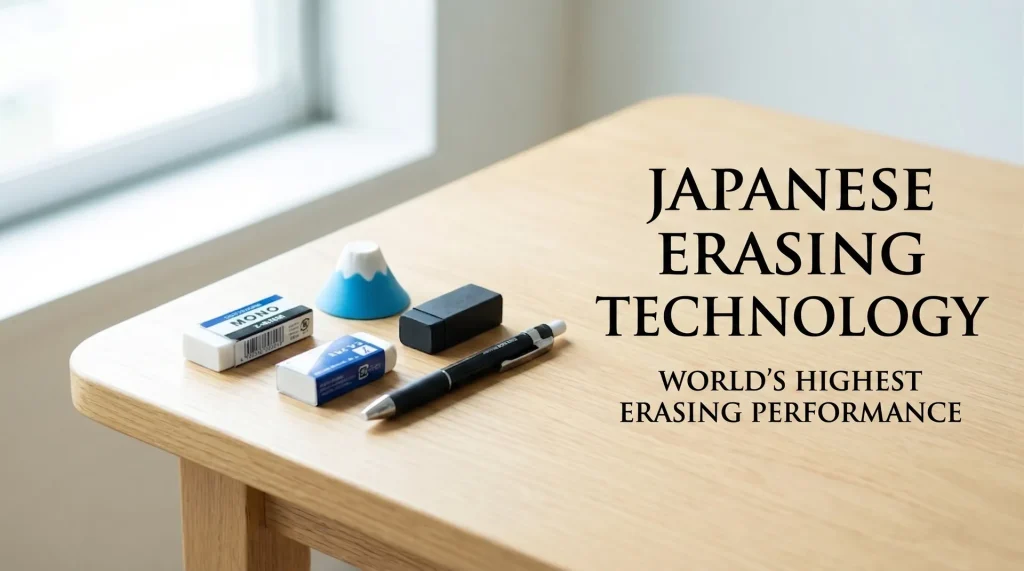
Japan's erasers (keshigomu) are the object of genuine admiration from stationery enthusiasts worldwide — collected, imported, and discussed with the same seriousness as fountain pens and knives.
It was Japan that invented the plastic eraser in 1956, creating what became the global standard. Japanese erasers erase with minimal force, gather into neat clumps rather than scattering, and come engineered for specific use cases — from single-character surgical precision to whole-line coverage without lifting the hand.
This guide introduces the best of them, including the Fuji Mountain eraser that became a worldwide phenomenon, and explains why correction tape from Japan is in a different category from what you've used before.
Quick Reference: Eraser Types at a Glance
| Type | Key Quality | Best For | Notable Brands |
|---|---|---|---|
| Plastic (standard) | Light force, clean debris clumping | All everyday pencil erasing | MONO, Air-In, Resare |
| Sand eraser (abrasive) | Abrasive particles remove surface layer | Ink, ballpoint pen marks | SEED, Kokuyo |
| Kneaded rubber (putty) | Lifts graphite without surface friction | Charcoal drawing, highlight lifting | Faber-Castell, Staedtler |
| Electric eraser | High-speed rotation, minimal manual pressure | Drafting, large-area correction | MONO, SEED |
1. Why Japanese Erasers Are Different: History and the JIS Standard
Most erasers sold outside Japan are still rubber-based — stiff, prone to tearing paper, and notorious for leaving dark smears instead of clean corrections. How did Japan's erasers end up so different?
A Japanese invention: the world's first plastic eraser (1956, SEED Co.)
In 1956, Osaka-based SEED Co. introduced the world's first plastic (PVC) eraser — and it changed everything.
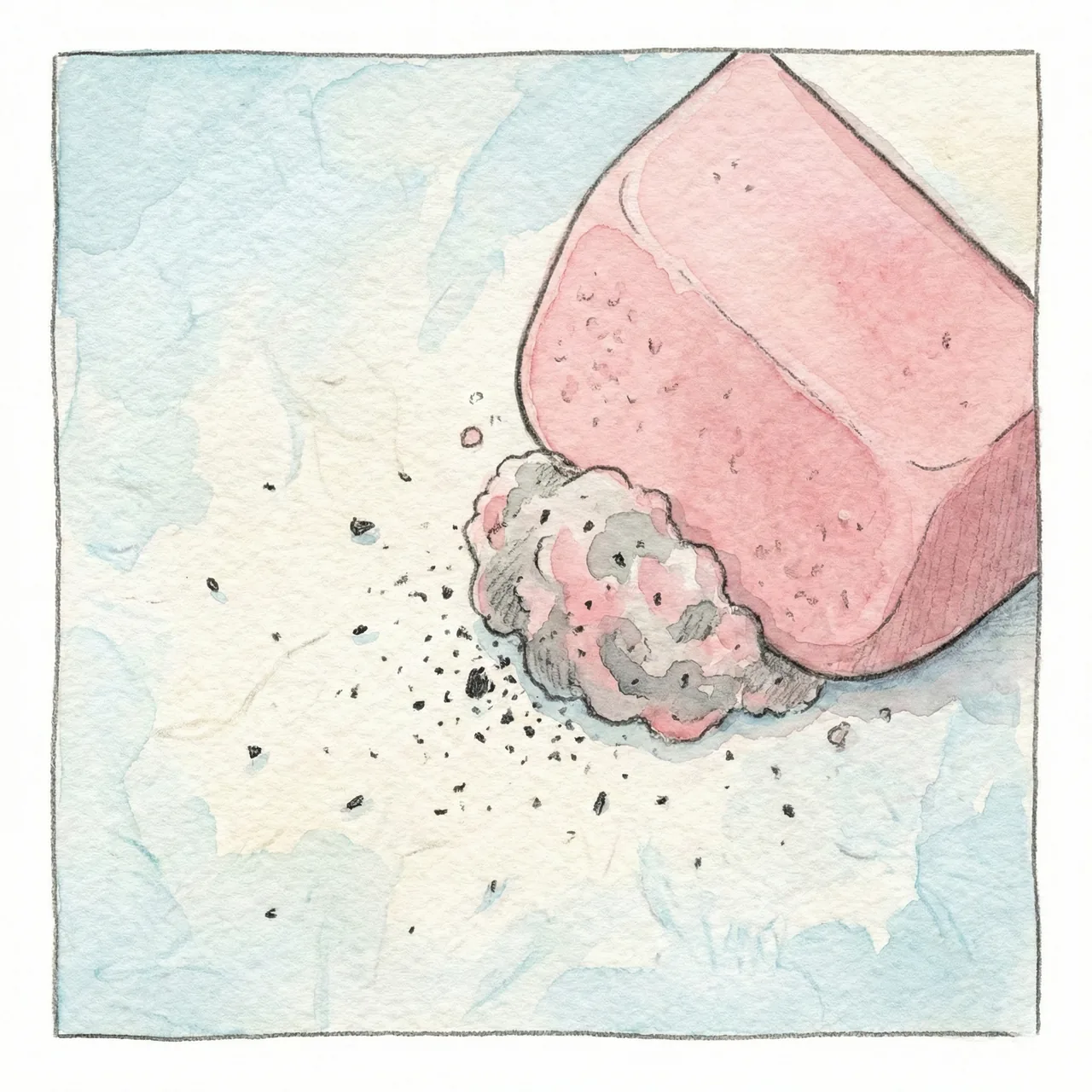
PVC compoundsallow for a texture that picks up graphite particles more efficiently than rubber, without dragging or tearing the paper. The debris forms compact, roll-able clumps rather than powdery scatter. And unlike rubber, PVC doesn't yellow or harden with age.
This is the material in virtually every eraser made today. Japan invented it, and Japan continues to refine it most aggressively.
The JIS standard: a 97% erasure rate, required to pass
Japanese industrial standards (JIS) for erasers include an erasure efficiency rate test: a standardized pencil mark is erased under controlled pressure and rubbing distance, and the remaining mark must be less than 3% of the original. This 97% threshold is exceptionally high.
"Any Japanese eraser is a safe buy" is a genuine statement, not marketing — because the standard forces every maker to perform at this level just to sell.
2. 4 Recommended Japanese Erasers
"Erases cleanly" is the baseline — every recommended eraser here meets the JIS standard by definition. What distinguishes them is the specific experience or problem each one addresses beyond that baseline.
PLUS — Air-In Fuji Mountain Eraser
The eraser that turns erasing into a game — and went viral worldwide.
A phenomenon among inbound visitors to Japan, and now a global stationery bestseller.
Molded from two colors of resin — blue-gray base and white top — the eraser is shaped so that even use of all four corners reveals a white peak emerging through blue-gray sides: a miniature Mount Fuji, built by the act of erasing.
This isn't mere gimmick: the core compound is the same porous ceramic-blended Air-In formula used in PLUS's flagship performance eraser, offering genuinely light, smooth erasing with minimal paper distortion.
SEED — Radar
The king of mild erasing — trusted since 1968.
One of the longest-running eraser bestsellers in Japan, with an especially devoted following in western Japan (Kansai) since its 1968 debut.
The Radar's texture is slightly firmer than most competitors — it doesn't give way easily under pressure. This firmness translates into what its fans describe as a "mild" or "adhesive" erasing sensation: the eraser grips the paper surface gently, lifting graphite with a satisfying resistance rather than gliding carelessly.
Debris forms coherent clumps that don't scatter, making it excellent for drafting. Available in sizes from standard school-grade to the oversize S-10000 — a novelty pillow-sized block that's also a perfectly functional eraser.
Tombow — MONO zero
Surgical precision for single-character correction — a professional manga artist's tool.
Have you ever erased the wrong character because the eraser was too wide?
The MONO zero uses an eraser tip just 2.3mm in diameter (round version) — one of the narrowest in the world — housed in a full-length metal guide barrel. The tip is always visible, so you can position it exactly before applying pressure, then correct a single letter, a single line segment, or a single dot without touching anything adjacent.
Illustrators use it to create highlight effects in finished drawings. Manga artists rely on it for fine corrections in inked panels. An instrument for precision, not just erasing.
Kokuyo — Resare Premium
Vivid colors, new-generation performance — the standard for the next decade.
Resare broke one convention — "erasers are white" — and proved that color and performance aren't in tension.
Available in black, deep purple, orange, and other colors, the Resare's appearance has a practical advantage: marks, dirt, and wear don't show, so it always looks like a working tool rather than a used object.
The compound itself combines special foam structure with proprietary polymers to achieve the lightest effective erasing force in its class. The colored debris is easy to spot and sweep away from white paper, reducing the chance of missing a smear.
3. Correction Tape: Japan's Precision Engineering Applied
"Correction tape always gets heavier as the roll depletes. And it snaps."
Neither of those things needs to be true. Japan's correction tape makers have solved both problems — and added a few capabilities you wouldn't expect.
Tombow — MONO Air (モノエアー)
The same feather-light pull from the first meter to the last — a genuine engineering achievement.
The most common complaint about correction tape is that as the roll depletes, friction increases and the feed feels heavy and sticky. Tombow engineered around this with their Air Touch System: a locking mechanism that releases only when the tape head is moving, then re-engages during pauses. The cassette tension remains constant regardless of remaining tape.
At 1 meter remaining, it pulls identically to a fresh reel. Silent operation makes it suitable for libraries, quiet offices, and exam rooms.
Midori — XS Correction Tape (Cream)
The correction tape that matches cream-colored paper — finally invisible.
Japan's finest notebooks — MD Note, Rollbahn, Hobonichi — use cream-colored paper specifically because it's easier on the eyes during long writing sessions. Standard white correction tape applied to cream paper creates a stark, obvious patch that undermines the notebook's aesthetic entirely.
Midori developed this cream-tinted tape for exactly this user. Applied over cream paper, the correction blends in visually, maintaining the journal or planner's appearance. A small innovation, but a deeply considerate one.
Hidden feature: most Japanese correction tapes work in both directions
Most Japanese correction tapes are designed to be used in two ways:
- Pull (standard): The normal mode — hold the dispenser and draw it away from you to cover a line of text.
- Push: Turn the dispenser around and push it toward you, right to left. In this mode, the narrower leading edge of the tape head can be used to target a single character with precision — similar to using the corner of an eraser. Many users never discover this technique despite years of use.
Think of it as using the corner of an eraser — applied to correction tape.
4. Frequently Asked Questions
My eraser melted onto my plastic ruler. What happened?
The plasticizer in PVC erasers migrated into the ruler — a known chemical interaction.
PVC erasers contain plasticizer compounds that keep the material flexible. When an eraser rests against another PVC surface (rulers, pen cases, binder covers), these compounds transfer and can soften or dissolve the contact surface over time.
Prevention: always store the eraser inside its paper sleeve. The sleeve acts as a barrier and prevents contact-transfer entirely. Never leave a bare eraser resting on plastic overnight.
My eraser has hardened and stopped erasing properly.
The outer surface has oxidized — the inside is still functional.
Erasers exposed to air over time develop a hardened skin as the plasticizer oxidizes. Rub the eraser on scrap paper or the edge of a table for a few strokes to abrade this layer away. Once you expose fresh material, the original erasing performance typically returns.
What's the point of a black eraser?
Marks don't show, and the debris is easy to see against white paper.
White erasers look dirty almost immediately and often get abandoned before they're spent. Black erasers maintain their appearance through heavy use, so there's no visual cue to replace a still-functional tool.
The contrast benefit is practical: black or dark eraser debris is easy to spot and sweep cleanly from a white or cream page. You're less likely to accidentally leave smear residue behind.
Correction tape or correction fluid — which is better?
For most everyday use, tape is more convenient — but fluid has specific strengths.
Correction tape: Immediately writable — no drying time. Compact, clean, portable. The clear choice for planners, notebooks, and everyday correspondence.
Correction fluid (bottle type): Better for covering large areas or applying to textured paper where tape doesn't adhere smoothly. Requires drying time (typically 30–60 seconds) before writing over it.
What's the technique for erasing without damaging the paper?
Erase in one direction — don't scrub back and forth.
Back-and-forth (scrubbing) motion generates friction heat and pushes fibers in multiple directions, causing paper to pill, wrinkle, or tear. Move the eraser in a single direction, with even pressure, at a consistent speed. Good paper and a high-quality eraser mean you shouldn't need much force at all.
Switching to an Air-In or Resare class eraser makes the single-direction technique considerably easier to maintain, because the compound is so forgiving.
How should I store erasers?
Always inside the paper sleeve, away from direct sunlight and heat.
The sleeve prevents plasticizer transfer to adjacent surfaces. Keep erasers out of car interiors, windowsill compartments, and other high-temperature environments — heat accelerates surface oxidation and plasticizer loss, making the eraser stiff and ineffective much sooner than it should be.
Store different erasers separately; stacking them in contact can cause surface bonding.
Final Thoughts: A Great Eraser Gives You Permission to Write Freely
Erasing isn't a failure. It's a sign of thinking — of reconsidering, refining, trying again.
"This expression isn't right — there's a better one." That's a positive cognitive act, not an admission of defeat.
Japanese erasers support that process with almost invisible efficiency. The marks disappear completely. The paper stays intact. You can begin again on the same surface, in the same notebook, as if the first attempt never happened.
A hundred-yen block of plastic, but one that says: it's fine to start over. Write what you mean to write, not what you're afraid to erase.

Japanese Premium Notebooks: Paper That Doesn't Bleed Even with a Fountain Pen
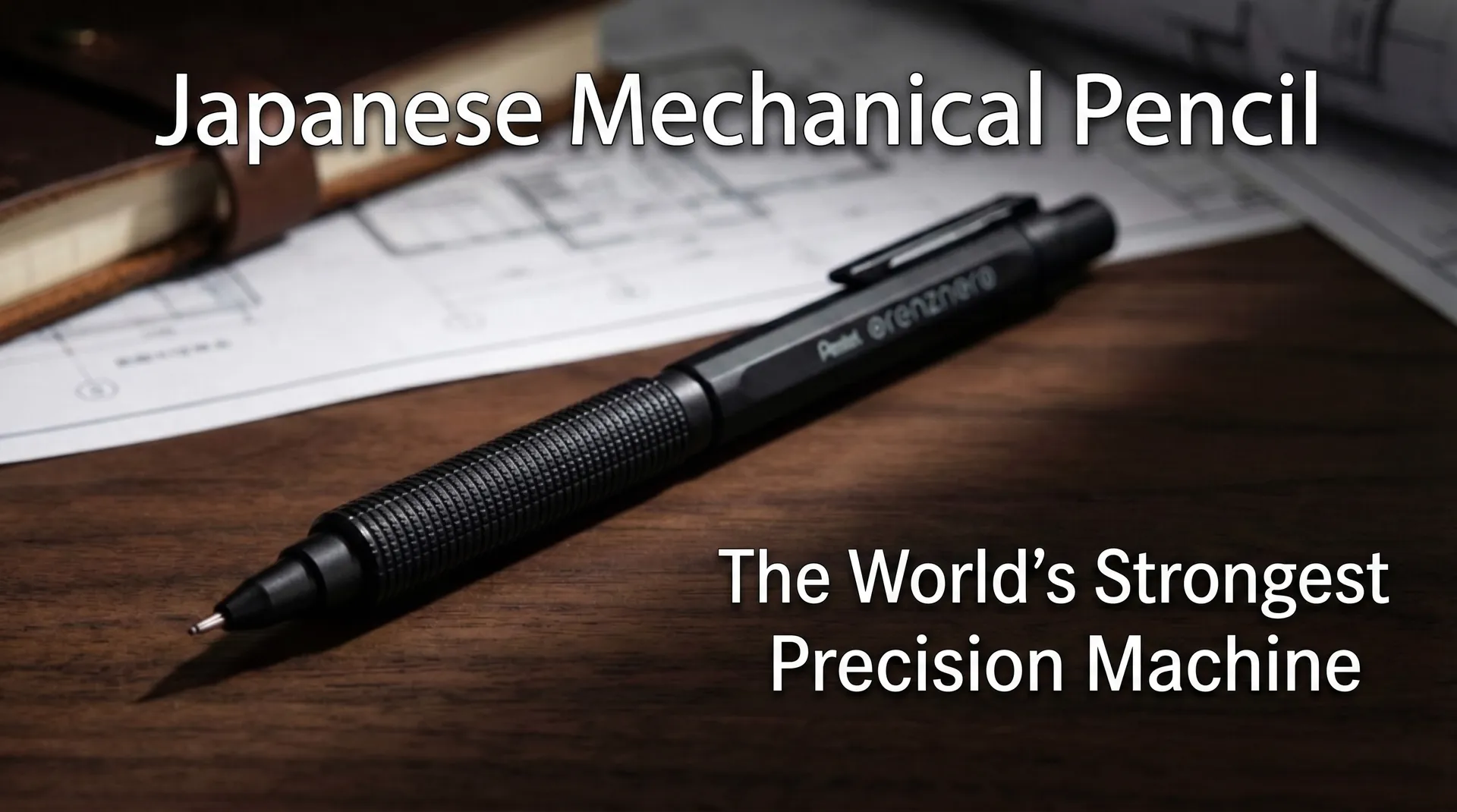
Japan's Best Mechanical Pencils: Break-Proof, Fatigue-Free Precision Instruments