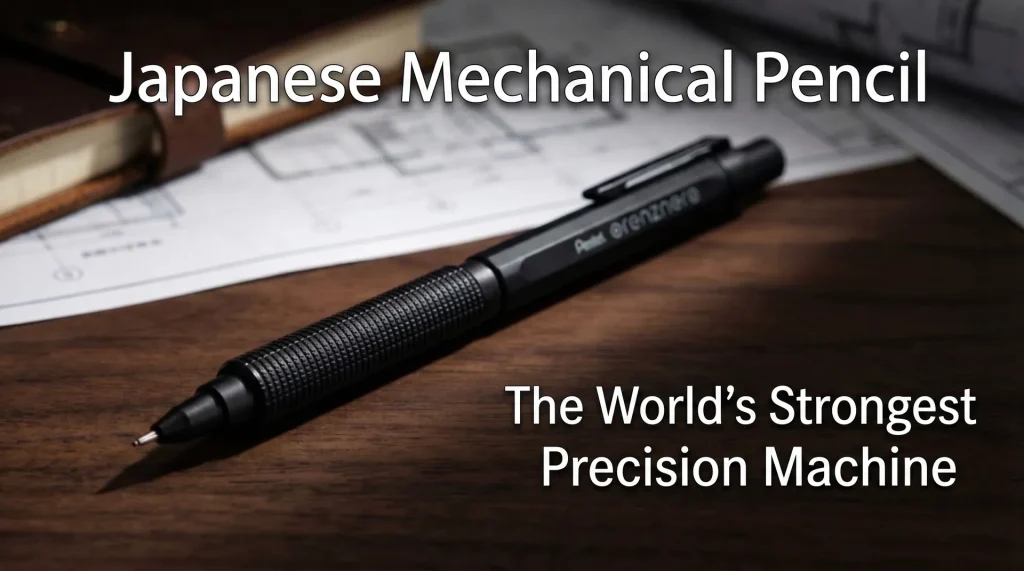
A mechanical pencil can cost four dollars or seventy, and the difference is not branding. It is a specific count of mechanisms inside the barrel. One rotates the lead so it never goes blunt. One sheathes the lead in a metal pipe so it cannot snap. One feeds fresh lead without you clicking. One stores forty leads in the body.
Japan is the only place where these were developed into an ordinary consumer product rather than a specialist tool. This guide explains what each mechanism actually does, which one solves your particular complaint, and where the price stops being worth it — plus the failure mode nobody warns you about before you spend real money.
What Each Price Step Adds
| Rough price | What is added | Who it suits |
|---|---|---|
| Under $3 | It writes. A click mechanism that advances lead | Occasional use; things you lose |
| $7–12 | Rigidity. The tip stops rattling. Real grip and balance | The practical baseline if you write daily |
| $20–30 | One mechanism (rotation or a guard sleeve) plus a metal barrel | Long writing sessions; gifts |
| $60+ | ⚠ Mechanisms combined. Auto-advance plus rotation | You resent stopping to click |
| ⚠ Unrelated to price | Lead capacity. One model holds forty | You are tired of carrying lead tubes |
| ⚠ The catch | The costlier the pencil, the thinner its metal sleeve — and the less it survives a drop | — |
1. Why Only Japan Took This Seriously
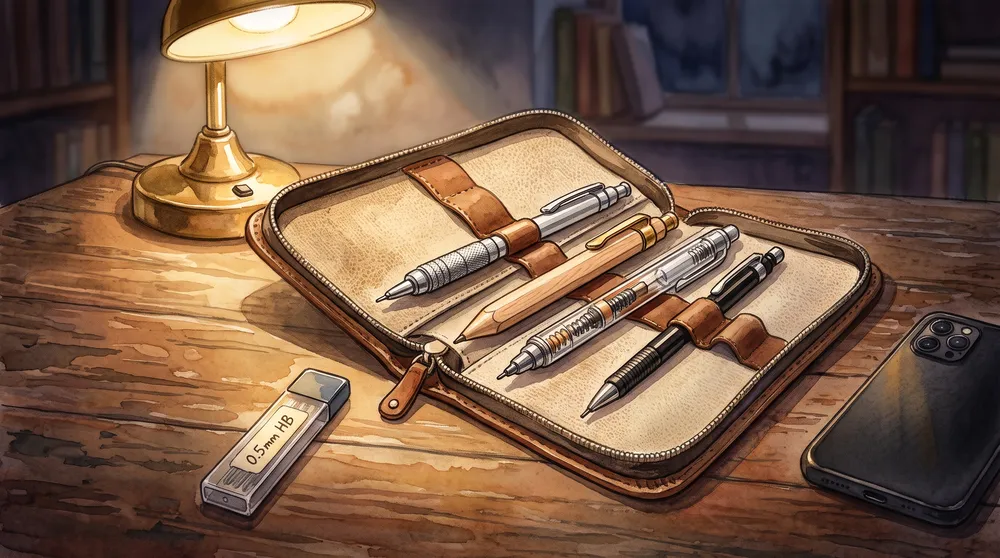
In most countries the mechanical pencil settled into one role: a wooden pencil that never needs sharpening. Cheap, plastic, disposable, and largely unchanged for decades. There was no reason to engineer it further.
Japan went a different way, and the usual explanation is the writing itself. Kanji have far more strokes packed into the same square, and the small hooks and stops that distinguish one character from another only survive if the line stays thin and even. A lead that goes blunt halfway down the page is not a minor annoyance — it starts to blur the writing.
Add a school system built around long handwritten study, and you get sustained demand for a pencil that behaves consistently over hours. The result is a category that competes on mechanism, the way cameras compete on sensors.
What is happening right now
This is not a settled market. Prices have been climbing sharply, driven by Japanese secondary-school students — a group that now treats a pencil as something to be seen with, photographed and collected.
One figure captures it. Pentel's unit sales have been flat, but revenue is up roughly a quarter over five years, purely because the average price rose. Makers noticed, and the ¥5,000–10,000 shelf that barely existed a decade ago is now the interesting one. ⚠ That is why a pencil you last bought for a few dollars now has siblings costing seventy.
2. What the Price Actually Buys
Round-up articles rank products. The more useful question is what you are paying for at each step.
Under $3 — it writes
A click mechanism and a chuck that grips the lead. That is a functioning pencil, and at this price Japanese mass production delivers it reliably. Nothing here is broken.
$7–12 — the rattle disappears
What changes is rigidity. On a cheap pencil the tip cone is a screwed-on part that works loose, and the resulting fraction of a millimetre of play is what "feels cheap" actually means.
Drafting-derived models solve it structurally: the tip and grip are moulded as one piece, so there is nothing to loosen. Add metal components low in the barrel and the pencil steadies itself, which lets your hand stop compensating.
⚠ For most people who write daily, this is where the real baseline sits. Ten dollars buys a pencil with nothing to complain about.
$20–30 — one mechanism appears
Rotation, or a sleeve that guards the lead. A patented mechanism enters the barrel, usually alongside a metal body that adds weight and finish.
$60+ — mechanisms multiply
Above this line, makers combine them: rotation and automatic feeding, in one barrel. Part counts rise, assembly tolerances tighten, and the price jumps accordingly.
⚠ Being honest about the returns: they fall off sharply here. The gap between $4 and $25 is obvious to anyone. The gap between $25 and $70 comes down to how many clicks you avoid. Whether that is worth it depends on how much you write and how much you enjoy the object itself — both legitimate reasons, but worth naming.
3. The Four Mechanisms
Japanese makers have competed on four problems. Identify which one is actually annoying you, and the shortlist writes itself.
⚠ One note on the market first. In the Japanese sales rankings for August 2026, six of the top ten were Kuru Toga models — so of the four, the one buyers back most heavily is the first.
① Rotate — the line stops thickening
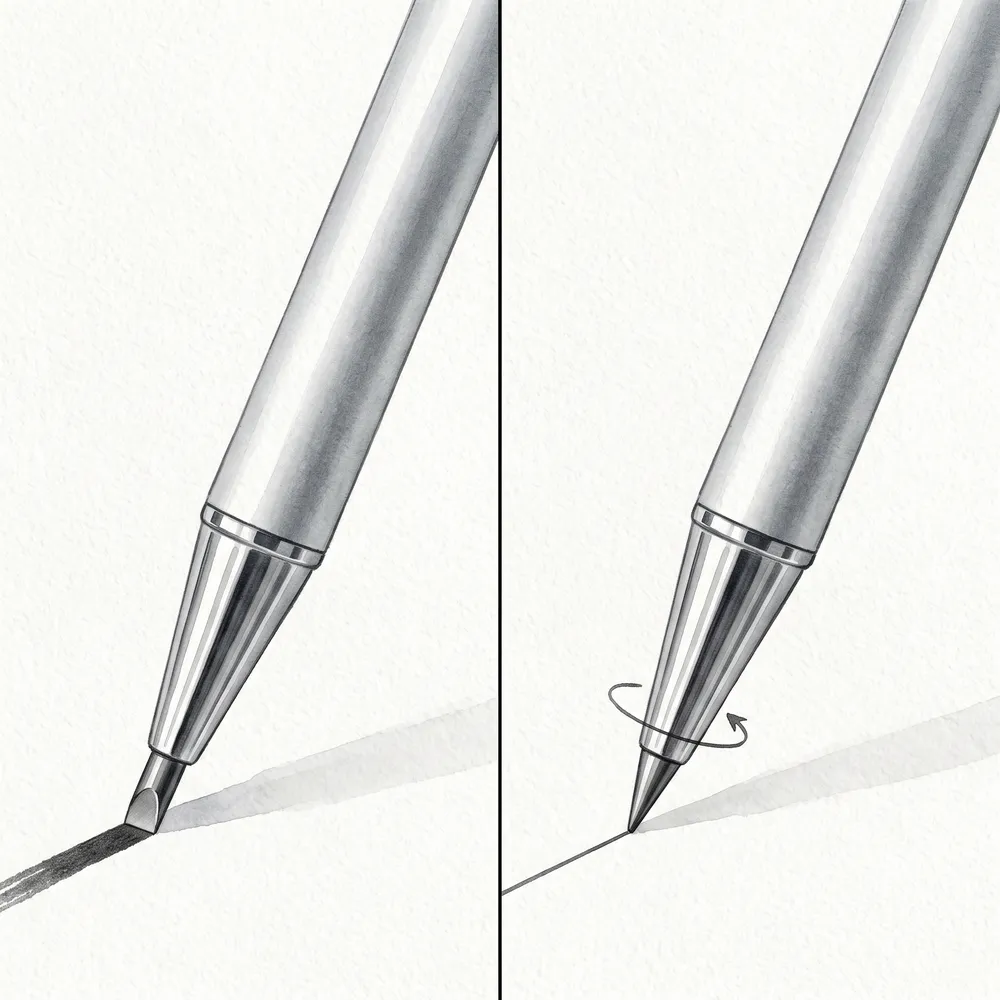
Lead wears on one side only. The tip develops a flat slanted face, the contact patch widens, and your line quietly gets thicker as the page goes on. Compare the first and last lines of a page of notes and you will see it.
Mitsubishi's Kuru Toga turns the lead a fraction with every stroke, so a different face wears each time and the cone stays symmetrical. Line width holds steady all the way down.
⚠ It does not work for everyone. The rotation is driven by pressure being applied and released. If you write very lightly, or in a continuous cursive hand without lifting the tip, the mechanism simply never advances.
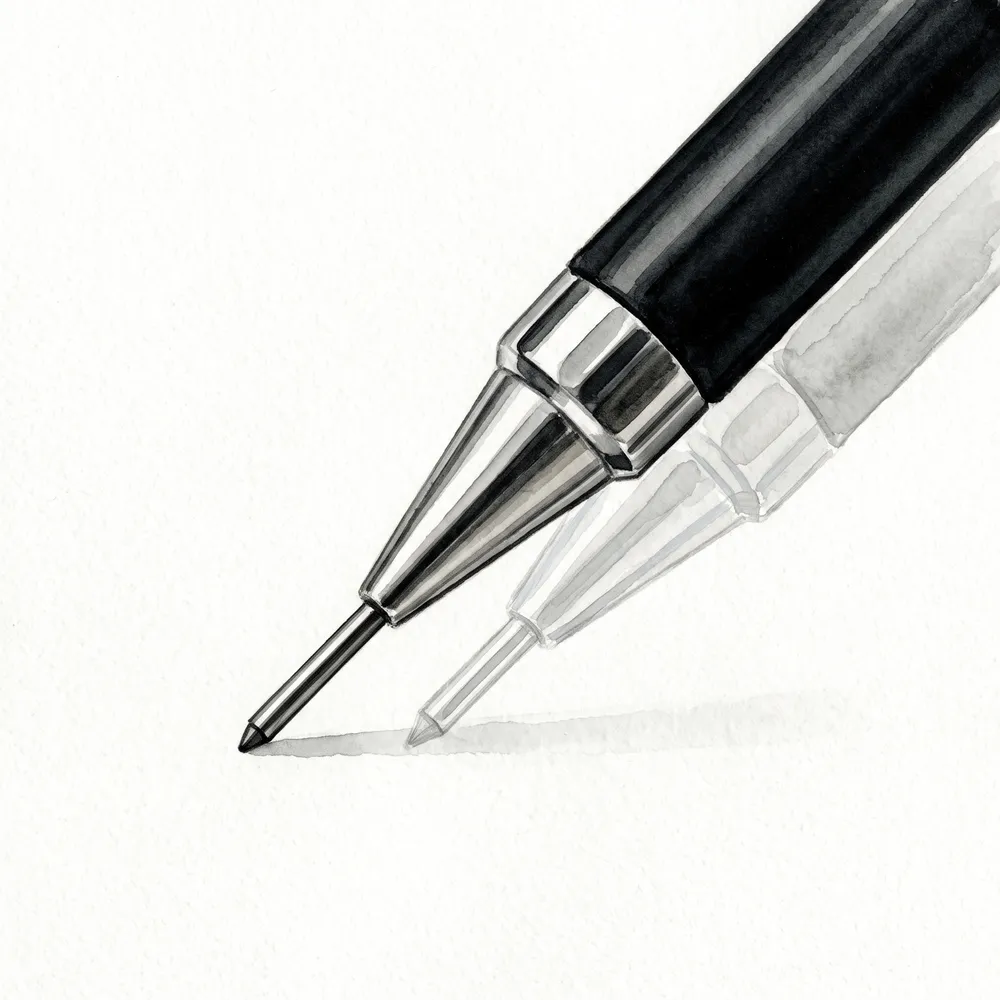
② Guard — the lead stops snapping
Lead breaks because lead is exposed. Pentel's answer was to stop exposing it. A thin metal pipe surrounds the lead and rests on the paper itself, retreating as the lead wears down.
Because the lead is never unsupported, it barely breaks — which is what made 0.2mm a usable size rather than a novelty.
⚠ The trade-off is that metal touches paper. There is a faint hard edge to the feel that some writers dislike. Try it before committing to a 0.2mm system.
③ Advance — the clicking stops
Stopping to click, thousands of times a year. Auto-advance removes it: the lead feeds itself as it wears, or each time you lift the tip from the page. Click once at the start and write until the lead runs out.
Most pencils above the $60 line include this, usually stacked on top of rotation or a guard sleeve.
④ Store — you stop carrying lead tubes
This one is unrelated to price, and it was the most celebrated mechanism in Japan this year. Most pencils hold three to five spare leads. One holds forty.
Sun-Star's "Sindbat" carries up to forty leads in the barrel. Discontinued in 2011 and revived in 2026 with a new design, it won the grand prize at Japan's national stationery awards. The benefit is plain: no lead tube in your bag, and far fewer refills.
⚠ Do not try this with an ordinary pencil. As section 6 explains, overloading a normal barrel is a common cause of jams. Sindbat works because it was designed around the load — forty leads in a pencil that was not is simply a jam waiting to happen.
Which one do you need?
Your line thickens as the page goes on → ①. You snap leads, or want to write finer → ②. You write long stretches and resent the interruption → ③. You are tired of the lead tube in your pencil case → ④. ⚠ You do not need all four in one pencil. Until you know which complaint is yours, a well-built $10 model tells you more than a $70 one.
4. Five Pencils, by the Problem They Solve
Ordered by the complaint they answer, not by price.
Pentel Smash — the baseline worth owning
Around $10, and the rattle is gone.
Drafting design, with the tip cone and grip moulded as a single piece so nothing can work loose. Rubber studs form the grip. No headline mechanism — just a pencil with nothing wrong with it.
⚠ Start here if you are not sure what you want. It tells you whether you actually need a mechanism, and it stays useful either way.
Uni Kuru Toga Dive — rotation and auto-advance
Mechanisms ① and ③ in one barrel.
Pull the cap and it is ready to write; close it and the lead retracts. There is no click at all. It sells out on every restock in Japan.
⚠ Not a first purchase. Buy it once you know you want both rotation and auto-feed — otherwise you are paying for a mechanism you will not notice.
Pentel Orenz Nero — the pencil that started the boom
Released 2017. Mechanisms ② and ③.
The guard sleeve plus auto-advance: click once, then write. In 0.2mm it still does not break, which is the point of the whole system.
A resin-and-metal composite body sits low in the hand and feels heavier than it looks. ⚠ Check that 0.2mm lead is easy for you to buy locally before you commit — it is far less common than 0.5mm.
PILOT S20 — wood that changes colour
Resin-impregnated birch, turned to a waisted curve.
Mechanically it is a straightforward pencil. What you are buying is the material — oils from your hand darken and polish the barrel over years of use.
The odd one out among these five, and the easiest to give as a gift. ⚠ If you want a mechanism, this is not the one — but nothing else here ages.
PILOT Dr. Grip — for hours, not for looks
On sale since 1991, and still the default for long sessions.
A thick barrel and silicone grip spread the load across the hand. Some versions advance the lead when you shake the pencil, so you never change your hold.
The pick if slim barrels tire your hand, or if your hands are large. It is not a collector's object and does not pretend to be.
⚠ It is no longer only a Japanese field
Worth saying plainly. In the Japanese sales rankings for August 2026, Germany's Kaweco held three of the top ten places, and one of the best-selling pencils of the year was a collaboration: the LAMY Safari barrel with the Kuru Toga rotation mechanism inside. It placed third at the national stationery awards.
⚠ So the useful frame is not "Japanese versus foreign". The mechanisms are Japanese; the barrels and industrial design increasingly are not. Choose by mechanism rather than by flag and you will end up with the right pencil.
5. Lead Sizes and Grades
The lead matters as much as the barrel, and it is far cheaper to experiment with.
- 0.5mm — the standard. Widest choice of grades, available everywhere. There is rarely a reason to start elsewhere.
- 0.7mm — the default in much of the world outside Japan. Breaks less, writes darker, suits larger handwriting.
- 0.3mm — planners, figures, technical work. ⚠ It snaps if you press hard. Pair it with a guard-sleeve model.
- 0.2mm — only viable with a guard sleeve. ⚠ Check local refill availability first. Outside Japan this often means ordering online every time.
Grade is about wear, not just darkness
HB, B, 2B — the ratio of graphite to clay. Toward B there is more graphite: darker lines, faster wear, more smudging. Toward H, harder and finer, but fainter.
⚠ If your hand tires, try a softer grade before you buy a different pencil. Darker lead marks at lower pressure, and pressure is what actually tires the hand. It costs a couple of dollars to test. Note that Japanese pencils and lead run softer than the American equivalents — a Japanese HB is closer to a US #2 in feel than the letters suggest.
6. ⚠ The Expensive Ones Break More Easily
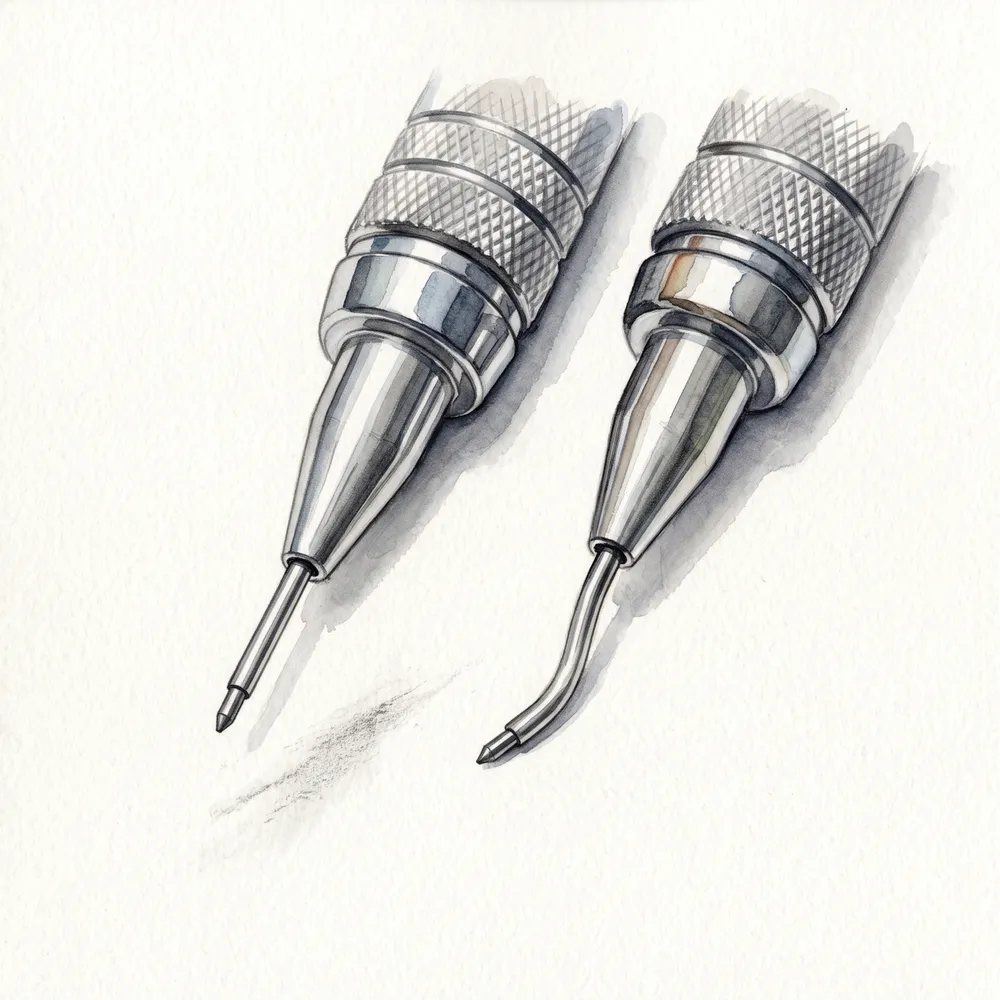
Rarely mentioned, and important. Drafting and premium models end in a long thin metal sleeve — that shape is what supports the lead and lets you run the pencil along a ruler.
That sleeve bends if you drop the pencil. Once bent, lead will not pass through it, and there is no repair. ⚠ A seventy-dollar pencil can be finished by one fall from a desk. A three-dollar one shrugs it off.
The fix is trivial: retract the tip or cap it when you stop writing. If the model has a retracting sleeve, use it. Rolling off a desk is how most of these die.
If the lead jams
Do not keep clicking — that crushes more lead inside. Use the cleaning pin, the thin wire found under the eraser on many models, pushing it in through the tip to clear the fragment. If yours has no pin, a fine needle does the same job.
⚠ Prevention is simply not overloading it. Three or four spare leads in the barrel is where jams begin. Keep it to two and this mostly stops happening.
7. Frequently Asked Questions
Will an expensive pencil improve my handwriting?
No. That is practice.
What changes is line consistency (rotation), how often lead snaps, and how tired your hand gets. ⚠ Where you see "writes more beautifully", read it as "keeps line width steady" — which is real, but a narrower claim than it sounds.
Does Kuru Toga work for left-handed writers?
Yes. The rotation is driven by pressure, not by direction, so handedness is irrelevant.
⚠ What does stop it is your writing style. Very light pressure, or a continuous hand that never lifts off the page, leaves the mechanism idle. It needs the press-and-release cycle to advance a step.
Can I get refills for these outside Japan?
0.5mm and 0.7mm, easily. Any brand of lead fits any pencil of the same diameter — this is a universal standard, not a proprietary one.
⚠ 0.3mm is harder and 0.2mm is genuinely inconvenient in most countries, usually meaning an online order each time. If that would annoy you, buy the 0.5mm version of whichever model you like.
Are these worth importing, or should I buy locally?
There is no technical barrier at all — no voltage, no regional formats, no warranty that matters. A pencil bought in Japan works identically anywhere.
The only practical considerations are lead diameter availability (above) and shipping cost on a light, low-value item. Most of these models are stocked on Amazon in the US and Europe, which is usually the simpler route.
What should I give as a gift?
The $20–30 band travels best. Above what people buy themselves, still packaged properly, and not so specialised that the wrong mechanism ruins it.
⚠ If the recipient is already into this, buy lead or a lead case rather than a pencil. Enthusiasts have strong mechanism preferences and probably own the obvious models already.
Why are prices rising so fast?
Because a high-price tier turned out to exist. Pentel's Orenz Nero proved in 2017 that a ¥3,000 mechanical pencil would sell, and makers have been building upward ever since.
⚠ The demand is coming from Japanese teenagers, who photograph and collect them — which is worth knowing, because it means some of what you are paying for is scarcity and finish rather than mechanism. The four mechanisms above are the part that affects writing.
8. Final Thoughts: Find Your Complaint First
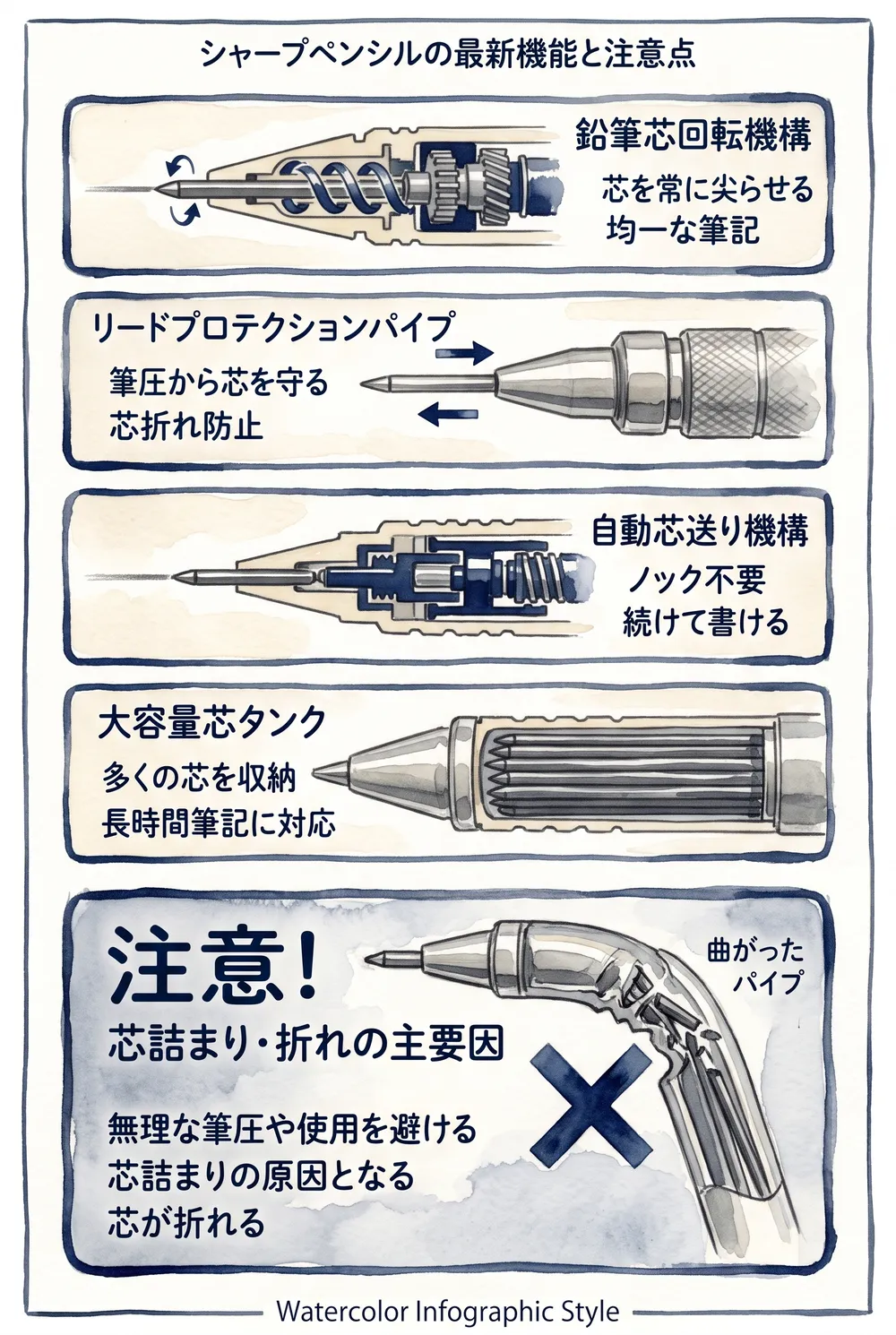
The price is not arbitrary. Rotation keeps the line thin, a guard sleeve stops breakage, auto-advance removes the clicking, and one model stores forty leads. How many of those are in the barrel is most of what you are paying for.
But the returns fall off fast. The step from $4 to $25 is obvious; the step from $25 to $70 is about avoided clicks. Buy something well made around ten dollars first and find out which complaint is actually yours.
And try a softer lead before buying a different pencil. It costs almost nothing and changes more than people expect. ⚠ Whatever you end up with, retract the tip when you put it down — the expensive ones do not survive the floor.
Japanese Ballpoint Pens: Best Picks for Gifts & Daily Use
Japanese Erasers That Erase Without Tearing