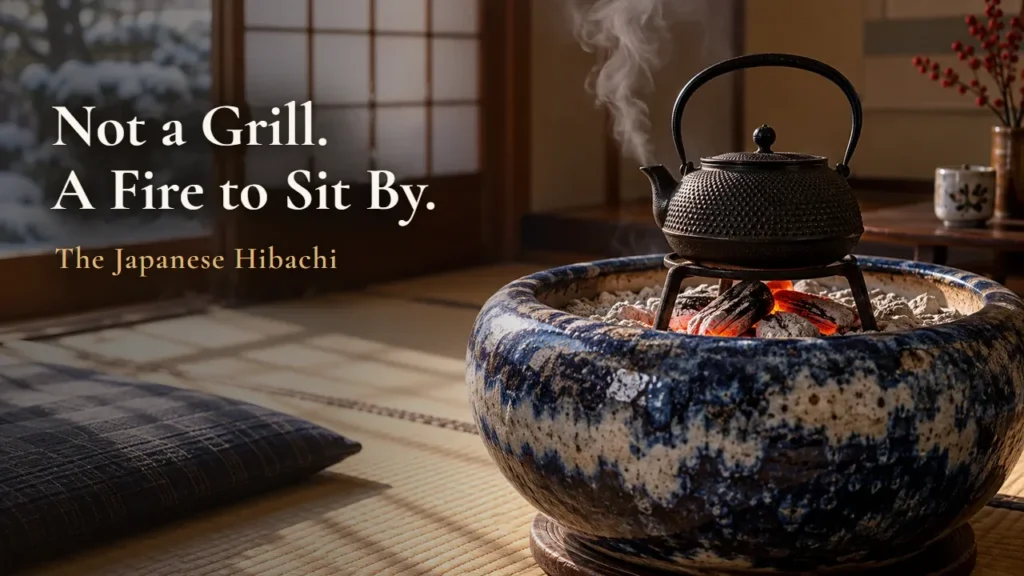
In Japan, a hibachi isn't a grill. Outside Japan the word usually means a teppanyaki restaurant or a small charcoal barbecue. A Japanese hibachi is a ceramic or wooden charcoal brazier: a bowl of ash with a few pieces of glowing charcoal. It won't heat a room. You sit around it, gently warmed, with an iron kettle on the coals for tea — or a little sake.
80%. That was the share of Japan's hibachi made in one town — Shigaraki, in Shiga Prefecture — at the end of the Second World War, according to the prefecture. This guide covers a Shigaraki hibachi, the ash-and-charcoal set that lets you light it on day one, a Nambu cast-iron trivet for the kettle, and brass tools for the ash. Read the safety section before you light anything.
Quick Reference: A Japanese Hibachi Setup
| Piece | Made in | Size | What it does |
|---|---|---|---|
| Shigaraki hibachi, namako glaze ▾ | Shigaraki, Shiga | Size 10: about 30 cm (11.8 in) across | A small fire to sit around, a small kettle |
| Shigaraki hibachi, white sand ▾ | Shigaraki, Shiga | Size 13: about 39 cm (15.4 in) | A larger trivet and kettle |
| Hibachi + ash and charcoal set ▾ | Shigaraki + Kurama charcoal | Size 10 | Everything to start |
| Iwachu gotoku trivet ▾ | Morioka, Iwate (Nambu ironware) | 17, 20 or 23 cm (6.7–9 in) | Holds the iron kettle |
| Hayashida brass ash tools ▾ | Japan (brass) | Ash smoother + fire chopsticks | Tending ash and charcoal |
1. Why Japanese: Shigaraki Was the Hibachi Town
80% of the country's hibachi, from one town
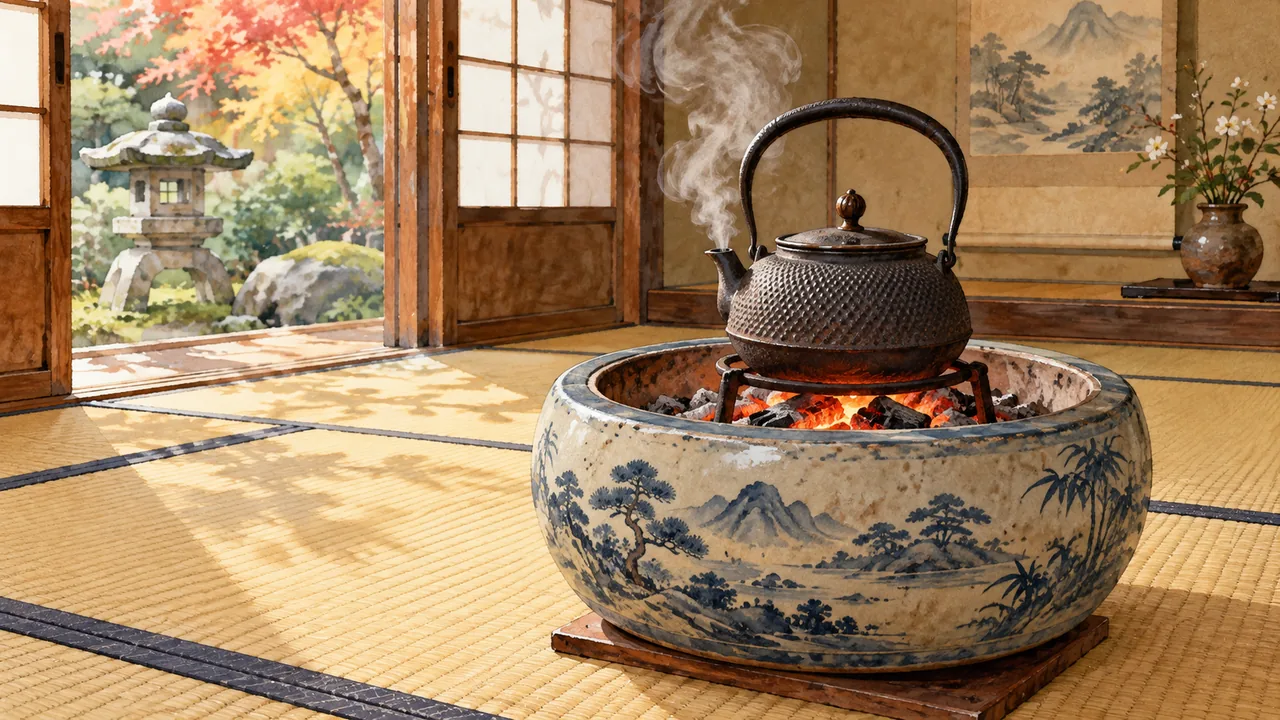
Shiga Prefecture's introduction to Shigaraki ware puts it plainly: at the end of the Second World War, metal shortages drove up demand for ceramics, and Shigaraki's hibachi reached 80% of the national market. Then, as kerosene heaters spread, hibachi sales collapsed, and Shigaraki moved on to plant pots, exterior tiles and flower vases.
A hibachi doesn't warm a whole room. Its warmth reaches only the people sitting close to it — which is exactly the point. In the Japanese countryside, people still gather around a hibachi, pour tea or sake, and let the evening go slowly while the kettle ticks over the coals. That is the modern pleasure of a hibachi: not heating, but a fire to sit around together. And the town still making them is Shigaraki, the town that once made most of Japan's.
Looking for the grill?
If you want to cook over charcoal at the table, the Japanese tool you're thinking of is the shichirin — a small diatomaceous-earth grill. See our Japanese shichirin guide. For the charcoal itself, see binchotan.
2. Is It Safe Indoors? Ventilation and Carbon Monoxide
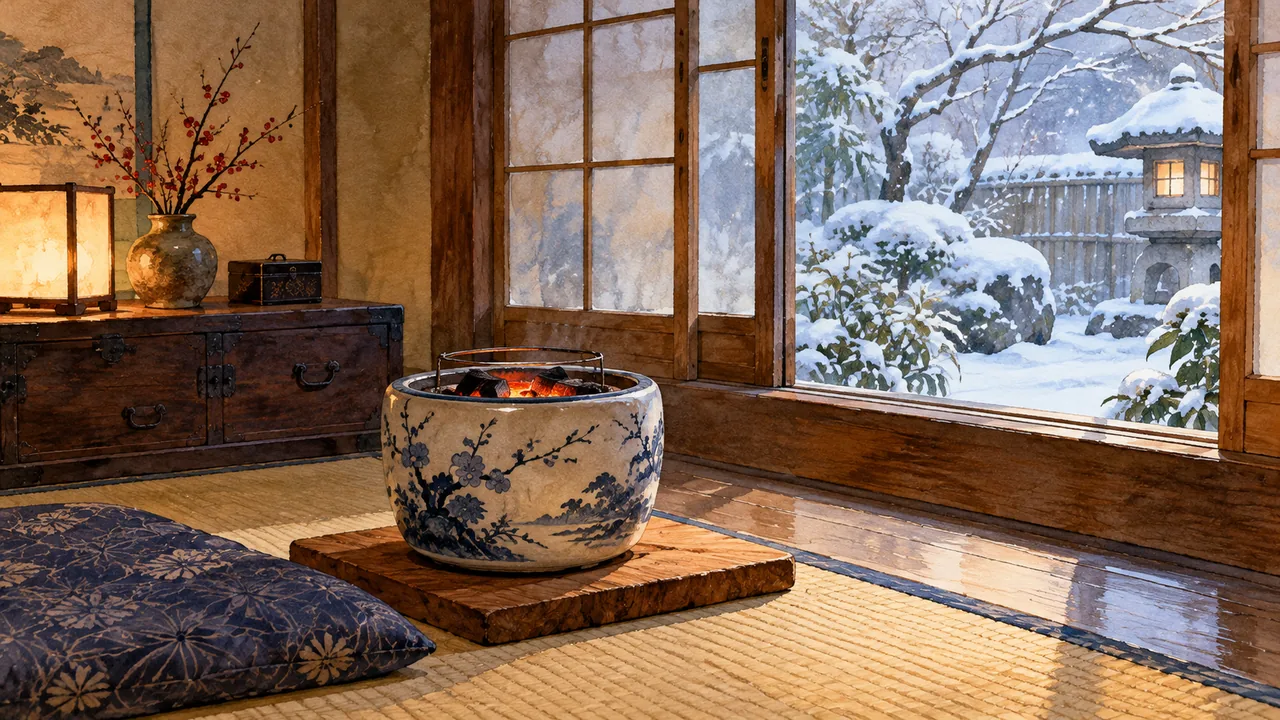
Short answer: only with ventilation, and never in a closed room. This is the one thing to settle before buying.
Burning charcoal produces carbon monoxide
Charcoal gives off carbon monoxide as it burns, and you can't smell or see it. Never use a hibachi in a sealed room. Open a window a little or run an extractor fan before you light it, keep a carbon monoxide alarm in the room, and never go to sleep with the hibachi lit.
Where to put it, and how to put it out
The ceramic body gets hot after a long burn. Keep it away from anything flammable, on a stable surface, and put a wooden board under it if it sits directly on the floor. To put the charcoal out, place it in a lidded charcoal extinguisher pot to cut off the air. Charcoal buried in ash can still be hot — don't walk away until it is completely cold.
3. The Shigaraki Hibachi: Namako Glaze or White Sand
Namako: the flowing blue glaze
The classic Shigaraki hibachi wears namako ("sea cucumber") glaze, with blues and whites running and pooling across the surface. Developed in the Meiji era, namako-glazed hibachi reached their peak in the Showa era.
Hibachi are sized by number. Size 10 is about 30 cm (11.8 in) across; size 13 is about 39 cm (15.4 in). For a small fire to sit around with a small kettle, choose 10; for a larger trivet and kettle, choose 13.
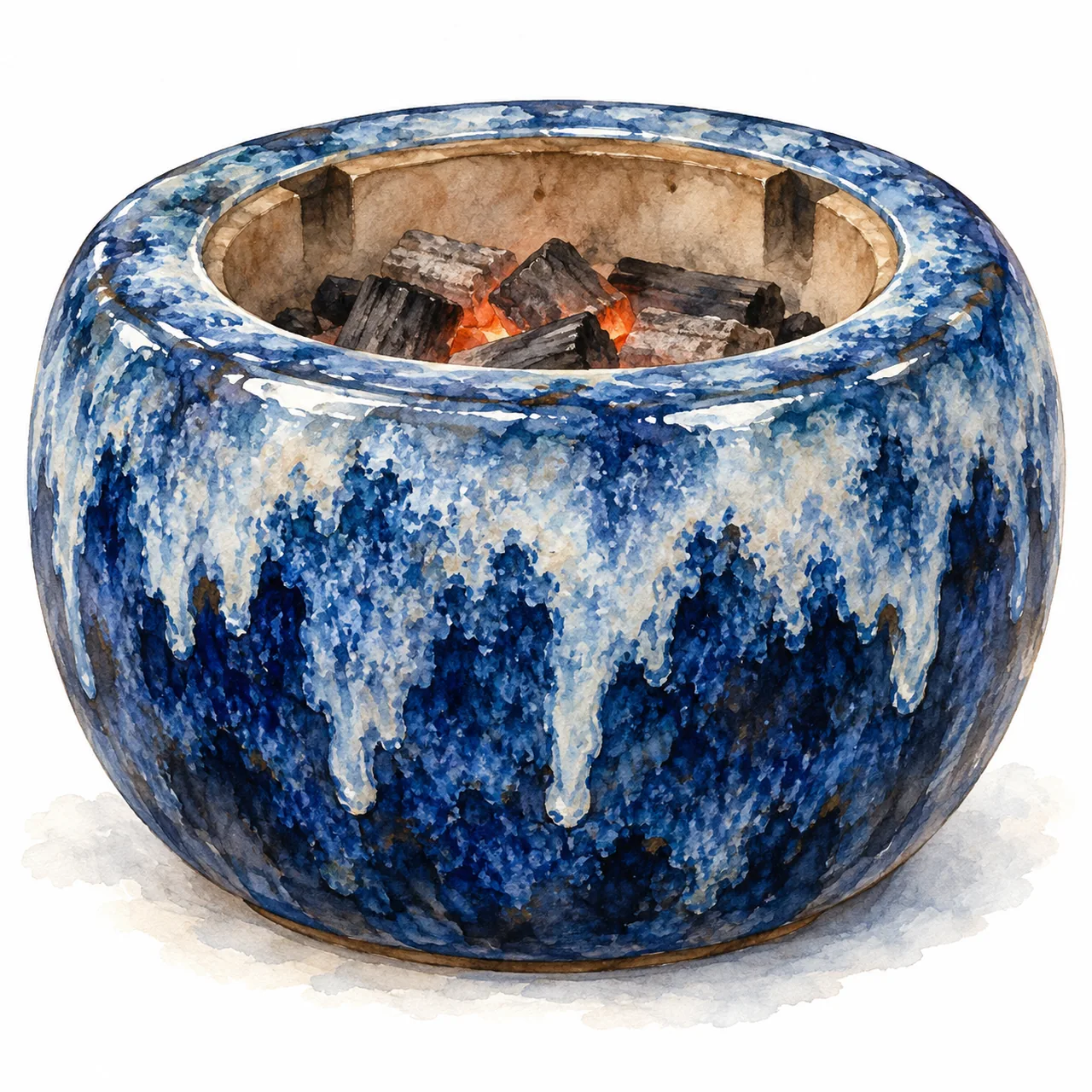
Shigaraki potter Ishida Seikaen sells both, shipped direct from Shigaraki: a namako size 10 (about 30 cm across, 22 cm tall — the right first hibachi) and a white-sand size 13 (about 39 cm), whose pale surface suits a tatami room or a wooden floor alike and holds enough ash and charcoal to keep a fire going for a long time. Out of season, either can become a planter cover or a water bowl.
4. Starting Out: The Ash and Charcoal Set
A hibachi needs ash and charcoal
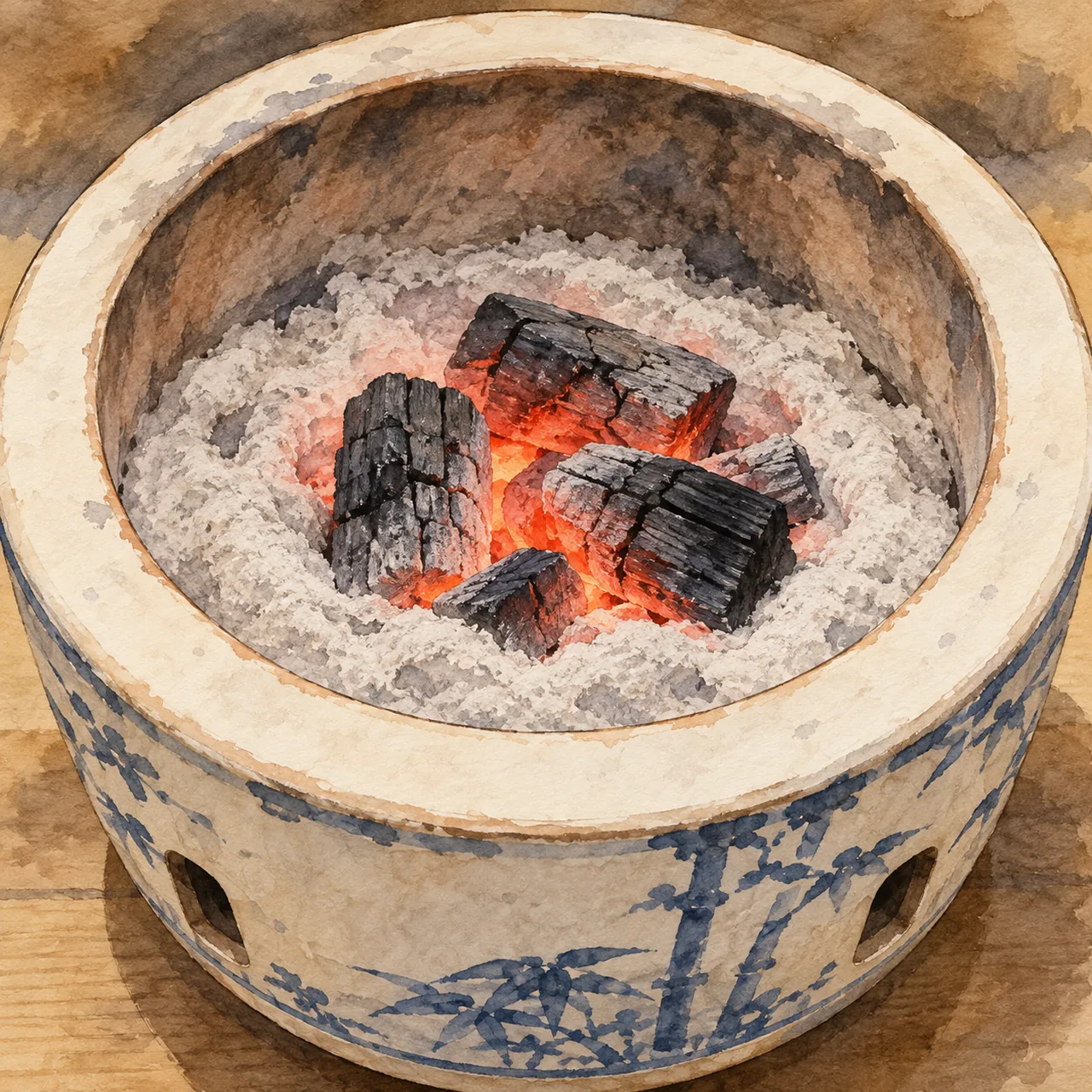
The bowl alone isn't enough. A layer of sand goes in the bottom, ash on top of that, and the charcoal burns on the ash.
Ishida Seikaen's five-piece set pairs the namako size-10 hibachi with 3 L of hyuga-tsuchi base sand, 4 L of wood ash, 2 L of small Kurama charcoal pieces, and 1 kg of top-grade Kurama charcoal from Kyoto — everything you need to light it the day it arrives.
5. A Nambu Iron Trivet for the Kettle
The gotoku holds the kettle over the coals
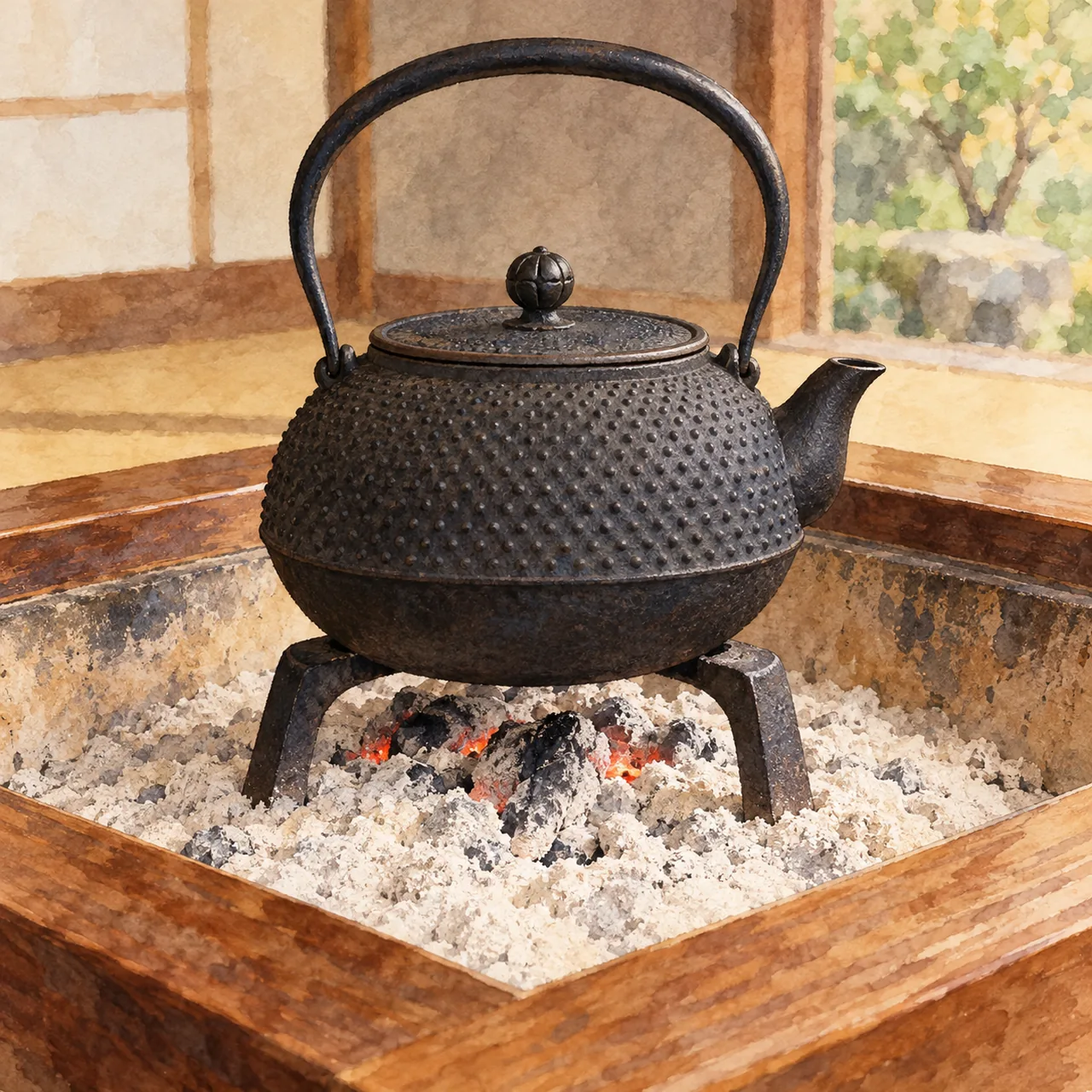
The gotoku is the three-legged stand set into the ash, holding an iron kettle or small pot over the charcoal. Iwachu of Morioka makes them in Nambu cast iron, in three sizes: small 17 cm (6.7 in), medium 20 cm (7.9 in) and large 23 cm (9 in) across. Iwachu's own shop lists them as made in Japan.
Iwachu notes that the size of the gotoku decides the size of kettle it suits. If you already own a tetsubin, choose the trivet to match it.
Iwachu Nambu cast iron gotoku, large (23 cm / 9 in)
A home for the kettle above the fire. Cast iron with a black baked finish, 23 cm across and 14.5 cm tall (9 × 5.7 in), about 2.7 kg. The large size suits a size-13 hibachi and a full-sized kettle. With a kettle and gotoku, the hibachi becomes a way to boil water for tea.
Iwachu Nambu Cast Iron Gotoku Trivet, Large (23 cm)
Loading product details…
Did you know: how Shigaraki's tanuki became famous
Many people know Shigaraki for its ceramic tanuki (raccoon dog) figures. According to Shiga Prefecture, they became known nationwide in 1951, when the Emperor visited Shigaraki: the town lined the road with tanuki holding flags to welcome him, and the Emperor wrote a poem about them. From hibachi to plant pots to tanuki — Shigaraki has changed what it makes every time Japanese life changed.
6. Brass Ash Tools
Smoothed ash makes the hibachi beautiful
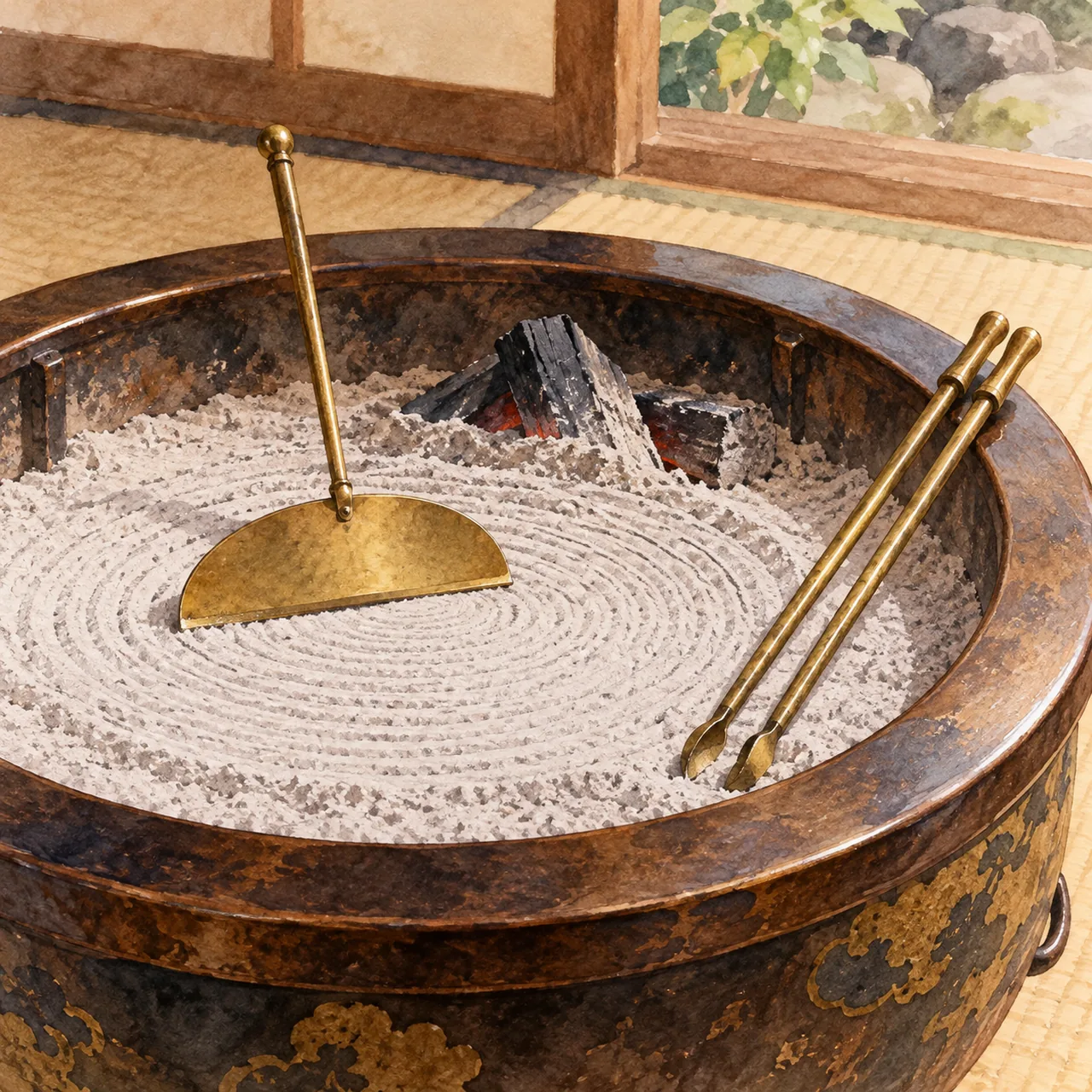
The hainarashi smooths the surface of the ash after use; the hibashi (fire chopsticks) pick up and move the charcoal. A hibachi with neatly combed ash is part of the room even when it isn't lit.
Hayashida Hokinsho's "Irori no Tomo" pairs a brass ash smoother with brass fire chopsticks, made in Japan and suited to a hibachi or an irori hearth. Brass settles into a deeper, quieter colour the more you use it.
7. Buying From Outside Japan
- The Iwachu gotoku in section 5 is on Amazon.com. For the kettle itself, see our Japanese cast iron kettle guide.
- The Shigaraki hibachi, the ash-and-charcoal set and the Hayashida brass tools are sold through Japanese shops. As of November 2026 we didn't find them on Amazon.com or with international shipping. A large ceramic hibachi is heavy and fragile, so ask the shop directly before ordering.
- Charcoal: use a clean-burning charcoal with little smoke or smell. Binchotan works too, but it is slow to light — start a small fire with easier-lighting charcoal first.
8. Frequently Asked Questions
Is a Japanese hibachi the same as a hibachi grill?
No. Outside Japan, "hibachi" usually means a teppanyaki restaurant or a small charcoal grill. In Japan, a hibachi is a charcoal brazier that people sit around, with a kettle on the coals. The Japanese tabletop charcoal grill is the shichirin.
Can I use a hibachi indoors?
Only with ventilation — never in a closed room. Burning charcoal produces carbon monoxide, which has no smell or colour. Open a window, run a fan, keep a carbon monoxide alarm nearby, and never sleep with it lit.
What do I need to start?
The hibachi, base sand, ash, charcoal, fire chopsticks and an ash smoother — plus a gotoku trivet if you want to boil a kettle. A hibachi sold with sand, ash and charcoal lets you start the day it arrives.
What size hibachi should I choose?
Size 10 (about 30 cm / 11.8 in) for a small fire and a small kettle; size 13 (about 39 cm / 15.4 in) for a larger trivet and kettle. A bigger bowl holds more ash and charcoal, so the fire lasts longer.
Will a hibachi heat my room?
No — it warms the people sitting around it, not the room. Think of it as a fire to gather at, with tea or sake and a kettle on the coals, rather than as a heater. Keep your usual heating, and keep the window open a little while it's lit.
What do I do with it in summer?
Leave the ash combed and use it as an ornament, or empty it and use the bowl as a planter cover or water bowl. Ash absorbs moisture, so if you take it out, store it somewhere dry.
Final Thoughts: A Fire to Sit By
A Japanese hibachi isn't a grill, and it isn't a heater — it's a fire to sit around. At the end of the war, Shigaraki made 80% of the country's hibachi, and it still makes them today.
A namako size 10 or a white-sand size 13; the ash-and-Kurama-charcoal set if you're starting from nothing; an Iwachu gotoku from Morioka for the kettle; Hayashida's brass tools to comb the ash. Each was made by Japanese craftspeople for a life with fire in the room.
Open the window a little first. Then gather around the coals this winter with a cup of tea or warm sake, and take your time.
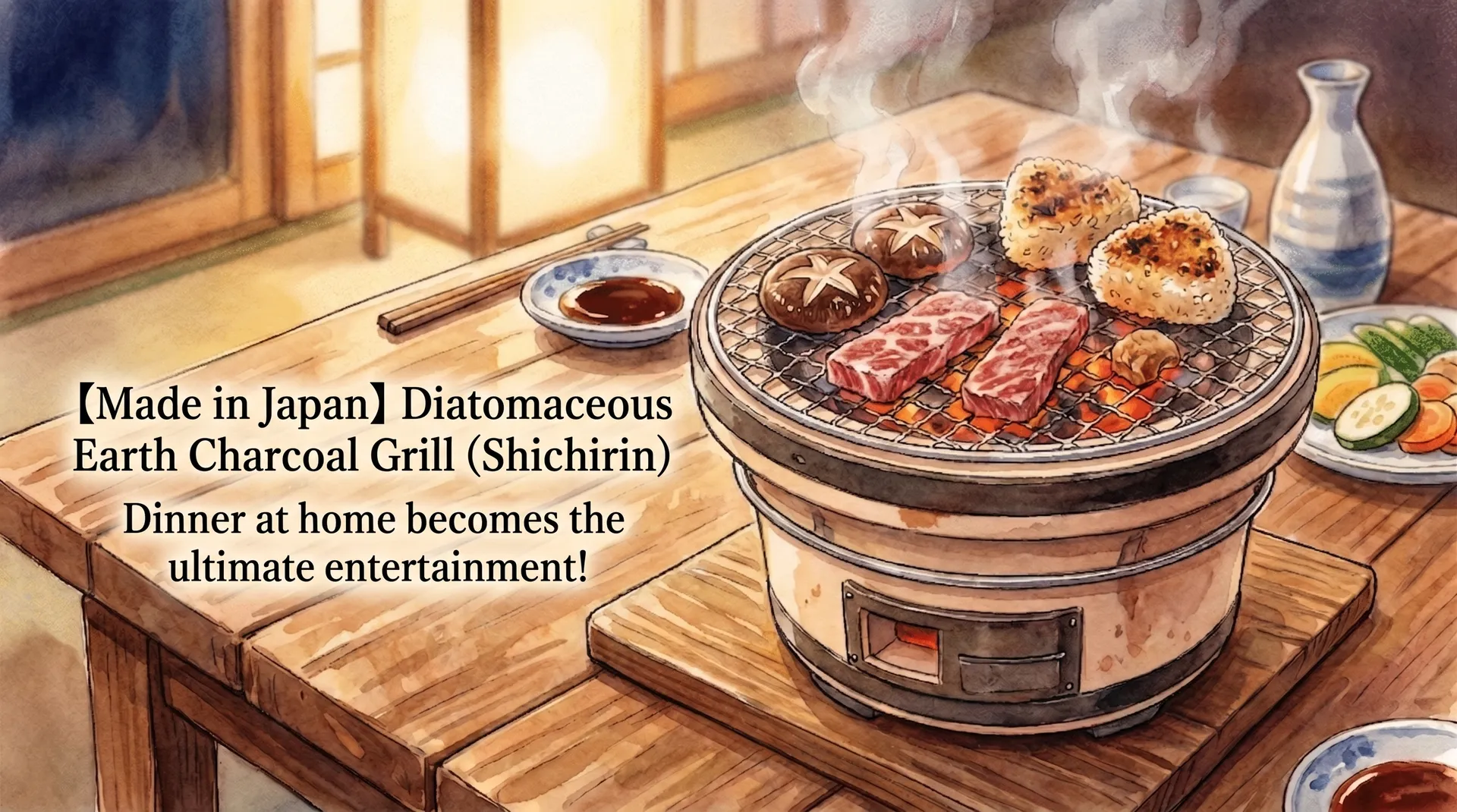
Japanese Shichirin: Noto Diatomite Charcoal Grill Guide
Binchotan Charcoal: Kishu, Tosa, Hyuga, and How to Use It