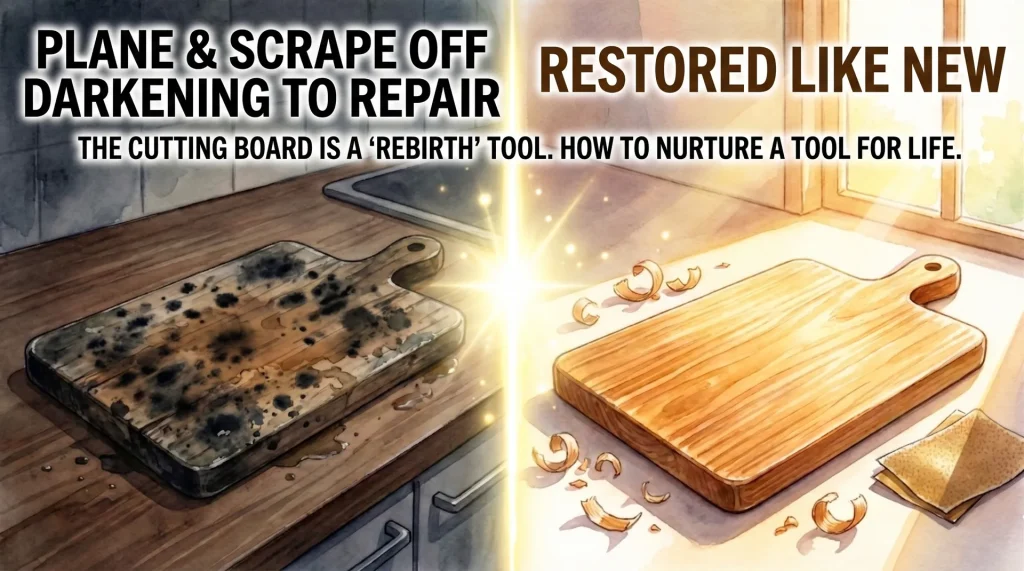
"I finally bought a beautiful wooden cutting board — and now it's covered in black stains."
"The center has worn down so much that my green onions come out still connected."
If you have a plastic board, that might be replacement time. But a wooden cutting board should never be discarded just because the surface is damaged.
Wood's greatest quality is this: only the surface wears — the inside remains untouched.
Black stains, grooves, and depressions can all be fully restored through proper maintenance (surface sanding). Done right, the board looks not just like new, but better — seasoned with character and depth.
This guide covers everything from DIY sandpaper resurfacing at home to professional re-planing services, plus the mistakes that will shorten your board's life.
Quick Reference: Cutting Board Trouble at a Glance
| Problem | Cause | Solution | Urgency |
|---|---|---|---|
| Surface blackening | Black mold rooted in the grain | Sand with sandpaper | ★★★ Address immediately |
| Center depression | Accumulated knife cuts over time | Full-surface sand with coarse paper | ★★ Once it becomes inconvenient |
| Unpleasant odor | Mold or food absorbed into wood | Hot water sanitizing + salt scrub → dry | ★★ Address sooner rather than later |
| Warping / bowing | Insufficient drying or direct sunlight | Soak in water and press flat with weight | ★ Mild cases often recover on their own |
1. What Is That Black Stain? Mold Roots, Not Surface Dirt
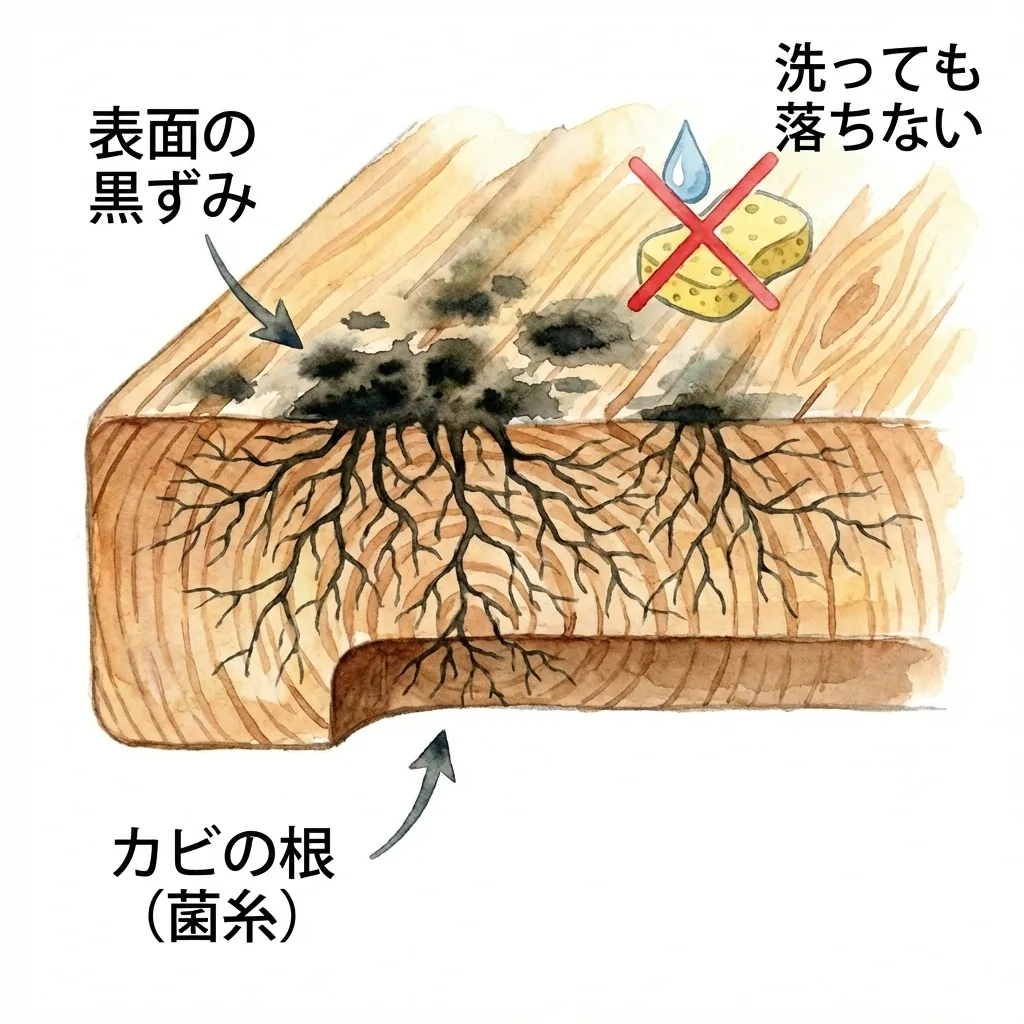
That black stain that won't wash off is almost never food coloring — in the vast majority of cases, it's black mold.
Left untreated, mold destroys the board from the inside
Wood absorbs moisture. Leave a wet board lying flat, or store it in a poorly ventilated spot, and mold will take root deep in the grain.
Surface-level blackening is still recoverable — but leave it long enough and internal decay sets in, eventually causing the board to crack or emit a persistent foul odor.
"Black = SOS." The sooner you act, the better.
2. DIY Fix: Sanding the Surface with Sandpaper
Light blackening and surface fuzz can be resolved with sandpaper from any home improvement store.
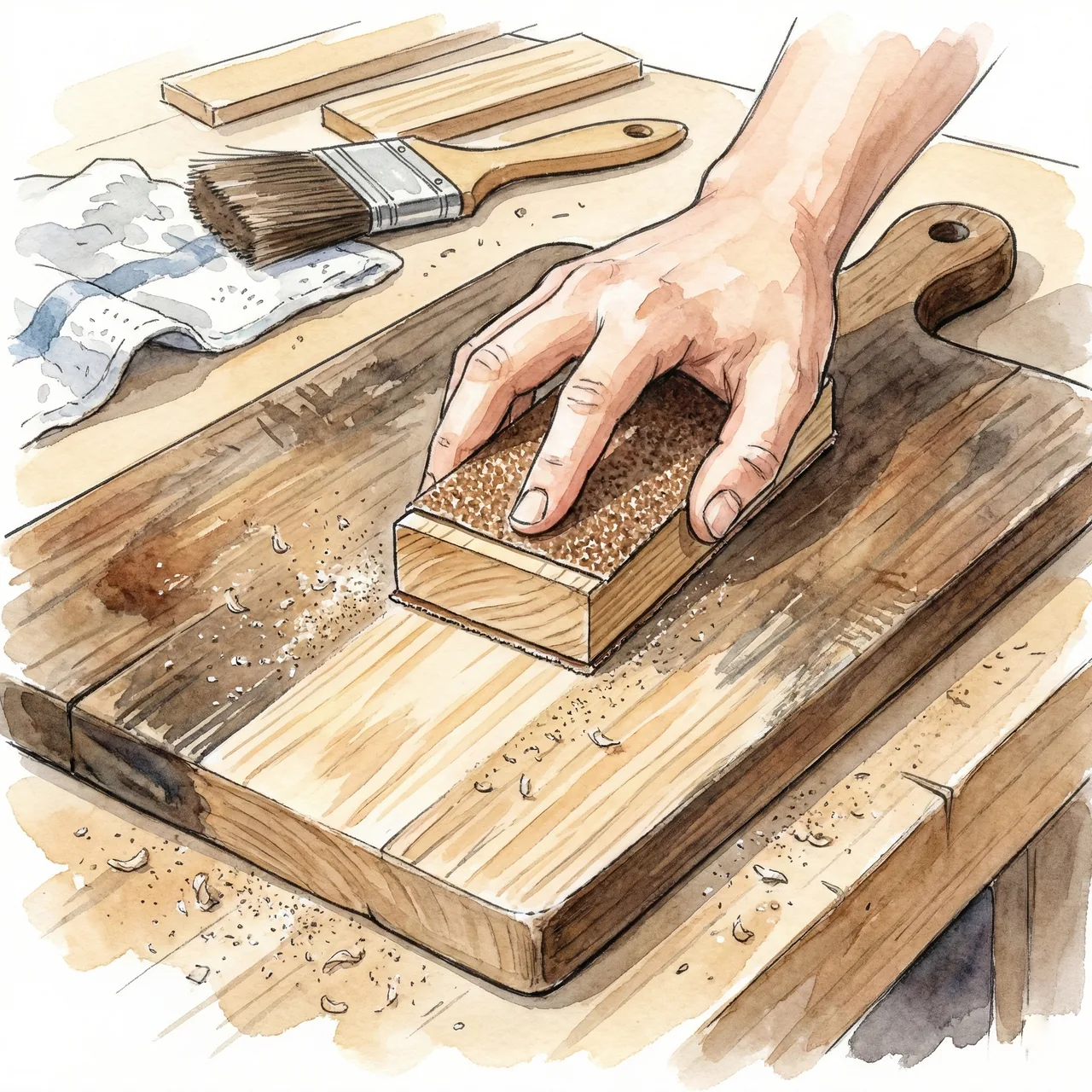
What you'll need: #100 coarse, #240 medium, and a sanding block
- Sandpaper #100 (or #150): Coarse grit to abrade away black stains.
- Sandpaper #240 (or #320): Fine grit to smooth the surface to a clean finish.
- Sanding block: A small square of wood or a kamaboko (fish cake) board to wrap the paper around. Essential for keeping even pressure across a flat surface.
Sand with the grain — evenly across the whole surface
1. Let the board dry completely. Wet wood won't sand properly.
2. Wrap #100 paper around your sanding block and move it only in the direction of the wood grain.
3. Once the black stains have disappeared, switch to #240 to smooth the surface.
4. Rinse off all sanding dust thoroughly and allow to dry.
※ Focusing your sanding only on the dark patches will create a depression in that spot. Always sand the entire surface evenly, even if only part of it is stained.
3. After Sanding: Oil Finishing to Restore Water Resistance
Freshly sanded wood is completely bare — unprotected and highly absorbent.
Without oil, water will penetrate immediately and mold will return just as fast. Apply oil to create a protective layer.
Olive oil is the wrong choice — use a drying oil
Reaching for the olive oil or cooking oil on your counter is a common mistake.
These are non-drying oils — they never fully cure, leaving the surface perpetually tacky. Over time they oxidize and create an unpleasant smell.
Always use an oil that cures on contact with air: walnut oil, linseed oil, or perilla (egoma) oil, or a beeswax-based finish specifically designed for cutting boards.
Apply across the entire surface, let it soak in, wipe off any excess, and allow to cure for half a day before using.
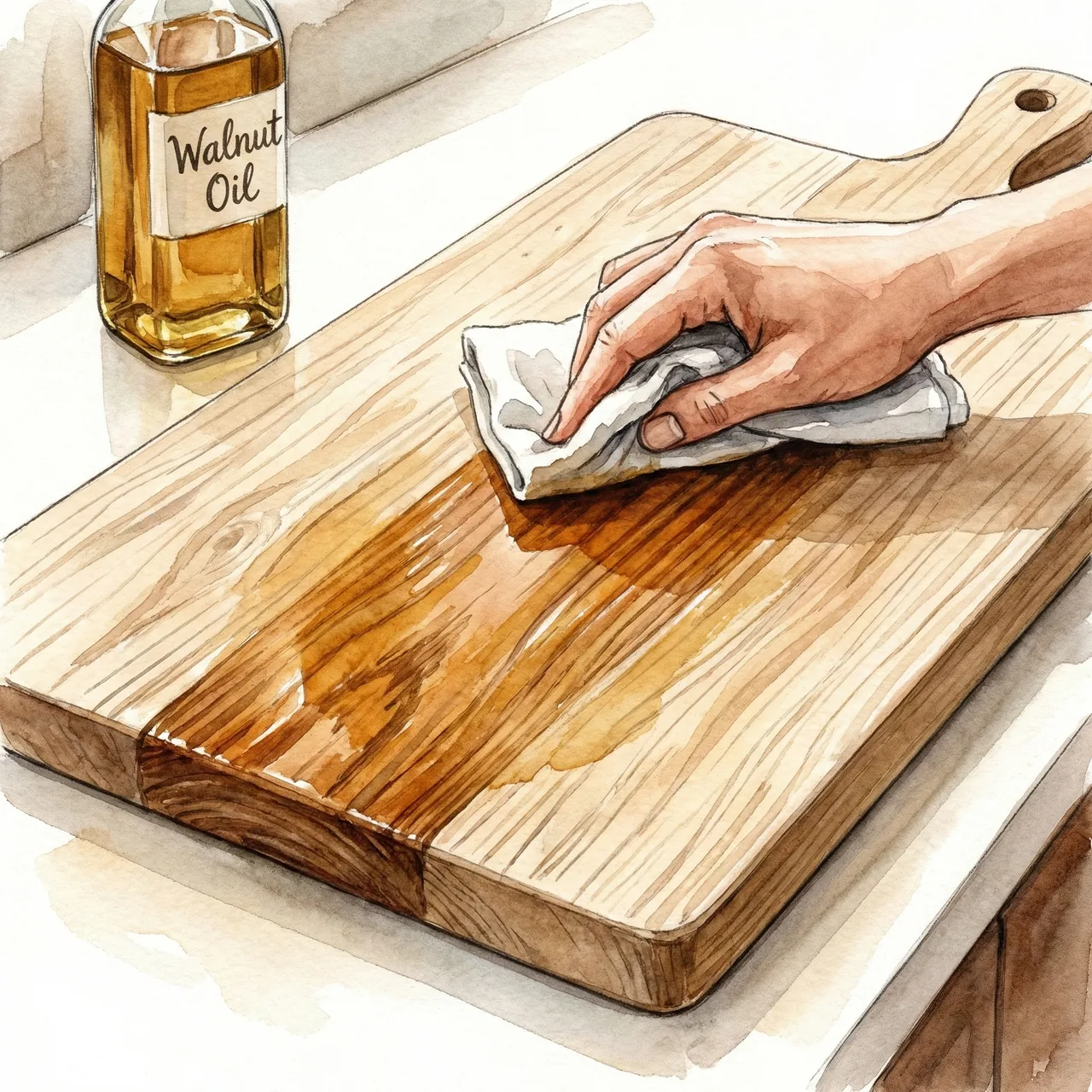
[Fukushima] Nakamura Toyozo Shoten — Walnut Oil (Kurumi Oil)
Founded in Meiji 28 (1895): a serious oil from Aizu's most uncompromising soba-tool maker.
Originally developed to preserve the wooden rolling pins (menbou) used in professional soba-making — a tool where even slight warping is unacceptable.
Made entirely from food-safe ingredients. Light in texture, excellent spreadability, and no off smell whatsoever.
A conditioning oil trusted by craftspeople for generations, with proven protective power against the warping and cracking that shortens a wooden board's life.
4. Can You Use Kitchen Bleach? Chlorine vs. Oxygen-Based Bleach
Mold and bleach feel like a natural pairing — but wooden cutting boards require some caution here.
Chlorine bleach (Kitchen Haiter, etc.) — not recommended for wood
Chlorine bleach is simply too powerful for wood. It breaks down lignin — the structural compound in wood fibers — leaving the surface bleached white, brittle, and dried out.
The chemical smell can also absorb into the wood and refuse to leave.
As a general rule, keep chlorine bleach away from wooden cutting boards.
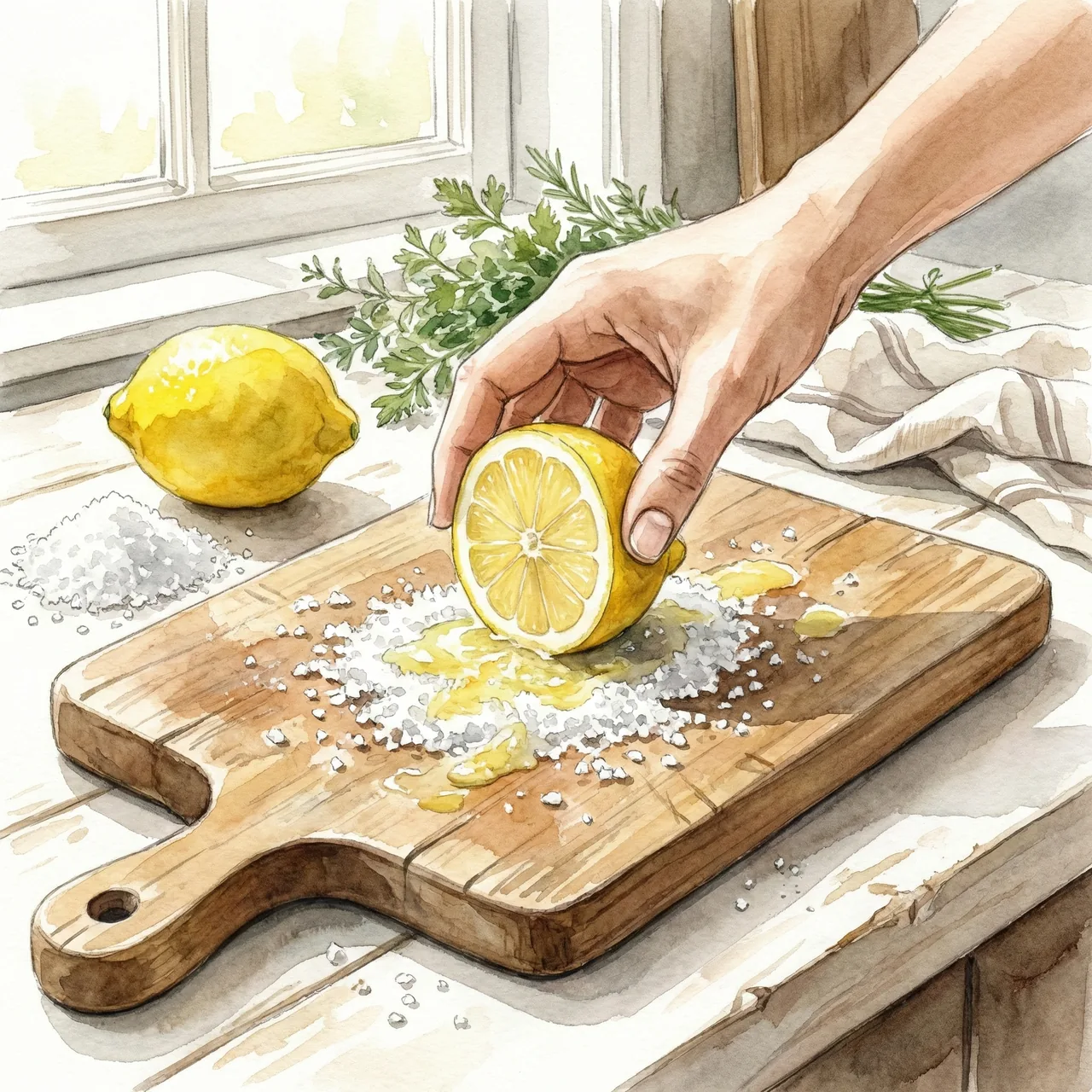
Natural alternative: the salt-and-lemon scrub
If you need to sanitize and deodorize, try this gentler approach instead.
Sprinkle coarse salt generously over the board surface, then scrub with the cut face of a lemon (or drizzle lemon juice).
The salt acts as a mild abrasive to lift surface grime; the lemon's acidity kills bacteria and neutralizes odors.
Rinse clean with water when finished. It's particularly effective at removing the smell of fish.
5. Professional Re-planing: New-Condition Results for Under ¥2,000
"The depression is too deep for DIY." "The whole surface needs more than I can manage at home."
In these cases, call in a professional re-planing service.
A professional plane reveals brand-new wood underneath
Many wooden cutting board makers, as well as local knife-sharpening shops, offer this service.
A professional machine or hand plane removes a few millimeters from the entire surface — eliminating even the deepest black stains and grooves and revealing a flat, fresh wood face as if the board just came off the shelf.
Pricing depends on size but typically runs ¥1,000–¥2,000 (plus return shipping).
Think of it as a full overhaul for a board you intend to use for a decade or more — an investment worth making every several years.
6. Daily Care to Prevent Blackening: Water Before, Dry After
The best repair is no repair at all. Here are the daily habits that keep black mold from taking hold.
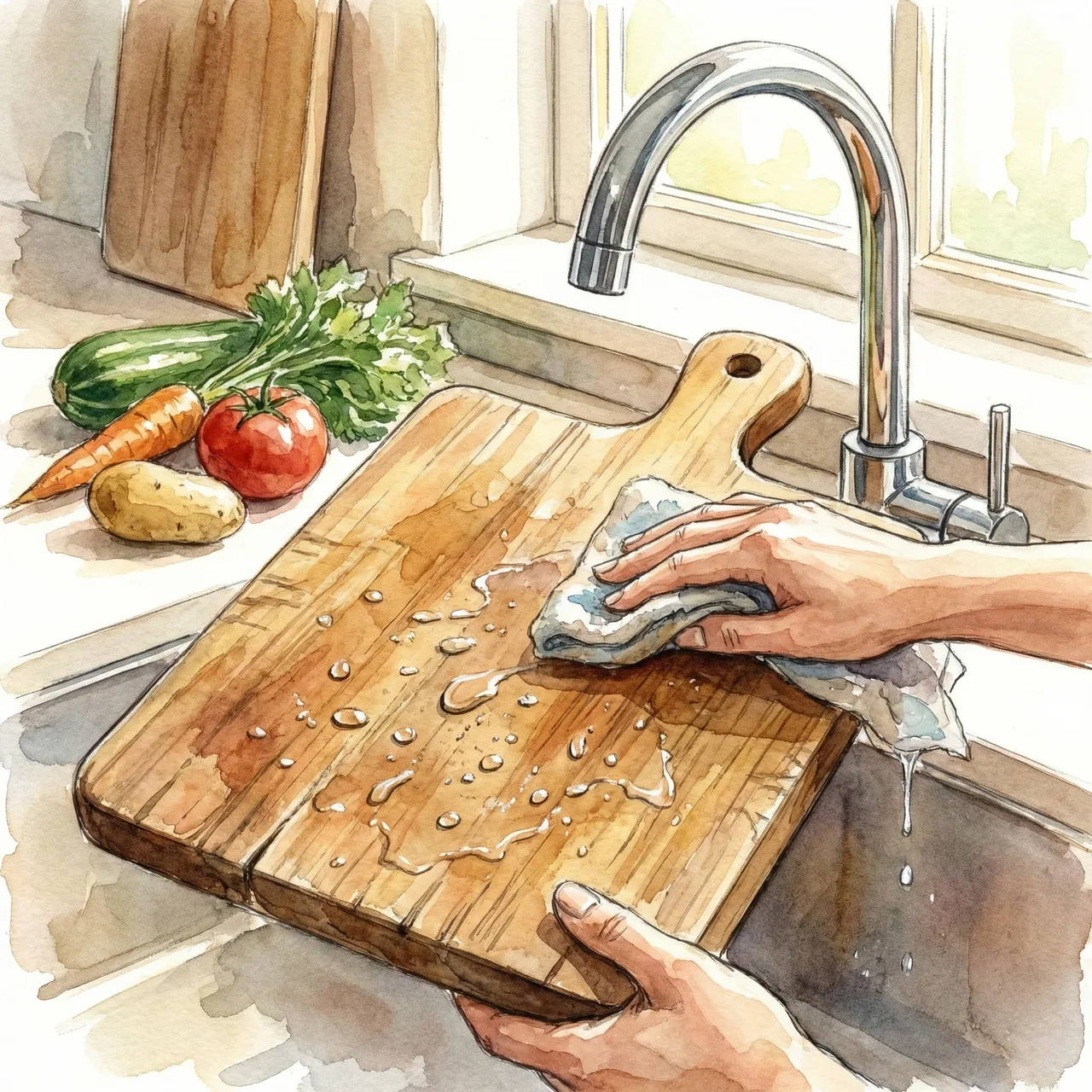
Wet the board before using to create a barrier
Never place meat or fish directly on a dry board — it will absorb juices instantly.
Before you start cutting, quickly wet both surfaces and wipe lightly with a cloth.
The thin water barrier prevents food odors and liquids from penetrating the grain.
Store standing upright with the grain running vertically
After use, scrub with a tawashi brush along the grain, then pour boiling water over both sides to sanitize.
The most important step is how you dry it.
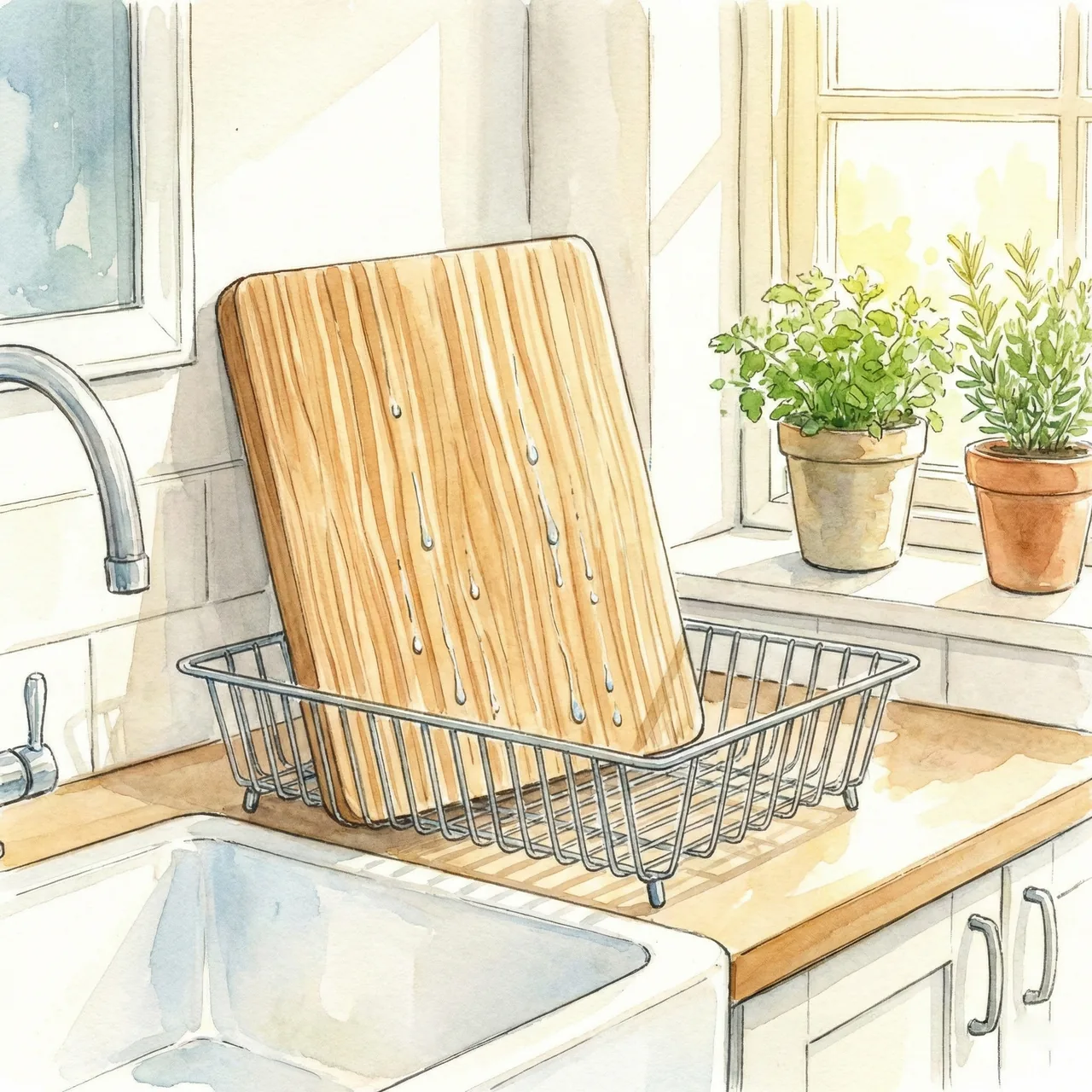
When placing the board in a drying rack, orient the wood grain vertically — perpendicular to the ground.
Water travels through wood via the vessel cells in the grain. A vertical orientation drains dramatically faster and cuts mold risk significantly.
7. Frequently Asked Questions
Can I put my wooden cutting board in the dishwasher or dryer?
Generally, no.
High heat and powerful detergents strip the wood's natural oils and cause rapid, uneven drying — leading to warping and cracking.
※ Exception: some boards are specifically labeled "dishwasher-safe" after special treatment.
How long does a wooden cutting board last?
With proper care, 10 years or more — potentially a lifetime.
As long as there's enough thickness remaining, it can be re-planed or re-sanded again and again.
Watching the board gradually slim down and lighten over the years is part of the pleasure of owning a quality wooden tool.
How should I sanitize after cutting meat or fish?
Hot water is the most effective method.
After washing with dish soap, pour a generous amount of boiling water over both surfaces.
Then stand the board upright to dry immediately — don't leave it lying flat.
Can I use perilla oil (egoma) or salad oil from my kitchen?
Perilla (egoma) oil: yes. Salad oil: no.
Perilla and linseed oil are drying oils — they cure on contact with air and form a protective film. Ideal for cutting board maintenance.
Salad oil and olive oil are non-drying oils — they stay tacky indefinitely and oxidize into an unpleasant odor.
Can I dry the board in direct sunlight to speed things up?
Never — it causes warping and cracking.
Direct sun creates rapid, uneven drying that puts severe stress on the wood structure.
Always dry in a shaded, well-ventilated spot, standing upright.
My board has lots of knife scratches. Should I do anything about them?
Address them before they deepen.
Knife scratches create crevices where bacteria and moisture accumulate. Shallow scratches can be resolved with fine-grit (#240) sandpaper alone.
Once the center has worn down enough that green onions "stay connected" after cutting, it's time for a full re-sand starting with coarse grit (#80–120).
Final Thoughts: With Care, a Wooden Cutting Board Lasts a Lifetime.
When a plastic cutting board is scratched and stained, it's a breeding ground for bacteria — throw it away.
But a wooden cutting board, even when scratched or blackened, can be planed back to new.
"Don't discard it when it's dirty — restore it."
That's the genuine richness of owning something made of wood.
This weekend, give your kitchen companion the attention it deserves.

Japanese Wooden Cutting Board Guide | Best Brands and How to Choose by Material and Size

Japanese Kitchen Knife Recommendations | Santoku, Gyuto, and Petty Knife Buying Guide