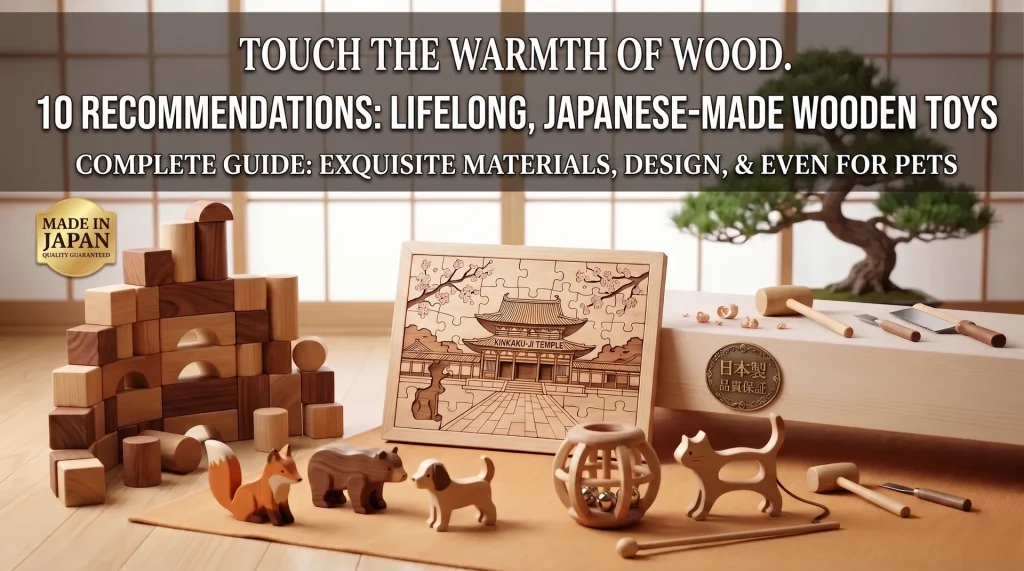
"She puts everything in her mouth, so I want a toy that's genuinely safe."
"Plastic toys seem to lose their appeal so quickly."
For a first birth gift or a child's first birthday, the colourful electronic toys are fun —
but the thing babies stay absorbed in longest is often a Japanese solid-wood toy.
Made from wood grown in Japanese forests, hand-sanded to round every edge, an untreated wooden
block is safe to put in the mouth. The gentle sound of wood against wood, and the beauty of
natural grain, stimulate a baby's senses in ways plastic can't. And because a wooden toy has no
single "correct" way to play, children create their own games as they grow — extending its useful
life from infancy through early school years.
This guide covers how to choose safe wooden toys and the Japanese brands worth knowing, led by
Oak Village's beloved animal blocks.
Quick Reference: Wooden Toy Finishes Compared
| Finish type | Characteristics & safety | Representative brands |
|---|---|---|
| Untreated (white wood) | Direct wood scent and warmth; completely safe to mouth; drool marks develop into character | Oak Village, Nakayoshi Library |
| Natural oil (linseed, beeswax) | Protected with food-safe natural compounds; resists soiling; grain stands out beautifully | Ed Inter (NIHON series) |
| Coloured paint (water-based) | Visually stimulating; uses food-hygiene-compliant paint meeting Japan's strict ST safety standards | Comomg, Heiwa Kogyo MOCCO |
1. Why Japanese Untreated Wooden Toys? The Difference from Plastic
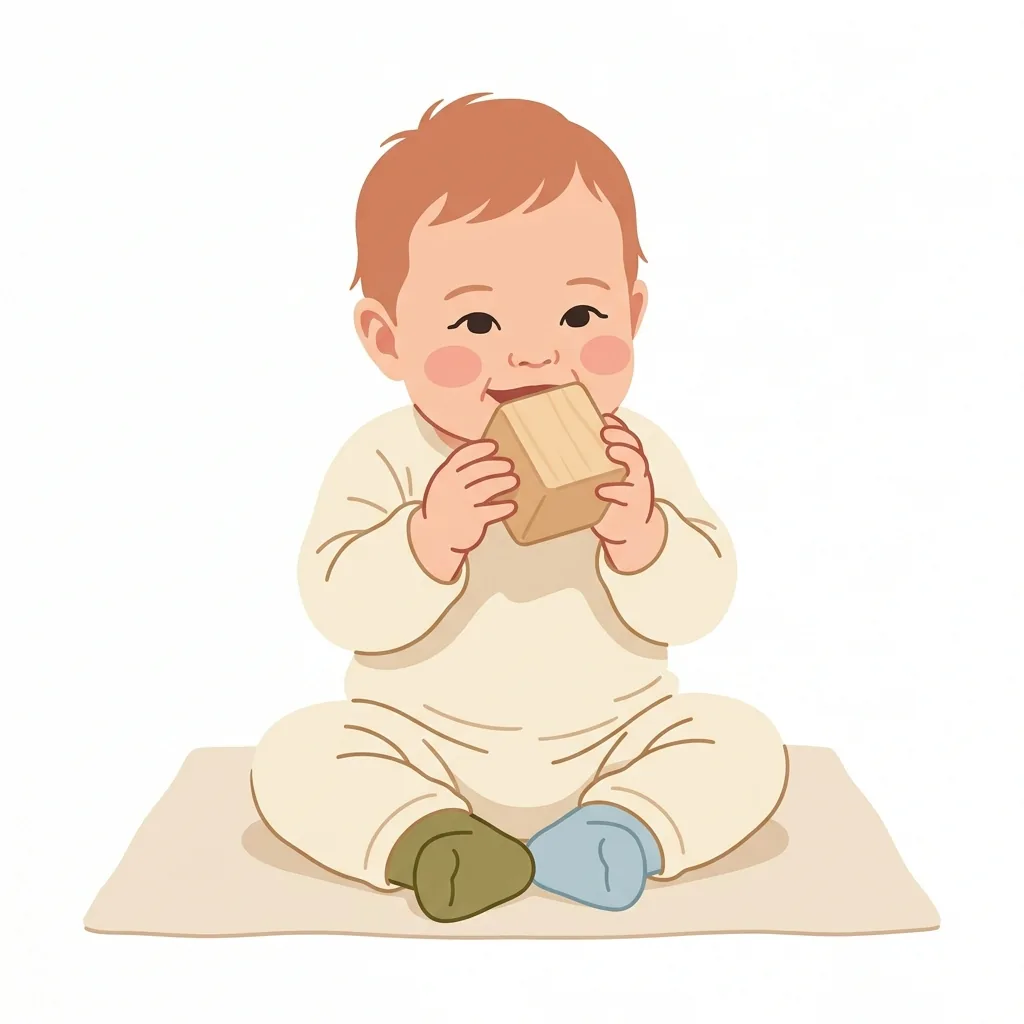
Babies "verify" the world using their hands and mouths. From around six months to eighteen months, they put everything they hold into their mouths to confirm what it is.
Mouthing is exactly why untreated domestic wood matters
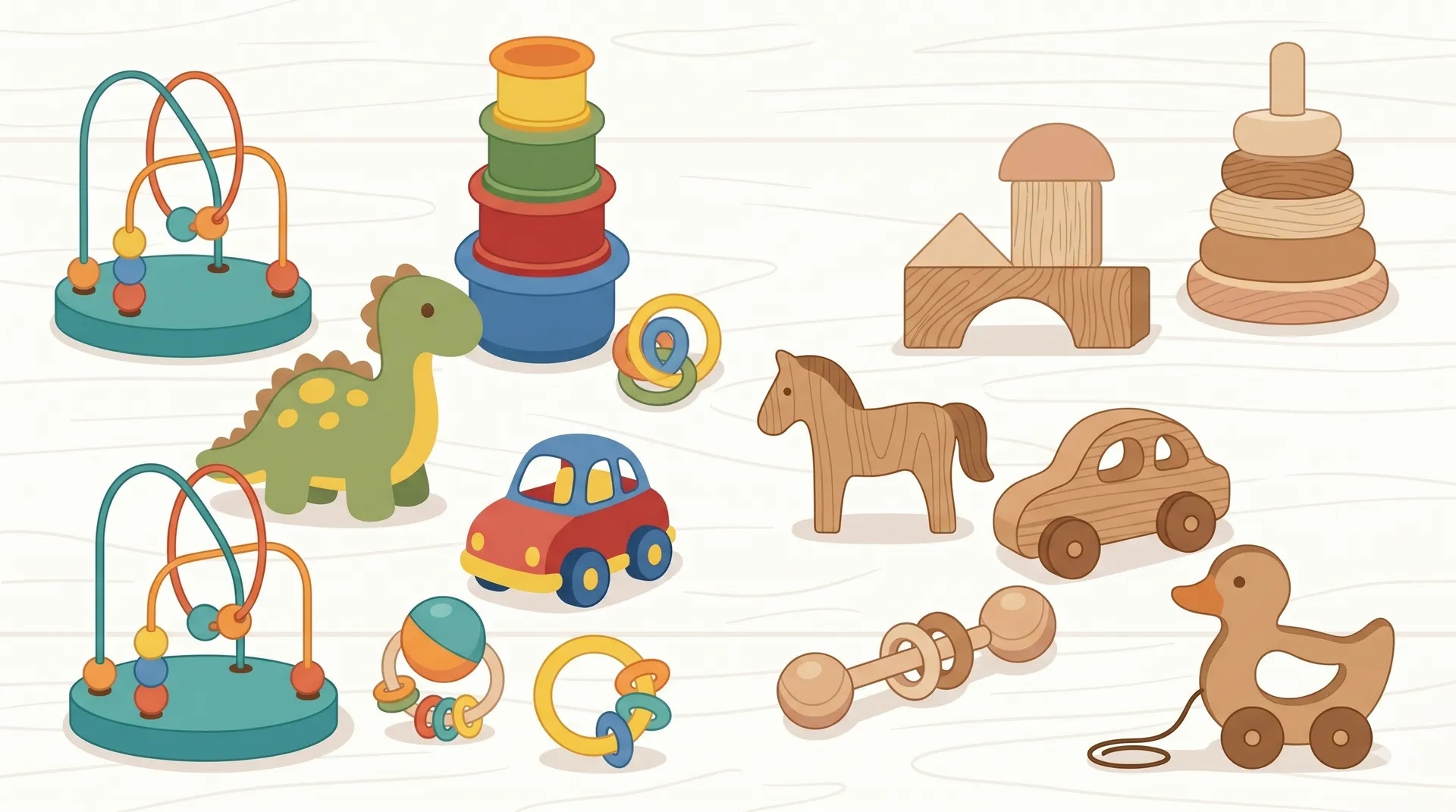
Plastic toys are light and washable, but many parents are uneasy about the synthetic chemicals
and colourants involved.
Japanese untreated wooden toys are carved directly from domestic beech, maple, or hinoki
cypress. Because no chemical paint is used at all, they're completely safe even when a baby
licks and chews them around the clock.
The "1/f fluctuation" hidden in the sound of wood
The clattering sound of plastic hitting plastic can over-stimulate a baby's nervous system. But the muffled "clack, kon" of wood against wood contains "1/f fluctuation" — the same soothing acoustic property found in a babbling brook or a human heartbeat. This is why babies playing with wooden toys often have such calm expressions.
2. Why Wooden Toys Are Praised as Birth & First-Birthday Gifts
If you're deciding on a birth gift, Japanese wooden blocks are a safe choice — and not only for safety reasons.
"Room for imagination" means lasting play
A toy that plays a sound when you press a button grabs a baby's interest intensely in the
moment. But because there's only one "correct" outcome — press = sound — they tend to lose
interest quickly.
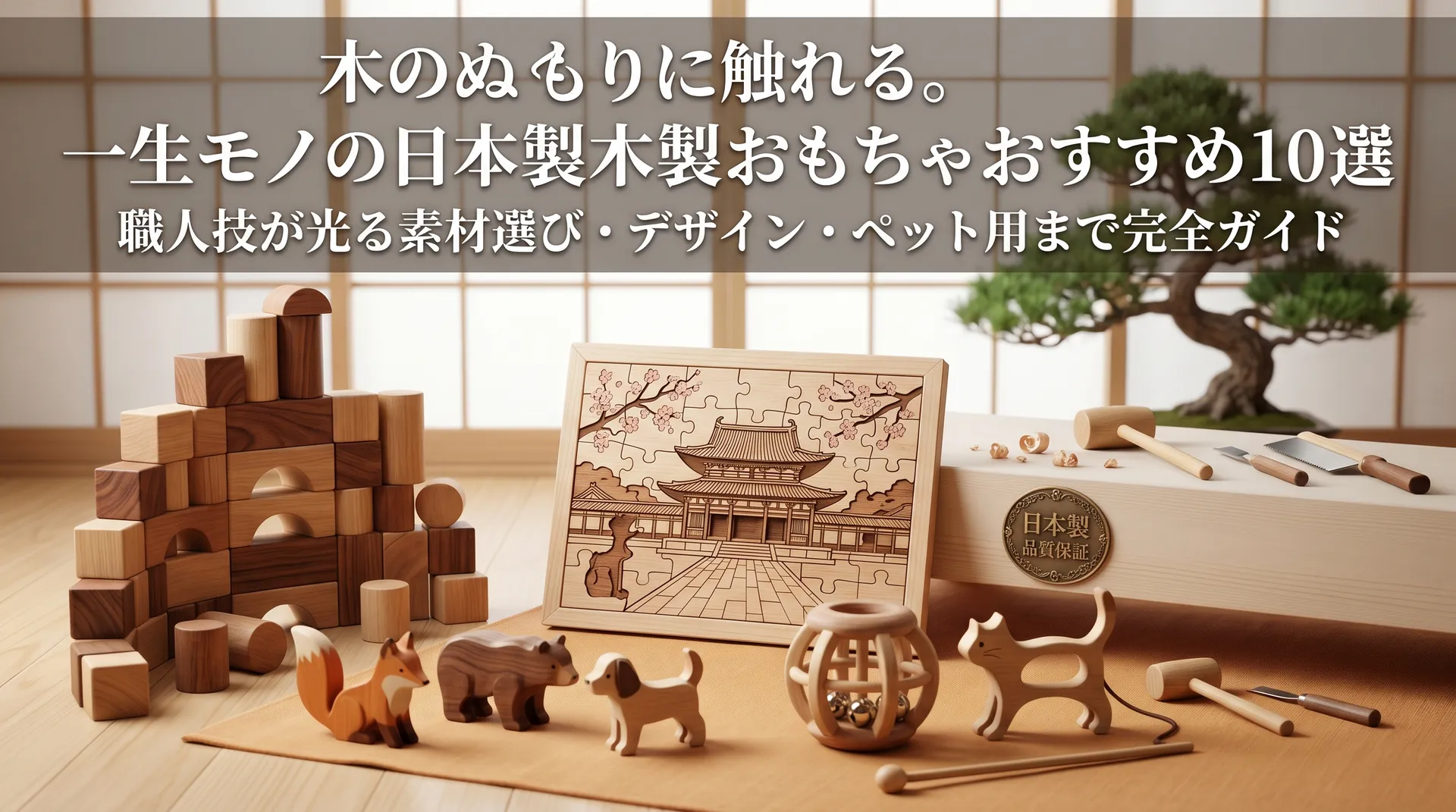
Wooden toys have no batteries and no fixed way to play. Stack them into a castle, tap them
as instruments, use them as pretend vegetables in a play-kitchen — the greatest strength is
that the child invents the play themselves, adapting it as they grow. That's
why they stay engaging from age 0 through the early school years.
3. How to Choose Safe Wooden Toys
Wooden toys range from cheap imports to Japanese artisan work. Three points to avoid regret:
1. Are the edges carefully chamfered?
A baby's skin is delicate. Cheap mass-produced blocks can have sharp corners or splintered cut edges that cause injury. Pieces from good Japanese workshops are all hand-chamfered (corners rounded by hand) and sanded smooth — as smooth as a baby's cheek.
2. Is it too big to swallow? (The 39mm rule)
The mouth of a child under three is about 39mm across. Toys with parts smaller than this pose a choking hazard. Most Japanese products are designed to safety standards (such as the ST mark) at sizes that can't pass through the throat — safe even if mouthed when you look away for a moment.
Japanese wood is dense and strong
The woods typically used for toys are beech and maple. Hardwoods grown in a country like Japan with sharp seasonal temperature swings have tightly packed growth rings — they're very hard and don't crack easily even when thrown. This is why so many heirloom wooden toys insist on domestic timber.
4. Mouth-Safe Picks: Blocks & First Toys
First, the safest options for a 0-and-up baby's first gift: Japanese-made blocks and teethers.
Oak Village — Forest Animal Blocks
The flagship of Oak Village, whose workshop is in Hida-Takayama, Gifu. Various Japanese forest woods — cherry, magnolia, chestnut, oak, white birch — are carved completely untreated and rounded. The remarkable part: each wood type has a different colour, weight, and scent. The animals (bear, fox, acorn) were designed by a picture-book artist and finished by hand by Hida-Takayama craftspeople. Playing with them, a child unconsciously learns the diversity of living things. There is no better birth gift. Available through international retailers.
- Material
- Five Japanese woods (cherry, magnolia, chestnut, oak, birch), untreated
- Origin
- Hida-Takayama, Gifu
- Best for
- First birth gift; multi-decade keepsake; sensory learning
Ed Inter — NIHON Series Building Blocks
The NIHON series follows the concept "Japanese wood, dyed with Japanese colours." It uses durable, scratch-resistant Itaya maple, coloured with mouth-safe paints. Traditional Japanese hues — kobai (plum pink), ruri (lapis blue), asagi (light blue) — gently develop a baby's sense of colour. The blocks come in a house-shaped wooden box, so tidying up itself becomes a puzzle game.
- Material
- Itaya maple, mouth-safe water-based paint, made in Japan
- Best for
- Colour development; traditional Japanese aesthetic; tidy-up play
Edute baby&kids — 3 Rings Rattle
A popular rattle from Edute, a Japanese brand specialising in infant educational toys. The three-stacked-ring silhouette is sized so even a 0-year-old with undeveloped fine motor skills can grip it firmly. Finished with mouth-safe materials and paint, it doubles as a teether. The pleasant rattle sound stimulates the senses, and it stays useful from the lying-down stage through the early grasping phase — a birth-gift staple.
- Material
- Wood, mouth-safe finish, made in Japan
- Best for
- 0-year-olds; rattle and teether in one; first-grip development
5. Picks for Walking Age: Push Toys & Play Kitchens
For after the first birthday, when dynamic play — "walk," "roll" — becomes possible, here are wooden toys with movement.
Heiwa Kogyo MOCCO — Forest Puzzle Bus
A perfect three-in-one design: a push-along walker to support a child starting to walk, a ride-on toy to straddle, and a shape-sorting puzzle on the sides. Made from untreated beech, with rubber-edged wheels that won't scratch floors. Substantial and durable — robust enough to survive vigorous play from an older sibling and be handed down to a younger one. A leading first-birthday gift choice.
- Material
- Untreated beech, rubber-edged wheels, made in Japan
- Best for
- First birthday; walking support; long-lasting hand-me-down
Comomg (こまむぐ) — Donguri Korokoro (Rolling Acorns)
A breakout hit from the Saitama wooden-toy workshop Comomg. Place the cute acorn-shaped toy on a sloped board and it tumbles down rocking back and forth in a wonderfully comical motion. Engaging from the crawling stage (visual stimulation of watching it move) through ages 2 and 3 (placing it on the slope themselves) — the whole family ends up smiling at its peculiar movement.
- Material
- Wood, made in Saitama, Japan
- Best for
- Crawling-stage visual play through age 3; family entertainment
Mokuyusha — White Wood Play Kitchen
From the Ehime Prefecture workshop Mokuyusha, an untreated natural pine play kitchen full of wood warmth. Its standout feature: remove the sink and stove, flip the body's shelf, and it converts into a child's desk — so after the play-kitchen stage, it continues as a desk for drawing and reading. The sink uses a genuine Noda Horo (enamelware) bowl; the tap and knobs actually turn. Untreated, so it can be sanded clean if soiled — a true lifetime domestic wooden toy.
- Material
- Untreated pine, Noda Horo enamel bowl, made in Ehime, Japan
- Best for
- Pretend play that converts to a desk; multi-year use; authentic detail
6. Play by Developmental Stage
Even a great wooden toy gathers dust if you don't know how to introduce it. Here's how to engage with the toy as the child grows.
0–6 months: "Licking and gripping" is the job
The stage of putting everything in the mouth. This is important experimental work — collecting data through the nerves of the lips and tongue about shape and hardness. Don't take it away with a "No!" — hand over an untreated block or teether and let them lick to their heart's content.
6 months–1 year: Learning the fun of "knocking down"
They can't yet stack well. At this stage, an adult builds a tall tower and the child enjoys knocking it down with a crash. The experience of causing objects to move and make a big sound connects to "the joy of producing a result."
1.5–2 years: Stacking, lining up, and pretend play begins
Fine motor skills develop and they can finally stack two or three pieces vertically. Pretend play also begins — holding a block like a phone and saying "hello," or running it like a car. Don't correct ("that's not a car") — going along with the child's worldview lets imagination bloom dramatically.
7. Frequently Asked Questions
Can I spray alcohol disinfectant on wooden toys?
Not recommended. Spraying alcohol directly strips the oils from the wood surface and can cause cracking or discolouration. For everyday care, wipe with a firmly wrung damp cloth, then dry thoroughly in a well-ventilated shaded spot away from direct sunlight. For heavier soiling, use a diluted additive-free soap solution to wipe clean.
My baby chewed a deep tooth mark into the toy.
That's proof of growth! Unlike plastic, wooden toys dent if dropped and scratch if chewed. But because solid wood is the same material all the way through, there's no coating to peel and reveal a different surface underneath. The chewed corners gradually rounding off, the colour turning amber from the oils of little hands — this patina is the joy of wooden products. Years later, that mark becomes a family time capsule: "you chewed on this so hard back then."
If I give blocks as a gift, will I overlap with what they have?
With quality blocks, overlap is welcomed. The more pieces you have, the more elaborate the constructions become (giant castles, long roads) — the level of expression jumps. Even if a friend has already bought one box, receiving additional pieces as a gift expands the scale of the child's play, so it's always appreciated.
I'm worried untreated wood will get mouldy or rot.
With proper drying, mould is rare. Much of the domestic timber chosen for Japanese toys has humidity-regulating properties suited to Japan's climate. The risk arises only if you leave a toy covered in drool in a poorly ventilated box for days. Wipe after play and store in a breathable spot like a basket.
Can untreated blocks be used as bath toys?
Please don't use them in the bath. When wood absorbs a large amount of water, it shrinks significantly as it dries, causing cracking or warping. Unless a toy is specifically processed and sold as a "bath toy" (special hinoki cypress, for example), keep it from being submerged.
The age says "1+" — is it okay to gift to a newborn?
Absolutely — it's actually the best timing for a birth gift. A newborn can't play immediately, but you can place it beside the crib and gently sound the wood, or use it for the very first "gripping practice." By the first birthday it will be an inseparable companion.
Final Thoughts: The First "Real" Texture Shapes Rich Sensibility
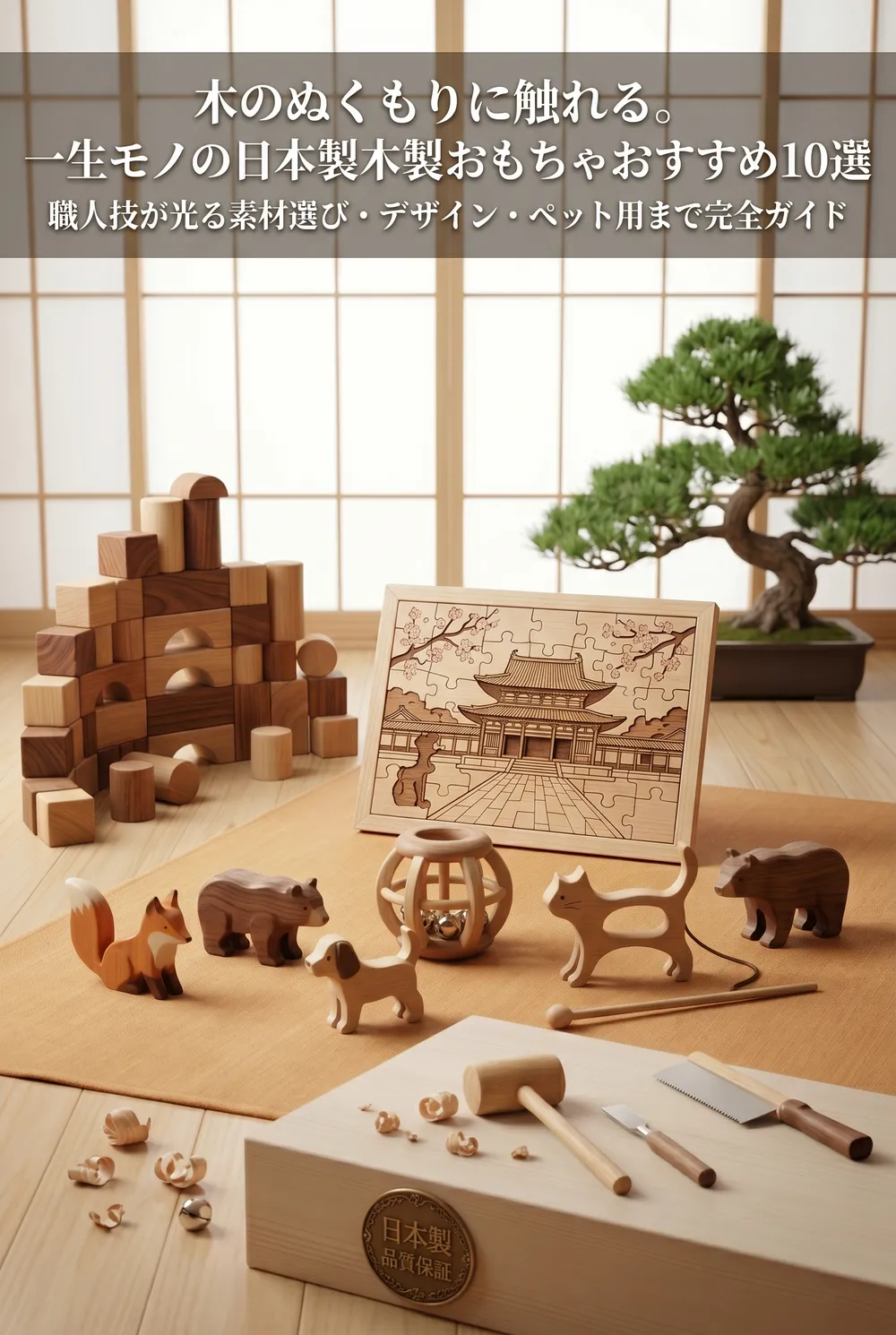
In an age overflowing with convenient digital devices and mass-produced plastic, the first
thing a newborn touches should — perhaps more than ever — be something "real" that carries
the warmth of nature.
Wooden toys grown in Japanese forests and carefully carved by Japanese craftspeople are
more than playthings. The texture of the wood grain, the gentle scent, the beautiful clacking
sound develop a child's senses and build a lifelong foundation of security.
For a birth gift or first birthday, consider a lifetime wooden toy — one passed from parent
to child, and on to the next generation.

Japanese Baby Clothes: 6 Brands for Newborn Wear & How to Choose
Japanese Baby Sleepers: Gauze & Cotton for Cozy Nights