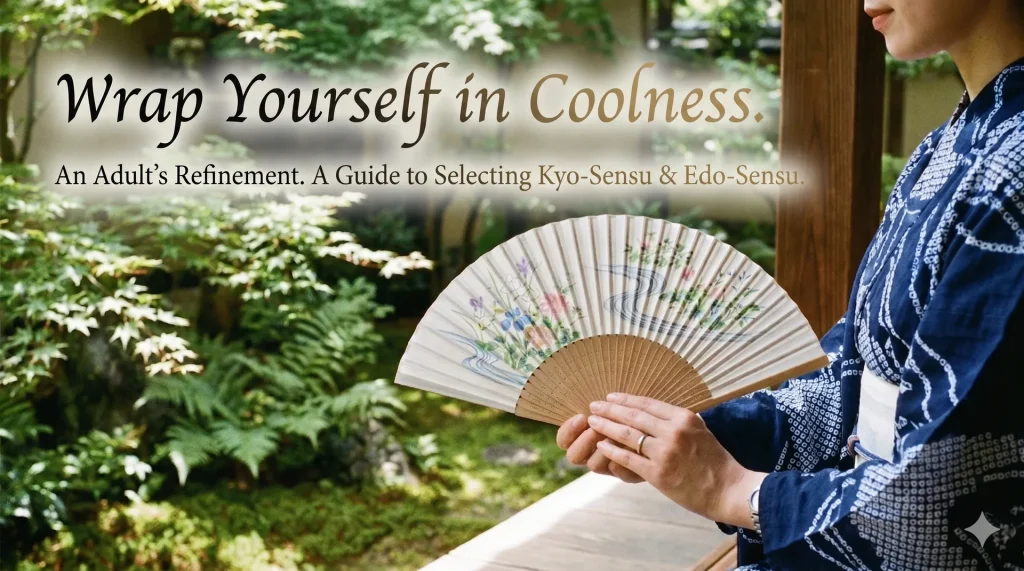
Japan's humid summer calls for something more than a portable electric fan. When you want to cool down with actual
style — one hand, one elegant motion — nothing compares to a sensu (折り扇), a Japanese folding
fan.
Slide it out of a bag, open it with a single thumb motion, and fan yourself quietly. The cool air arrives with a
kind of calm authority that a battery-powered gadget simply cannot replicate.
If you've been making do with a plastic souvenir fan or a cheap import, this year is a good time to try a genuine
Japanese-made folding
fan.
The difference is immediate. A well-made fan opens with a satisfying snap, feels balanced in the hand, and sends a
gentle, directional breeze with far less effort than you'd expect.
This guide covers the two great traditions — the refined Kyo-sensu of Kyoto and the bold Edo-sensu of Tokyo — and
two of the most respected makers in each tradition: Miyawaki Baisenan and Ibasen.
Series: This article is part 8 of the "Wearable Japanese Masterpieces" series.
1. The Art of Fanning — Slow and Quiet Is the Refined Way
A sensu is not just a cooling tool. How you use it reveals your character.
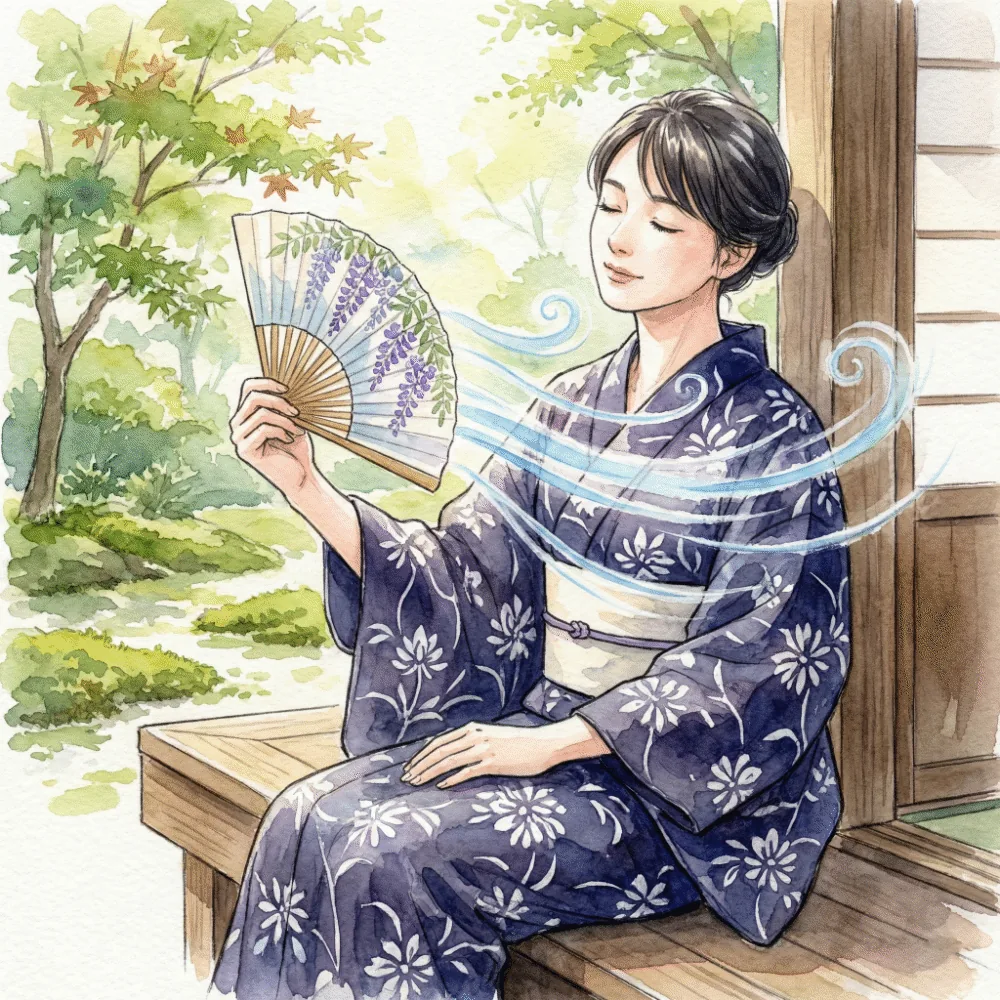
Fan toward yourself, not at others
Fanning frantically in public — especially on a crowded train — sends the air toward everyone around you, which
is considered thoughtless. The refined approach is to hold the fan close to your chest, direct it toward your
collarbone or neck, and move it slowly and steadily.
Good fans are engineered to generate a meaningful breeze from minimal movement. A quality fan doing slow, quiet
work will cool you more effectively than a cheap fan being waved furiously.
That restraint — doing more with less effort — is at the heart of what makes a sensu a mark of refinement.
2. Kyo-Sensu vs. Edo-Sensu — Elegance from Kyoto, Wit from Edo
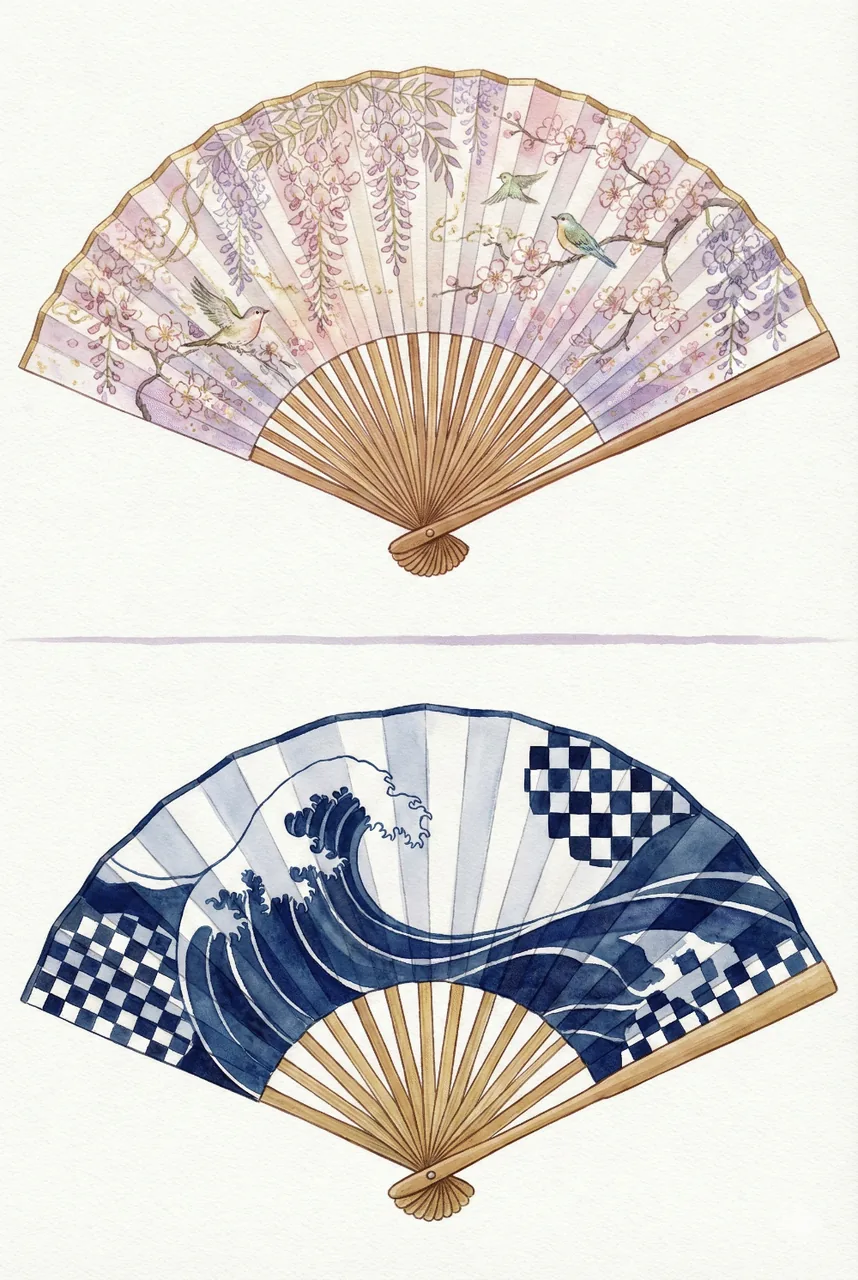
Japan's folding fan tradition divides into two distinct schools. Understanding the difference will help you choose the right fan for your personality.
Kyo-Sensu — refined by a division of labor stretching back 1,200 years
Folding fans were invented in Kyoto during the Heian period. Their production involves roughly 87 separate steps
carried out by dedicated specialists: one artisan splits the bamboo, another weaves the ribs, another applies
the paper, another paints the design.
This division of labor allows extraordinary refinement at each step. The result is a fan with many ribs (30+),
intricate design work, and a formal, aristocratic feel — appropriate for tea ceremony, traditional dance, or
gifting.
Kyo-sensu are predominantly for women and for formal occasions, though modern designs are increasingly
gender-neutral.
Edo-Sensu — made by one craftsman, bold and direct
The Edo-sensu tradition developed during Japan's Edo period as a practical, working person's fan — often made
entirely by one craftsman from start to finish.
Fewer ribs (15–18), thicker bones, strong construction, and bold graphic patterns define the style. The opening
snap is louder and more assertive — a confident sound that suits the Edo aesthetic of "iki" (stylish
simplicity).
Edo-sensu work well with everything from a summer suit to casual streetwear.
3. Paper vs. Fabric — The Crisp Snap or the Resilient Feel
Beyond the Kyo/Edo distinction, the face material affects how the fan feels, sounds, and ages.
Paper fans — the traditional sound and feel
Multiple layers of washi (Japanese handmade paper) are laminated together, giving the face enough stiffness to
produce the iconic crisp snap when opened. The air they move is focused and strong.
Paper fans lend themselves to detailed painted designs and work beautifully in formal settings. The drawback:
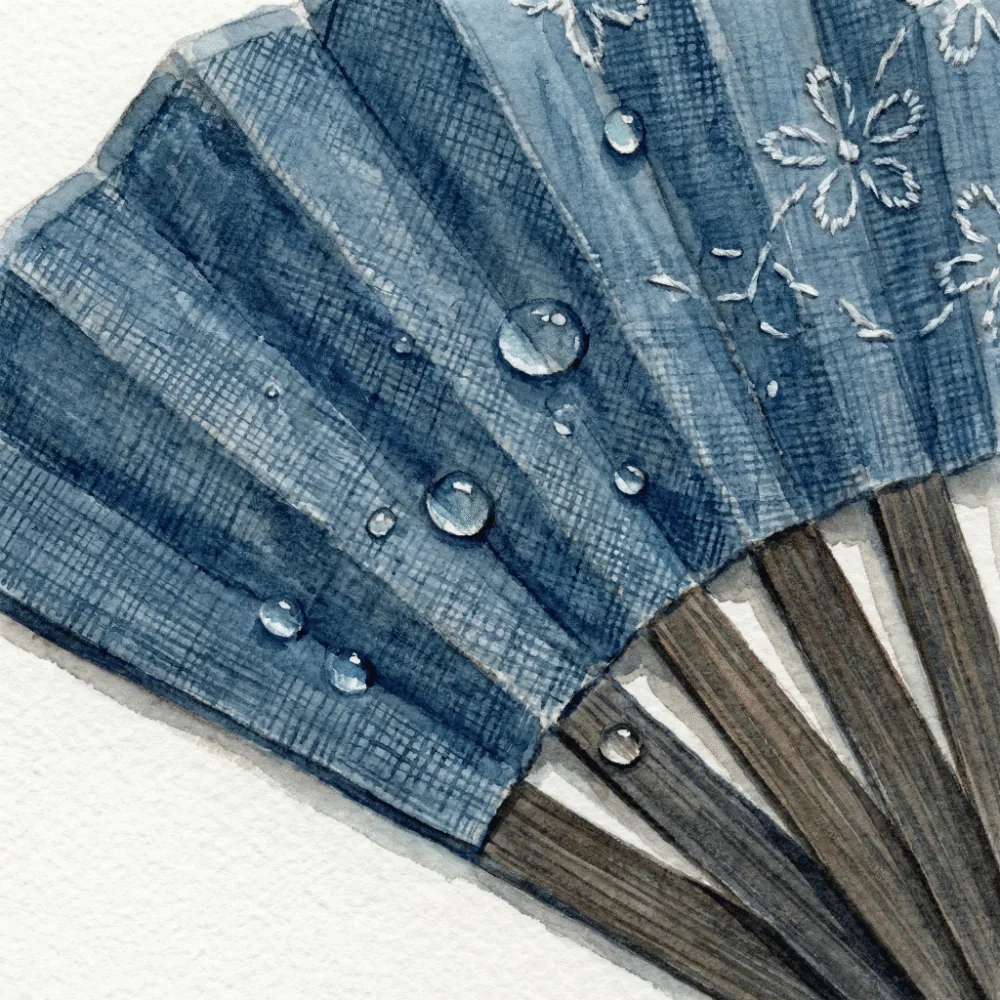
they're fragile when wet. Keep them out of rain.
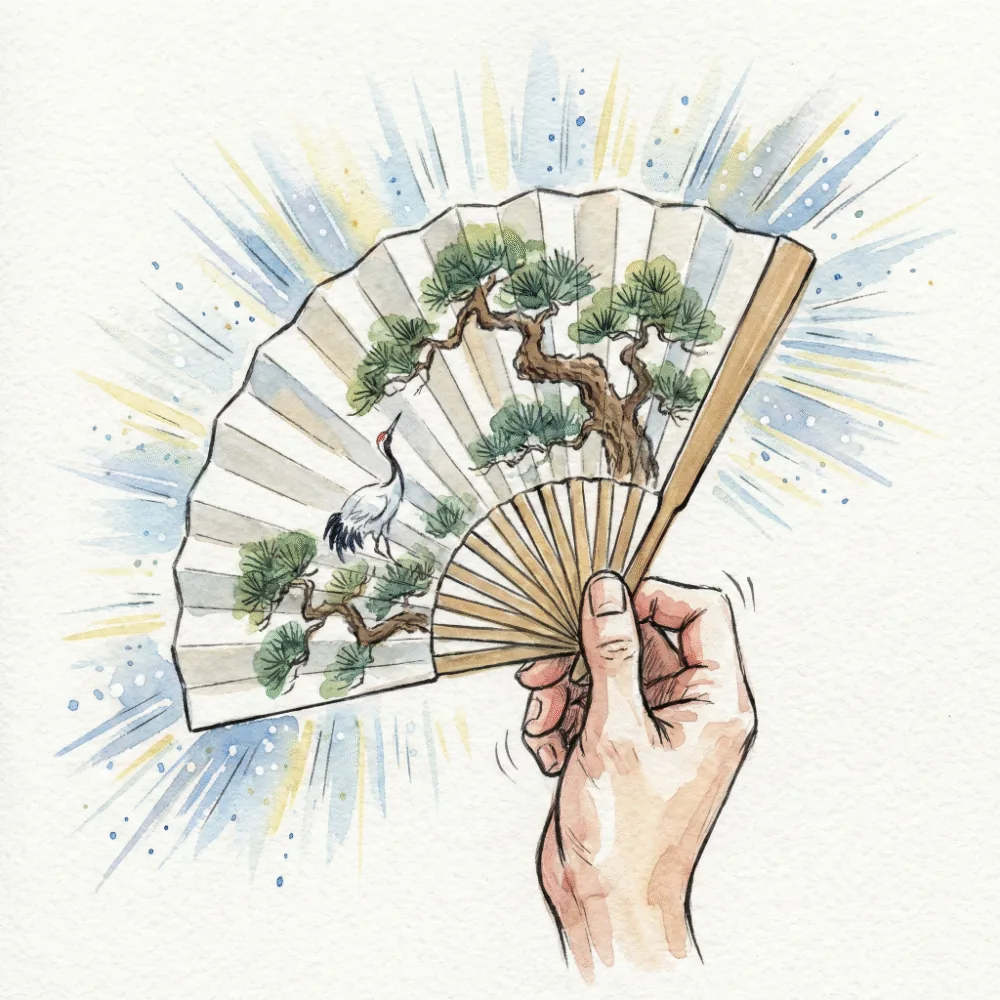
Fabric fans — everyday durability
Cotton, linen, or silk faces are more durable and handle moisture better than paper. They don't snap — they open
with a soft, quiet whisper — and the hand feel is gentler.
Embroidered or block-printed fabric fans have a tactile richness that plain paper can't match. For an everyday
bag fan you'll use without worrying, fabric is often the better choice.
Contemporary fabric designs — minimal, geometric, monochromatic — suit business settings as naturally as they do
a Sunday market.
4. Recommended Brand ①: Miyawaki Baisenan (Kyoto) — 200 Years of Tradition
Founded in 1823 (Bunsei 6). One of Kyoto's most important cultural institutions, and the defining standard for Kyo-sensu.
Miyawaki Baisenan (宮脇賣扇庵)
Every detail is art — from the pivot to the way it closes in your hand.
The main shop on Rokkaku-Tominokoji in central Kyoto is itself a historic landmark, its atmosphere a reminder
that Miyawaki Baisenan has been serving the Imperial court and Kyoto's artistic elite for two centuries.
What distinguishes a Miyawaki fan is its precision: the ribs align perfectly when closed, the open face forms
a perfect semicircle, and the bamboo handle is finished to a smoothness that feels almost magnetic in the
hand.
The range spans classical designs (seasonal flowers, cranes, waves) and contemporary graphic work, making it
equally appropriate as a personal purchase or a meaningful gift.
Left-handed fans are available by request — a thoughtful detail most makers overlook.
Miyawaki Baisenan Kyo-Sensu
A traditional Kyoto folding fan from one of Japan's oldest fan makers. Multiple classic and contemporary designs available — browse the full collection on the official site.
Visit Official Site5. Recommended Brand ②: Ibasen (Tokyo) — Heir to Edo's Wit
Founded in 1590 (Tensho 18) — the same year Tokugawa Ieyasu entered Edo. One of Tokyo's oldest surviving businesses, and the definitive voice of the Edo-sensu tradition.
Ibasen (伊場仙)
Ukiyo-e on bamboo — carrying four centuries of Edo style in your breast pocket.
Ibasen began as a paper and bamboo merchant for the Tokugawa shogunate, and later became famous for turning
the woodblock prints of Utagawa Hiroshige and Kuniyoshi into fans and round fans (uchiwa) that swept
through Edo society like a cultural fever.
Today's lineup preserves that bold graphic sensibility: thick ribs, confident construction, and designs drawn
from ukiyo-e prints and Edo komon (geometric textile patterns).
The result is a fan that works just as well with a summer kimono as with tailored trousers and a linen shirt.
The Edo-sensu aesthetic is, at its core, effortlessly modern.
Ibasen Edo-Sensu Folding Fan
A traditional Edo-style folding fan from Japan's oldest fan merchant. Bold ukiyo-e and geometric designs on thick, sturdy ribs. Browse the full collection on the official English store.
Visit Official Site6. Making Your Fan Last — The Pivot Pin and the Closing Band
A quality fan is delicate. The right habits will keep it beautiful for years.
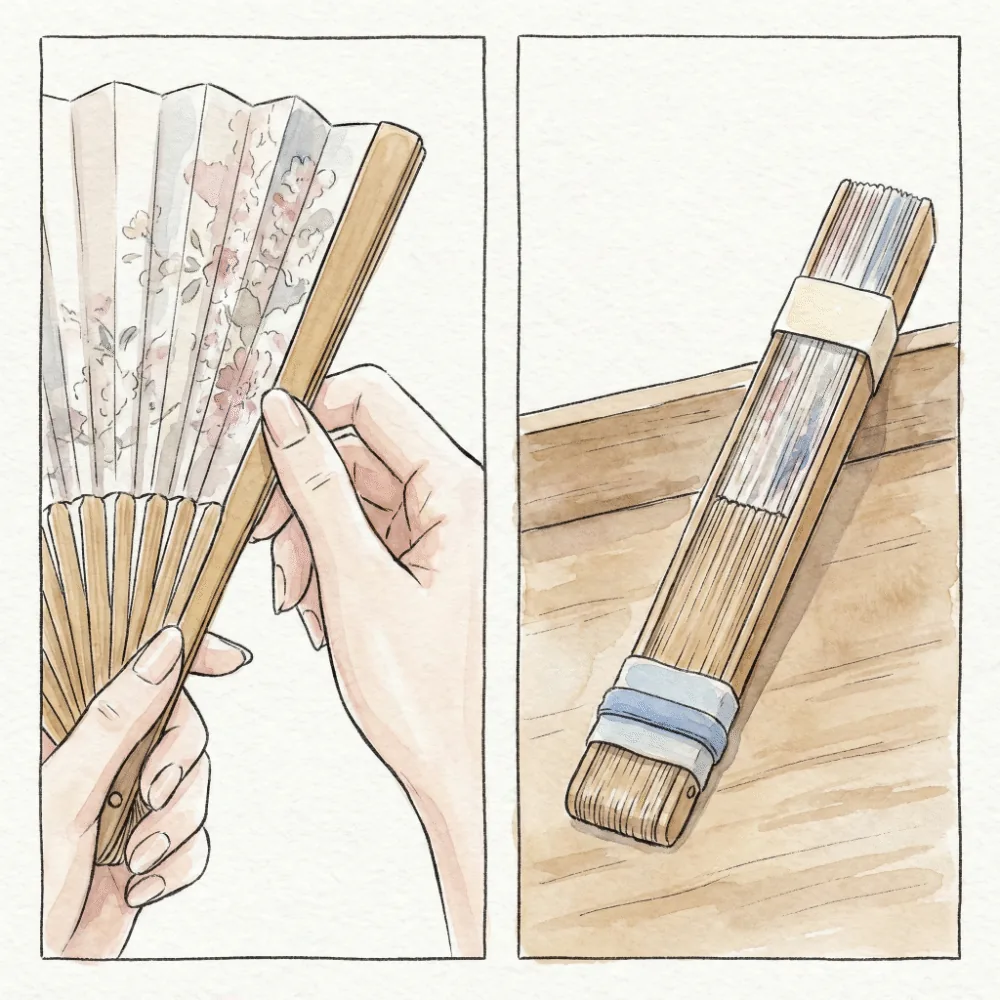
Open from the outer ribs, never flick it open
The pivot pin (kaname) at the base is the heart of the fan — all stress passes through it. To protect
it, open the fan by pressing your thumb against one of the outer ribs (the thick ones) and sliding them apart
slowly. Never flick the fan open with a wrist snap; the sudden tension will loosen the pivot over time.
Closing is equally important: fold the ribs back one by one deliberately, rather than collapsing them all at
once.
Store closed with the paper band or a soft elastic
Fans left loose gradually fall slightly open, which strains the ribs and deforms the shape.
The simplest solution is the closing band (shimegami) that comes with new fans — or a soft hair tie
around the tip when storing. This keeps everything aligned.
Avoid extreme humidity (causes mold on paper fans) and extreme dryness (causes warping). A paulownia wood box,
if you have one, is ideal for long-term storage.
7. Frequently Asked Questions
Are left-handed fans available?
Yes — and they're worth seeking out if you're left-handed.
Standard fans are designed for right-handed opening; using one in your left hand requires an awkward grip
reversal.
Miyawaki Baisenan produces left-handed fans, though the selection is more limited than their standard range. It's
always worth asking any maker directly.
Can a damaged fan be repaired?
A loose pivot pin can often be tightened, and paper faces can sometimes be re-mounted.
High-quality fans — particularly Kyo-sensu from Miyawaki Baisenan — are designed to be repairable, since they're
produced through a division of skilled specialists who can undo and redo their own work.
Broken ribs are harder to repair and may not be possible, but it's always worth contacting the shop before
discarding a beloved fan.
What's the difference between men's and women's fans?
Primarily size — and to some extent, design.
Men's fans are typically 7.5 sun (about 22.5 cm), women's fans 6.5 sun (about 19.5 cm). Men's designs trend toward
bold, restrained patterns; women's toward fine, colorful work — but contemporary unisex designs are increasingly
the norm. Choose by hand size and what you'll actually reach for.
Why does my fan have a pleasant fragrance?
Premium Kyo-sensu are often scented with aromatic woods like aloeswood or sandalwood.
The scenting is applied during production — either as an infused incense into the paper, or as a small piece of
fragrant wood embedded in the ribs. Each time you fan yourself, a faint warmth carries the scent toward you.
This fragrance fades over years of use, which is considered part of the fan's life, not a flaw.
How long will a quality fan last?
With care, a lifetime. Without, sometimes a single season.
The biggest killers are rough opening technique (stresses the pivot), leaving it loose and open in storage (bends
the ribs), and water damage on paper fans. Follow the care guidelines above and a Miyawaki or Ibasen fan can
become a true heirloom.
Final Thoughts: One Fan in Your Bag All Summer
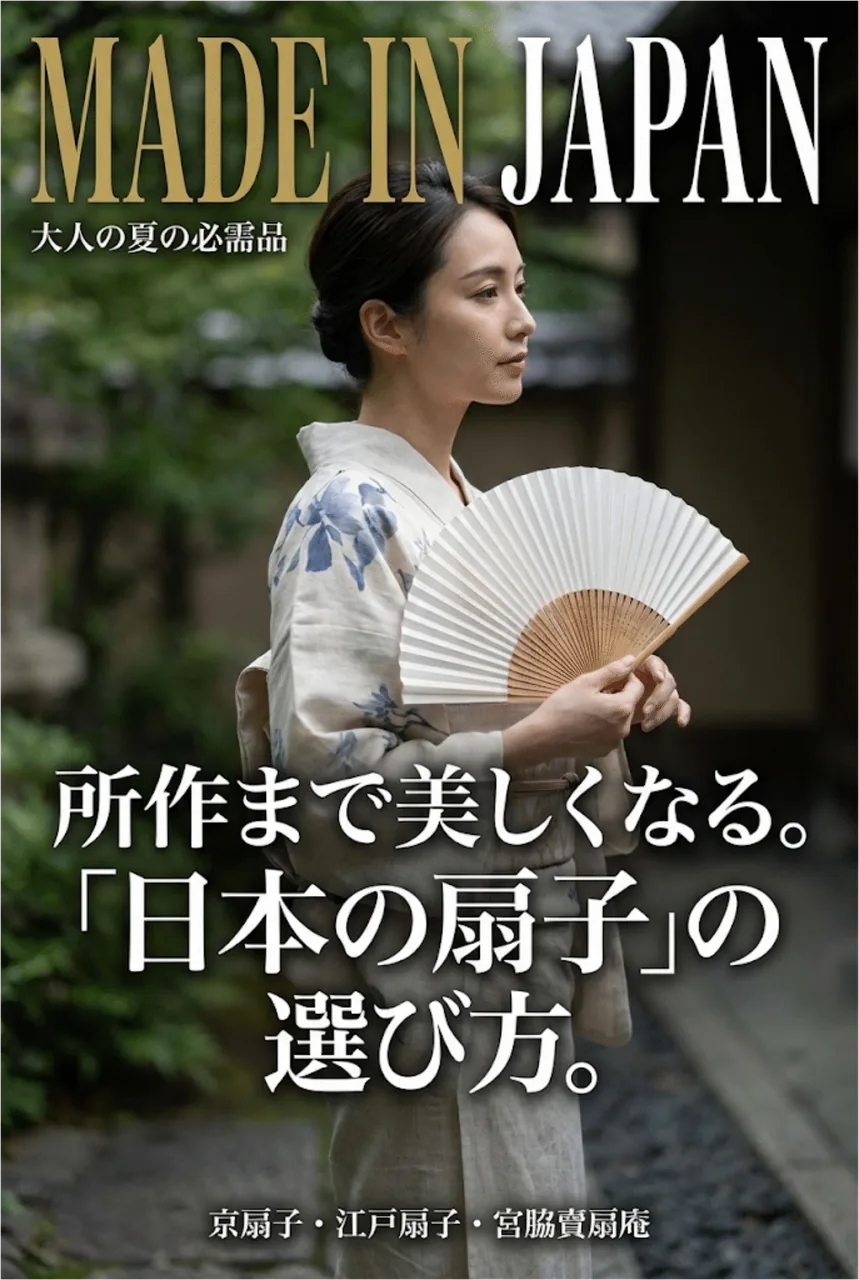
A sensu is a piece of Japanese summer distilled into an object small enough to fit in a shirt pocket.
The moment you reach for it in a warm restaurant, or open it silently on a crowded platform, you carry something
quietly different from the people around you — an object with a history measured in centuries, built by
craftsmen who understood that the way something feels in the hand is as important as what it does.
This summer, find your fan. It will last far longer than the season.