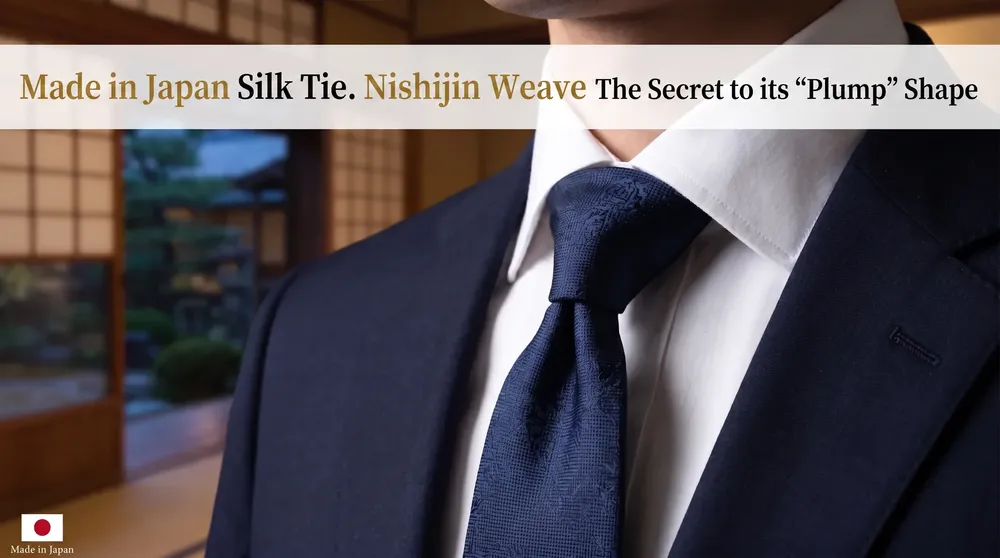
In 2008, a textile company in northern Kyoto got rid of every power loom it owned.
Then it went looking for hand looms that had been sitting unused for about forty years, bought
them, and rebuilt them to its own specification.
Two years later it launched a tie brand. Today those ties are sold by Huntsman on
Savile Row — a tailor with multiple Royal Warrants — and the ones made for Huntsman carry
Huntsman's own serial number in the lining.
That is the short answer to why a Japanese silk tie is worth considering in a
market where the conversation is normally Italian or English. Before any of it matters,
though, there is a measurement to check.
Quick Reference: Before You Order
| Check | What you want |
|---|---|
| Length | 146 cm or more. 140 cm is a domestic cut |
| Blade width | 8.0–8.5 cm, matched to your lapel |
| Woven or printed | Woven. That is the entire point |
| Knot to tie it with | Four-in-hand if hand-woven — it is already thick |
| Cleaning | Never a standard press. It flattens it |
| The one number that matters: if the listing does not state a length, ask. A 140 cm tie on a 185 cm man does not reach the belt, and no knot fixes it. | |
Check the Length First
Ties are not made to one international standard, and Japan's is shorter than yours.
| Made for | Typical length | Suits |
|---|---|---|
| Japan (domestic) | About 140 cm | Up to roughly 175 cm tall |
| UK / Italy | 146–148 cm | Most adult men |
| US | 138 cm to over 150 cm | Varies by maker — check |
The gap sounds small and is not. A Windsor or double knot eats several centimetres more than a four-in-hand, so a 140 cm tie that just works on a 175 cm man in a simple knot stops well short of the belt on a taller one in a fuller knot.
Why 140 cm? Because of how silk is cut
Tie fabric is cut on the bias, at 45° across the cloth — that is what lets a tie
hang straight and recover its shape. Cutting at that angle, 140 cm is the length
that wastes the least silk, so it became the domestic default and stayed.
It is a cutting-room decision, not a design one, which is why it has nothing to
do with quality and everything to do with whether the tie will fit you.
The good news is that the makers who export have already fixed this. KUSKA's
ties measure 146 cm — the British and Italian standard — so the problem is
not "Japanese ties" as a category.
It is specifically ties bought from the domestic market: department-store
brands, secondhand finds, anything shipped by a proxy service.
Look for a stated length, and treat its absence as a warning.
Why Japanese — The Mill That Went Backwards
Tango, on the northern coast of Kyoto prefecture, has been weaving for around 1,300 years, and today it produces something like 70% of all the silk cloth used for kimono in Japan. Its speciality is chirimen, a silk crepe with a fine crinkled surface.
KUSKA is a brand launched there in 2010, out of a weaving business with three centuries behind it. The founding decision is the interesting part, and it ran in the direction nobody runs in: in 2008 the company disposed of its mechanical looms entirely and sourced hand looms that had been out of service for about forty years.
Textile companies do not usually give up their machines. Machine weaving is
faster by orders of magnitude and produces perfectly consistent cloth, which is what almost every
customer wants.
The company's own explanation is about rhythm — machine weaving keeps the same
beat throughout, hand weaving follows the weaver's. The result is cloth that is not
uniform, and that turns out to be the useful property.
And then Savile Row bought it
Huntsman on Savile Row stocks KUSKA, and the pieces made for them carry a Huntsman serial number in the lining. They are also carried by a well-known tie house in Florence, and sell in five countries.
That matters because the authorities in ties are Naples and London, and neither has any reason to be sentimental about a Japanese weaver. A Savile Row house putting its own serial number in something is a harder endorsement than anything a guide can write.
What Hand-Weaving Does to a Knot
A power loom drives the weft home with the same force every pass. That produces dense, flat, even cloth — excellent for a printed pattern and for consistency, and it packs the air out.
A hand loom beats more lightly and less evenly, so the cloth ends up looser and thicker for the same weight of silk. The maker's own description is a three-dimensional textile, loosely woven, with air inside it.
In a tie, that loft is the whole game. A knot in lofted silk holds its shape and springs back instead of compressing flat, and the dimple below it stands up on its own rather than needing to be coaxed.

Which means: tie a smaller knot
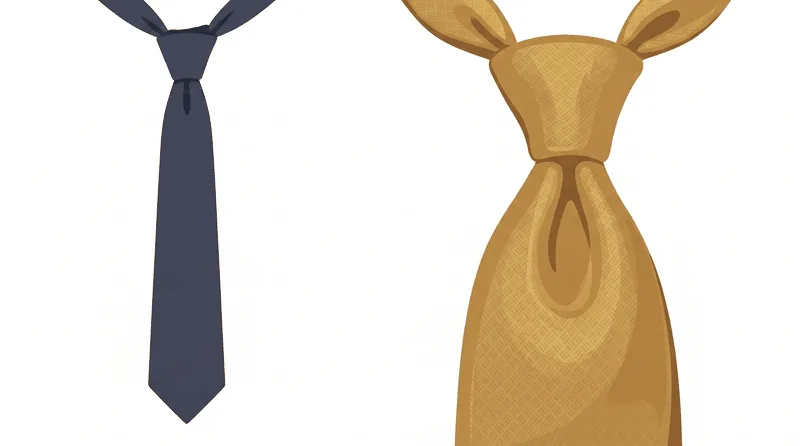
The instinct with an expensive tie is to tie a big knot, and with these that is wrong. The silk is already thick, so a Windsor produces something the size of a fist.
A four-in-hand is the right knot for a hand-woven tie — slightly asymmetric, compact, and it lets the fabric's own body do the work. A half-Windsor is as far as you should go, and only with a spread collar.
For the dimple: press a finger into the fabric directly under the knot as you draw it up, and let a single fold form. Lofted silk holds it all day.
What to Buy
KUSKA hand-woven tie — the one this article is about
Hand-woven and hand-stitched, 100% silk, from Tango. The dimensions are
already correct for a Western wearer, which is not something you can assume of a Japanese
tie.
Start with a solid or a small repeating pattern rather than a bold one —
the reason to own this tie is the texture and the way it takes light, and a busy design
fights it.
- Length
- 146 cm — international standard
- Blade width
- 8.0 cm
- Material
- 100% silk, hand-woven and hand-stitched
- Made
- Tango, Kyoto
- Price
- About $240
Perfect for: Someone who already owns good Italian ties and wants something they have not seen.
BECOS ships from Japan — $25 to North America, free over $250, typically 6–12 working days.
Or see one in London first
If you are anywhere near Savile Row, handle one before ordering. The
difference between hand-woven and good machine-woven silk is entirely tactile, and no
photograph conveys it — which is a problem when the tie costs $240.
Huntsman's own version carries their serial number, so it is also the one
case where buying locally gets you something the Japanese shops do not have.
The other Kyoto silk: Nishijin
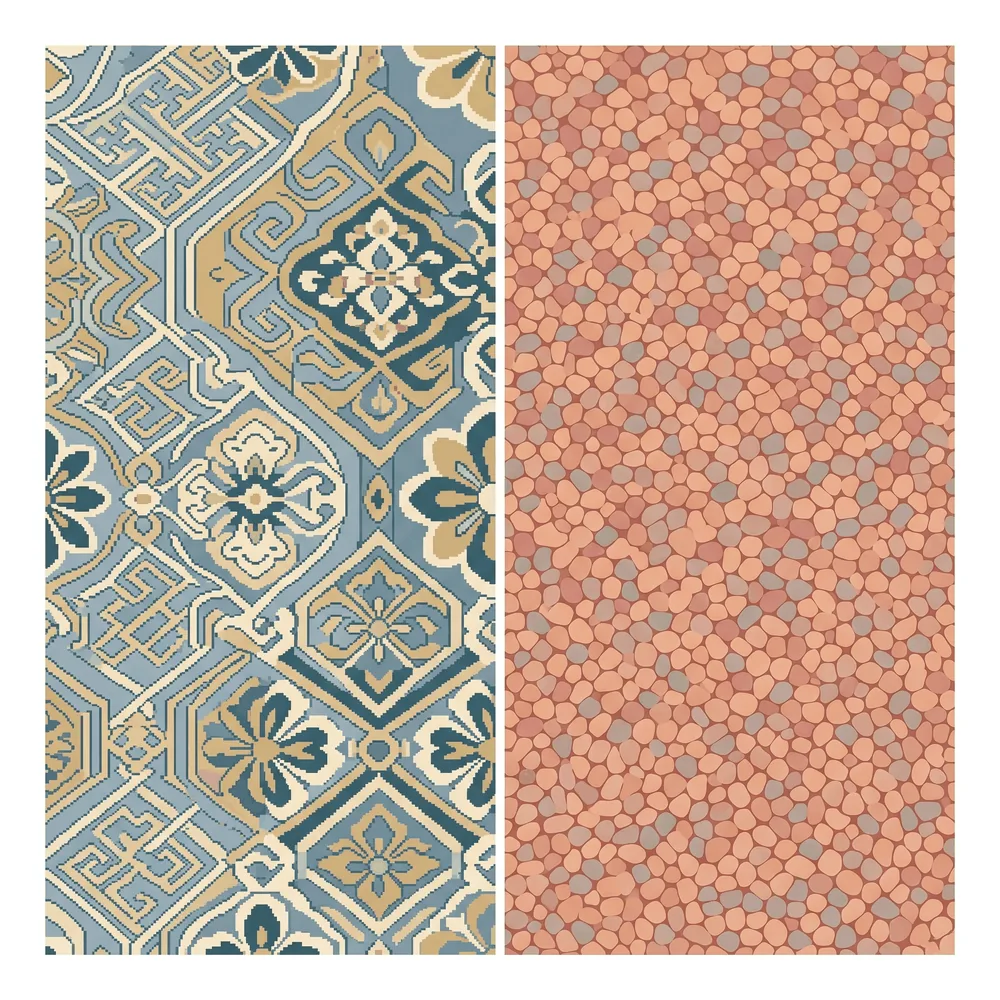
Nishijin-ori is the brocade weaving of Kyoto city — the cloth of formal
kimono and temple hangings — and several Tokyo and Kyoto tie makers use it. It is machine-woven
on jacquard looms, but at a density and complexity that has no real Western equivalent.
It gives you pattern rather than loft: intricate woven designs that shift colour
as they catch light. Different pleasure, different tie. Most of these makers
sell domestically only, so this one usually means buying in Japan.
The Way to Ruin One
Send it to an ordinary dry cleaner and it comes back flat. A commercial press
crushes the loft out of the fabric and the rolled edges, and the tie returns looking like a much
cheaper tie.
This article is entirely about that loft, so this is not a minor risk — it is
the specific accident that destroys the thing you paid for. If a tie must be cleaned,
use a specialist and say explicitly that it must not be pressed flat.
- Untie it in reverse, never by pulling the blade through. Yanking it stretches the slip stitch and the interlining, and that is what makes a tie start to twist.
- Rest it two days between wearings. Silk needs time to release the moisture it picked up and let the creases fall out on their own.
- Lay it flat or roll it loosely from the narrow end for a few hours before it goes back on a hanger. Hanging it straight after wearing sets the creases in.
- Never wash it at home. Silk shrinks in water and loses its lustre, and a tie's bias cut means it will not go back to straight.
- If you must iron: a pressing cloth, low heat, and hold the iron off the fabric so only steam reaches it. Direct contact kills the sheen and flattens the edges permanently.
Frequently Asked Questions
Will a Japanese tie be too short for me?
It depends entirely on whether it was made for export. The domestic standard is
about 140 cm; the British and Italian standard is 146–148 cm.
Check the stated length and want 146 cm or more if you are over about 178 cm or
tie anything fuller than a four-in-hand. If no length is given, ask before buying.
Is hand-woven actually better, or is it just a story?
It produces measurably different cloth — looser, thicker and less uniform,
because a hand loom beats the weft in more lightly than a machine does.
Whether that is "better" depends on what you want. For a knot that holds its
shape and a dimple that stands by itself, it genuinely helps. For a crisp printed pattern, a
machine-woven tie is the better tool.
What knot should I use?
A four-in-hand. Hand-woven silk is thick to begin with, so a Windsor produces an
enormous knot that swamps most collars.
A half-Windsor works with a genuine spread collar and that is the upper limit.
Bigger is not dressier.
Can I wear a Japanese regimental stripe in the UK?
A Japanese striped tie is a pattern, not a claim. It is not the tie of a
regiment, club or school, and it is not woven to any of their specifications.
If you would rather avoid the question entirely, a solid or a small repeating
motif shows off woven texture better anyway — which is the reason to buy this kind of tie.
What blade width should I choose?
Match your suit's lapel — for most business suits that means 8.0 to 8.5 cm, which
is also where Japanese makers sit by default.
Narrow ties under 7 cm read as casual, and anything past 9 cm is a deliberately
classic look that needs a wide lapel to balance it.
Is silk really worth it over a blend?
For knotting, yes. Polyester blends are cheap and stain-resistant but slippery,
so the knot works loose through the day.
Wool blends are a genuine alternative in winter — matte instead of lustrous, and
they hold a knot well. It is silk's shine you would be giving up, not its performance.
Final Thoughts: Slower on Purpose
Almost every improvement in textiles for two hundred years has been about weaving faster and more evenly. KUSKA looked at that and decided the unevenness was the part worth having, then bought back the machines everyone else had thrown away.
You can feel the result in about two seconds, which is why Savile Row put its own serial number in it.
Check the length, tie a four-in-hand, and keep it away from a commercial press. Those three cover everything that can actually go wrong.
Japanese Dress Shoes: Wide Fittings and How to Buy
Tochigi Leather Belts: The Tannery, Not the Brand