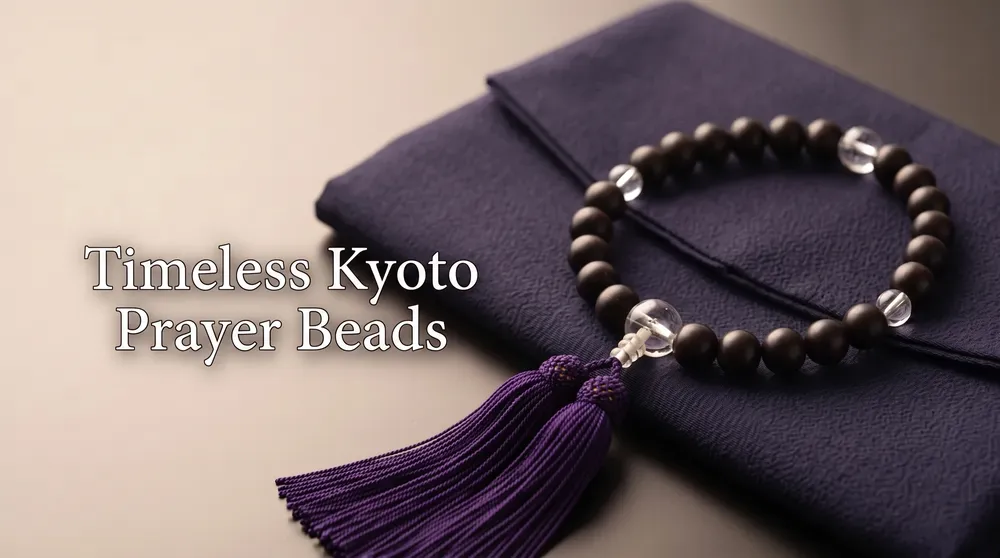
If you already own a mala, you may assume a Japanese juzu is the same thing with a
different name. They share an ancestor — the Indian japamala — and then they
diverged.
A mala is worked in one hand, thumb advancing one bead per recitation. A juzu is
most often looped across both hands and rubbed together during gasshō,
and frequently not counted at all.
The other difference is that a juzu is an object you take to a funeral. That
changes what you should buy, and it is the one thing worth getting right before anything about
materials or price.
Quick Reference: Which Juzu to Buy
| Your situation | Buy |
|---|---|
| You do not belong to a Buddhist sect | Ryakushiki — the single loop |
| Attending a funeral in Japan | Ryakushiki. Correct at any sect's service |
| You practise with a named school | Honshiki — but that school's form |
| You want it for meditation | Either — but know what it is |
| Buying it as a gift | Ryakushiki. Not rude — see below |
| If you take one thing from this page: unless you belong to a specific school, the single-loop ryakushiki is the right answer. Carrying another school's formal beads is less correct, not more. | |
Ryakushiki or Honshiki — the Only Decision That Matters
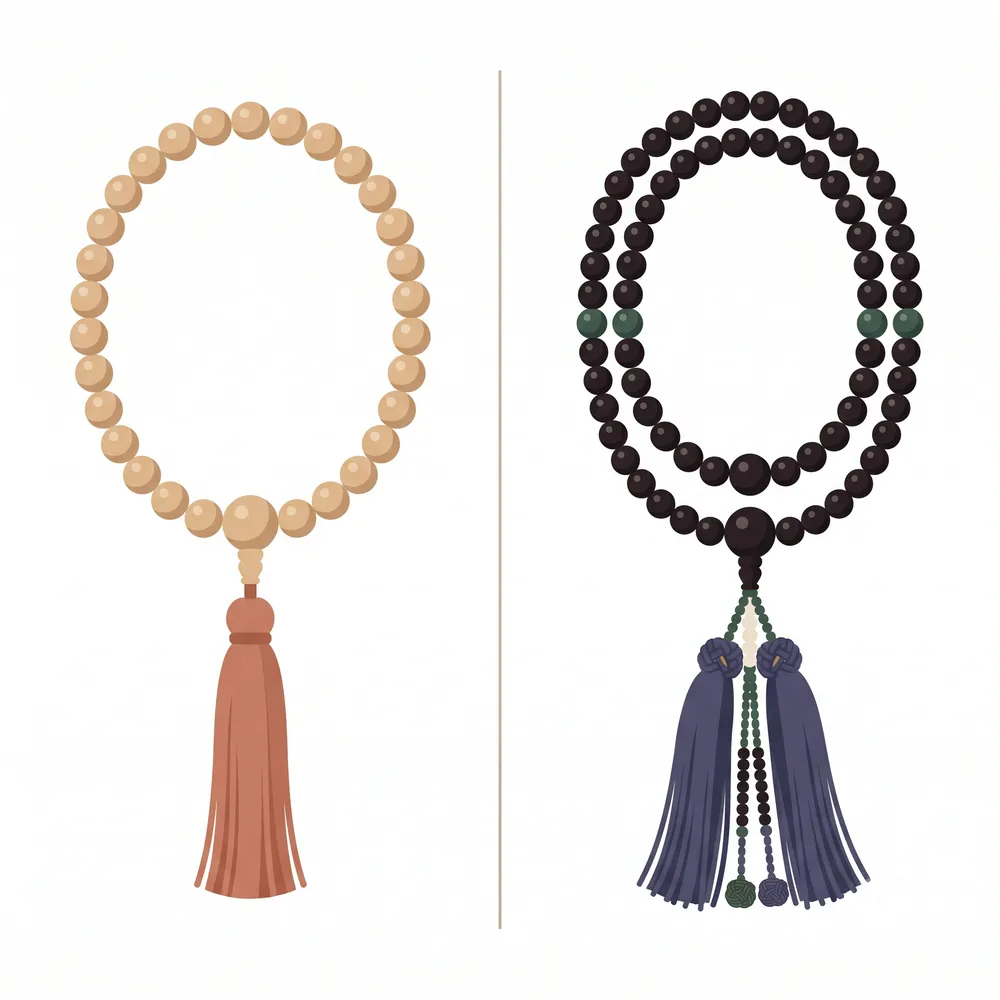
Japanese juzu come in two kinds, and everything else is detail.
Ryakushiki — the simplified form. A single loop, short enough to sit in one hand, usually around 18 or 27 beads. It is correct at any Japanese Buddhist service, whatever the school.
Honshiki — the formal form. A double loop, based on 108 beads, with the shape, the fittings and the way it is held all set by the particular school.
If you do not belong to a school, buy the ryakushiki. This is not a compromise.
A honshiki juzu declares which school you belong to — the differences are
specific enough that Sōtō Zen beads carry a metal ring where Rinzai Zen beads do not.
Carrying one school's formal beads while belonging to none is not extra respect; it is a
statement that is not true.
The ryakushiki says nothing about affiliation, which is exactly what you want it
to say.
The 108, and what juzu are actually for
The 108 beads of a honshiki correspond to the 108 bonnō — the earthly desires or afflictions of Buddhist cosmology. Sect forms also run to 54, 27, 23 or 21, which are divisions and variations of that number.
In lay Japanese practice they are not usually counted through. The beads are held while the hands are joined, and rubbed together during recitation. Counting one bead per repetition is the mala's method rather than the juzu's — which is the practical difference if you are coming to this from a yoga or Tibetan Buddhist background.
Why Japanese — Kyo-Nenju, and the Tag to Look For
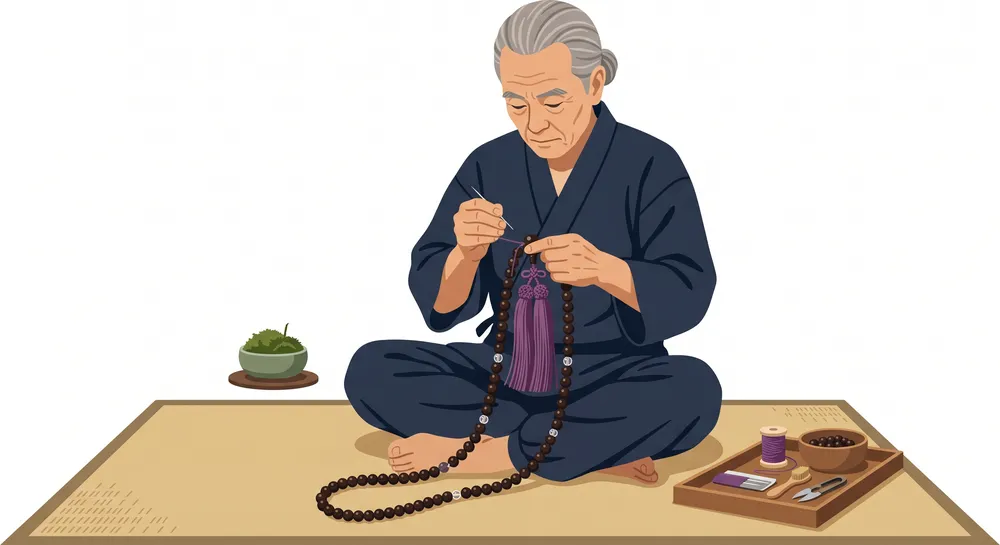
Kyoto is the centre of Japanese prayer-bead making, and Kyo-nenju is a nationally designated traditional craft. The shops there are not young: one has been making nenju since 1683 in the same location, another has been in business over 300 years.
The visible difference is in the parts that fail on a cheap strand — the drilling of the beads, the evenness of their sizing, the cord, and above all the tassel. A few-dollar juzu tends to have a tassel that frays within a year and stringing that goes slack.
There is a tag, and it is checkable
Only genuine Kyo-nenju may carry the tag of the Kyoto prayer-bead makers'
cooperative, which marks it as the work of a certified Kyo-nenju craftsman.
That is a more useful thing to look for than the words "made in Kyoto", which
anyone can print. If a seller does not mention the cooperative, ask whether the strand
carries the tag — the good shops know exactly what you mean.
Beads and Tassels
Two families of bead dominate.
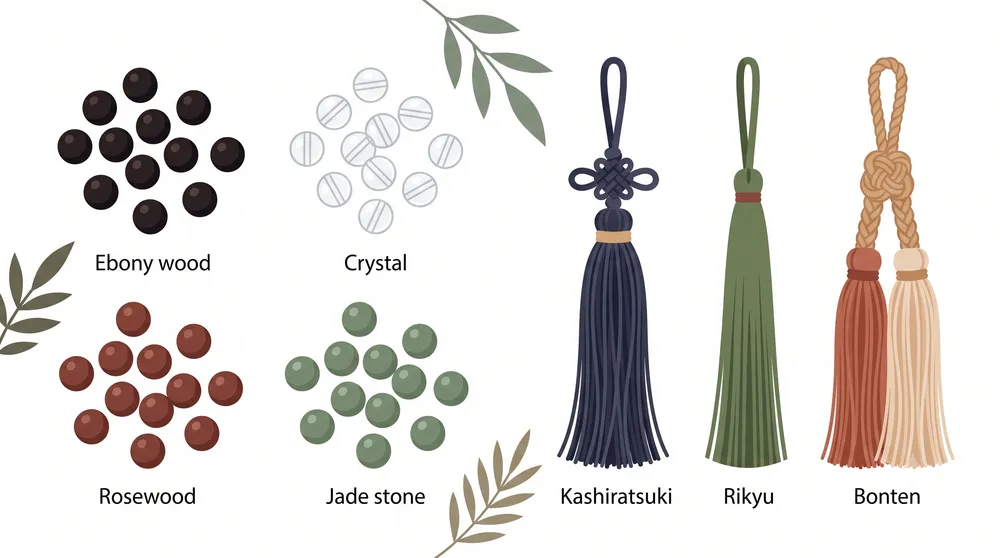
- Karaki — dense tropical hardwoods, principally ebony (kokutan) and rosewood (shitan). Deep, quiet colour, warm in the hand, and they darken slowly with handling. The conventional choice for a sober, formal strand.
- Stone — rock crystal, rose quartz, jade, agate. Cool to the touch and brighter to look at, and heavier than wood. Crystal is the most common.
- Bodaiju — bodhi seed, from the tree associated with the Buddha's awakening, and regarded as the most fitting material of all.
Bead diameter is the other variable: strands are commonly made around 10–12 mm or around 6–8 mm. The larger sizes are conventionally sold as men's and the smaller as women's in Japan — as a practical matter, buy the size that sits comfortably closed in your hand.
The tassel is where the money shows
Three forms are standard: the kashiratsuki, with a bound head, is the
most formal; the rikyū is plainer and slimmer; the bonten is a round pompom.
What matters more is the fibre. A shōken (pure silk) tassel hangs
properly, holds a sheen, and can be steamed back into shape for decades.
Synthetic tassels frizz and never recover — and the tassel is what people see.
How to Carry It
The conventions are few, and knowing them is most of what makes someone comfortable at a Japanese service.
- Carry it in your left hand, tassel hanging down, held gently rather than with fingers pushed through the loop.
- When you join your hands, the beads go over them — either hung on the left hand or looped across both, resting between thumb and index finger. The exact form varies by school, and nobody expects a visitor to know theirs.
- Offering incense: beads stay in the left hand, the right hand takes the incense. This is the moment people fumble, and knowing it in advance is worth a great deal.
- Never set it down on the floor, or bare on a table. It goes in its pouch, or on a folded handkerchief.
- They are not lent or borrowed. A juzu is treated as personal to its owner, which is precisely why it is worth having your own rather than expecting to be handed one.
None of this is a test. A guest holding plain beads in the left hand and following the person in front is doing it correctly, and the alternative — arriving without any — is far more conspicuous than holding them slightly wrong.
Where to Buy
Kyoto-made, shipped internationally
The most straightforward route is an English-language shop that lists Kyoto-made
strands and states plainly which are ryakushiki and which are
honshiki — that labelling is the thing you actually need, and most general
marketplaces do not provide it.
Expect roughly $80 to $120 for a good single-loop strand in wood or stone
with a silk tassel.
- Look for
- "Ryakushiki" stated explicitly
- Tassel
- Shōken — pure silk
- Price
- About $80–$120
- Avoid
- Unlabelled strands under $20
Or buy it in Kyoto, from a shop that will also repair it
Two Kyoto houses keep English pages and are worth going to in person. One
has made nenju since 1683 and supplies head temples; the other is a member of the Kyoto
prayer-bead cooperative, sells sect-specific strands, and offers repair.
Being able to hold several strands and say what it is for — a funeral next
month, a specific school, daily practice — gets you a better answer than any
website.
⚠ Neither states international shipping. One notes that it runs occasional overseas pop-up shops but that the countries and dates are irregular. Treat both as places to visit rather than as mail-order, and use the shops above if you are ordering from home.
Care, and Why These Get Repaired Instead of Replaced
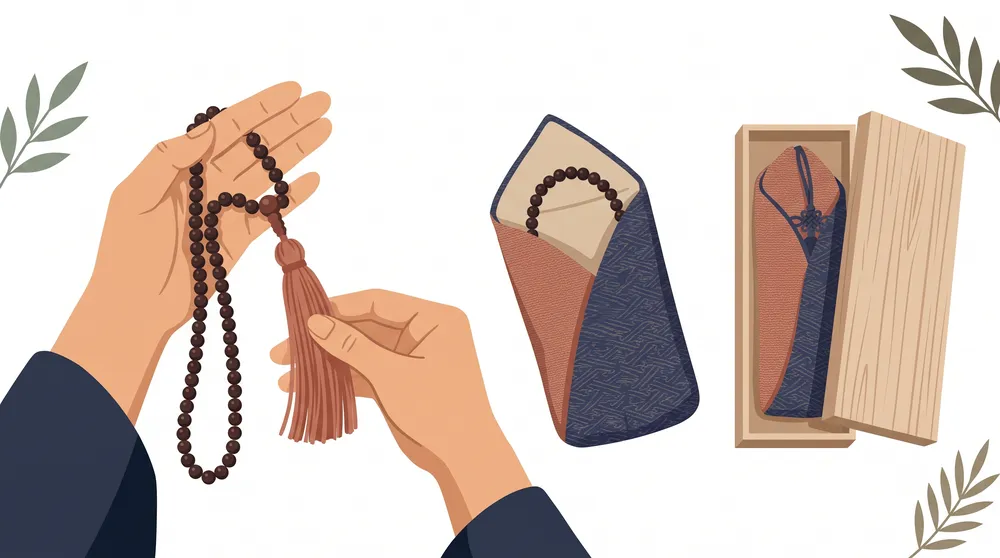
A juzu is one of the few things sold as an heirloom that genuinely functions as one. The beads are the durable part; the cord and the tassel are consumable.
Kyoto shops restring and re-tassel as ordinary work — so as long as the beads survive, the same strand can be renewed repeatedly and handed down. The economics favour buying one good one and maintaining it over replacing a cheap one every few years.
- Wipe the beads with a dry soft cloth after use and put it away in its pouch. Skin oils and damp are what dull them.
- Keep it away from water and direct sun. Wood loses its colour, stone fades, and neither comes back.
- Comb the tassel straight with your fingers before it goes in the pouch. Most tassel damage is simply from being crushed while stored twisted.
- To revive a spread or kinked silk tassel: a few seconds in the steam from a kettle, then comb it with your fingers and let it dry fully before storing. Seconds, not longer — and mind your hand.
- Fragrant woods keep better in a closed box, and stone beads should be kept away from cosmetics and perfume.
- If the cord feels slack, have it restrung before it breaks. A strand that breaks in public sends beads across a floor, which is the one outcome worth the small cost of prevention.
Frequently Asked Questions
Can I use my mala instead?
At a Japanese funeral, a plain ryakushiki juzu is what is expected, and it is
inexpensive enough that there is little reason to improvise.
The objects are related but the conventions are not the same — the juzu is held
across joined hands rather than counted through, and its proportions are made for that.
Is a ryakushiki really acceptable at any sect's service?
Yes. That is what it is for. The simplified single-loop form is used across
schools and is not a discourtesy at any of them.
If you do not know the family's school — or your own — it is the correct choice,
not a fallback.
Is it rude to give someone a juzu?
No — they are a traditional gift in Japan, given at coming of age, at
graduations and weddings, and at a sixtieth birthday.
Choose a ryakushiki so the gift carries no assumption about the recipient's
school. That is the only real consideration.
Does the bead size have to match my gender?
Japanese shops conventionally sell larger beads (10–12 mm) as men's and smaller (6–8 mm)
as women's, and most Japanese buyers follow that.
The practical question is whether the strand closes comfortably in your hand.
Choose the size that does.
My tassel has gone frizzy. Can it be fixed?
A silk tassel usually can. Pass it through kettle steam for a couple of seconds,
comb it straight with your fingers, and let it dry completely before storing.
If it is badly worn, a Kyoto shop will replace the tassel entirely and keep the
beads — this is routine work, not a special commission.
Are there juzu for children?
Yes — smaller ryakushiki strands sized for a child's hand, for family services
and gatherings.
The usual pattern is a child's strand first and a proper adult one later, often
as a coming-of-age gift.
Final Thoughts: One Strand, Kept
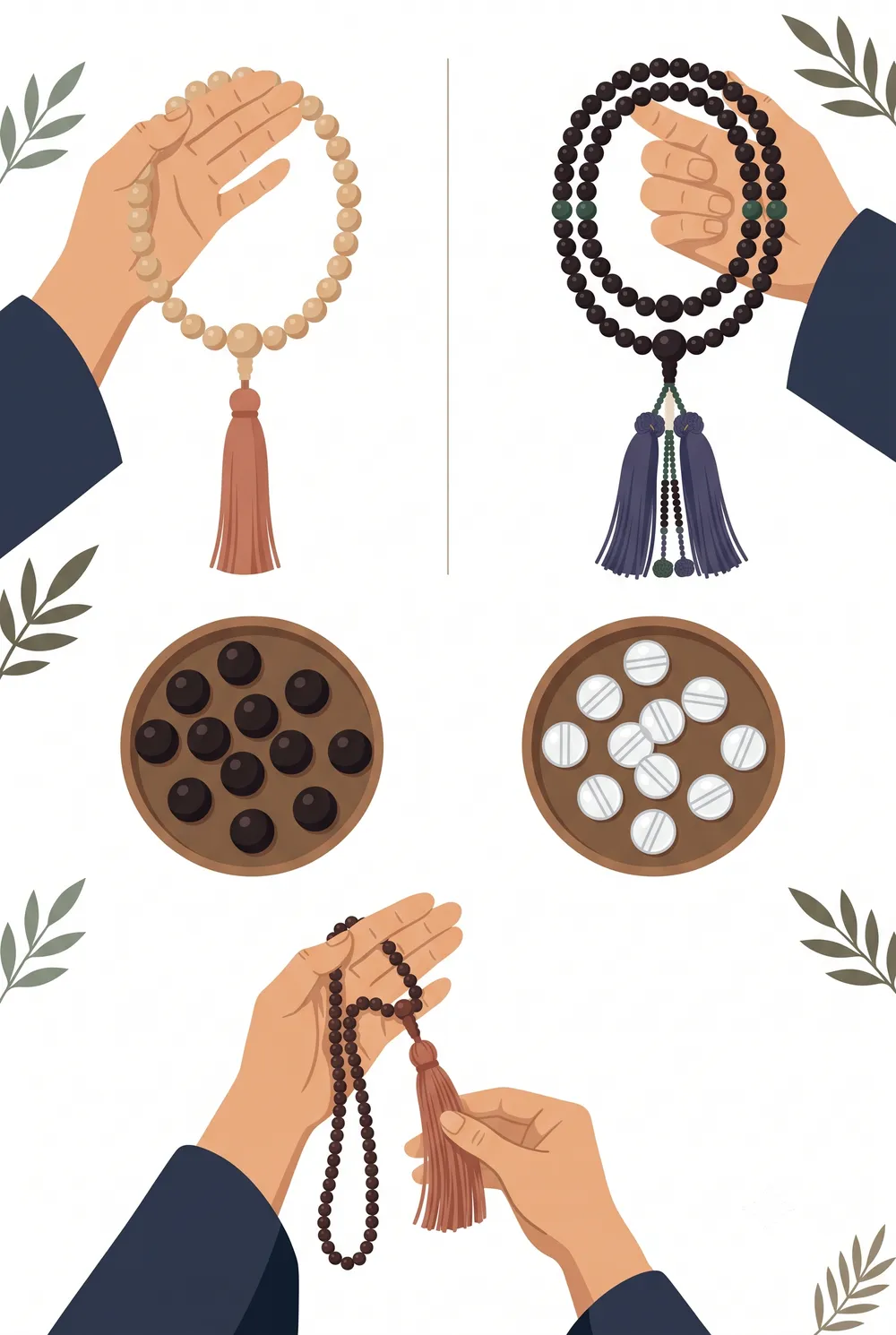
The whole decision is the first one. Single loop unless you belong to a school, in which case that school's form and nobody else's.
After that it is ordinary craft judgement — beads that match, a cord that holds, a silk tassel that can be steamed back into shape thirty years from now, and the cooperative's tag if you want Kyoto specifically.
And then it is the rare purchase you make once. Restrung and re-tasselled as needed, the beads outlast the person who bought them, which is rather the idea.
Japanese Formal Bags: IWASA & Hamano for Ceremony Dress Codes

Japanese Incense Guide: Awaji, Kyoto Brands & How to Burn