Before anything else: do not buy a Japanese-market rice cooker and a step-down
transformer. It is the most common plan and it is the wrong one — a transformer big enough
to run one safely costs more than simply buying the right cooker in the first place.
Zojirushi, Tiger and Panasonic all sell 120V versions built for North America. And
the part nobody mentions: the top US-market Zojirushi models are still made in Japan.
You are not trading away the thing you wanted.
With that settled, this guide covers what actually makes these cookers worth $300 to $1,000 —
induction heating, pressure, and why the inner pot is where the money goes.
Quick Reference: Which Heating System
| Type | How it heats | Price / verdict |
|---|---|---|
| Micom | A heating plate under the pot, with a microchip managing it | $150–$250. Already far better than a Western cooker |
| IH induction heating |
The pot itself becomes the heating element — heat from all sides | $250–$450. The real upgrade |
| Pressure IH | IH plus pressure, raising the boiling point above 100°C | $450–$1,000. Sweeter, stickier grain |
| ⚡ Buy the 120V version, not a Japanese-market model with a transformer. Read the next section before you order anything. | ||
Will a Japanese Rice Cooker Work in Your Country?
Short answer — buy the 120V model made for your market. For a rice cooker specifically, the transformer route does not make financial sense, and in Europe it barely makes sense at all.
| Where you live | Voltage | Does the plug fit? | What you need |
|---|---|---|---|
| Japan | 100V | — | Nothing |
| United States / Canada | 120V | Yes — same Type A plug | Buy the 120V model. Zojirushi, Tiger and Panasonic all make them |
| Europe / UK / Australia | 230–240V | No | A 220–240V export model, or a large transformer |
The danger is that it fits and it works
A Japanese rice cooker plugs straight into an American outlet. Same NEMA 1-15 Type A plug, no adapter needed. It will switch on. It will cook rice.
What is happening is that a heating element designed for 100V is receiving 120V — about 20% more power than it was built for. Short term it works. Over months it runs hot, shortens the appliance's life, can trip its own thermal protection, and voids the warranty entirely. Because nothing obviously fails on day one, people keep doing it.
Why a transformer is the wrong answer here specifically
For a small appliance a step-down transformer is a reasonable $30 solution. A rice cooker is not a small appliance, and the arithmetic changes completely.
- Heating appliances need transformer headroom of three to four times their rating to survive the current spike when the element switches on.
- A typical pressure IH cooker draws around 1,100–1,400W. That implies a transformer rated near 5,000W.
- A transformer that size costs more than the 120V rice cooker does. It is also heavy, hot, and permanently occupying a socket.
- IH cookers rectify AC to DC and then generate a 20–40kHz field. They are sensitive electronics, not a kettle — a cheap "converter" rather than a true isolating transformer is a genuinely bad idea.
The good news: 120V does not mean "not Japanese"
A reasonable worry is that the export model is a lesser product built somewhere else.
For Zojirushi's upper range it is not: the 120V pressure IH models
NW-JEC10BA and NW-JEC18BA carry "Made in Japan". You get the domestic build and
a plug that belongs in your wall.
What you do give up is lineup breadth — Japan gets more models, more finishes and
the very newest flagships first.
⚠ A plug adapter is not a solution
A plug adapter changes the shape of the pins. It does nothing whatsoever to the voltage. This is the single most common and most expensive misunderstanding in this category, and the two regions get it wrong in opposite ways.
United States and Canada: nothing stops you
Japan and North America use the same Type A plug. A Japanese appliance fits a US socket with no adapter at all — it simply plugs in and turns on.
That is precisely the danger. There is no physical obstacle, no error message, and nothing that feels wrong. 120V into a 100V appliance is 1.2× the voltage, which is about 1.44× the power — so it runs hot, ages fast, and any thermostat inside it is now calibrated for conditions that no longer apply.
Europe, UK and Australia: an adapter alone destroys it
Here the plug shape is different, so you will go looking for an adapter — and travel shops
sell them by the till.
230V into a 100V appliance is 2.3× the voltage, which is roughly 5.3× the power.
That is not shortened life. That is immediate failure, and a genuine fire risk.
You need an adapter AND a transformer. The adapter makes it fit; the transformer
makes it safe. Neither one substitutes for the other.
⚠ And a "travel converter" is not a transformer
Cheap travel converters chop the AC waveform rather than transforming it, and are
meant only for simple resistive loads like a travel iron, for short periods.
They will damage anything with electronics, a thermostat or a motor.
Look for the word "transformer," and ideally "toroidal."
Sizing the transformer
| Appliance type | Transformer rating |
|---|---|
| No motor, no heating element | 1.5× the rated watts |
| Motor or heating element | 2–4× the rated watts — startup draw exceeds the printed figure |
A rice cooker is a heating appliance drawing around 1,200W, which puts the required transformer at 2,400–4,800W.
That is a very large and expensive box — and it is why we recommend buying a 120V model instead. The transformer can cost more than the difference, weighs several kilograms, and lives on your counter permanently.
Why Japanese Rice Cookers Are Different
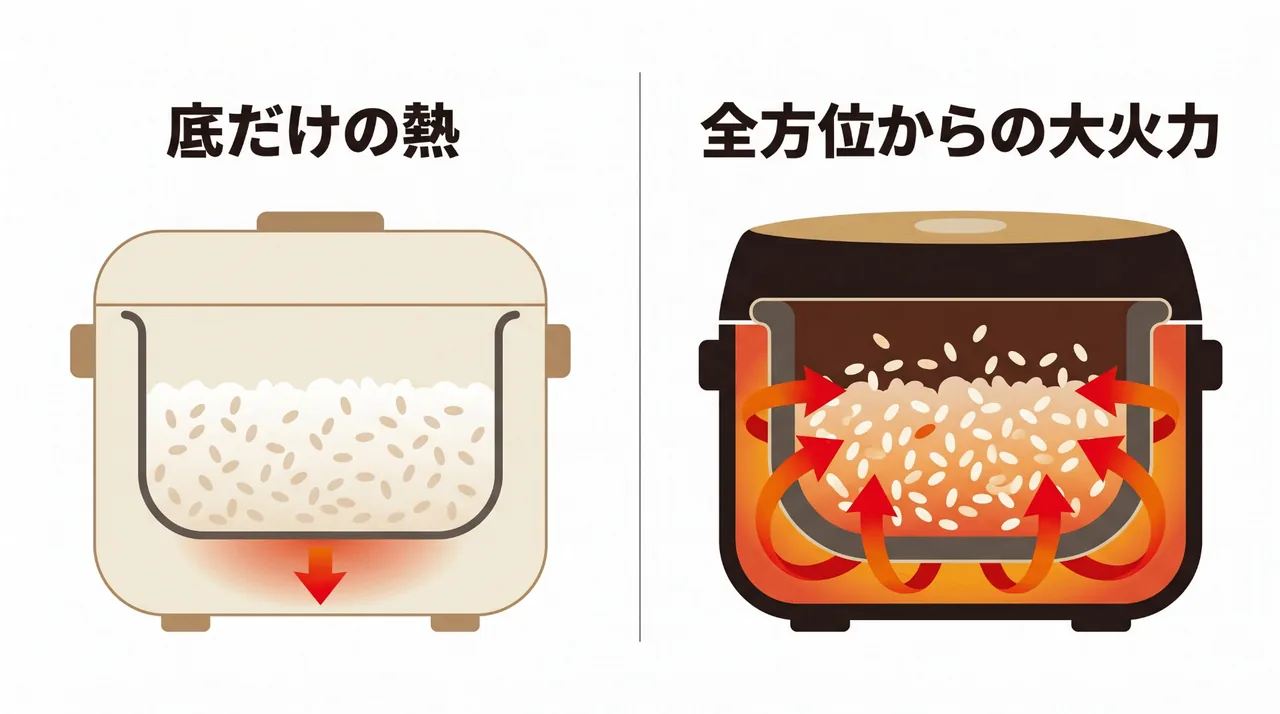
A Western rice cooker boils water until a thermostat notices the water is gone, then stops. A Japanese one runs a programme — soak, ramp, boil, steam, rest — with the temperature curve tuned for the variety of rice you selected.
Induction: the pot becomes the heating element
An IH cooker generates a magnetic field that induces current in the metal of the inner
pot itself. The pot is not being heated by something else — it is the heater,
across its whole surface at once.
That produces violent convection: the water genuinely churns, grains circulate rather than
sitting in a compacted mass, and each grain cooks evenly instead of the bottom layer
overcooking while the top steams.
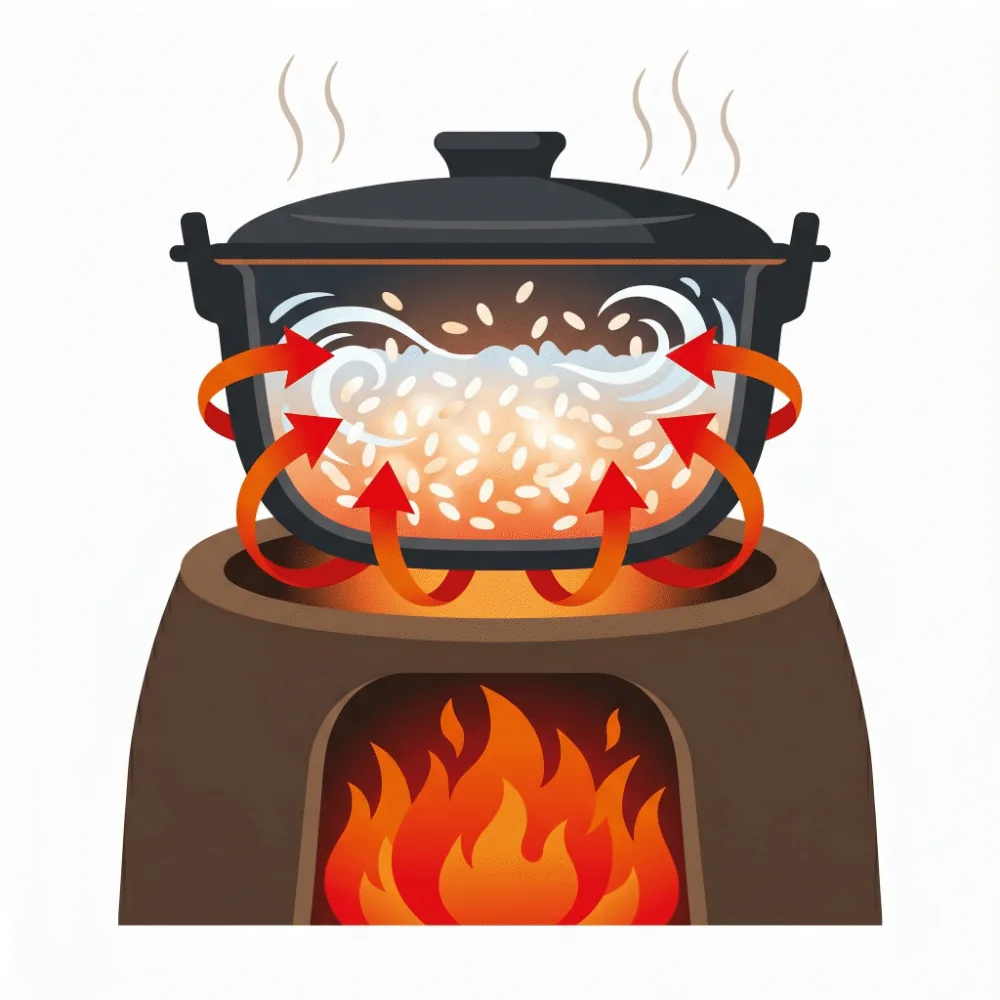
Pressure: raising the boiling point
Adding pressure lifts the boiling point above 100°C. Hotter water gelatinises the starch more completely, which is what produces the sweeter, stickier, glossier grain that pressure models are bought for.
It is a preference, not an upgrade. If you like rice with distinct separate grains — for fried rice, or if you mostly cook long-grain — non-pressure IH suits you better. Pressure excels at Japanese short-grain eaten plain.
Where the money actually goes: the inner pot
On expensive models, most of the cost difference is the pot. Thicker walls hold heat more steadily; multi-layer construction of iron, aluminium and stainless tunes how the induction field couples and how heat spreads; some use carbon or applied charcoal, others earthenware. A heavy pot in a cheap body beats a light pot in an expensive one, which is why pot specifications are the first thing to compare.
What to Buy
All of these are 120V North American models. Zojirushi also runs its own US online store, which is the safest route if you want warranty support.
Zojirushi NW-JEC10 / NW-JEC18 — pressure IH, made in Japan
The one to buy if you want the full experience without importing. Pressure induction
heating, 120V, and "Made in Japan" on the box — the combination most people assume
does not exist.
NW-JEC10 is 5.5 gō (about 5.5 US cups uncooked, feeding roughly 3–5 people);
NW-JEC18 is the 10-cup version.
- Heating
- Pressure IH
- Voltage
- 120V — no transformer needed
- Made in
- Japan
- Capacity
- 5.5 cups (JEC10) or 10 cups (JEC18)
- Price range
- $500–$700
Perfect for: Anyone who eats Japanese short-grain rice several times a week and wants the domestic-market build.
Zojirushi NP-HCC10 / NP-HCC18 — induction without pressure
Induction heating, no pressure system, and the best value in the range. The
jump from a plate-heated cooker to induction is the one you actually taste; the jump from IH
to pressure IH is real but much smaller for a lot more money.
Fewer moving parts than a pressure model, which also means less to go wrong and less to clean.
- Heating
- IH, no pressure
- Voltage
- 120V
- Grain style
- Firmer, more separate. Good for mixed cooking
- Price range
- $250–$400
Perfect for: Most households. Start here unless you specifically want the pressure texture.
Zojirushi NS-ZCC10 / NS-ZCC18 — the sensible entry point
Micom rather than induction: a heating plate with a microprocessor running the programme.
This is still enormously better than a Western on/off rice cooker, because
the difference between the two is mostly the programme rather than the heat source.
If you are not sure you will use it often enough to justify $500, buy this and find out.
- Heating
- Micom (heating plate + microprocessor)
- Voltage
- 120V — built for overseas markets
- Price range
- $150–$230
Perfect for: First Japanese rice cooker, small households, or anyone testing how much rice they really eat.
The Japanese flagships you cannot plug in
These are the models Japanese buyers actually queue for. All are 100V domestic products — listed because they are worth knowing about, not because you should import one.
- Zojirushi Enbudaki ("dancing flame") — multiple independent induction coils firing in sequence to imitate an uneven wood fire under a pot.
- Tiger Gohobi-daki — a genuine earthenware inner pot rather than a coated metal one, aiming at the scorched aroma of a clay pot.
- Vermicular Ricepot — a cast-iron enamel pot on an induction base, with no keep-warm function at all. The company decided keeping rice warm ruins it, and simply left the feature out.
The Inner Pot Is the Expensive Part
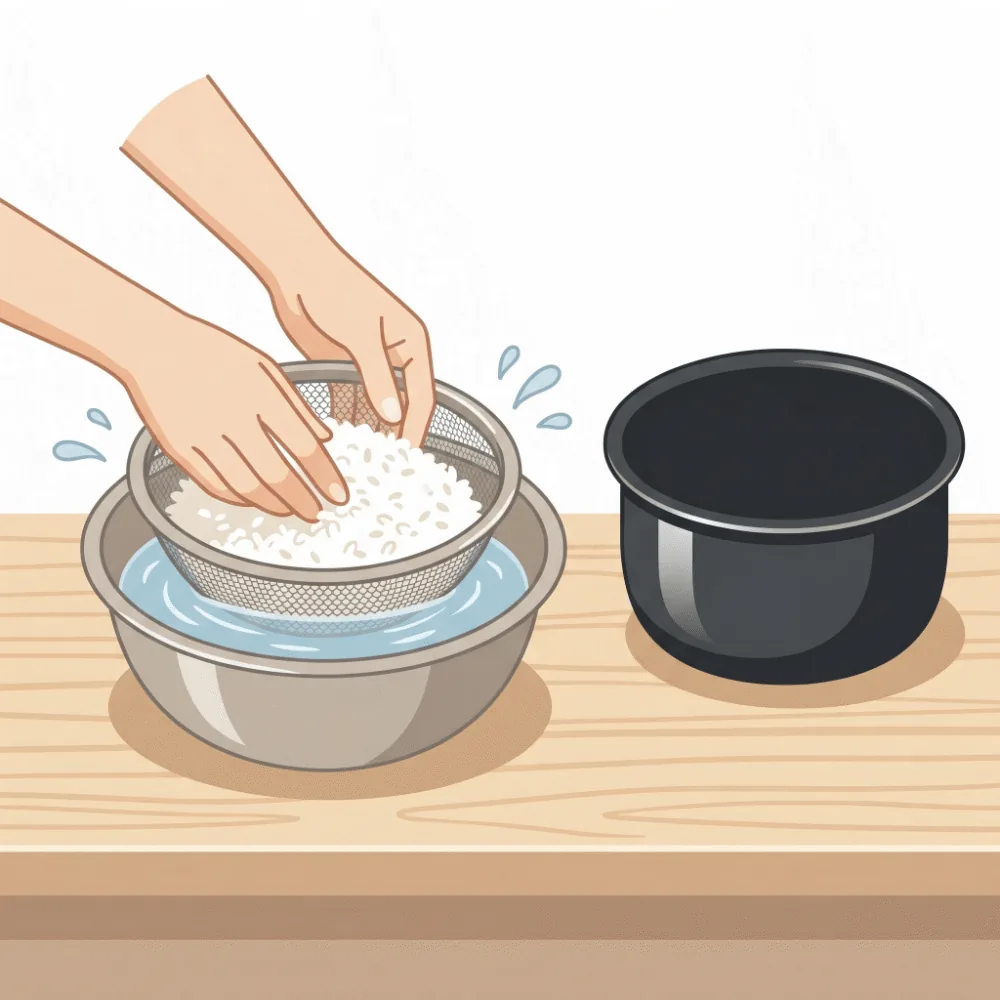
Do not wash the rice in it
This is the one habit that decides how long the cooker lasts. Rice grains are abrasive,
and rinsing them by hand inside the coated pot grinds that coating away. Once it goes,
rice sticks, cleaning gets worse, and the pot alone can cost a third of the machine.
Rinse in a separate bowl or a mesh strainer, then transfer. It adds ten
seconds. Japanese manuals say this and almost nobody outside Japan reads them.
- Never use metal utensils in the pot. Use the plastic paddle supplied — it exists for this reason.
- Wash the inner lid and steam vent every time. Starch collects there, and it is what makes an old cooker smell.
- Do not soak the pot for hours or run it through a dishwasher unless the manual specifically permits it.
- Replacement pots are sold separately — worth checking availability for your model before you buy, because a cooker you cannot re-pot is a disposable one.
Frequently Asked Questions
Can I use a Japanese rice cooker in the US with a transformer?
Technically yes, practically no. Heating appliances need a transformer rated
three to four times their draw, so a ~1,200W cooker implies something near 5,000W — which costs
more than buying the 120V model outright, and is heavy and hot besides.
Buy the 120V version. Zojirushi, Tiger and Panasonic all make them.
What happens if I just plug the 100V model into a US outlet?
It fits, it turns on, and it cooks rice — which is exactly why people do it. The
heating element is receiving about 20% more power than designed.
Over time that shortens the appliance's life, can trigger its thermal protection, and
voids the warranty. Nothing dramatic happens on day one, and that is the trap.
Are the 120V models made in Japan?
Some are. Zojirushi's 120V pressure IH models NW-JEC10BA and NW-JEC18BA are
marked "Made in Japan".
What you give up by buying export rather than domestic is choice — Japan gets
more models and the newest flagships first — not necessarily country of manufacture.
Is pressure IH worth the extra money over plain IH?
It depends on what you want the rice to be like. Pressure gives sweeter,
stickier, glossier grain — ideal for short-grain rice eaten plain. Non-pressure IH gives firmer,
more separate grains, which is better for fried rice and mixed dishes.
The bigger jump is from a heating plate to induction. Make that one first.
What does "5.5 cups" actually mean?
It is 5.5 gō, a Japanese measure of about 180ml of uncooked rice — so
roughly 5.5 US cups uncooked, which cooks up to feed three to five people generously.
A cooker performs best at half to three-quarters full, so buy for your usual meal, not
your largest one.
How long do these last?
Six to ten years is normal, and the inner pot coating usually fails before the
electronics do. That is entirely within your control: rinse rice in a separate bowl, never use
metal utensils, and clean the inner lid every time.
Check that replacement pots exist for your model before buying.
Final Thoughts: The Right Plug, Then the Right Pot
Buy the 120V model. The transformer plan sounds thrifty and ends up costing more than the cooker, and the domestic unit will quietly run hot for years until it does not.
Then spend on the heating system in the order that matters: plate to induction is the difference you taste; induction to pressure is a preference. And whatever you buy, compare the inner pot before the feature list — that is where the money went.
Finally, the free upgrade: rinse the rice in a different bowl. Ten seconds a day, and the pot outlives the machine instead of the other way round.
Benriner Mandoline: Which Model, and Which Glove
Donabe Rice Pots: Clay Instead of Electricity