Yamatada
A mortar shaped by Takada soil — making suribachi grinding more comfortable.
Based in Takada-cho, Tajimi (Gifu), Yamatada is a pottery studio known for mortars and related tools. The story goes back to 1794, when the first Toubei opened a branch kiln with the idea of "Create Something out of Nothing." Yamatada values local "Aoto" raw clay and the tactile, slightly rough feel that supports grinding. In recent years also developing the JUJU mortier with the swirling "Hamon Kushime" ridge pattern — designed to keep ingredients from escaping upward and usable in either clockwise or counterclockwise direction. The lineup includes Karakusa and line-carved rim mortars, spouted mortars, and natto bowls — various shapes. Choosing from the gallery and ordering through contact — a slightly special way to enjoy.
Why We Love It
Once it arrives, first do the "atari" break-in — grasping the sensation of the pestle touching the whole surface helps starting use feel smooth. For aroma-evoking sesame and sansho, try the JUJU mortier and its direction-free ridges. For dressings and sauces, the spouted mortar lets you pour directly and pull things together quickly. For use as a serving vessel — the Karakusa or line-carved rim mortar works as a "serving bowl." The natto bowl is also a comfortable mixing size — just right for a morning side dish.


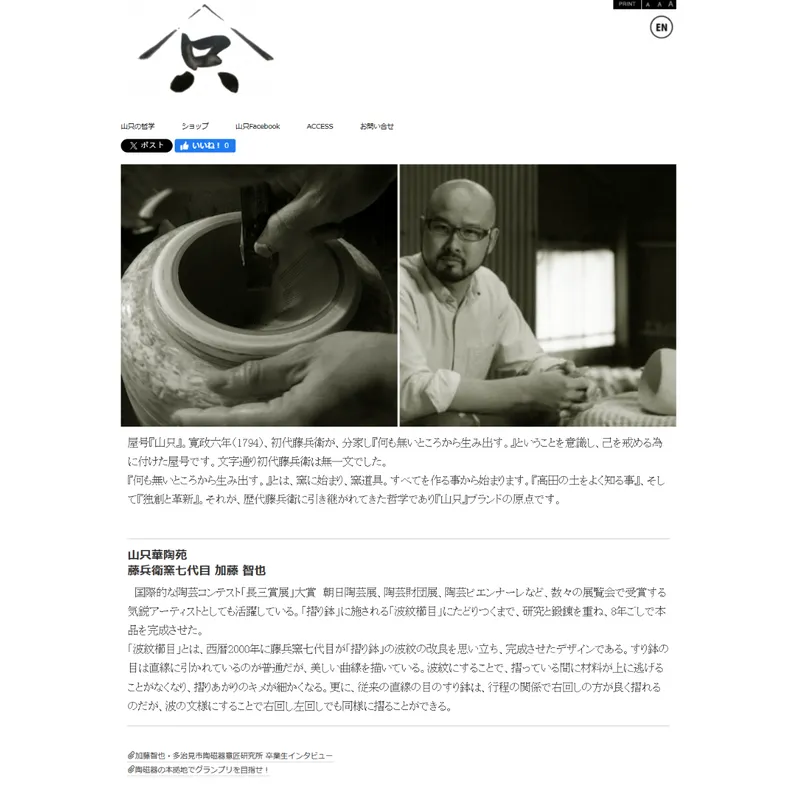
PROFILE About the Company / Workshop
Yamatada's journey begins in 1794, when the first Toubei opened a branch kiln — naming it "Yamatada" with the meaning "create something out of nothing." Both the kiln itself and the kiln tools — first made by hand to start pottery making — that origin is still passed down today. The mottos "understanding the soil of Takada" and "creativity and innovation" — these two inherited through generations of Toubei are the backbone of "the mortar kiln."
When talking about soil commitment, "Aoto" always comes up. When made into clay by levigation — the "roughness" born when large particles enter between fine ones — they say — is the foundation of friction. The Yamatada-like explanation is that the difference is easy to understand compared with glazed ridges or porcelain clay versions. About wear — often spoken of as a mortar defect — they face it through the perspective that the clay particles "gently guard the sharpness."
The lineup is enjoyable from rim decorations — "Karakusa Rim Suribachi," "Line-carved Rim Suribachi," "Spouted Suribachi" — to JUJU mortier. The swirling "Hamon Kushime" was thought up so ingredients are hard to move upward and easy to grind finely on the spot. Spending about 9 years on development — aiming for ridges that don't choose rotation direction. Differences in expression like Wara-shiro and Tetsu-kuro are also choosing points.
Tools are not finished by buying — they are raised including the manner of use. The "atari" Yamatada recommends is the procedure of moistening mortar and pestle, and grinding clockwise and counterclockwise evenly. Also touching on the background that sansho wood has been used for pestles — also showing the stance of wanting domestically-grown wood used. Products are chosen from the gallery — and delivered while consulting through inquiry. The pace of slow selection is also this kiln's appeal.
Friction and gentleness shaped by Takada's "Aoto" soil
Aoto is the local raw clay from Takada — so called because the dug-up soil looks slightly bluish. With properties that make it usable after just removing impurities through levigation — the mixture of fine and large particles leaves a "rough" feel on the inside. This roughness — the idea is — connects to the mortar's friction.
The "white ring" — even the firing devices are not hidden
Because mortars are fired stacked — alumina is applied to keep pieces from sticking together. The white ring visible inside is the remnant. In the first generation, mountain sand was substituted — but even after refining became possible, to approach the original feel — specially mixing large-particle alumina to reduce the ring.
The "atari" break-in adjusts mortar and pestle
Yamatada recommends doing the "atari" break-in before use. Soaking mortar and pestle in water to moisten, then grinding clockwise and counterclockwise equally without ingredients. When the thin weak portions between ridges are removed, it's done. Like the break-in for a car — by adding one step at the start, the grinding feel becomes easier to adjust.
The swirling "Hamon Kushime" — an original born in 2000
The inside ridges made swirling — "Hamon Kushime" — is an original design formed at the 7th-generation studio in 2000. Born from the idea that ingredients don't escape upward and are ground on the spot. Aiming for ridges usable regardless of rotation direction — taking about 9 years to completion — the development time also speaks to seriousness toward the tool.