Tamuracho
Sea umami inherited in Miketsukuni Wakasa-Obama. A long-established maker carefully crafting kodai-no-sasazuke, heshiko, and mackerel cans.
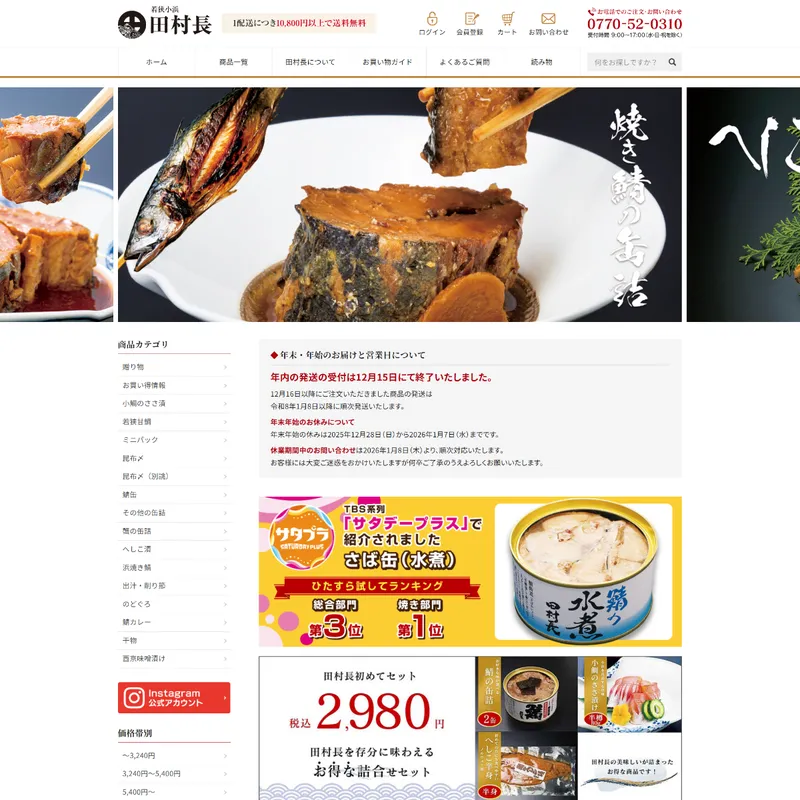
Obama in the Wakasa region of Fukui Prefecture is a land long known as "Miketsukuni" (Land of Imperial Food) — supporting the Imperial family's food — and as the starting point of the "Saba Kaido" (Mackerel Highway) that carried fish to Kyoto. Tamuracho started seafood commerce under the trade name "Tamuracho" in 1823 (Bunsei 6) — inheriting techniques of facing fish across generations. Starting with "Kodai no Sasazuke" (Small Sea Bream Sasazuke) and "Heshiko" expanded to nationwide sales by leveraging catering cuisine techniques — plus mackerel cans and grilled mackerel cans also pleasing as gifts — the brand delivers Wakasa's food culture by placing it on "the daily dining table."
Why We Love It
First, the signature "Kodai no Sasazuke" you want to pick up. Renko-dai (small sea bream) is filleted one by one, low-temperature aged with light salt, arranged with kombu and broth umami, and lightly pickled with vinegar — this "subtraction taste" surprisingly accompanies both rice and sake. The other specialty "Heshiko" is a Wakasa preserved food — after salting, slowly rested in a rice bran bed for about half a year. Both taste hit those who value "properly delicious every time" over flashiness. For gifts, the mackerel can variations and assortments are reliable choices. The justice of canned food — a single dish is determined without warming.
PROFILE About the Company / Workshop
Wakasa-Obama is a land called "Wakasa Province" in the Asuka and Nara periods — said to have controlled the imperial food. Known as "Miketsukuni" (Land of Imperial Food) from the background of delivering fresh sea bounty to Kyoto, the tradition is still passed down today. Where Tamuracho takes root is exactly the heart of this food culture.
The offshore of Obama is a favorable fishing ground typical of the Sea of Japan, where cold and warm currents mix. After lightly salting fish — starting with mackerel and amadai (tilefish) — and carrying them through the night to Kyoto, by the time they arrived they were "just right" — the road born from such wisdom and traffic later came to be called "Saba Kaido" (Mackerel Highway). This road connecting to the capital of food still remains as a history of exchange — also registered as Japan Heritage.
Tamuracho's walk doesn't stop at commerce as a seafood merchant. From Edo to Taisho, in addition to sales to peddlers, the company also conducted on-site cooking and catering to village communities — polishing the technique of "making fish complete as cuisine." Eventually in Showa, alongside fresh fish sales, leveraging catering cuisine techniques, "Kodai no Sasazuke," "Wakasa Karei," and "Heshiko" began nationwide sales. The flavor of the land is converted to a deliverable form.
The signature "Kodai no Sasazuke" is built — from material sorting to barrel packing — with the process accumulation creating flavor outline. Renko-dai is carefully filleted into three pieces — light-salted and low-temperature aged. Seasoned with kombu, shiitake, mackerel flake, and sardine flake broth — and lightly pickled with vinegar — so umami doesn't become muddy, and only the aftertaste lingers long. The finishing wooden barrel packing — arranging texture while removing excess air and moisture — is the final important gesture.
On the other hand, "Heshiko" is a representative preserved food born from Wakasa living. It's "cooking with time" — salting, rice bran bed, weights, and aging across seasons. Salt and rice bran push up fish umami, and to the eater, depth unique to fermentation is delivered. Not flashy production — effort and time create flavor — that's what comes to mind each time you eat it.
On the store-building side, while centered on the Obama main store, Tamuracho opened a directly managed store at Tokyo Nihonbashi Takashimaya in 1985 (Showa 60) — and then also developed directly managed stores at Kyoto department stores. As a "trustworthy flavor" chosen even for travel rewards and formal gifts, the brand continues to deliver Wakasa food culture nationwide.
Founded in 1823 (Bunsei 6). Walking together with Wakasa-Obama food culture
With roots in a seafood business that started in the Obama castle town in 1797 (Kansei 9), seafood commerce started under the trade name "Tamuracho" in 1823 (Bunsei 6). The wisdom of "leveraging fish" — cultivated in the bounty of Wakasa Bay and the history of the Saba Kaido continuing to Kyoto — connects to modern food.
Kodai no Sasazuke — carefully consistent from selection to salt, kombu, broth, and barrel packing
From sorting renko-dai (small sea bream) caught in the Sea of Japan and filleting each one — from preparation removing belly and thin skin. Light salting and low-temperature aging — using kombu from Japan's leading kombu wholesaler "Okui Kaiseido," and seasoned with broth from kombu, shiitake, mackerel flakes, and sardine flakes — then lightly pickled with vinegar. The finish is, after seeing the moment when the meat turns white, hand-packing one by one into wooden barrels and pressing to remove excess air and moisture — a flow of completion.
Growing the Wakasa preserved food "Heshiko" with the time of salt and rice bran
After salting mackerel for 2-3 weeks, into a bran bed with original blending of rice bran and chili pepper. Pushing in one at a time, applying about 50kg of weights — from rainy season through summer until around autumn, the fish is aged for about half a year. The preserved food born in Wakasa where the sea and living are close is finished into modern flavor with proper effort.
Gift-strong mackerel cans. Convenient variations — soy sauce, miso, ginger, kombu
For mackerel cans, in addition to standards — soy sauce flavor, miso-simmered, ginger-added, kombu-added — assortments and mini cans are also developed. While highlighting values like proposals as gifts that are pleasing to receive, popularity with children, and high nutritional value, the lineup supports the table's "one more dish."
LINKS Official Links / Social Media
- Official Website https://www.tamuracho.co.jp/
- Online Shop https://www.tamuracho.co.jp/p/search
- Contact Form https://www.tamuracho.co.jp/f/contact
- About Tamuracho (Brand / History) https://www.tamuracho.co.jp/f/about
- Kodai no Sasazuke https://www.tamuracho.co.jp/c/gr1
- Heshiko https://www.tamuracho.co.jp/c/gr3
- Mackerel Cans https://www.tamuracho.co.jp/c/gr4