Turn it over. That is the entire test.
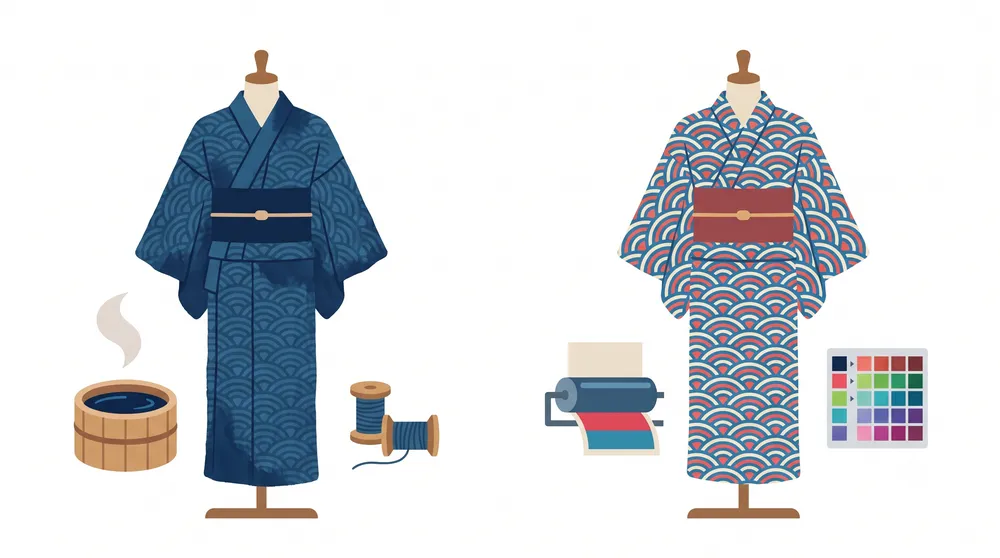
A yukata dyed the traditional way has the same pattern, in the same strength of colour, on
the inside — because the dye was poured through the cloth rather than printed onto it. Hold
up a cheap one and the reverse is pale, or blank.
And this is not connoisseurship. Printing lays pigment across the fibres and partially seals
them, so the cloth absorbs less and feels stiffer. A yukata exists to soak up sweat
on a hot night — so a printed one is worse at the only job it has.
Quick Reference: Real or Printed
| Check | Traditionally dyed | Printed |
|---|---|---|
| The reverse side | Same pattern, same depth | Pale or blank |
| Absorbency | Fibres stay open | Pigment partly seals the fibres |
| Hand | Soft, improves with washing | Slightly stiff, stays that way |
| Price | $150–$600 | $30–$90 |
| ⚠ Close it left over right. The reverse is how the dead are dressed, and it is the single most common mistake foreign wearers make. | ||
Left Over Right — Settle This First
Your left front panel goes over your right one. Looking down at yourself, the
left side is on top.
The reverse is used only to dress the deceased — for men and women alike, and for
every wrapped Japanese garment.
The two-second check: slide your right hand into the front opening at chest height. If it goes in easily, you are correct. If the cloth blocks it, swap the panels.
Do not verify this in a mirror — the reflection reverses it, which is exactly how careful people still get it wrong. Use your hand.
Two things worth knowing, both covered in full in our
samue and jinbei guide:
the Japanese name for the correct closure is migimae, "right front", because
the Japanese terms describe what the person facing you sees — the same garment,
the opposite word.
And women's Western blouses fasten the opposite way to men's shirts, which means
a lifetime of dressing has trained roughly half of readers toward the wrong side. Check, do not
trust the reflex.
Why Japanese — The Name Is a Specification
Yukata is a contraction of yukatabira — yu, hot water, and katabira, a thin unlined robe. It was bathing wear.
In the Heian period, bathing meant a communal steam room. Nobles wore a hemp yukatabira inside it to keep the steam off their skin, to absorb sweat, and for modesty. By the Azuchi-Momoyama period people were wearing it after the bath instead, for the same reason — it dries you. In the Edo period the cloth changed from hemp to cotton, the merchant classes made it stylish, and it walked out of the bathhouse into the street.
That history explains every design decision in the garment. Unlined, because it
has to dry. Cotton, because cotton drinks. No undergarments required, because it began
as the undergarment. Loose, because it was made to be worn in heat.
A yukata is not a simplified kimono. It is a towel that grew up.
Which is why printing ruins it
Traditional dyeing sends colour through the cotton, leaving the fibres open. Printing lays pigment across the surface, and in doing so partially blocks the fibres.
The visible result is that the reverse side stays pale. The result you feel is that the cloth absorbs less and sits stiffer against you, on precisely the kind of humid August evening the garment was designed for. The authenticity argument and the comfort argument are the same argument.
Chusen and Shibori: Two Ways of Getting Colour In
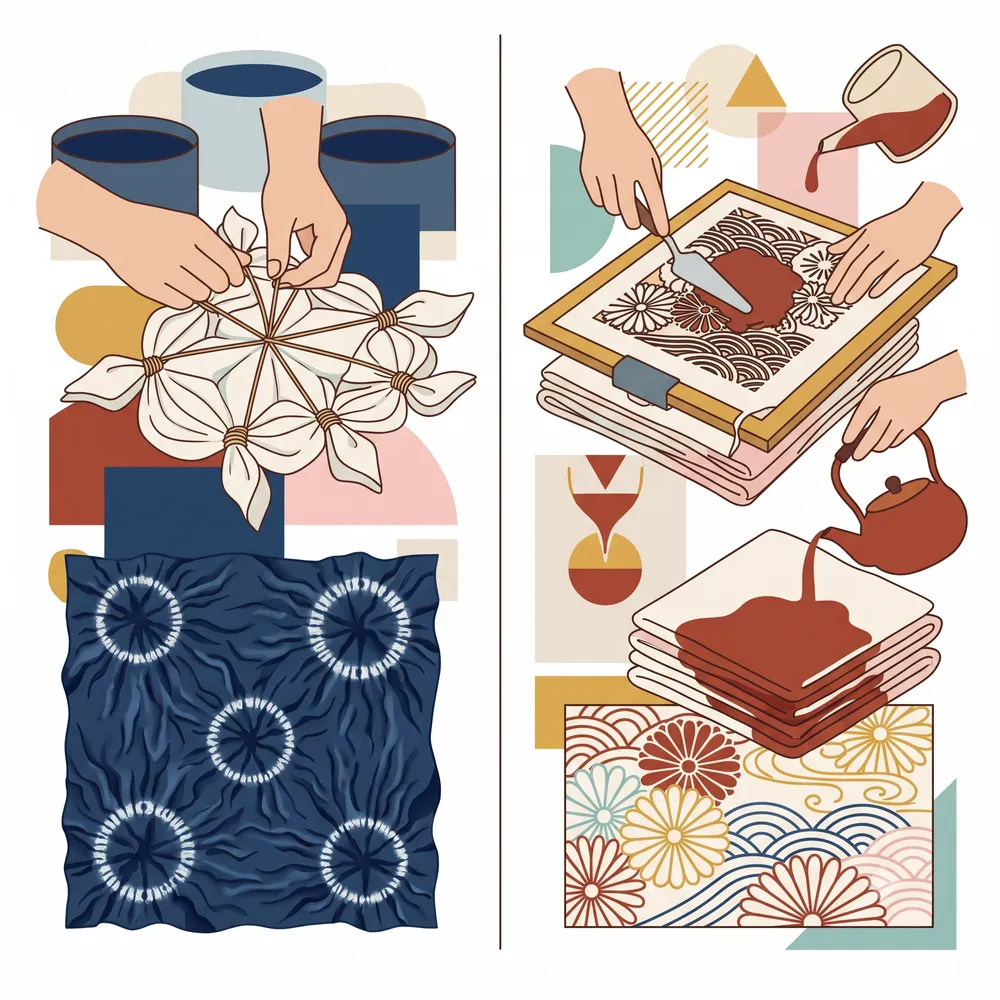
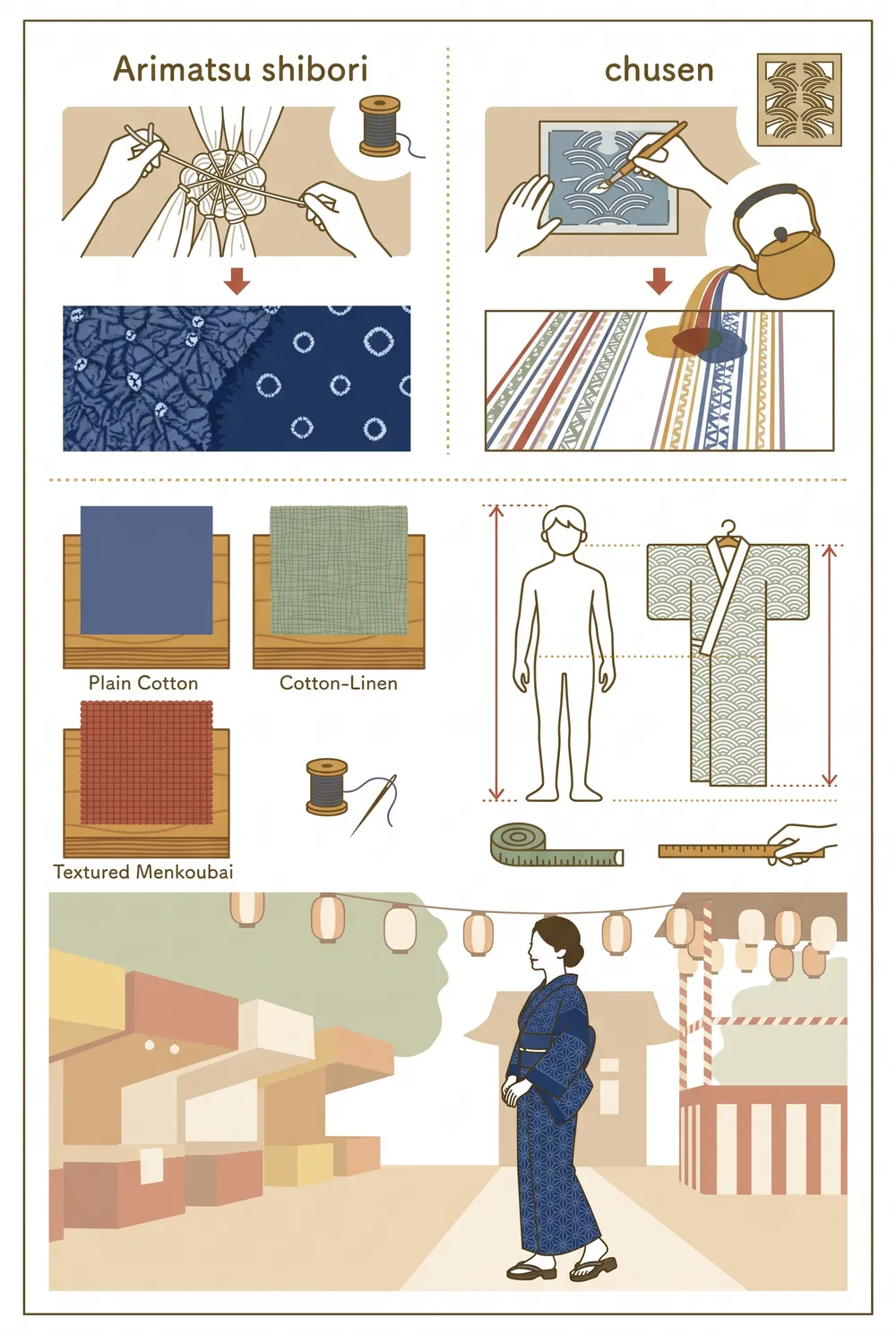
Chusen — pouring the dye through
The cloth is folded into a stack, resist paste is applied through a stencil, and
dye is poured from above and drawn through from below. Many layers are dyed at
once, in several colours, in one operation.
Because the dye passes right through, there is no front and no back. Colours
bleed softly into one another at the edges rather than stopping dead, which is the look people
mean by a "real" yukata.
Hamamatsu, in Shizuoka, produces around half of all Japanese chusen and more
yukata than anywhere else in the country.
Shibori — binding the cloth before it is dyed
Shibori is a word English has already borrowed, usually for the indigo tie-dye look. What English has generally not picked up is the scale of it: Arimatsu, near Nagoya, works in over a hundred distinct named techniques — kanoko, kumo (spiderweb), sekka (snow-flower), miura, nui (stitched), and on from there. It is a family of methods, not a method.
The tradition began in the early Edo period, when workers brought in for the construction of Nagoya Castle carried the technique with them, and the Owari domain protected and developed it from there. Most shibori made in Japan still comes from this one district.
The part that matters when you wear it
A shibori yukata is not flat. The binding and stitching leave permanent texture
in the cloth — small ridges and puckers where it was compressed — and
that texture holds the fabric off your skin.
Air moves underneath. It is the same principle that makes seersucker work, arrived at from a
completely different direction. Do not iron it flat; the relief is the product.
If you want one yukata: chusen. It is the classic, it drapes cleanly, it costs less, and it looks like what people picture. Shibori is the second one you buy — more expensive, more striking, and noticeably cooler to wear.
Fabric and Size, Especially If You Are Tall
The two measurements that decide it
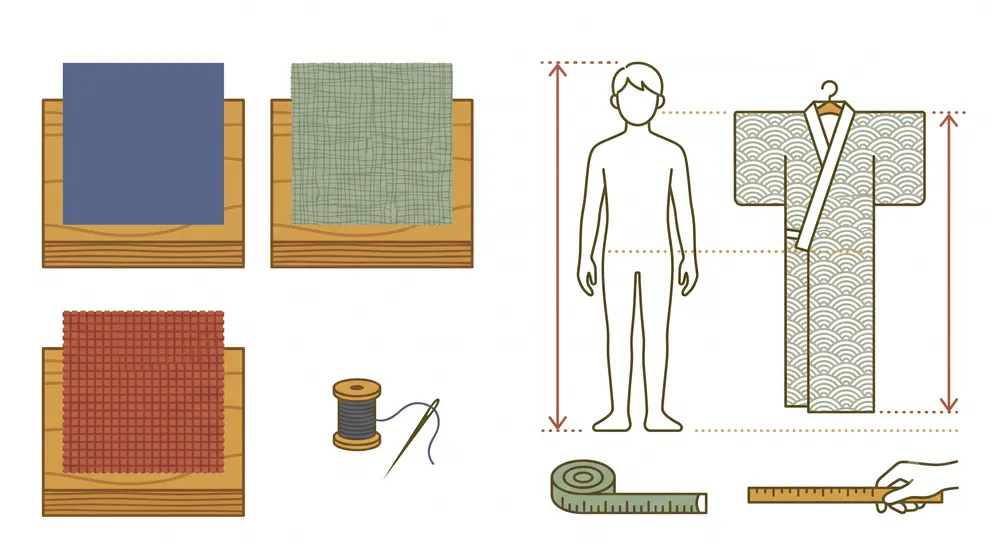
- Mitake — the length of the garment. For women this should be roughly equal to your own height, because the extra length is folded up at the waist into the ohashori, the tuck that sits below the obi. Too short and you cannot make the fold at all, which is the failure mode nobody warns tall buyers about.
- Men's yukata works differently. There is no ohashori — the garment is worn at its actual length, so it should already fall to your ankle bone. A men's yukata sized to your full height will be far too long.
- Yuki — centre of the back neck to the wrist bone. This is where ready-made Japanese sizing fails Western buyers first. If your sleeves finish well above the wrist, the whole thing reads as borrowed. Check the number rather than the letter size.
Cloth
- 100% cotton — the standard, easy to wear and to wash. Start here.
- Cotton-linen blend — crisper, cooler, holds its shape better in humidity.
- Menkoubai and menro — cottons woven with a raised grid or openwork rows so the surface is textured. Same trick as shibori: the cloth stands off the skin. These are the genuinely cool ones and they look more formal.
What to Buy
Hamamatsu chusen — the one to start with
Hamamatsu accounts for roughly half of Japan's chusen output and the largest
yukata production in the country, so this is the mainstream traditional choice rather than a
rarity.
Look for the words honzome (true-dyed) or chusen in the
description — and then check the photograph of the reverse, which good
sellers include precisely because it is the proof.
- Where
- Hamamatsu, Shizuoka
- Test
- Reverse side matches the front
- Cloth
- Cotton 100%, soft, gets softer
- Look
- Colours bleed softly into each other
- Price range
- $150–$400
Perfect for: A first real yukata, and for anyone who wants the classic summer-festival look done properly.
Arimatsu-Narumi shibori — the textured one
Four centuries of work in one district outside Nagoya, and
over a hundred named binding techniques still in use. Each knot, stitch and
fold is done by hand before the cloth ever meets the dye, which is why the price is what it
is.
Buy it for the texture as much as the pattern. The relief left in the cloth
is what makes it comfortable, and it is the thing a photograph never conveys.
- Where
- Arimatsu and Narumi, Aichi
- Since
- Early Edo period, under Owari domain patronage
- Techniques
- 100+ named methods, all hand-worked
- Feel
- Three-dimensional — holds off the skin
- Price range
- $400–$1,500
Perfect for: A second yukata, and anyone who already owns shibori homeware and did not know how deep the tradition ran.
Menkoubai and cotton-linen — the ones that are actually cool
If you intend to wear a yukata in real heat rather than for photographs,
the weave matters more than the dyeing. Menkoubai is cotton woven
with a raised grid; menro has openwork rows. Both stand the cloth off your
body.
They also read as a step up in formality, which is useful if you want something that works
beyond a festival.
- Menkoubai
- Raised grid texture, minimal skin contact
- Menro
- Openwork rows, very light
- Cotton-linen
- Crisp, cool, resists limpness in humidity
- Note
- Often sold pre-tailored and ready to wear
Perfect for: Anyone who has worn a cheap yukata in August and concluded the garment does not work. It does — that one did not.
What else you need
An obi — a half-width hanhaba obi for women, a narrow kaku obi
for men. A koshihimo or two, the thin ties that actually hold the
garment closed. Geta, worn barefoot.
No tabi socks and no undergarments — those belong to kimono. Sets sold as
complete usually include the obi and ties, which saves guessing.
Wearing It, and Keeping It
Most of what goes wrong is the collar coming loose during the evening. Set it properly at the start and it holds:
- Left over right, hem at the ankle bone, then tie the koshihimo firmly at the waist before anything else. The obi is decoration; the thin tie is what holds the garment together.
- Pull the back of the collar slightly away from the neck for women — a fist's gap is the usual guide. Sitting flat against the nape looks stiff and is hotter.
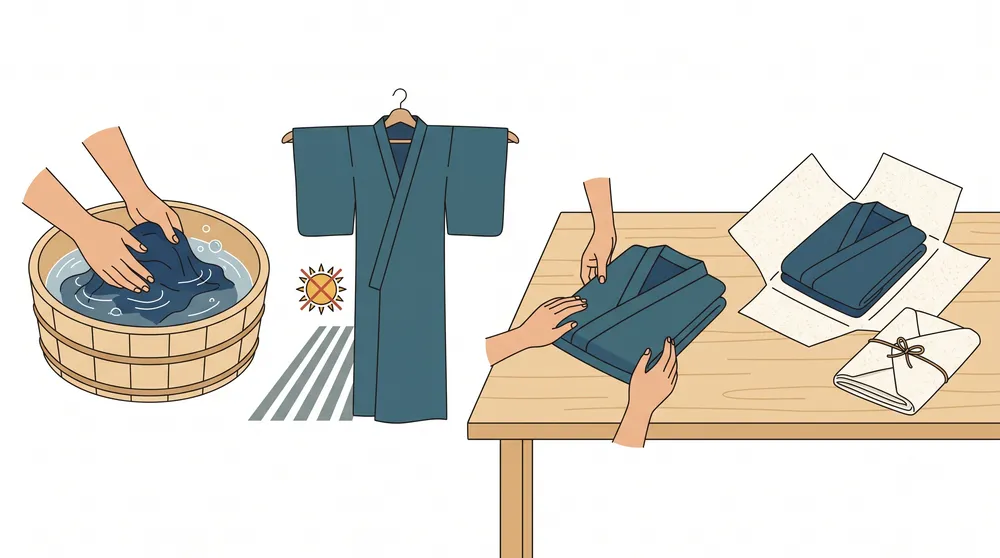
- Wash it yourself, in cold water, in a mesh bag. Cotton yukata are meant to be washed. Never tumble dry.
- Hang it damp on a wide hanger and smooth the seams flat by hand. Done this way it needs no ironing, and a shibori yukata must never be pressed flat anyway.
- Store it folded, not hanging, and keep it out of light. Indigo and traditional dyes fade in sunlight, and a season on a hanger leaves shoulder marks that do not come out.
Frequently Asked Questions
How do I tell a real yukata from a cheap one?
Look at the reverse side. Traditional chusen dyeing pours colour through
the cloth, so the inside carries the same pattern at the same strength. A printed yukata
is pale or blank on the back.
It is not only a question of authenticity — printing partially seals the fibres, so the
cloth absorbs less sweat and feels stiffer.
Which side goes on top?
Left over right — your left panel covers your right. The reverse is used only for
the deceased.
Check by sliding your right hand into the front opening: if it slips in easily
you are correct. Do not check in a mirror, which reverses the image.
What is the difference between a yukata and a kimono?
A yukata is unlined cotton, worn against bare skin, with bare feet in geta. A
kimono is lined, often silk, and requires an under-robe, tabi socks and considerably more
apparatus.
The yukata began as bathing wear — it is the simpler garment by design, not by
abbreviation.
What size do I need if I am tall?
For women, the garment length should be about your own height, because the excess
is folded into the ohashori tuck at the waist — too short and the fold cannot be
made. Men's yukata has no such fold and should simply reach the ankle bone.
Check the yuki measurement too (back neck to wrist). Short sleeves are
where ready-made Japanese sizing fails Western buyers first.
Can I wash a yukata at home?
Yes — it was designed to be washed. Cold water, mesh bag, gentle cycle, and never
a tumble dryer.
Hang it while damp and smooth the seams by hand, and it will need no ironing.
Never press a shibori yukata flat; the raised texture is the point of it.
Is a yukata only for festivals?
No. It is ordinary summer clothing in Japan, and it is what you are handed at a
ryokan or an onsen town to wear to dinner and out along the street.
A cotton-linen or menkoubai yukata in a restrained colour reads as clothing
rather than costume, which is the version worth owning if you want to wear it more than
once a year.
Final Thoughts: A Towel That Grew Up
Everything odd about a yukata makes sense once you know it began as something you wore in a steam bath. Unlined so it dries. Cotton so it drinks. No undergarments, because it was the undergarment.
Which is why the reverse-side test is not snobbery. A printed yukata has pigment sitting across the fibres, doing exactly what a garment built to absorb sweat should never do. Turn it over before you decide.
Then get the length right, and close it left over right. Nobody at the festival will check your dyeing method. They will notice the other thing.
Samue vs Jinbei: The Difference and How to Wear It
Tenugui: The Cloth That Does Everything