Two things most people who buy Japanese pencils do not know.
The three-diamond mark on a uni pencil has nothing to do with the car company.
Mitsubishi Pencil registered that logo in 1903 — ten years before the Mitsubishi
conglomerate registered theirs — and the two firms have never been connected.
And if you own a Blackwing, you already own a Japanese pencil. The American cult
pencil relaunched in 2010 is manufactured in Japan, to Californian specifications, by a Japanese
art-pencil maker. Which is as good a demonstration as any of what this guide is about.
Quick Reference: Which Japanese Pencil
| If you want | Buy | Why |
|---|---|---|
| The best graphite pencil | Hi-uni | 22 grades, 10H to 10B — the widest range made |
| Colored pencils that sharpen to a point | Holbein | Oil-based, 150 colors, no wax bloom |
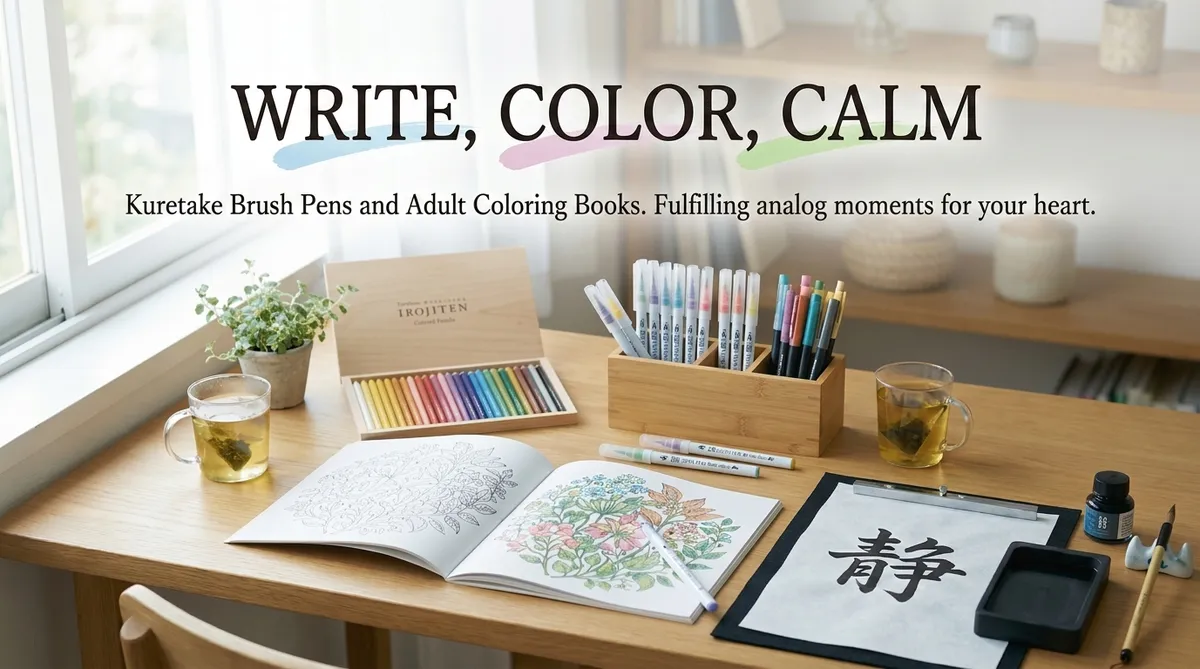
| Soft, creamy, easy blending | Tombow Irojiten | Wax-based, sold as a 90-color "dictionary" |
| Colored pencils you can erase | uni Arterase | Genuinely erasable, which is rare |
| "Oil-based" in Japanese means something different from "oil-based" in English. This trips up almost everyone — see the section below before you order. | ||
The Easiest Japanese Product to Buy
Most guides on this site have to open with an obstacle. A rice cooker needs the right voltage. A shower head needs the right thread. A cassette stove needs fuel you cannot ship.
Pencils have none of that. No electricity, no certification, no plumbing, no hazardous-goods rules. They are light, they are cheap, they do not break in transit, and the good ones are already stocked by Western art suppliers — Blick, Jackson's, JetPens, Cult Pens and the rest carry Hi-uni and Holbein as a matter of course.
So the only real question in this category is which one — and that turns out to be a more interesting question than usual, because one of the words you will read on the packaging does not mean what you think it means.
Why Japanese — 1903, and a Pencil You May Own
The three diamonds are older than the conglomerate's
Mitsubishi Pencil began supplying Japan's Ministry of Communications in 1901, and registered its three-diamond trademark in 1903 — a mark taken from the founding family's crest, three fish scales.
The Mitsubishi industrial group registered its own version a decade later. The two have never shared ownership, never been part of the same keiretsu, and have simply coexisted for over a century with near-identical logos. The pencil company was there first.
Blackwing is made in Japan
The Blackwing 602 was an American pencil, made by Eberhard Faber from 1934, discontinued in 1998, and mourned by writers and animators for over a decade. California Cedar brought it back in 2010 — and had it manufactured in Japan.
Californian incense cedar, Japanese graphite, Japanese assembly. The company describes its supplier only as Japan's finest art-pencil maker and has never publicly named it, which tells you something in itself.
What actually makes a good pencil core is boring and hard. Graphite and clay,
ground fine and mixed evenly. Fine, so the line is smooth rather than gritty. Evenly, so the
core does not have hard and soft spots that make it snap.
That is the entire competitive advantage, and it is a manufacturing-consistency
problem rather than a materials one — which is precisely the kind of problem Japanese
manufacturers tend to win.
Wax, Oil, Water: A Distinction Japanese Does Not Make
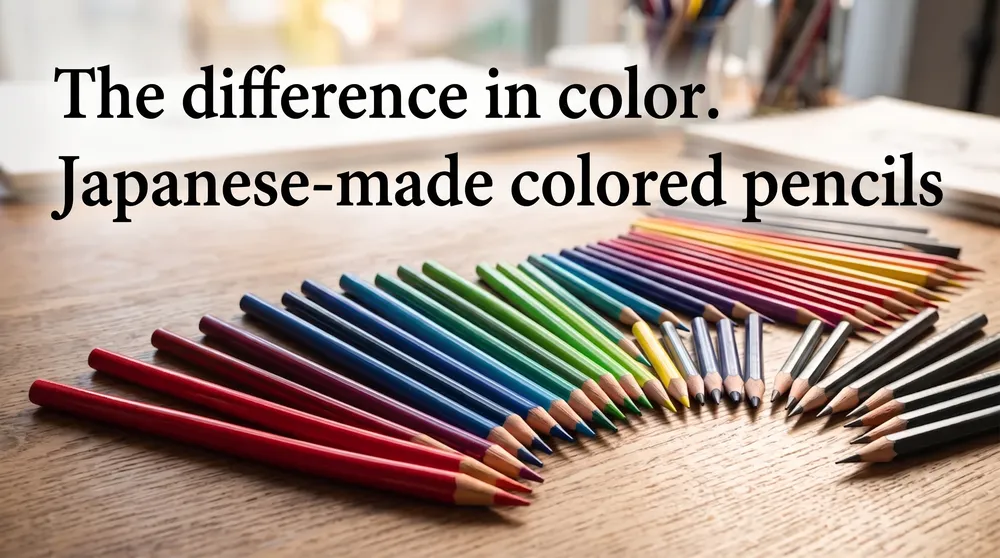
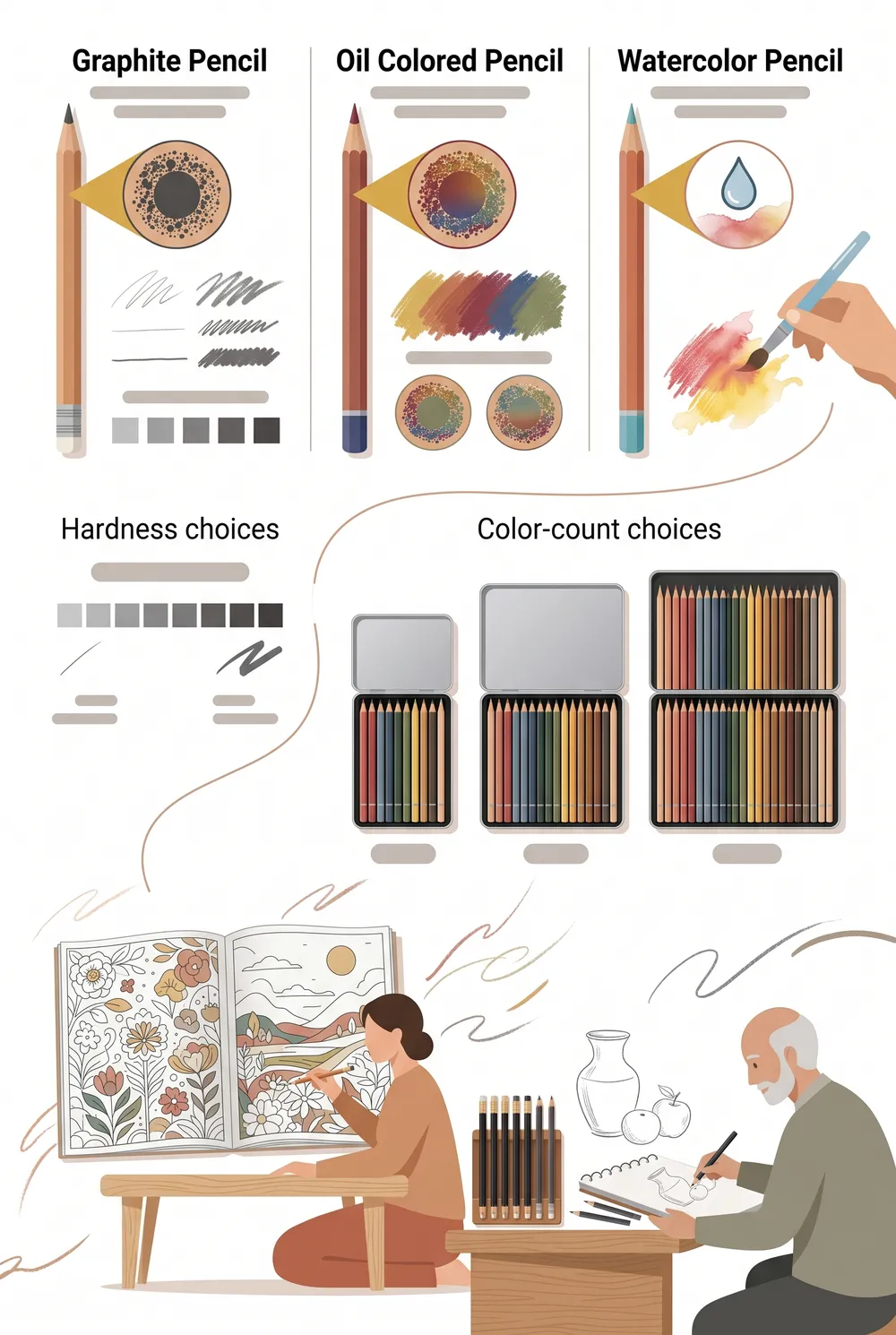
Japanese sorts colored pencils into two types: yusei (oil-type) and
suisai (watercolor). But yusei just means "does not dissolve in water" —
it covers both wax-based and oil-based pencils, which English treats as two different
things.
So a Japanese product page saying "oil-based" may well mean what English calls wax-based.
Check the core, not the label.
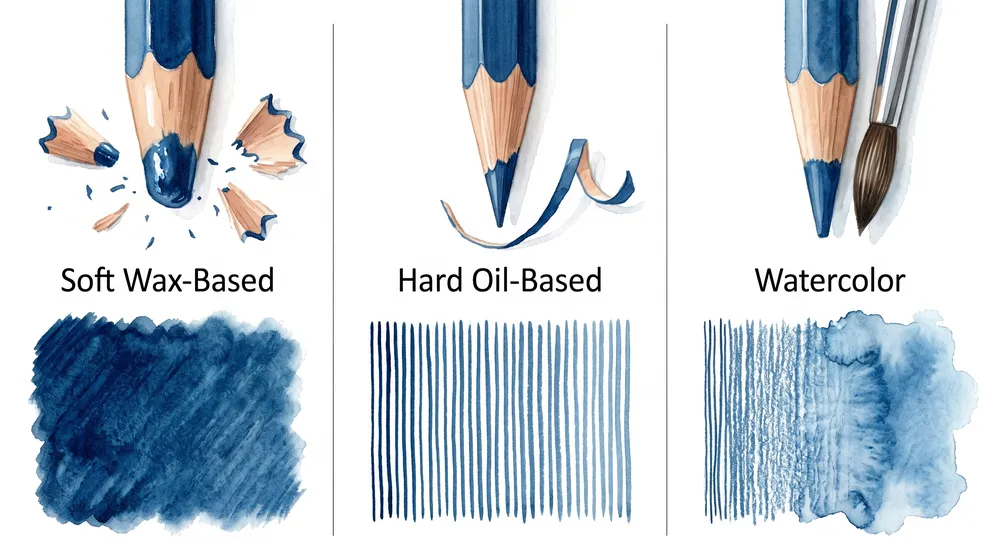
The difference matters in the hand, not on paper specifications:
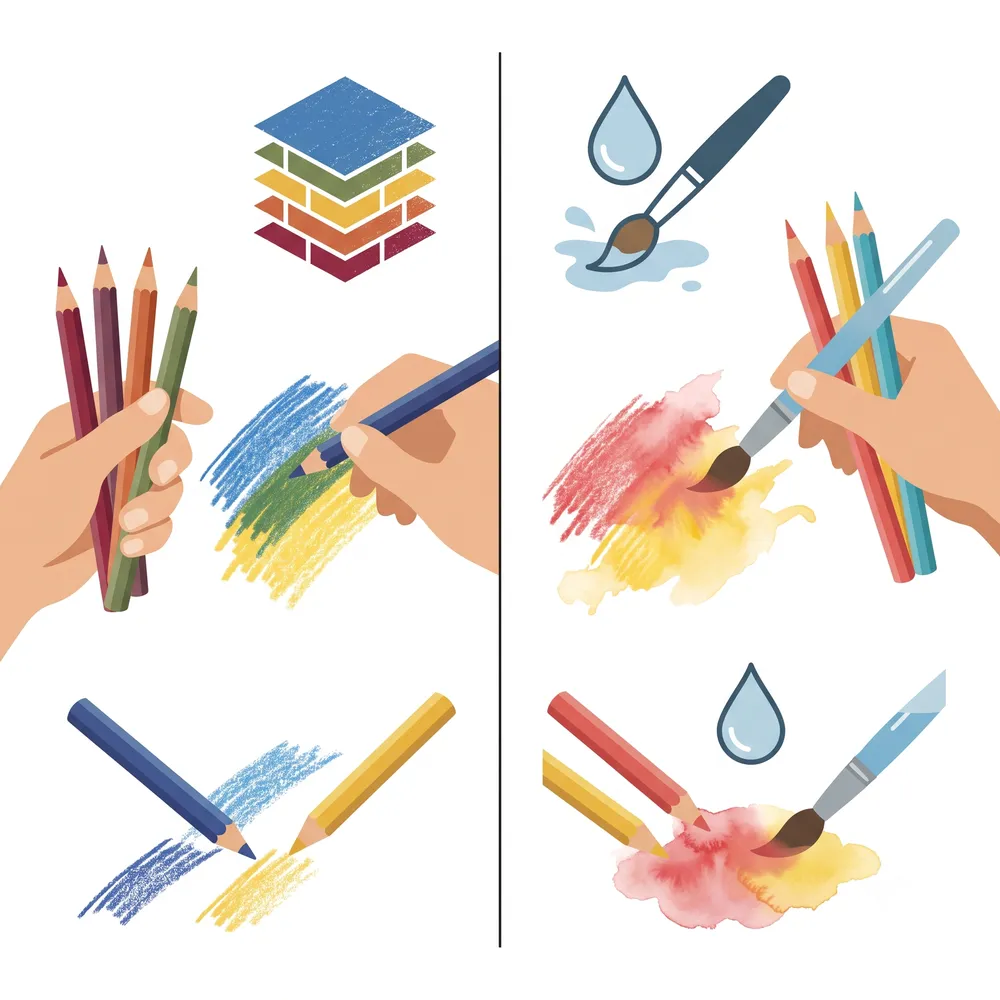
- Wax-based — soft and creamy, lays down colour fast, blends beautifully. The trade-off is that the point crumbles quickly and it produces wax bloom: a faint whitish haze that rises to the surface of finished work over days or weeks. It wipes off, and it comes back. Tombow Irojiten sits here.
- Oil-based — firmer core, holds a sharp point, no wax bloom. Better for detail and for work you intend to keep. Slower to fill large areas, and less immediately satisfying to blend. Holbein sits here.
- Water-soluble — draw dry, then run a wet brush over it and it becomes watercolour. Two mediums in one pencil, and excellent for travel sketching.
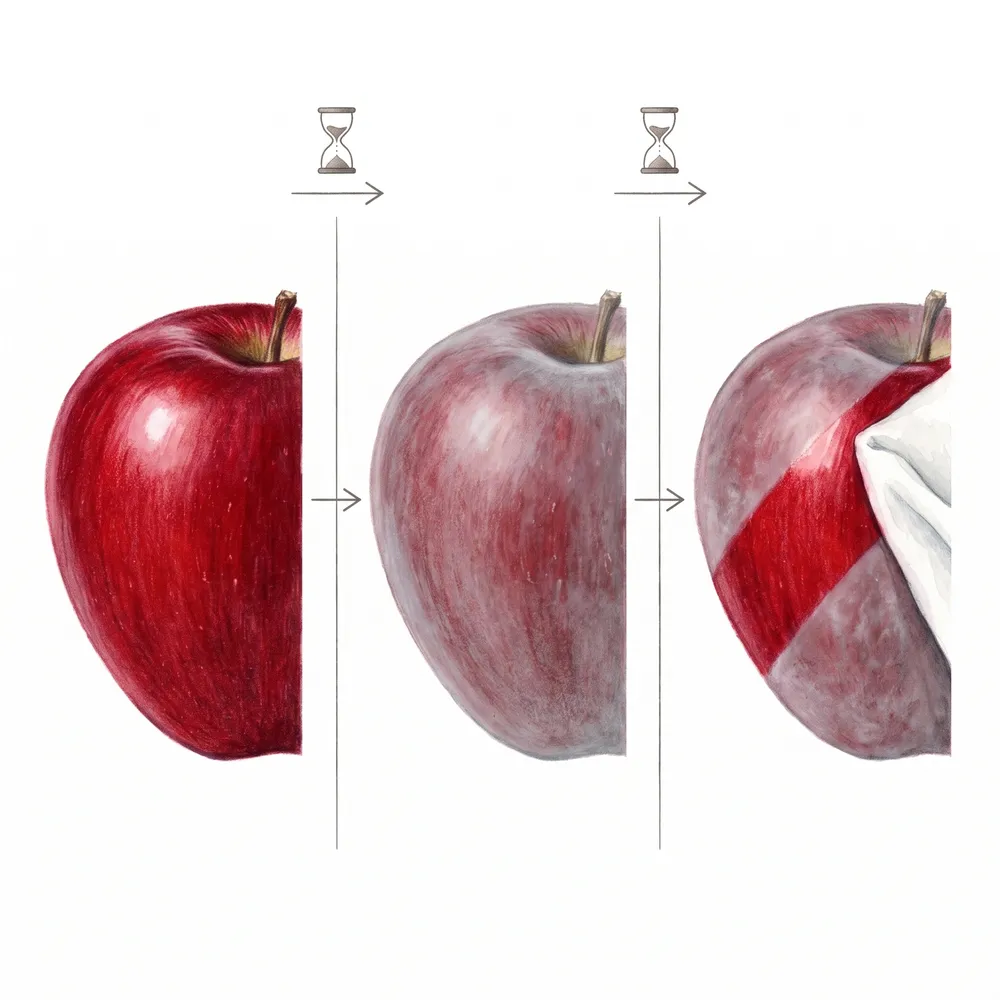
What wax bloom actually looks like
You will not see it on the day. Days or weeks later, a faint whitish film rises to the
surface — worst in the areas you laid down most heavily — and the colour beneath goes
flat and slightly chalky.
It wipes off with a soft cloth, and then it comes back. Fixative stops it. So
does buying an oil-based pencil in the first place, which is the whole reason the distinction
is worth caring about.
If you are choosing between them: oil-based for drawing, wax-based for colouring, water-soluble for sketchbooks. Most people who do a lot of this eventually own all three and reach for them by task.
HB Is Not a Standard
There is no international standard for pencil hardness. H and B grades are each manufacturer's own claim about its own range — which is why one brand's HB writes noticeably darker than another's, and why Japanese pencils have a reputation for running softer and darker than European ones at the same nominal grade.
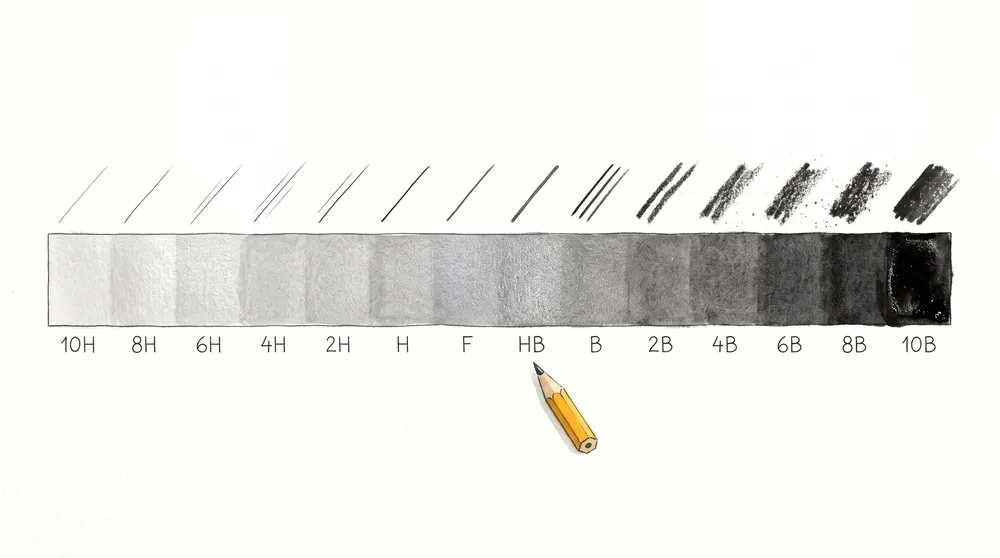
| Task | Grade | Note |
|---|---|---|
| Writing | HB to 2B | HB is what Americans call a #2 pencil |
| Drawing / shading | 2B to 6B | Buy several grades, not one |
| Technical / drafting | H to 2H | Fine, pale, holds a point |
| Under a colored-pencil layer | H or HB, light pressure | Soft grades smear into the colour |
Japanese children start on 2B
Where Western schools issue an HB or a #2, Japanese primary schools typically specify B or
2B for the first years — the reasoning being that a small hand cannot generate much
pressure, so a softer core produces a legible line without a struggle.
It is a small thing, but it is why the Japanese pencil aisle is weighted towards the soft end in a
way a Western one is not.
What to Buy
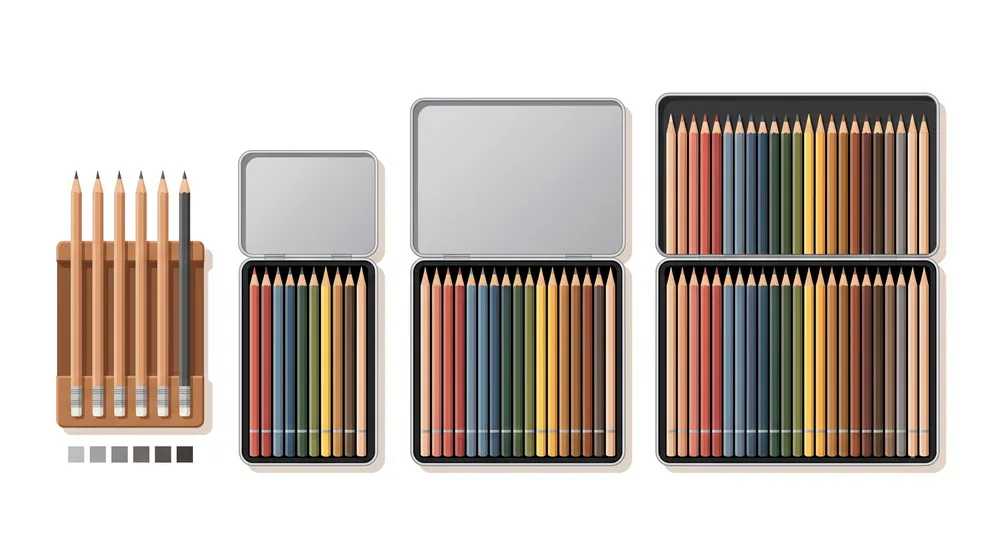
Mitsubishi Hi-uni — graphite, 22 grades
Introduced in 1966 and still the reference against which other premium graphite pencils are
measured. The full art set runs 10H to 10B — twenty-two grades, the widest range
any manufacturer offers, in a reusable aluminium case.
What you notice first is not darkness but consistency: the line does not
vary as you go, and the core does not snap under a shading stroke.
- Range
- 22 grades, 10H to 10B
- Introduced
- 1966
- Finish
- Deep maroon lacquer, gold accents, supplied unsharpened
- Where
- Widely stocked by Western art suppliers
- Price range
- $3 each; around $80–$120 for the 22-grade set
Perfect for: Anyone who draws. Also the cheapest way to find out whether the fuss about Japanese pencils is justified.
Holbein Artists' Colored Pencil — oil-based, 150 colors
The Japanese colored pencil that Western artists take most seriously, and the one to choose
if you want a point that stays sharp and work that does not develop wax bloom.
A 3.8mm core in a 7.8mm round barrel — unusually thick, so it puts down a lot
of pigment for an oil-based pencil, which is normally the weakness of the type. 150 colours,
available singly.
- Type
- Oil-based — no wax bloom
- Core
- 3.8mm, in a 7.8mm round barrel
- Colors
- 150, sold as sets or open stock
- Wood
- PEFC-certified
- Price range
- $3–$4 each; $500+ for the full 150
Perfect for: Detailed work, botanical and portrait drawing, and anything you intend to frame.
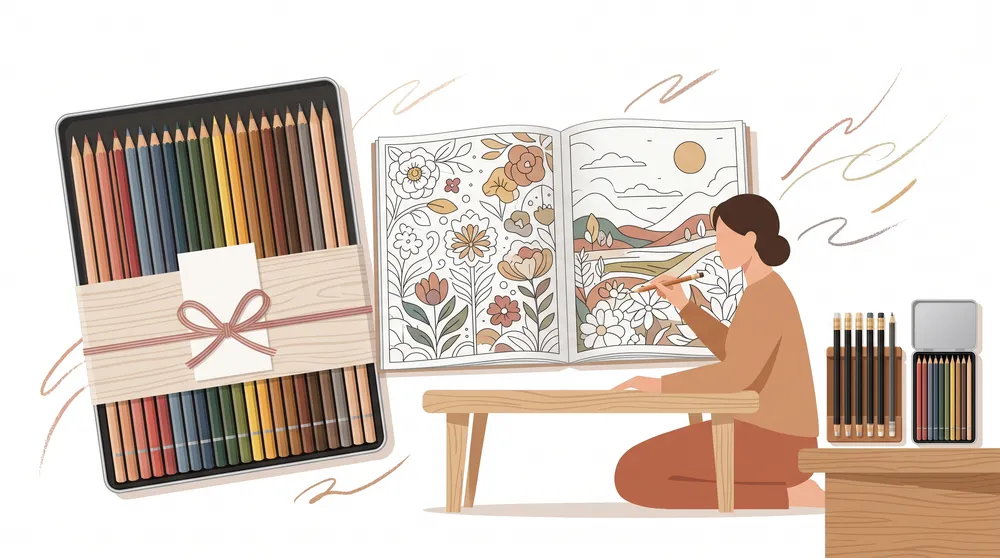
Tombow Irojiten — wax-based, sold as a dictionary
Irojiten means colour dictionary, and the packaging takes the idea
literally: ninety colours issued as three slipcased sets of three "volumes", each volume ten
colours, spines out on a shelf like reference books.
Wax-based, so it is soft, creamy and forgiving to blend — the natural choice
for colouring rather than drawing. Tombow sells it directly in the United
States, so it is one of the easiest to obtain.
- Type
- Wax-based — soft, creamy, blends easily
- Colors
- 90 total, as three 30-colour sets
- Sets
- Rainforest / Woodlands / Seascape
- Finish
- Enamel-coated barrels
- Price range
- $30–$45 per 30-colour set
Perfect for: Adult colouring, journalling, and anyone who wants to start with one set rather than commit to a system.
uni Arterase — colored pencils that actually erase
Colored pencils normally do not erase, because wax and oil bind the pigment into the paper
fibres. Arterase is formulated so an ordinary eraser lifts it, which is
unusual enough to be worth knowing about.
The trade-off is what you would expect — less intense than a pencil designed to stay
put — but for planning, underdrawing, or working with children it solves a real
problem.
- Type
- Erasable with a normal eraser
- Core
- Soft, designed not to score the paper
- Trade-off
- Lighter colour than permanent pencils
- Where
- Stocked by specialist stationery retailers in English markets
Perfect for: Sketching out a composition in colour, and for anyone who finds permanence stressful.
And the one you may already have
Blackwing is an American brand making Japanese pencils, sold worldwide, with a distinctive flat ferrule and replaceable eraser. If you have been curious about Japanese graphite and own one already, you have your answer and did not know it. blackwing602.com
Getting More Out of Them
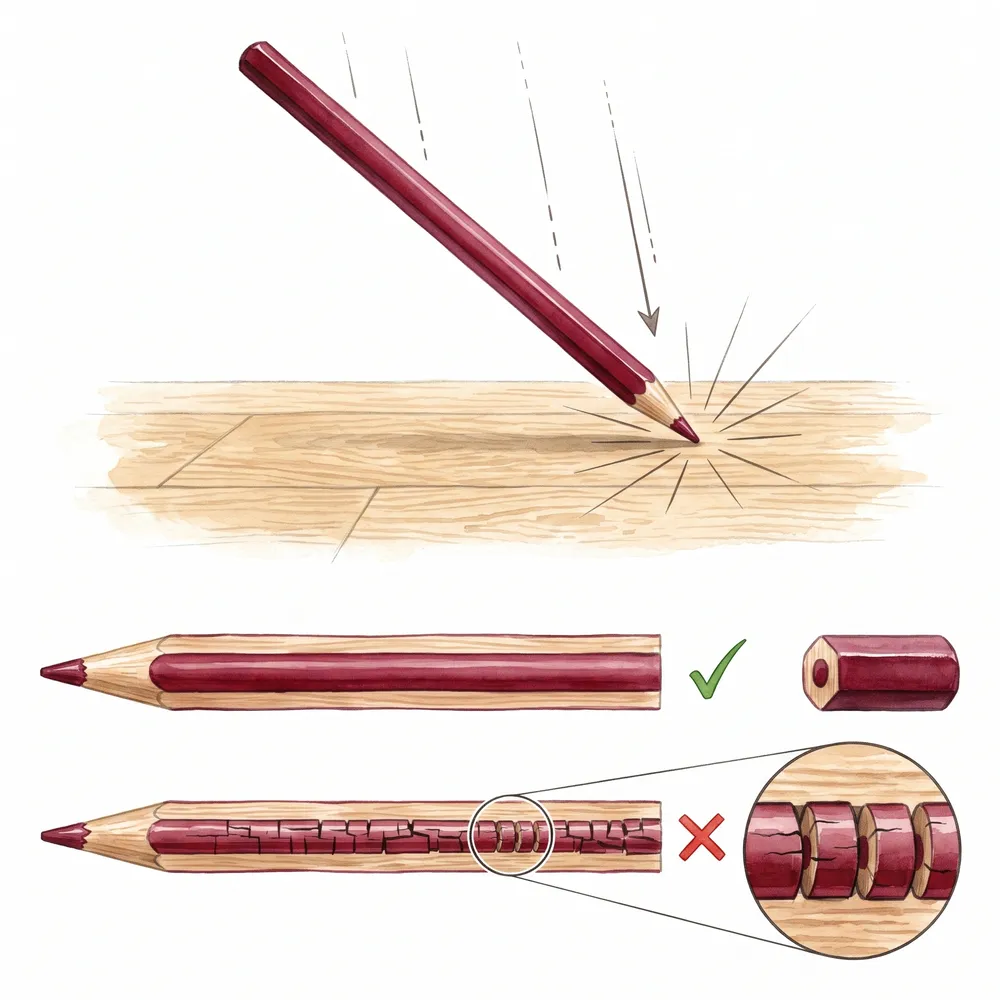
- Do not drop colored pencils. The core shatters inside the barrel along its whole length, and then it breaks off every time you sharpen — for the rest of the pencil's life. There is no fixing it. This is the single most common way good colored pencils are ruined.
- Sharpen gently, and less than you think. A long, fine point on a soft wax-based pencil is wasted; it will break on the first stroke.
- Vary the angle, not the pressure. Held low, the side of the core fills large areas evenly. Held upright, it does detail. Pressing harder mostly damages the paper and closes off the tooth you need for further layers.
- Underdraw in graphite, lightly, in H or HB. Colored pencil will not erase cleanly, so plan in something that will.
- If wax bloom appears, wipe it. A soft cloth removes the haze. On work you want to keep, a light spray fixative prevents its return — or use an oil-based pencil in the first place.
Frequently Asked Questions
Is Mitsubishi Pencil part of Mitsubishi?
No, and it never has been. Mitsubishi Pencil registered its three-diamond mark in
1903, drawn from the founder's family crest — ten years before the Mitsubishi industrial
group registered theirs.
Two unrelated companies, near-identical logos, more than a century of coexistence. The pencil
company got there first.
Are Blackwing pencils Japanese?
They are made in Japan. The brand is American — California Cedar revived the
discontinued Eberhard Faber pencil in 2010 — but production is Japanese, using Californian
incense cedar and Japanese graphite.
The manufacturer is described only as Japan's finest art-pencil maker and
has not been publicly named.
What is the difference between wax-based and oil-based?
Wax-based pencils are softer and blend more easily but suffer wax bloom — a
whitish haze that surfaces on finished work. Oil-based pencils hold a sharper point and do
not bloom, at the cost of being slower to fill an area.
Note the translation trap: Japanese calls both types yusei, which only
means "not water-soluble". A Japanese listing saying "oil-based" may mean either.
Is a Japanese HB the same as a Western HB?
Not necessarily — there is no international standard for pencil grades. Each
manufacturer grades against its own range, and Japanese pencils tend to run softer and
darker at the same nominal grade.
For reference, the American #2 pencil is HB. If you are buying to draw, buy
several grades rather than trying to predict one.
How many colors do I need?
Twelve to twenty-four to start, thirty-six or more to stop wishing you had more.
Layering and blending get you a long way from a small set, and a beginner with 150 colours mostly
has a storage problem.
Buy the smallest set of a good pencil rather than a large set of a mediocre one —
both Holbein and Irojiten sell singly, so you can extend later.
Can colored pencils be erased?
Generally no. Wax and oil bind the pigment into the paper, and a normal eraser
only lightens it. A kneaded eraser pressed gently onto the area lifts a little more.
The exception is uni Arterase, formulated specifically to erase — which is the
whole reason it exists.
Final Thoughts: The Cheapest Way In
Almost everything else on this site asks you to think about voltage, shipping or certification. A pencil asks you for three dollars. That makes this the one Japanese category where you can simply try the best thing available and decide for yourself.
Buy one Hi-uni in 2B and one in 4H before you buy a set of anything. The difference between a good pencil and an ordinary one is not a claim that survives description — it is a thing you notice in the first line you draw, or you do not.
And if the label says oil-based, check whether it means oil-based or merely not-watercolour. That one word is the difference between a point that stays sharp and a drawing that hazes over in a fortnight.
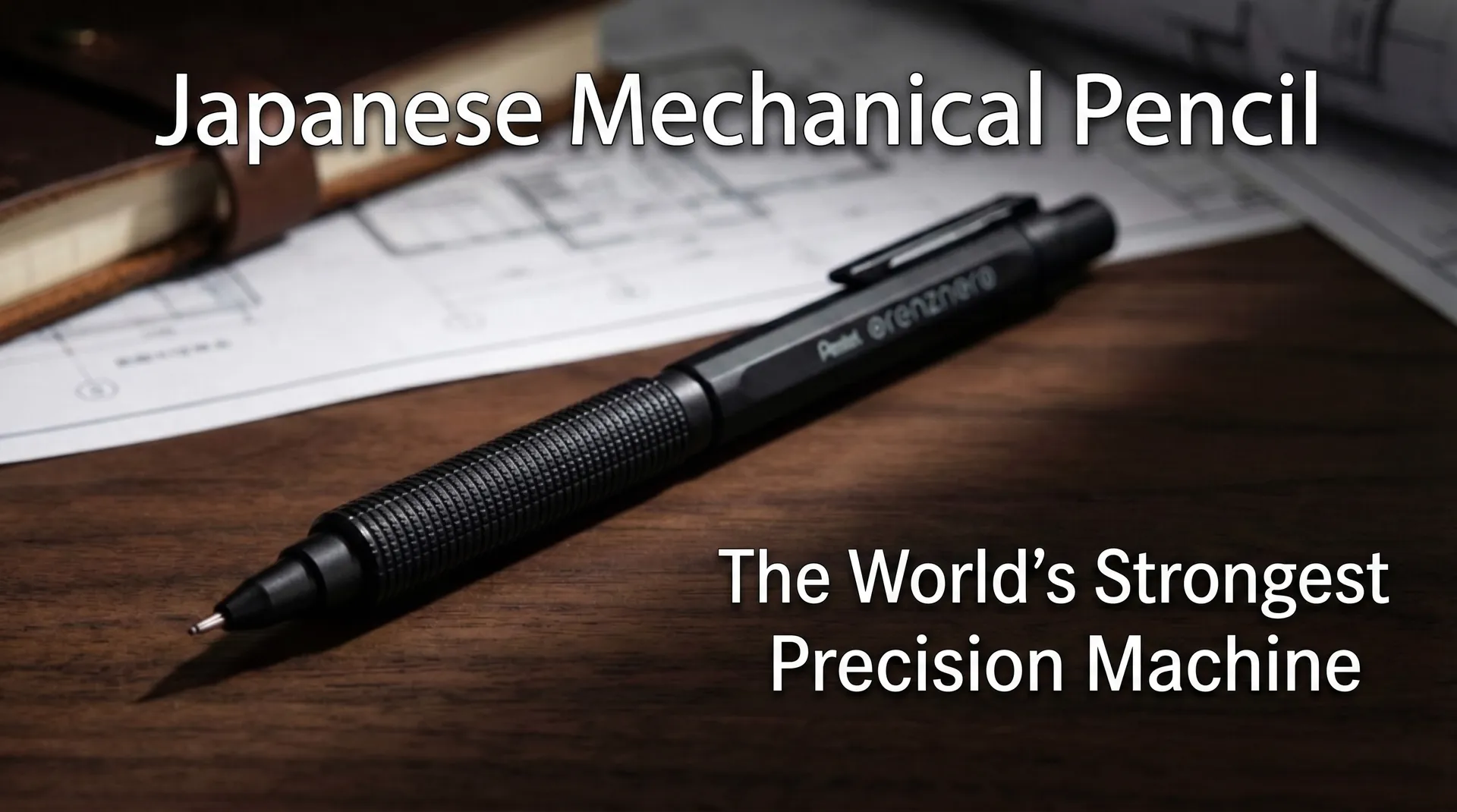
Japanese Mechanical Pencils: Kuru Toga and Beyond
Calligraphy and Coloring: Slow Hobbies From Japan