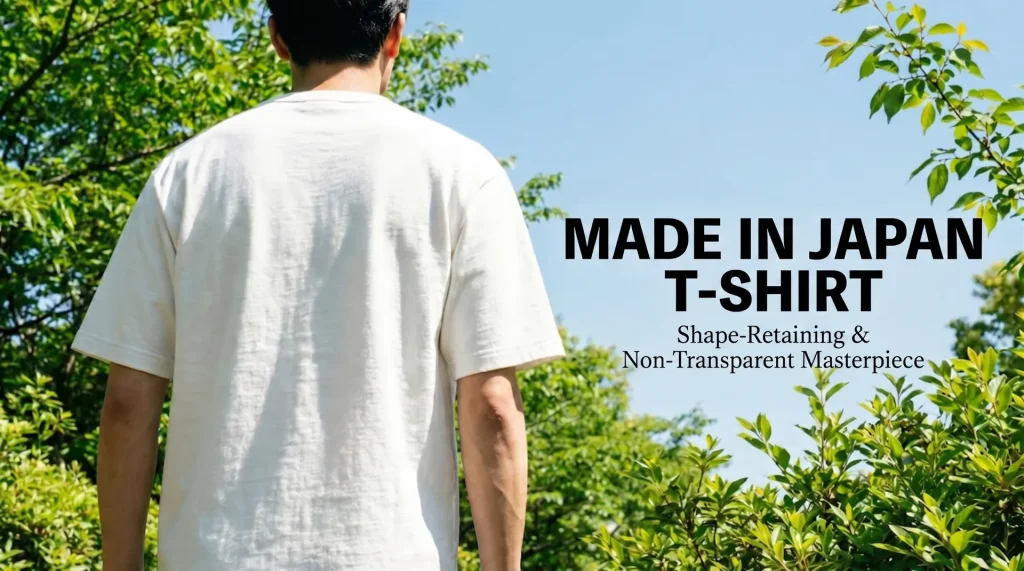
You bought a T-shirt you liked — and after three washes the collar is stretched out and misshapen.
You want to wear a white T-shirt on its own, but the transparency is embarrassing.
If either sounds familiar, the solution is not a different brand of the same cheap T-shirt — it's a Japanese heavyweight loop wheel
T-shirt.
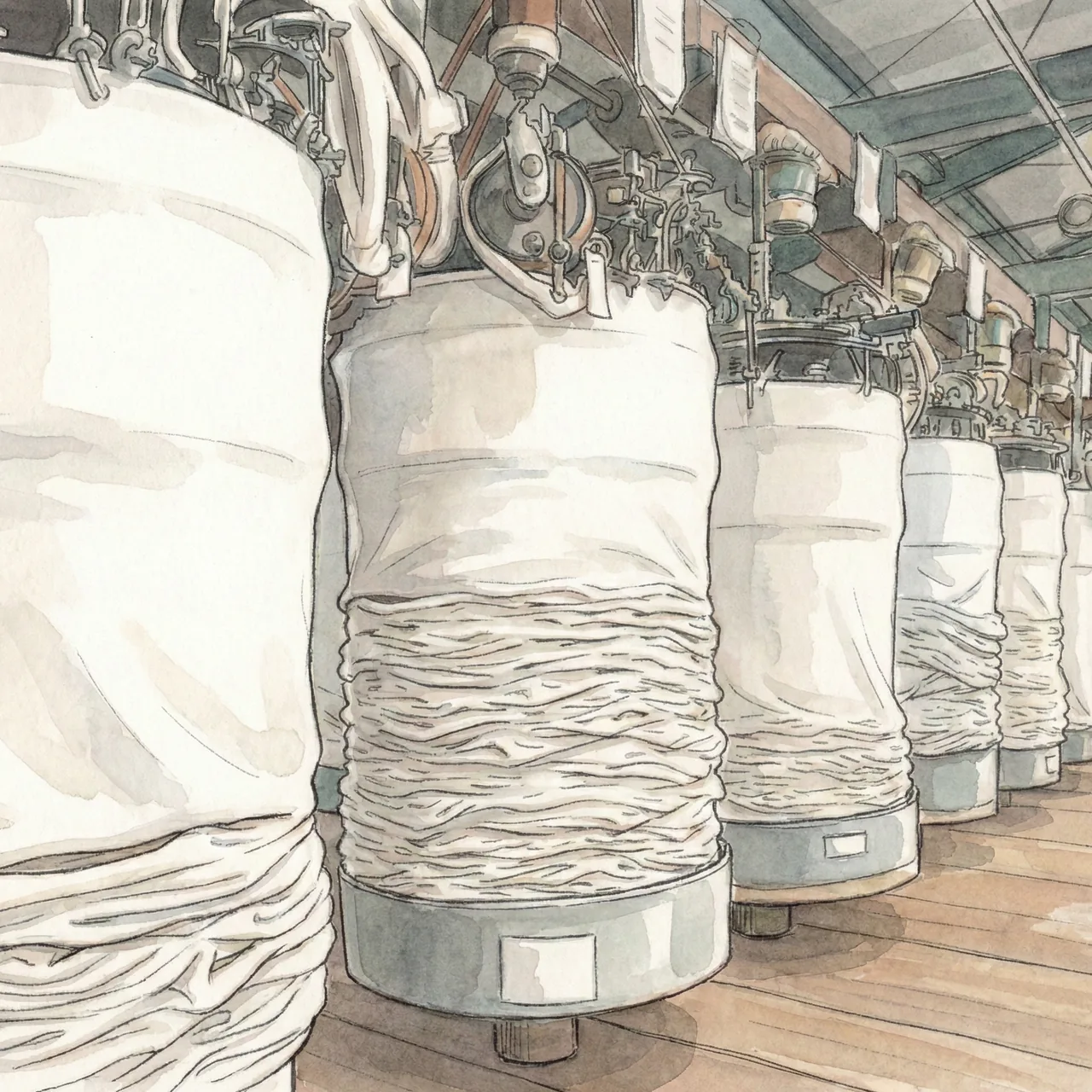
In Wakayama Prefecture, a small number of antique knitting machines — called tsuriami-ki (loop wheel
machines) — are still in operation, producing fabric the modern world has largely forgotten how to make. These
machines knit so slowly that a modern high-speed machine produces in one minute what a loop wheel produces in an
hour. The result is fabric with an almost hand-knitted quality: extraordinarily soft, full of air, and structurally
stable enough to survive a decade of regular washing without losing its shape.
This guide covers the engineering behind loop wheel fabric, how to choose the right weight for a see-through-free
white T-shirt, and the Japanese brands that have made this forgotten technology their identity.
1. The Loop Wheel Machine | Wakayama's Living Relic
Any serious discussion of Japanese T-shirts leads quickly to the tsuriami-ki (loop wheel machine) —
an antique knitting machine that survives almost exclusively in Wakayama Prefecture.
Why does a machine this old produce fabric that the entire modern textile industry cannot replicate?
One Meter Per Hour — and Why That Inefficiency Is the Point
A modern high-speed knitting machine produces in one minute what a loop wheel machine takes an hour to produce.
The loop wheel is not faster — it's hanging from the ceiling, knitting under gravity alone, applying almost no
tension to the yarn as it forms.
This zero-tension construction is everything. The loops of yarn are not pulled or stretched during manufacture —
they retain their full volume and natural loft. The finished fabric has a softness described as "air
trapped in cloth", combined with a structural integrity that high-speed-knitted fabric simply cannot
match.
It is, in the truest sense, something only handcraft or its closest mechanical equivalent can produce.
Tubular Body — No Side Seam, No Twisting
Cheap T-shirts develop a frustrating problem after repeated washing: the side seams rotate toward the front,
twisting the garment out of shape.
Loop wheel machines knit in a continuous tube, producing what is called a marudo (round body) — a
seamless cylinder with no side seam at all. Without a side seam, there is nothing to migrate. The T-shirt
maintains its correct orientation through washing after washing, year after year.
2. No See-Through, No Awkward Lines | Choosing the Right Ounce Weight
For a T-shirt worn on its own, the two things that matter most are see-through and silhouette. Both are directly determined by fabric weight — measured in ounces (oz).
| Weight (oz) | Thickness | Transparency / Best Use |
|---|---|---|
| 3–4 oz | Lightweight | Undershirt / base layer. Definitely see-through when worn alone. |
| 5–6 oz | Standard | Typical printed T-shirt weight. White versions may still feel uncomfortably thin. |
| 7 oz+ ★ Recommended |
Heavyweight | No see-through, even in white. The fabric doesn't cling to the body, providing coverage without compression. |
For a white T-shirt worn without a layer underneath, 7 oz or above is the clear target.
If you find heavy fabrics stiff and uncomfortable, choose a loop wheel version — the construction gives heavyweight
fabric a softness that defies the weight.
3. Top Japanese T-Shirt Brands
Material, construction, silhouette — all considered. The definitive Japanese brands for a T-shirt worth investing in.
ENTRY SG
The starting point for anyone new to loop wheel T-shirts.
Made at a factory in Tokyo using recycled cotton, ENTRY SG is the brand most closely associated with bringing loop
wheel fabric to a wider audience.
Their signature "Excellent Weave" T-shirt has a melt-against-the-skin softness that is immediately apparent — and
a binder neckline that holds its shape through washing after washing without budging.
The color range is exceptional, making it the best option for adding a considered accent color to a wardrobe.
ENTRY SG Excellent Weave — Loop Wheel T-Shirt
Tokyo-made recycled cotton loop wheel T-shirt. Melt-soft texture, binder neckline that never stretches, exceptional color range — the definitive entry into Japanese loop wheel fabric.
Visit Official SiteBARNS OUTFITTERS
The feeling of vintage Americana, produced new with Japanese craft.
BARNS OUTFITTERS recreates the atmosphere of 1950s–60s American workwear through Japanese manufacturing — a
combination that has earned them devoted fans in both countries.
The seaming is done on a rare Union Special flatseamer: the seam lies completely flat against the skin, creating
zero friction or irritation even without an undershirt.
The loop wheel fabric has an already-broken-in quality from the moment you put it on — the feeling of a worn-in
vintage piece without waiting years for it.
View BARNS OUTFITTERS Brand Details
BARNS OUTFITTERS — Loop-Wheeled Plain Henley T-Shirt (Made in Japan)
Japanese reproduction of 1950s–60s American workwear. Union Special flatseam construction, loop wheel fabric with immediate vintage character — worn-in feeling from day one.
View on AmazonKume Seni Kogyo (KUME)
Japan's T-shirt pioneer — in Kinshicho, Tokyo since 1935.
Founded in 1935, KUME is a third-generation family-run factory in Kinshicho, Tokyo, widely credited as the first
manufacturer to produce T-shirts in Japan.
Their "Sei Young" T-shirt — said to have been favored by film stars of the golden era — features exceptionally
fine stitching at the cuffs and hem, and is cut from a pattern developed specifically for Japanese body
proportions. The fit when you first put it on is described by repeat customers as immediately, inexplicably
"right."
Jackman
Baseball uniform toughness applied to everyday T-shirts.
A brand born from a Fukui Prefecture factory whose founder was passionate about baseball — so the construction DNA
comes from the demands of athletic uniform manufacturing.
The "do-zume" (tightly packed) high-density knit has a firmer, more structured feel than typical T-shirts — ideal
for anyone who prefers a fabric with substance rather than drape.
Built to be washed aggressively and come back looking intact — machine-wash-and-go durability with no special
handling required.
Jackman — High-Density Knit Japanese T-Shirt
Fukui-made, baseball-tough. High-density do-zume knit with structured hand feel — built for aggressive machine washing with no shape loss. For those who prefer substance over drape.
Visit Official Site4. Sizing and Shrinkage | What to Expect
Sizing and post-wash shrinkage are the two things to get right before buying a Japanese T-shirt.
Does 100% Cotton Shrink When Washed?
Most Japanese T-shirts undergo a "one-wash" finishing process during manufacturing, which pre-shrinks the fabric
before it reaches you. This significantly reduces first-wash shrinkage — but expect 1–2 cm of body length
reduction over the first few washes regardless.
Sizing rule of thumb:
If you normally wear a Medium in an American brand (Hanes, Fruit of the Loom, etc.), a Japanese brand's
Large is typically the better fit.
Loop wheel T-shirts in particular tend toward a slim, fitted silhouette. If you prefer a relaxed fit, size up by
one — this is a strong recommendation, not a suggestion.
5. How to Dry a T-Shirt Without Stretching the Collar
Even an excellent T-shirt is ruined in one drying session if the method is wrong. A stretched collar is caused entirely by the weight of wet fabric pulling on the neckline.
Never Hang from the Collar — Use the "Banzai" Method or Fold-Over
Threading a hanger through the collar puts the full weight of wet fabric on the neckline — it will stretch
irreversibly.
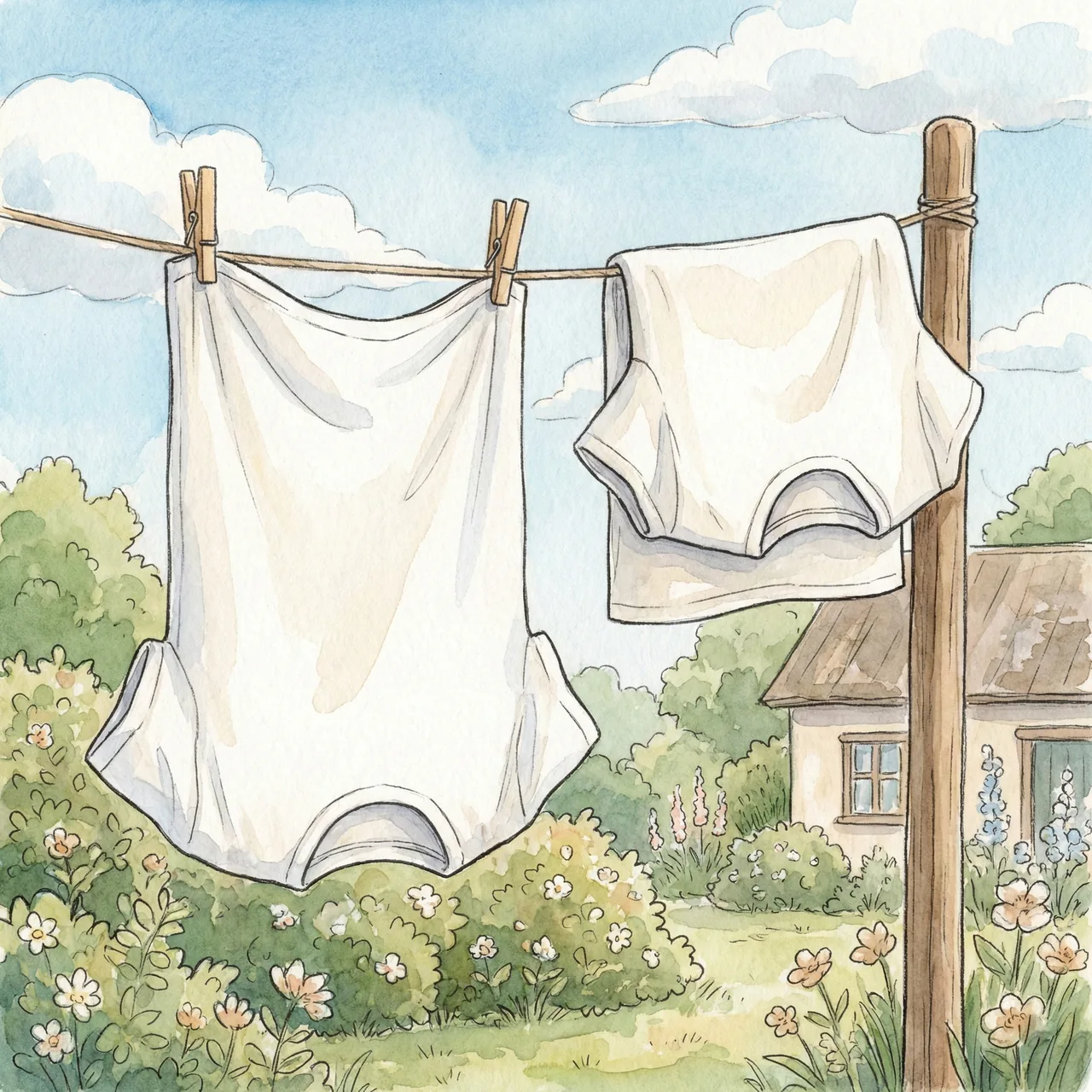
Method 1 — "Banzai" (upside-down) drying:
Clip the hem with laundry pegs and hang the T-shirt upside down. Gravity now pulls toward the hem rather than
the collar — zero stress on the neckline.
Method 2 — Fold-over drying:
Drape the T-shirt folded in half over a drying rack or rod. The fabric is supported at the center, and neither
the collar nor the hem bears the full weight.
6. Frequently Asked Questions
Can I use a tumble dryer?
No — avoid the dryer for 100% cotton T-shirts.
Tumble dryer heat causes cotton fibers to contract violently. A single cycle can shrink a T-shirt by a full size
or more — three to five centimeters of body length — turning an adult garment into something unwearable.
If longevity is the goal, air-dry only.
How do I prevent yellow staining on white T-shirts?
Yellowing is caused by sebum (skin oil) oxidizing in the fabric. The rule is to wash the same day you wear the
shirt — don't let body soil sit overnight.
If yellowing has already developed, a warm-water (40°C) soak with enzyme-based detergent is the most effective
home treatment — the same approach used for sneaker cleaning.
More detail on this method:
$50–$80 for a T-shirt — is that really justifiable?
When calculated per wear, a quality Japanese T-shirt is often cheaper than fast fashion.
A $15 T-shirt worn 30 times before it deteriorates costs $0.50 per wear.
An $80 loop wheel T-shirt worn 150 times over five years costs approximately $0.53 per wear — essentially the
same.
The difference is not in cost-per-wear — it is in the daily experience of wearing something well-made, the absence
of collar embarrassment, and the elimination of the annual "replace the T-shirts" exercise. That gap is real and
measurable.
Even with a heavy-weight T-shirt, should I still wear an undershirt?
Not for opacity — but yes for garment longevity.
At 7 oz or above, there is no see-through issue. But wearing a T-shirt directly against bare skin in summer means
sebum and sweat absorb directly into the fabric, accelerating collar yellowing and fiber degradation.
If you want the T-shirt to last years, wearing a seamless beige base layer (something like Uniqlo AIRism)
underneath keeps the outer T-shirt clean and extends its life significantly — and it is invisible from the
outside.
What do I do when pilling appears?
Never pull pills off by hand — use a fabric shaver or small scissors only.
Pills tend to form in friction zones: underarms, areas where a bag strap rubs, the lower hem. Pulling a pill off
by hand pulls the fiber thread from the fabric, creating a thin spot that eventually becomes a hole.
A fabric shaver removes only the surface ball, leaving the fiber intact. Cotton pills are softer and easier to
remove than synthetic fiber pills — a brief pass with a shaver restores a near-new appearance.
Editor's Note: Five Years In — Here's What Loop Wheel Looks Like
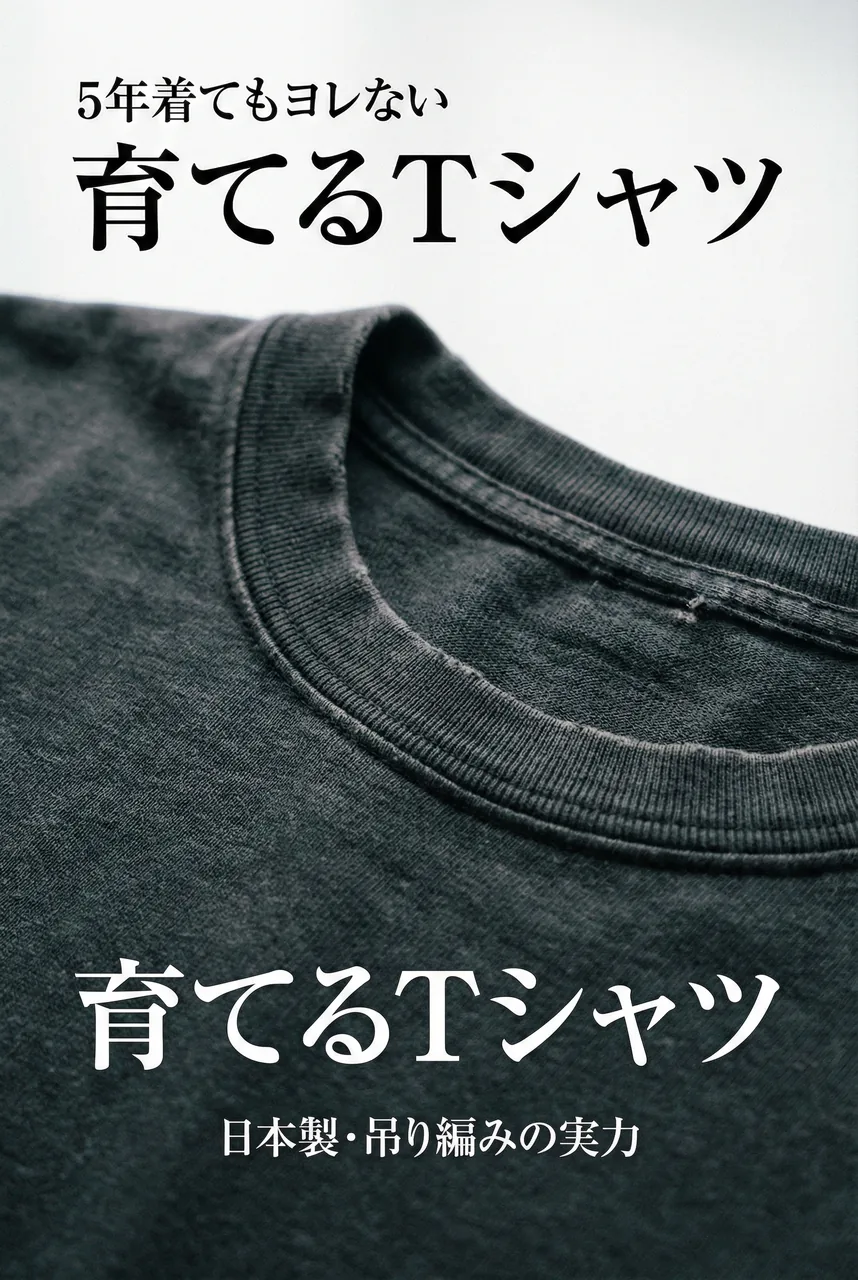
This T-shirt has been worn hard. The color has faded.
But the collar is exactly where it was on day one — not a millimeter of stretch.
The surface has developed a slight texture, like a piece of well-worn denim. That is not deterioration. That is
what a good T-shirt does.
A $70 loop wheel T-shirt worn for five years carries a different relationship to the object than ten $7 T-shirts
discarded over the same period. One of them gets better. The others get worse.
Try one this summer. Give it a season. Let it start to become something.