
A Japanese pillow is smaller, firmer and far more breathable than a Western one — traditionally
filled with buckwheat husks (soba-gara) or, in modern versions, with plastic pipes, and sized to support
the neck rather than cradle the whole head.
The three Japanese pillow brands most worth buying for neck pain are Nishikawa, LOFTY, and Makura no
Kitamura — all built firm, breathable, and adjustable in height, so your neck keeps its natural curve
instead of sinking the way it does in a soft Western pillow.
"I bought an expensive pillow, but I still wake up with a stiff neck."
"I sleep perfectly in hotels — so why do I keep waking up at home?"
The answer is almost always the height and material of your pillow — not its price.
Compared to European skull shapes, East Asian heads tend to have flatter occiputs, and Japan's hot, humid summers demand excellent airflow from bedding. The result: a soft, sinking Western-style pillow often does more harm than good. What works better is a Japanese-made pillow — supportive, breathable, and adjustable.
This guide covers why buckwheat (soba-gara) pillows are having a revival, the precision advantages of plastic pipe fill, and the models from veteran Japanese bedding makers that have helped countless stiff shoulders finally relax.
1. How to Choose a Pillow: Height and Firmness Are Everything
Design and price matter far less than finding a pillow that matches your body's specific geometry.
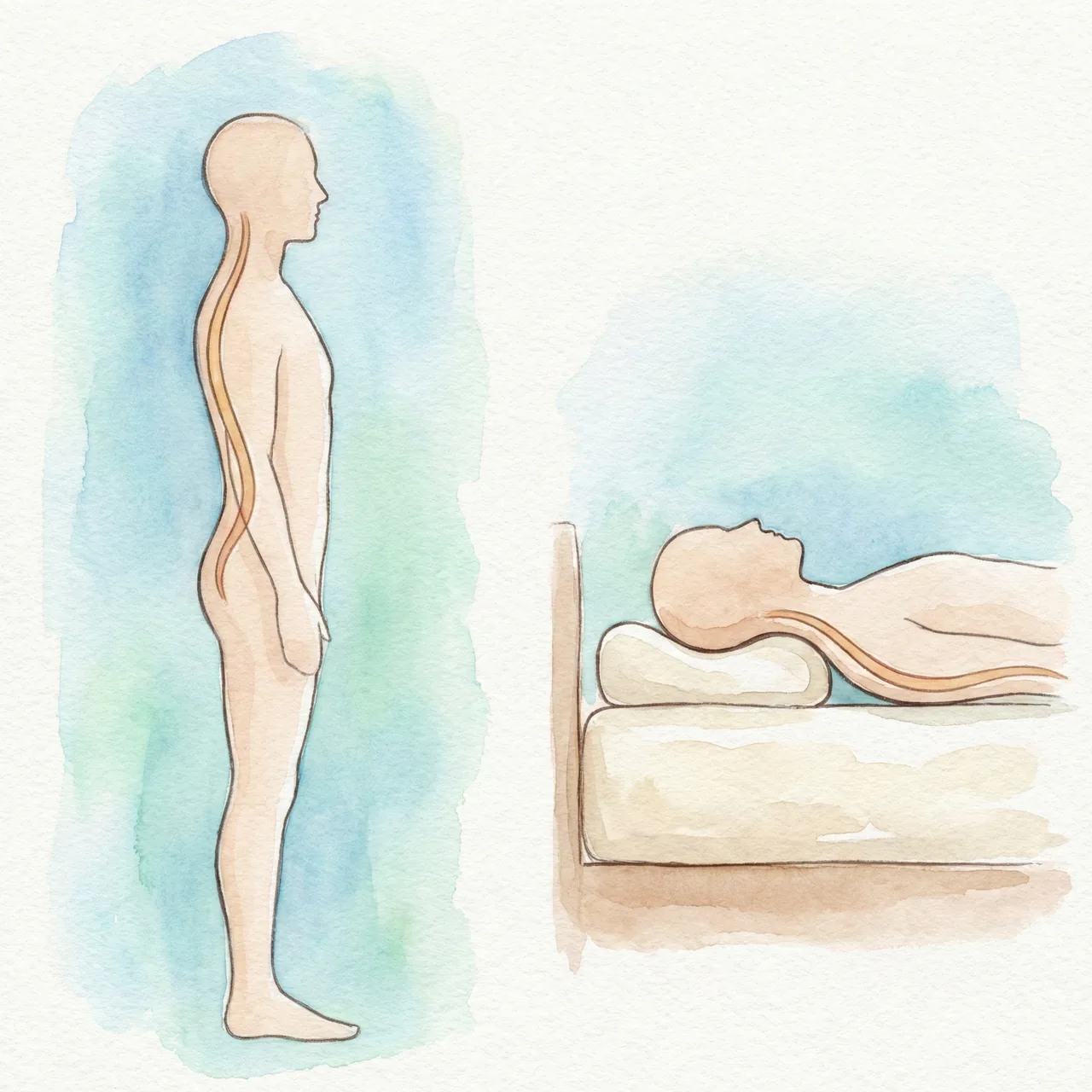
The ideal sleeping posture mirrors how you stand — the pillow fills the gap
A good pillow does one thing: it maintains the same natural S-curve in your spine that you have when standing upright.
Specifically, it needs to fill the gap between the mattress and the natural arch of your cervical spine (the back of the neck).
Too high, and your airway narrows — causing snoring and a sore throat. Too low, and the neck muscles work through the night to compensate, causing the classic "stiff neck by morning" that plagues so many people.
Why Japanese people tend to prefer firmer pillows — and why that helps you turn over
The cloud-soft pillows common in Western hotels look inviting, but there's a hidden drawback: when your head sinks deeply into the fill, the pillow grips it in place. Sleep requires regular positional shifts — rolling over (negaraeri) is how the body redistributes pressure and maintains circulation through the night.
A pillow that holds the head too rigidly prevents this movement. Firmer fill — buckwheat, pipe, or high-rebound foam — allows the head to shift more freely, reducing shoulder strain and improving sleep quality across the night.
Japanese Pillows for Neck Pain: Why They Help, and How to Get the Height Right
If you're here because you wake up with a stiff or aching neck, this is the section that matters. The short version: most morning neck pain is a height problem, and Japanese pillows are built around fixing exactly that.
Your cervical spine has a natural forward curve. When a pillow is too high, the neck bends forward all night; too low, and the head drops back and the muscles around the neck and shoulders work overtime to compensate. Western plush pillows make this worse by changing height as they compress. Japanese pillows attack the problem from two directions: firm fills that hold a consistent height all night (buckwheat, pipe), and adjustable construction — most quality Japanese pillows have zippered chambers so you can add or remove fill until the height matches your body, often separately for the center and the sides.
Getting the height right at home is simple: lie on your back and have someone check your face angle. Your gaze should point slightly downward toward your feet — roughly a 5-degree tilt — not straight at the ceiling with your chin up, and never chin-to-chest. On your side, your forehead, nose, and breastbone should form one straight, level line. If you can't hit that line, adjust the fill — or slide a folded towel under the pillow in 1-centimeter steps until you can. Japanese sleep-fitting stores do precisely this with measuring rigs; the towel method gets you most of the way there for free.
Did you know: Japan measures pillows in millimeters
Japanese pillow makers take height so seriously that premium brands like Nishikawa run in-store fitting services that measure the depth of your neck's curve — and then adjust the pillow's internal chambers in 5-millimeter increments. Five millimeters sounds like nothing, but it's roughly the difference between your neck muscles resting all night and working all night. It's also why "just buy a softer pillow" so rarely fixes neck pain.
2. Buckwheat (Soba-gara) Pillows: Heat Dissipation and Firmness for Eastern Heads
The soft crackling sound of buckwheat husks shifting underhead is nostalgic for many Japanese. Modern sleep science explains why it's been trusted for centuries.
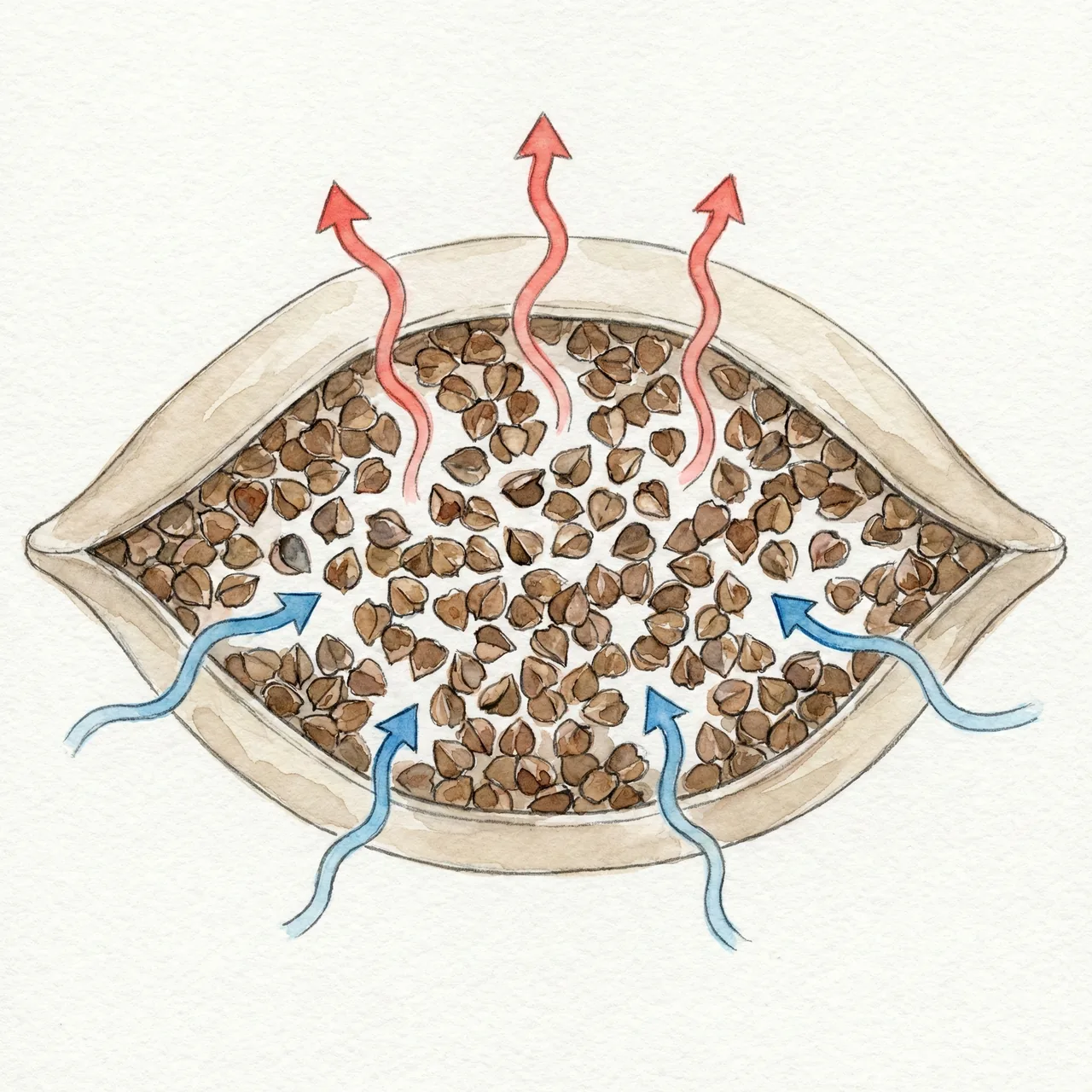
Exceptional ventilation: buckwheat keeps the head cool through Japan's humid summers
Buckwheat husks (soba-gara) are the dried outer shells of buckwheat seeds. Because they stack loosely without compressing flat, air moves freely through the fill — drawing heat and moisture away from the head as you sleep.
Traditional Japanese health wisdom recommends keeping the head cool and the feet warm during sleep (zukansokunetu). A buckwheat pillow achieves the "cool head" part naturally, making it especially suited to Japan's hot, humid summers.
Modern sterilized buckwheat: allergies and insects are a solved problem
Older buckwheat pillows sometimes developed mites or mold if moisture got in — a fair concern that put many people off the material.
Modern Japanese-made buckwheat pillows are heat-sterilized and deep-cleaned during production, eliminating virtually all pest and microbial risk. The one genuine caution: anyone with a buckwheat (soba) food allergy should avoid these, as the protein can be present in the husks.
Did you know: The husk's shape is the air conditioner
A buckwheat husk is a tiny, hollow, three-sided pyramid. Piled by the thousand inside a pillow, the husks can never pack flat — every one of them traps an air channel against its neighbors. That's why a buckwheat pillow stays cool on a humid summer night without any "cooling gel" technology: the ventilation is built into the seed's geometry. Japanese households have used this trick for centuries, sun-drying the husks each season to refresh them.
3. Plastic Pipe Pillows: Machine-Washable and Perfectly Adjustable
Small hollow plastic tubes — the modern evolution of buckwheat. The same supportive firmness and airflow, updated for today's hygiene standards.
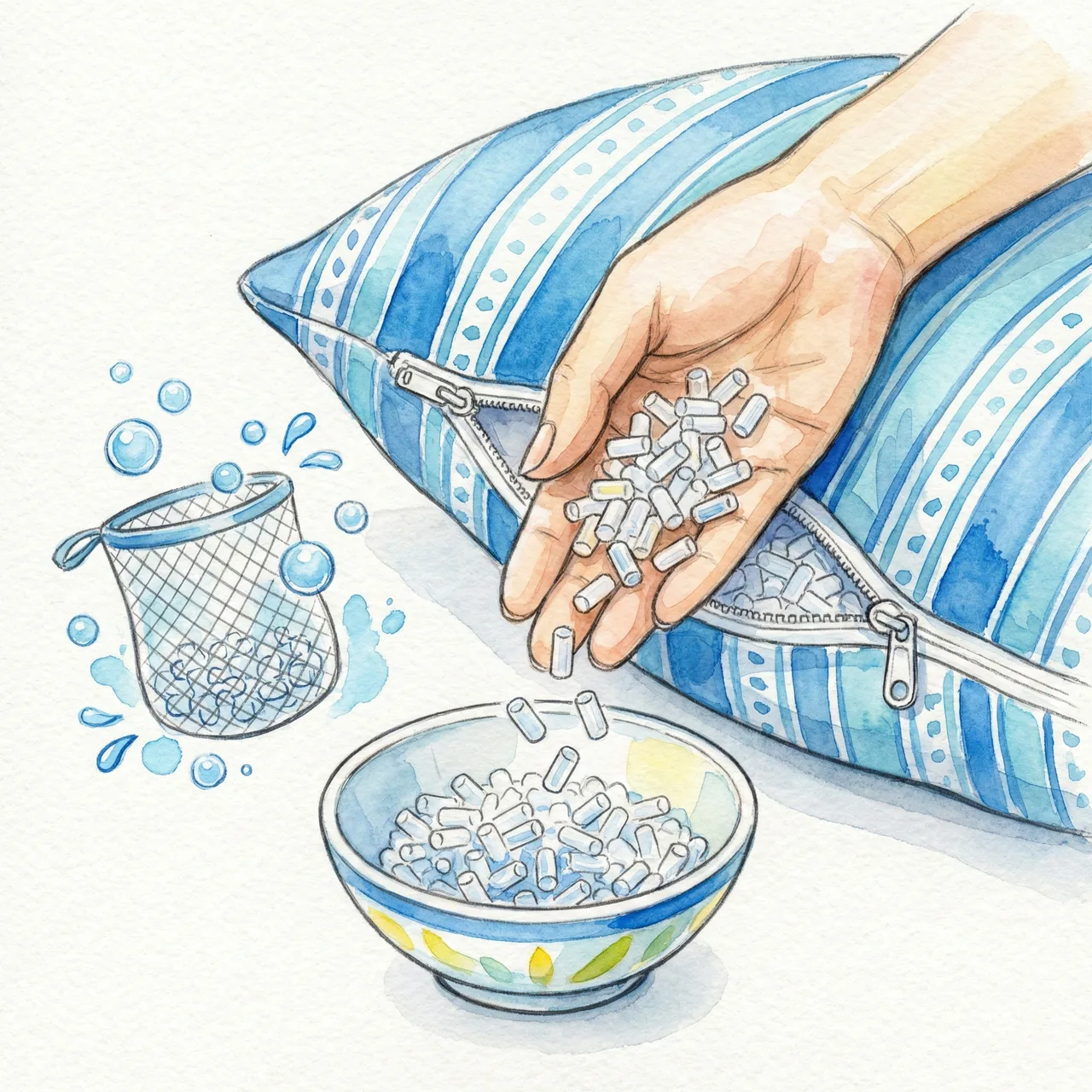
Zip open and adjust fill volume to the millimeter — at home, any time
The greatest advantage of pipe pillows is the zipper. Open it, add or remove a handful of tubes, and the pillow height changes precisely — no guesswork, no waiting weeks for foam to break in.
"I want it 5mm higher on the neck side" or "I need less support when lying on my side" — these adjustments take about thirty seconds. Once you find your ideal configuration, the tubes don't compress over time, so the height stays consistent for years.
Dust-mite resistant and machine washable — ideal for sensitive sleepers
Synthetic tubes offer no nutrition to dust mites and don't produce fiber particulates. Most models can be washed in a mesh laundry bag on a gentle machine cycle and dry quickly.
If you wake up stuffy or have known dust sensitivities, a pipe pillow is almost certainly the right choice.
4. Urethane & Cotton: Low-Rebound vs. High-Rebound Explained
For those who prefer a conforming, wrapped feeling over a firm surface, urethane foam offers a different kind of support.
High-rebound foam: choose pillows that push back, not ones that swallow your head
Low-rebound memory foam had a long moment in the spotlight — that slow-sinking, pressure-distributing sensation feels luxurious initially. But over time, the same quality that makes it appealing (slow recovery) makes it harder to roll over, and many users find their neck drifts into poor alignment as the foam gradually gives way under heat.
The current standard in Japan leans toward high-rebound urethane — foam with enough spring to actively support the head rather than simply absorbing it. Three-dimensional contoured structures, with zones of differing density for the neck versus the back of the head, also address the problem more precisely.
If you choose urethane, look for perforated or textured surfaces — solid foam traps heat, and summer sleep becomes uncomfortable without adequate airflow through the material.
5. Pillow Care: Sun-Drying vs. Shade-Drying by Material
Pillow covers get washed regularly — but most people never think about the pillow itself until something goes wrong.
Buckwheat and pipe: sun-dry. Urethane: always shade-dry
- Buckwheat / Pipe: Durable in sunlight. Air them in direct sun periodically to dissipate accumulated moisture and benefit from UV sterilization. Turn them so both sides get exposure.
- Urethane (low- or high-rebound): UV light degrades urethane rapidly, causing it to crumble and lose structure. Always dry in a shaded, well-ventilated location — never in direct sunlight.
- Down / Cotton fiber: Shade-dry as well. Avoid beating them to "fluff them up" — that breaks the internal fibers. Instead, gently shake the pillow to redistribute the fill and let air in naturally.
6. 3 Recommended Japanese Pillow Brands
These makers have spent decades studying how Japanese people sleep — and building pillows that solve the specific problems that keep them awake.
Nishikawa — Doctor-Recommended Health Pillow
Sleep science made tangible. The go-to recommendation when you don't know where to start.
Founded over 450 years ago, Nishikawa is Japan's largest bedding company and one of its most trusted institutions.
Their flagship Doctor-Recommended Health Pillow series was developed in collaboration with orthopedic physicians. The three-dimensional internal structure supports both the back of the head and the cervical spine simultaneously — addressing the two zones that most pillows handle separately or ignore entirely.
Adjustable height shims are included, so you can fine-tune loft at home rather than gambling on a fixed height.
LOFTY (ロフテー) — Sleep Consultation Pillow
The pioneer of in-store pillow fitting, now available for home adjustment.
LOFTY was the first company in Japan to offer individualized pillow consultation at department stores — and their engineering reflects that patient-facing approach.
The signature feature is a five-compartment internal structure (cervical support architecture): the fill is divided into five independent chambers, preventing it from shifting and compacting unevenly over time. Side sleepers are particularly well served — the raised outer chambers support the head at the correct height in lateral positions, while the lower center provides neck support when lying on the back.
A wide range of fill materials is available, so you can find the specific feel that suits you.
Makura no Kitamura — Gymnast (そら豆型) Pillow
Shaped around the arc of how your head actually moves when you roll over.
A pillow maker from Kitanagoya City, Aichi Prefecture, with a very specific insight: when you roll over in your sleep, your head doesn't travel in a straight line — it arcs.
The Gymnast pillow is shaped like a broad bean (soramame) — curved to follow that arc — so that the head stays supported throughout the turning motion rather than falling off the edge. The result is smoother, less disruptive positional changes through the night.
Four different types of pipe fill are used in combination across the pillow's zones, reflecting a craftsman's attention to sleep ergonomics at the microscale.
7. Frequently Asked Questions
How long does a pillow last before it needs replacing?
It depends on the fill material, but 2–3 years is a useful general benchmark.
- Buckwheat: 1–2 years. When husks start fragmenting into powder and you can feel them through the cover, it's time.
- Cotton / Urethane: 2–3 years. When the pillow no longer springs back and has lost its original loft, replace it.
- Pipe: 3–5 years. Very durable, but the cover fabric eventually wears and the zipper may fail.
Even a visually clean pillow can be the wrong height after years of gradual compression — causing increasing neck strain without any obvious visible cue. Check height, not just appearance.
Is sleeping without a pillow bad for you?
Generally not recommended, but individual anatomy varies.
Without a pillow, the head typically tilts back, narrowing the airway, and placing the neck muscles in constant tension. This also tends to promote mouth breathing.
However, those with pronounced forward head posture or a "straight neck" (loss of cervical lordosis) sometimes find a flat folded towel more comfortable than a standard pillow. The goal in all cases is the same: fill the gap between the mattress and the natural cervical curve.
Can I use a bath towel in place of a pillowcase?
Yes — folding a towel over the pillow daily is a practical hygiene approach.
If daily pillowcase washing feels like too much, draping a large bath towel over the pillow and swapping it each morning is perfectly effective. Just be aware that a thick, multi-layered towel adds meaningful height to the pillow — account for this when assessing fit.
Are Japanese pillows good for neck pain?
Yes — because they solve the two things that cause most morning neck pain: wrong height and inconsistent
support.
Firm fills like buckwheat and pipe hold the same height all night instead of compressing, and most quality
Japanese pillows are height-adjustable via zippered fill chambers, so you can match the pillow to your neck's
curve instead of hoping it fits. They are not a medical treatment — persistent or radiating neck pain deserves a
doctor — but for ordinary "I slept wrong" stiffness, height correction is usually the fix.
Why are Japanese pillows smaller and harder than Western pillows?
By design: they support the head and neck rather than cradle the whole upper body.
A compact, firm pillow keeps the cervical spine at one consistent height and lets the head roll freely when you
change positions — which Japanese sleep science treats as essential for circulation. The plush "hotel pillow"
feel is comfortable for the first ten minutes; the firm Japanese pillow is comfortable at 6 a.m. Both sizes of
comfort exist — Japan simply optimized for the second one.
What pillows do Japanese people actually use?
A mix — but adjustable pipe pillows are the modern mainstream, with buckwheat as the traditional
favorite.
Washable pipe fill dominates because of Japan's humid climate and hygiene culture, buckwheat (soba-gara) remains
beloved for its coolness and firm support, and urethane foam has grown through brands like Nishikawa. What's
nearly universal is the expectation that a pillow's height can be adjusted — a feature that's still surprisingly
rare in Western bedding.
What is a traditional Japanese pillow?
Historically, a Japanese pillow (makura) was a small, firm bolster filled with buckwheat husks
— closer to a neck support than to the large soft pillows used in the West.
During the Edo period, elaborate hairstyles led to raised wooden pillows (takamakura) that held the head
off the bedding so the hair was not crushed overnight. Comfort was not the only design goal.
What carried over into modern Japanese pillows is the underlying logic: keep the head cool, keep the surface
firm enough to turn over on, and support the neck's curve rather than let the head sink. That is why today's
buckwheat and pipe pillows still feel closer to that tradition than to a down pillow.
Final Thoughts: 5 Millimeters That Change Your Mornings
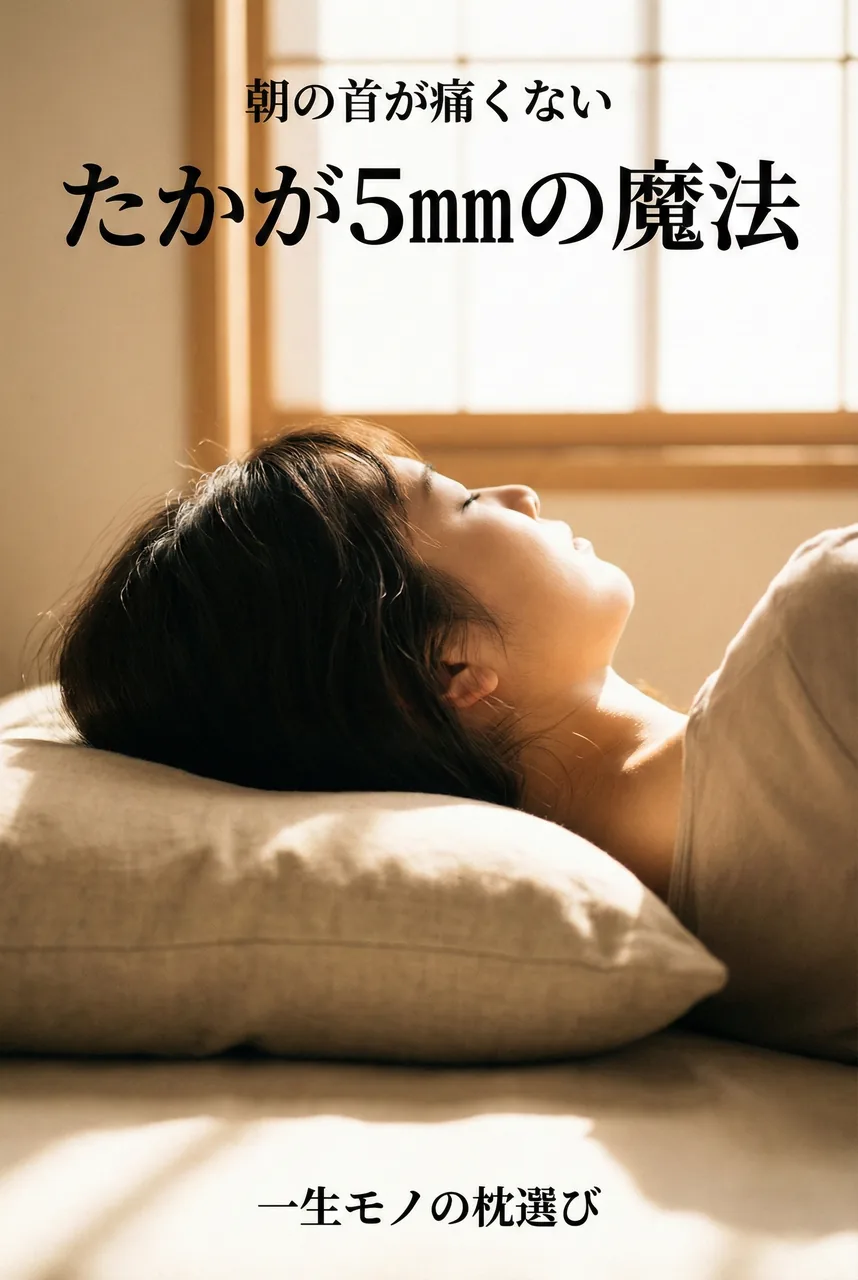
We spend a third of our lives lying on a pillow. That pillow occupies perhaps forty centimeters of our world — and it quietly determines whether we wake up energized or creaking with tension.
The wrong shoes cause foot pain. The wrong pillow causes neck pain, poor sleep, and a foggy head that follows you into the day. The right pillow does none of that — it simply disappears beneath your head, doing its job invisibly.
Whether it's the familiar crackle of buckwheat, the precision-adjustable pipe, or a contoured support designed around orthopedic research — Japan has been thinking seriously about this problem for a very long time.
Find the one that fits, and tomorrow morning will feel different.