
Two things to settle before you spend $400 on a Japanese hair dryer.
First, voltage. A hair dryer is a high-wattage appliance, so the transformer route
that works for a fan does not work here. But there are three genuine ways around it —
including one Japanese dryer that simply takes 100–240V and needs nothing but a
plug adapter.
Second, and more important: a Japanese premium dryer is not built to dry your hair
quickly. It is built to dry it without cooking it, which is a different objective. If what
you want is to be out of the bathroom in four minutes, this whole category is the wrong
purchase — and almost nobody says so before you buy.
Quick Reference: Which One Can You Plug In?
| Route | Voltage | Verdict |
|---|---|---|
| KINUJO Voyage | AC 100–240V | Works anywhere. Plug adapter only |
| Panasonic regional version | 220–240V, or a separate US line | Buy the one made for your market |
| Hair irons / straighteners | Often dual-voltage | Lower wattage, so more options exist |
| Japanese 100V dryer + transformer | 100V only | Don't. High wattage makes this impractical |
| ⚠ Amazon listings saying "100V only, shipped from Japan" mean exactly that. They will plug into an American socket and they are not built for it. | ||
Will a Japanese Hair Dryer Work in Your Country?
Short answer — buy a model made for your voltage. Do not buy a Japanese 100V dryer and a transformer.
| Where you live | Voltage | Does the plug fit? | What you need |
|---|---|---|---|
| Japan | 100V | — | Nothing |
| United States / Canada | 120V | Yes — same Type A plug | A dual-voltage model, or the maker's US line |
| Europe / UK / Australia | 230–240V | No | A 100–240V model, or the 220–240V regional version |
Why a transformer is the wrong answer for a dryer
A hair dryer is essentially a heating element with a fan, and it draws well over a kilowatt.
Heating appliances need a transformer rated three to four times their consumption
to survive the switch-on surge, which puts you into large, heavy, expensive territory for a device
you hold in one hand.
It is the same arithmetic that makes transformers pointless for rice cookers — and the opposite of
the situation with a DC fan, which draws so little that a small transformer is fine.
The three routes that do work
- 1. A genuinely dual-voltage Japanese dryer. KINUJO's Voyage model is rated AC 100–240V and needs only a plug adapter. This is the cleanest answer and most guides never mention that such a thing exists.
- 2. The maker's regional version. Panasonic sells its Nanocare dryers in market-specific voltages — a 220–240V version alongside the Japanese 100V one — and runs a separate product line for the United States through its own store. Same technology, correct plug.
- 3. Buy the iron rather than the dryer. Straighteners and curling irons draw far less power than dryers, so dual-voltage models are common — KINUJO's worldwide straightener being the obvious example. If the silk-plate technology is what attracted you, this route avoids the problem entirely.
⚠ Read the Amazon listing, not the storefront
Japanese-market dryers are listed on Amazon.com with wording like "100V only, shipped from
Japan" right in the title. The product is genuine; it is simply not built for your
supply.
Buying on your local Amazon does not mean buying a local-voltage product. Check
the voltage line on every listing, every time.
⚠ A plug adapter is not a solution
A plug adapter changes the shape of the pins. It does nothing whatsoever to the voltage. This is the single most common and most expensive misunderstanding in this category, and the two regions get it wrong in opposite ways.
United States and Canada: nothing stops you
Japan and North America use the same Type A plug. A Japanese appliance fits a US socket with no adapter at all — it simply plugs in and turns on.
That is precisely the danger. There is no physical obstacle, no error message, and nothing that feels wrong. 120V into a 100V appliance is 1.2× the voltage, which is about 1.44× the power — so it runs hot, ages fast, and any thermostat inside it is now calibrated for conditions that no longer apply.
Europe, UK and Australia: an adapter alone destroys it
Here the plug shape is different, so you will go looking for an adapter — and travel shops
sell them by the till.
230V into a 100V appliance is 2.3× the voltage, which is roughly 5.3× the power.
That is not shortened life. That is immediate failure, and a genuine fire risk.
You need an adapter AND a transformer. The adapter makes it fit; the transformer
makes it safe. Neither one substitutes for the other.
⚠ And a "travel converter" is not a transformer
Cheap travel converters chop the AC waveform rather than transforming it, and are
meant only for simple resistive loads like a travel iron, for short periods.
They will damage anything with electronics, a thermostat or a motor.
Look for the word "transformer," and ideally "toroidal."
Sizing the transformer
| Appliance type | Transformer rating |
|---|---|
| No motor, no heating element | 1.5× the rated watts |
| Motor or heating element | 2–4× the rated watts — startup draw exceeds the printed figure |
A hair dryer draws roughly 1,200W, so a correctly sized transformer is 2,400–4,800W. Hair irons draw far less and are much easier.
For a dryer this is not a practical purchase — buy a 100–240V model instead. For a lower-wattage iron, a 500W unit may be enough; check the plate first.
Why Japanese — Not Speed, But Not Cooking Your Hair
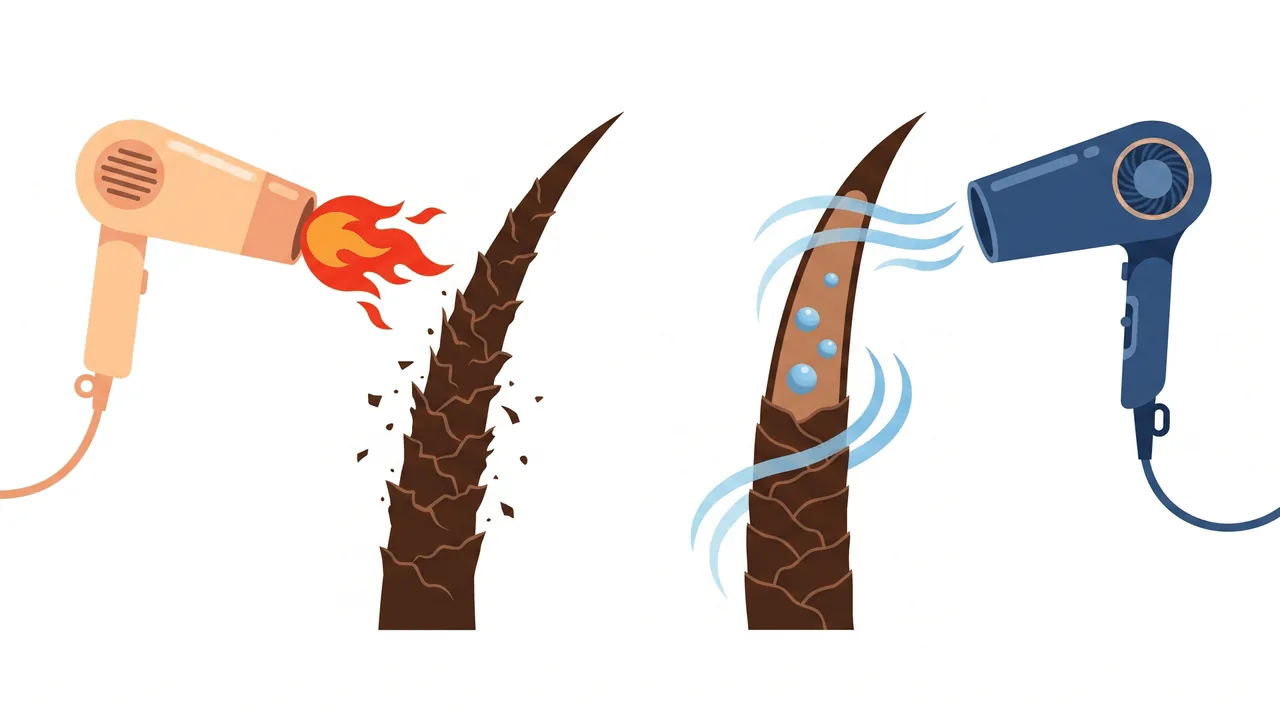
This is the expectation gap that causes disappointment, so it goes before the product list rather than after it.
Western dryers are largely sold on power and speed — wattage figures, airflow figures, "dries in half the time". Japanese premium dryers are sold on what happens to the hair: temperature control that avoids heat damage, and technologies that aim to leave moisture inside the shaft rather than driving it out.
What "heat damage" actually is
Hair is keratin, a protein. Protein denatures at temperature — the structure
changes irreversibly, which is why heat-damaged hair does not recover and has to grow out.
The Japanese design response is to keep the air below the temperature where that
happens and accept that drying takes longer. Several models actively monitor and drop
the temperature when the airflow gets too hot on one spot.
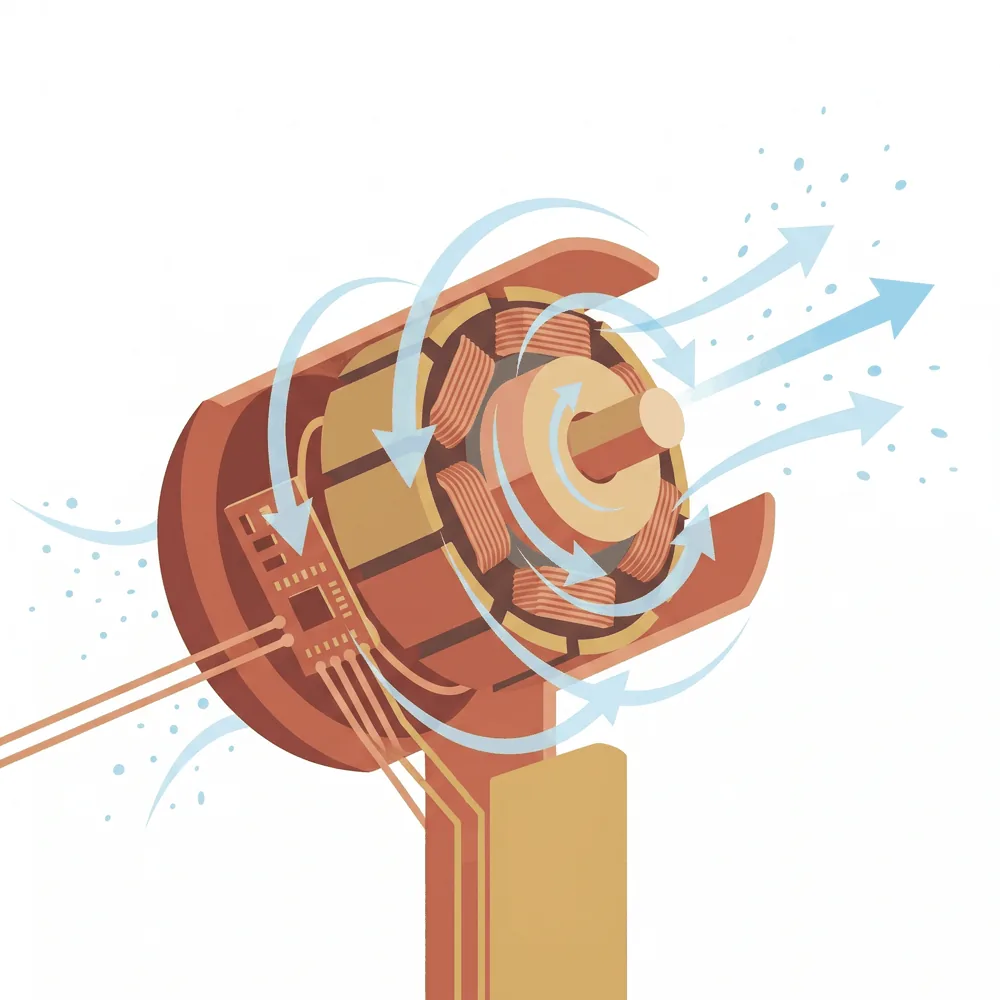
The ion and moisture claims, honestly
Panasonic's nanoe and similar systems emit charged water particles into the airflow, with the claim that these penetrate the hair and improve moisture content. Manufacturers publish their own testing; independent replication is thin, and the language around this category is enthusiastic.
What is not disputed is the temperature control, and that alone is a real and sufficient reason to buy one if your hair is damaged or chemically treated. Treat the ion claims as a possible bonus rather than the purchase justification.
Who should not buy one
If your priority is getting out of the door fast, buy a powerful Western dryer.
A high-wattage dryer used for a short time may well do less cumulative damage than a gentle one
used for twice as long — and you will actually enjoy owning it.
This category is for people with damaged, coloured, fine or chemically treated hair,
for whom the heat is the problem rather than the time.
What to Buy
KINUJO Hair Dryer Voyage — the dual-voltage one
Rated AC 100–240V, so it runs on any supply with a plug adapter — the single
most useful fact in this article for anyone outside Japan. Very light at around 290g, which
matters more than people expect for something held above your head.
KINUJO runs English-language pages and a regional site for Australia, so this
is a company with real international presence rather than an export accident.
- Voltage
- AC 100–240V — no transformer
- Weight
- About 290g
- Technology
- Infrared, ion emission
- You need
- A plug adapter outside Japan and North America
- Price range
- $250–$400
Perfect for: Anyone buying from abroad who wants this category without a voltage project. Also genuinely good for travel.
Panasonic nanoe — buy your region's version
The Nanocare line is what most people mean by "Japanese hair dryer". Panasonic sells
it in market-specific voltages, and runs a separate product line for the United
States through its own store — so the correct move is to buy the version for where you
live rather than importing the Japanese one.
The flagship Japanese models are 100V and stay in Japan. The regional
versions carry the same core technology with a different top-end specification.
- Voltage
- Region-specific. 100V Japan, 220–240V elsewhere, separate US line
- Technology
- nanoe moisture emission, temperature control
- ⚠ Watch for
- Listings marked "100V only, shipped from Japan"
- Price range
- $80–$400 depending on line and market
Perfect for: Someone who wants the best-known name in the category and would rather have a warranty than the absolute flagship.
The straightener route — lower wattage, more options
KINUJO's reputation rests on its silk plate — a plate coating intended to
reduce friction as hair passes through, on the reasoning that dragging damages hair as much as
heat does. The company makes a worldwide-voltage straightener alongside the
dryer.
Irons draw far less power than dryers, so this is the easiest part of the category to buy from
abroad — and if plate friction is your problem, it is also the more targeted tool.
- Voltage
- Worldwide model available
- Plate
- Low-friction coating; glides rather than drags
- Temperature
- Use the lowest setting that works. Higher is not faster in any useful sense
- Price range
- $150–$300
Perfect for: Anyone who straightens regularly. The friction argument is more concrete than most claims in this category.
Domestic-only names worth knowing
LOUVREDO and several salon-channel brands make well-regarded dryers that are sold almost entirely inside Japan, often through hair salons rather than retail. No international distribution was found, and they are 100V — so treat these as names to look for on a trip rather than something to import.
Using It Properly Matters More Than the Model

Direct the air from the roots downwards, along the length of the hair. The
cuticle is made of overlapping scales that all point one way — towards the ends. Blowing down
the shaft lays them flat, which is what produces shine. Blowing upwards lifts them, which is
what produces frizz.
This costs nothing and changes the result more than the price of the dryer does.
- Towel-dry properly first — press, do not rub. Wet hair is at its most fragile, and rubbing it with a towel does mechanical damage before the dryer even starts.
- Dry the roots first, ends last. The ends are the oldest and most damaged hair, and they dry fastest. Left in the airflow throughout, they get the most heat and need it least.
- Keep the nozzle moving and about 15cm away. Holding it still on one spot is how you get localised heat damage regardless of the temperature setting.
- Finish on cool. A cold blast at the end sets the cuticle flat and holds the style. Almost everyone skips this and it takes twenty seconds.
- Do not dry to bone dry. Stop at about 90%. The last of it evaporates on its own and the final stretch is where most heat damage happens.
Clean the air intake filter monthly. A blocked intake makes the dryer run hotter and work harder — it is the most common cause of both premature failure and unexpectedly hot air.
Frequently Asked Questions
Can I use a Japanese hair dryer abroad with a transformer?
Practically, no. Dryers draw well over a kilowatt, and heating appliances need a
transformer rated three to four times their consumption — which is large, heavy and expensive for
a handheld device.
Buy a dual-voltage model or your region's version instead. KINUJO's Voyage is
rated 100–240V; Panasonic sells market-specific versions.
I found one on Amazon. Is it my voltage?
Check the listing. Japanese-market dryers appear on Amazon.com with wording such
as "100V only, shipped from Japan" in the title — genuine products, wrong supply.
Buying on your local Amazon does not guarantee a local-voltage product.
Why does my Japanese dryer feel weak?
Because it is not trying to be fast. The design goal is drying hair without
reaching the temperature at which keratin is damaged, which takes longer by definition.
If speed is what you want, buy a powerful Western dryer — a strong dryer used
briefly may do less cumulative damage than a gentle one used for twice as long.
Do the ion and moisture claims work?
Manufacturers publish testing; independent replication is limited. Treat those
claims as a possible bonus.
The temperature control is not in dispute, and on its own it justifies the
purchase if your hair is damaged, coloured or chemically treated.
What temperature should I set a straightener to?
The lowest setting that actually works on your hair, and one pass rather than three.
Fine or damaged hair generally needs much less heat than the maximum, and going hotter does not
make the result last longer.
Friction matters as much as heat, which is the argument behind low-friction plate coatings.
Why did my dryer die?
Usually a blocked air intake filter. Lint and hair collect on the rear grille,
airflow drops, the element runs hotter, and the motor works harder — which shortens its life and
makes the output unexpectedly hot.
Clean it monthly. It takes seconds and is the single most effective maintenance
there is.
Final Thoughts: Buy the Right Voltage, and the Right Objective

The voltage problem has a clean solution — a dual-voltage KINUJO, or Panasonic's version for your market. What does not work is a Japanese 100V dryer and a transformer, and that is the plan most people arrive with.
Be honest about what you want. This category exists for damaged, coloured or fine hair, where heat is the enemy. If you want to be dry in four minutes, a powerful Western dryer is the better purchase and you will be happier with it.
And whichever you buy: dry roots first, aim the air downwards, finish cool, stop at 90%, and clean the filter monthly. That list is free and outperforms the difference between any two dryers on this page.
Japanese Hair Brushes: Pig Bristle vs Wild Boar

Japanese Skincare: Sunscreen, Sake Lees, Rice Bran