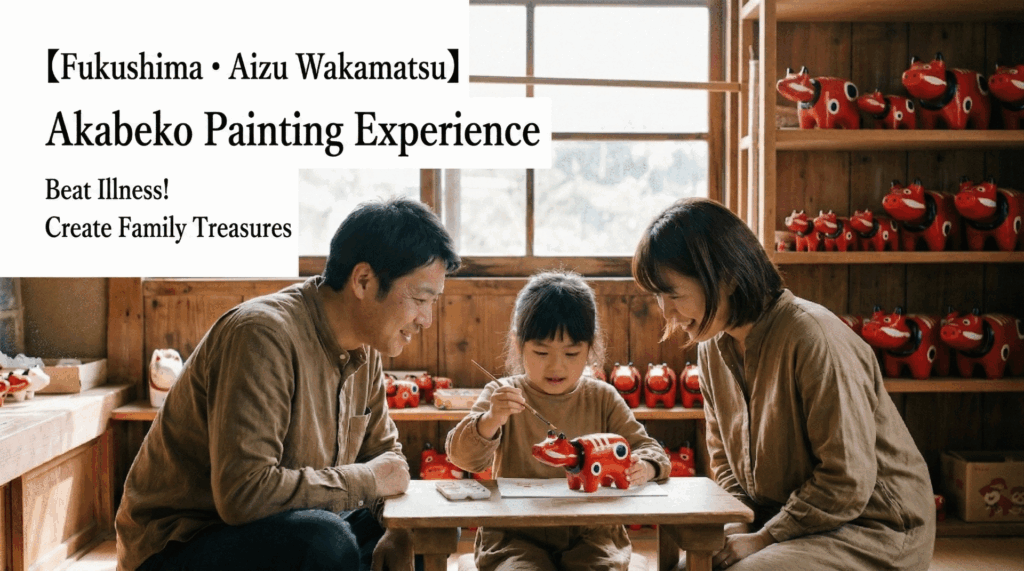
"Oh, its neck is bobbing! So cute!"
The "akabeko" — the red cow figurine that nods its head with charming humor at the slightest touch — is one of Fukushima Prefecture's most iconic folk toys. You've surely seen it at least once.
"Beko" is the Tohoku dialect word for "cow." Far more than just a cute toy, the akabeko has long carried the strong wish of "warding off evil and expelling illness (may children never fall sick)" — it is a family guardian.
Aizu-Wakamatsu City has many experience spots where you can use a brush to paint your own face and patterns onto a plain red (or plain white) akabeko.
You don't need to paint as skillfully as an artisan. An akabeko with "a slightly odd face" — where the paint went a little outside the lines, or the eyes came out too big — is an irreplaceable lifelong treasure that captures a snapshot of the child's growth at that exact moment.
In this guide, we thoroughly cover everything from fun facts like why akabeko is red, to the enormous "sauce katsu-don," and the historically romantic Tsurugajo Castle — a complete outing plan to enjoy every inch of Aizu's castle town!
Tips for Enjoying a Family Akabeko Experience (30 seconds)
- Wear clothes you don't mind getting dirty: White paint is used, so it's best to go in clothes where you won't mind a little stain on the cuffs
- Love the "quirks" of the face: Don't intervene — let children's free imagination (even an unbalanced face) remain as-is
- Dries quickly!: The paint dries fast, so you can box it up and take it home on the same day
- White and black akabeko too?: Depending on the facility, you can choose bases other than red — white or black — so siblings can get different colors
- The castle town is a gourmet paradise: Before and after the experience, fill up on Aizu specialties like "sauce katsu-don" and "Kitakata ramen"
1. [Before You Go] What Pattern Will You Paint? A "Family Meeting" in Advance Is Key!
In the painting experience, you're handed a brush and paint and told "go ahead and paint freely!" Children need some preparation so they don't feel lost.
Absolutely Essential! Rules Before Your Visit
- ① Hold a "design meeting" in the car
Tracing traditional patterns is fine, but discussing in the car on the way — "Want to do a heart pattern?" "How about a winking face?" "Write your name on the back?" — pays off hugely in terms of children's concentration at the venue. - ② Parents absolutely must NOT "help"!
Once children hold the brush, you'll be tempted to say "make the eyes rounder" and step in — resist. An asymmetric eye or a smudged pattern is where the "endearing quality" lives when you look back later.
2. [Insider Knowledge] Why Is It "Red"? The Secret of the Back's Pattern
Before the experience, take a close look at a real "akabeko." The reason for the red color and the pattern painted on its back contain the heartfelt prayers of people from long ago.
The "Magic Color" That Protects Children from Illness
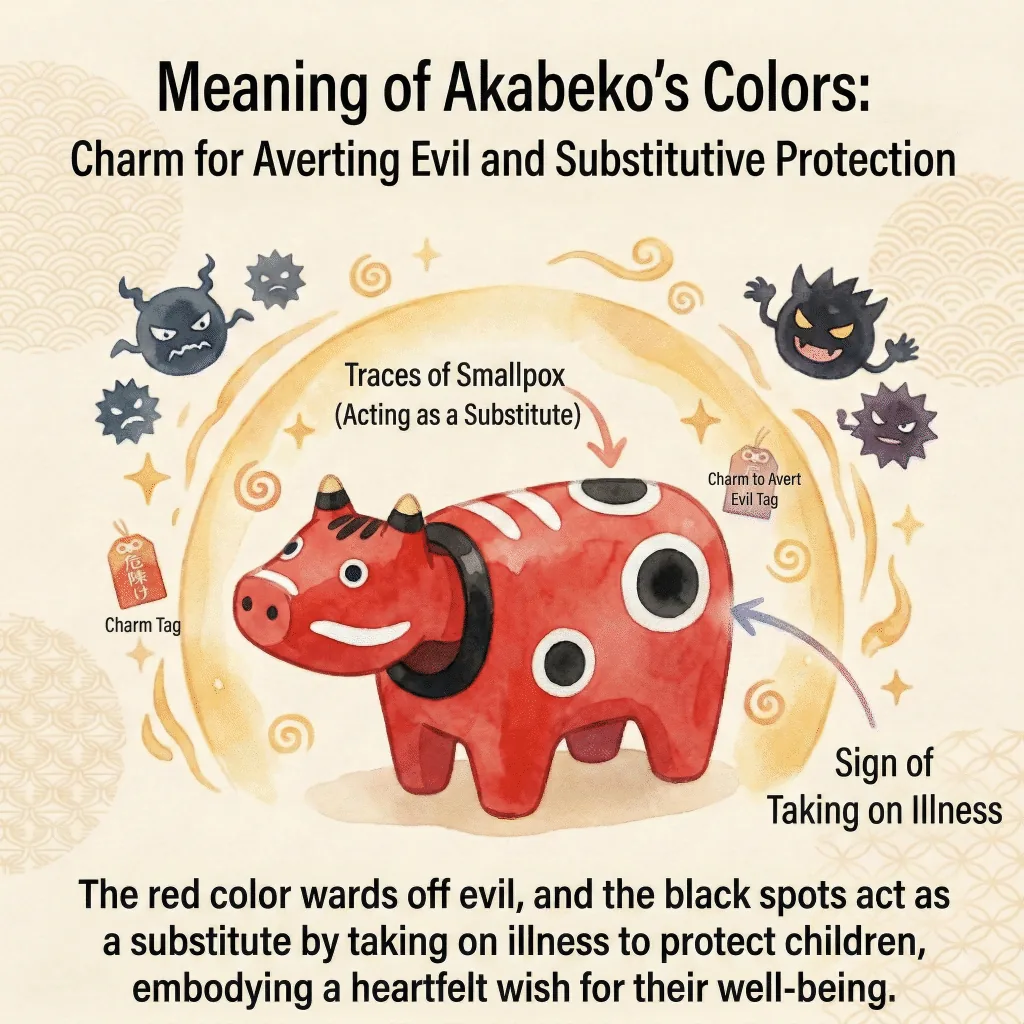
Akabeko is pure red because, since ancient times, people believed "the color red has the power to ward off evil and repel illness (epidemics)." In an era when medicine was not advanced, parents placed red toys near their children with the strong prayer: "Please let them grow up healthy without ever falling sick."
And the "black spots" and "white circles" painted on akabeko's back and face. These represent the marks of "smallpox (tenpou)" — a terrifying disease that once ran rampant — and it is said that they are a mark of gratitude, meaning "the akabeko bore the illness as a substitute for us."
Sharing this story with children before the experience changes the way they hold their brush — just a little more seriously.
3. Classic Red, or a Unique White or Black? How to Choose Your Experience
In the painting experience, you can choose the base color of the "beko (cow)" (varies by facility).
| Base Color | Features and How to Choose |
|---|---|
| Red akabeko (classic) |
[This One If You're Wishing for Good Health] The traditional red cow. Paint patterns onto it using white paint. The best recommendation for those who want to honor the "good-luck charm" meaning, and for a first-time experience. |
| White or black beko |
[For a Free Artistic Creation] A pure white (or pure black) beko offers maximum creative freedom as a canvas! Use a variety of paint colors beyond red to make a panda pattern, colorful polka dots, or a contemporary art-style piece. |
4. [Fukushima / Aizu-Wakamatsu] 2 Recommended Akabeko Experience Spots for Families
* The pins on the map mark the spots featured in this article. Please check the official websites for the latest information on prices and opening days.
① Handmade Experience Plaza Bansho | The Maker's Own Shop — See Real Artisans at Work!
When it comes to akabeko-making, this is the place! A highly authentic experience workshop operated directly by the "manufacturer" of akabeko — designated as a Fukushima Prefecture traditional folk craft.
The biggest highlight is being able to watch up close the actual work of real akabeko artisans — layering washi paper onto a wooden mold and painting it red. After watching the real craftsmanship and deepening your "respect for the tool," you then paint your own akabeko. The result is a beautiful, traditionally shaped akabeko with dignified eyebrows and pointed horns.
👨👩👧👦 Family Checklist
- You can also paint "Akabee": In addition to the traditional akabeko, you can paint the Aizu mascot character "Akabee" clay bell — a huge hit with small children.
Basic Information (Approximate)
- Experience: Akabeko painting, Akabee clay bell painting, etc.
- Duration: Approx. 60 minutes
- Approximate price: From ¥1,300 (tax included)
- Reservation: Individuals do not need a reservation (groups of 10+ require one). Easy to drop in.
② Tsurugajo Kaikan | Right in Front of the Castle! Choose White or Black Too — Superb Location
Aizu-Wakamatsu's largest souvenir & dining facility, located immediately in front (3 minutes on foot) of the city's symbol "Tsurugajo Castle."
Its overwhelming accessibility makes it easy to include in any sightseeing route! In the spacious experience corner, you can enjoy not just the classic akabeko, but also "shiro-beko" (white), "kuro-beko" (black), and even "okiagari koboshi" (tumbler doll) painting. The newly redesigned akabeko with a rounder, cuter shape is also a stunning piece of décor.
👨👩👧👦 Family Checklist
- Every comfort covered: As a large tourist facility, restrooms and rest areas are spacious, and buying souvenirs after the experience qualifies you for free or discounted parking — super convenient.
Basic Information (Approximate)
- Experience: Akabeko / shiro-beko / kuro-beko painting, okiagari koboshi, etc.
- Duration: Approx. 30–40 minutes
- Approximate price: Akabeko, etc. ¥1,430 (tax included)
- Reservation: Walk-ins accepted if space is available, but advance reservation is recommended on weekends.
③ Aizu Buke Yashiki | Experience History and Hands-On Crafts All at Once!
"Aizu Buke Yashiki" — a vast history theme park where you can feel the history of Aizu. A chief retainer's residence from the Edo period has been faithfully reconstructed, and stepping inside feels just like time travel.
The "Handmade Experience Hall" on the grounds offers akabeko and okiagari koboshi painting, as well as glass etching and more. After exploring the sprawling mansion and learning history, you can then settle in at the calm workshop for a focused painting session — a brilliantly two-for-one spot for parents.
👨👩👧👦 Family Checklist
- Explore like a ninja: The vast samurai residence is like a maze — the ultimate adventure playground that sparks children's spirit of exploration.
- Lots of experience options: "Big brother tries glass etching, little sister does akabeko" — siblings can choose different experiences.
Basic Information (Approximate)
- Experience: Akabeko painting, okiagari koboshi painting, glass etching, etc.
- Duration: Approx. 40 minutes (1.5–2 hours including the full facility tour)
- Approximate price: Akabeko painting approx. ¥1,300 (* separate admission fee for Buke Yashiki required)
- Reservation: Walk-ins accepted at any time for individuals.
🐄 Wishing for Good Health! Order Akabeko and Aizu Lacquerware Online
For those who can't make it all the way to Aizu — the gently bobbing "akabeko" and okiagari koboshi are available to order online! Displayed in the entryway or living room, they become cute good-luck charms protecting the family's health. Aizu is also one of Japan's premier production areas for "lacquerware (Aizu-nuri)." Why not pair them with beautiful bowls and chopsticks that enrich your everyday dining table?
5. [Model Course] Castle, Katsu-don, and Akabeko! Aizu Day-Trip Schedule
Aizu-Wakamatsu City has historical spots, outstanding gourmet, and experience facilities all packed tightly together. Here's our classic family-friendly plan with minimal travel time!
- 10:00 | Arrive at Aizu's symbol "Tsurugajo Castle (Tsurugajou)". Tour the gleaming white castle tower
- 11:30 | Absolutely must-eat for lunch! Tuck into Aizu's famous "sauce katsu-don"
(Popular restaurants have long lines, so get in early — that's the golden rule!) - 13:30 | Akabeko painting experience at "Handmade Experience Plaza Bansho" or "Tsurugajo Kaikan"!
(Wishing for good health, laughing together as a family while painting the face) - 15:00 | Drive to explore the fascinating double-spiral architectural wonder "Aizu Sazaedo"
- 16:00 | Pick up warm "awa-manju" (millet buns) at a nearby shop and head home fully satisfied
6. Places to Play After the Experience! 3 Powerhouse Sightseeing & Gourmet Spots Nearby
① Aizu's Famous "Sauce Katsu-don" | Hooked on Thick Cutlets and Sweet-Savory Sauce!
Coming to Aizu-Wakamatsu and not eating this would be a waste! Aizu's "katsu-don" is not the egg-simmered variety — instead, shredded cabbage is piled onto rice, and thick tonkatsu soaked generously in a special sweet-savory sauce is placed on top. That is the standard "sauce katsu-don."
The sauce absorbed into the crispy breading, with the crunchy texture of the cabbage, pairs so perfectly with white rice that you simply cannot stop your chopsticks!
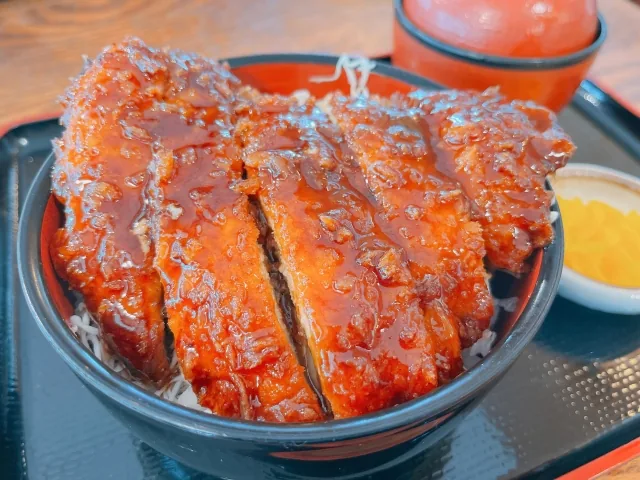
Great Spots for Aizu Sauce Katsu-don!
- Ganso Nishome Sauce Katsudon Nakajima: In addition to the standard cabbage style, their original "simmered in sauce" katsu-don invented by the founder is famous.
- Tontei: A super-popular restaurant with lines forming before opening! Famous for the superb balance of thick, juicy cutlets and a not-too-heavy sauce — with tatami seating, it's comfortable for families too.
7. After the Experience, Head to a Famous Onsen! Recommended Family Accommodation in Aizu
After enjoying the akabeko experience and Tsurugajo Castle sightseeing, soothe your travel fatigue in Aizu's renowned hot springs.
We've picked family-popular accommodations famous for their buffets and large baths from "Higashiyama Onsen" and "Ashinomaki Onsen" — both just a short drive from Aizu-Wakamatsu city center!
♨️ Higashiyama Onsen Area (Easy access — just 15 min by car from city center!)
Aizu Higashiyama Onsen Onyado Toho
About 15 minutes by car from Tsurugajo Castle and the experience facilities. A large ryokan with overwhelming family popularity as a base for Aizu sightseeing.
The secret to its popularity: the spectacular open-air bath "Sora no Yu" overlooking the whole town of Aizu, and a lavish buffet with superb variety! At the buffet, local Aizu specialties like "sauce katsu-don" and "Kitakata ramen" are made fresh right in front of you — a feast for both kids and adults enjoying local flavors to the fullest.
🏞 Ashinomaki Onsen Area (Like an Anime World!? A Non-Everyday Hot Spring Inn)
Ashinomaki Onsen Okawaso
About 30 minutes by car from Aizu-Wakamatsu city center. A long-established hot spring ryokan built along a stunning natural gorge.
Step inside and you're greeted by a soaring atrium "floating stage" with live shamisen music — which became famous for resembling the "Mugen Castle" from a hit anime! The tiered open-air baths jutting out over the gorge, and a buffet using local ingredients, create an extraordinary atmosphere that makes family trips truly unforgettable.
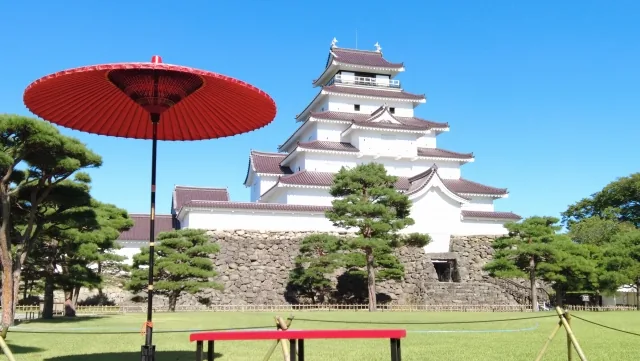
② Tsurugajo Castle | The Legendary "Impregnable Fortress" with Beautiful Red Roof Tiles
Known as the "impregnable fortress" that endured nearly a month of fierce fighting during the Boshin War at the end of the Edo period — this is Aizu's symbol.
The current castle tower is a reconstruction, but its greatest feature is the "red roof tiles (aka-kawara)" — rare even nationwide. The beautiful red roof designed to withstand the cold winters and heavy snow stands out brilliantly against blue sky and cherry blossoms. Inside the castle is an interactive digital museum where children can enjoy learning history too.
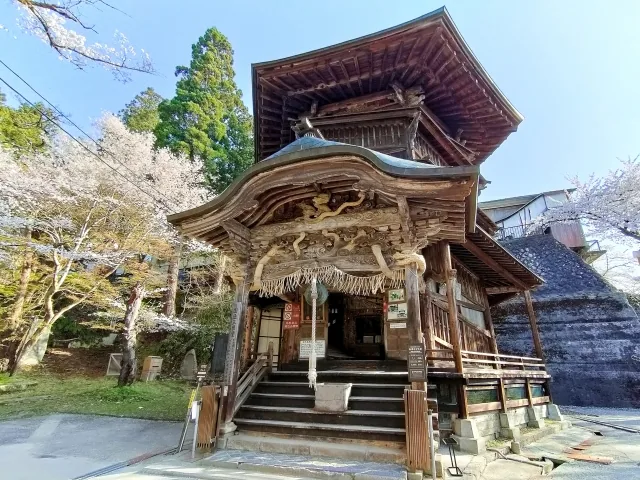
③ Aizu Sazaedo | People Going Up and Down Never Pass Each Other!? A Mysterious Tower
A peculiar wooden structure about 16 meters tall, built in the Edo period, on the mid-slope of Mt. Iimoriyama.
Step inside and instead of stairs you'll find a "ramp," winding up in a spiral. Remarkably, when you reach the top it connects directly to a downward ramp, creating a unique double-spiral structure found nowhere else in the world — "the ascending and descending paths never cross, and you emerge outside without ever passing anyone." Children exclaim "It's like a ninja house!" as they explode with excitement at this utterly thrilling attraction.
7. [After You Return] Display It Where the Family Gathers and Watch It Nod as Children Grow
After returning from your trip, immediately display the akabeko your child made at home. Here's how to display it to maximize its power as a "good-luck charm."
How to Make Your Akabeko Your "Family Guardian"
- Place it somewhere above eye level (As a ward-off charm, place it somewhere slightly elevated — on the entryway shoe cabinet, or on a living room shelf — so it can watch over the family from above)
- Occasionally give its head a gentle touch (An akabeko comes alive when its neck bobs. Before heading out in the morning, touching its head with a "see you later" and watching it nod nurtures a child's gentle heart)
- Cherish the "odd face" (A line that didn't quite go right, asymmetric eyes. "Back then you couldn't hold a brush very well yet" — look at the akabeko and share the memory together as a family)
✨ Display Your Lucky Charm! Japanese Décor to Adorn Your Home
If you're going to display your handmade "akabeko" in a room, why not make it a slightly special place? Simply placing it on a small wooden decorative stand, or arranging a single stem in a bud vase beside it, transforms your living room or entryway into a serene "Japanese gallery." The act of carefully displaying a Japanese lucky charm itself becomes a wonderful habit that nurtures a rich heart.
Summary: The Slightly Wonky Face Is the Best "Good-Luck Charm"
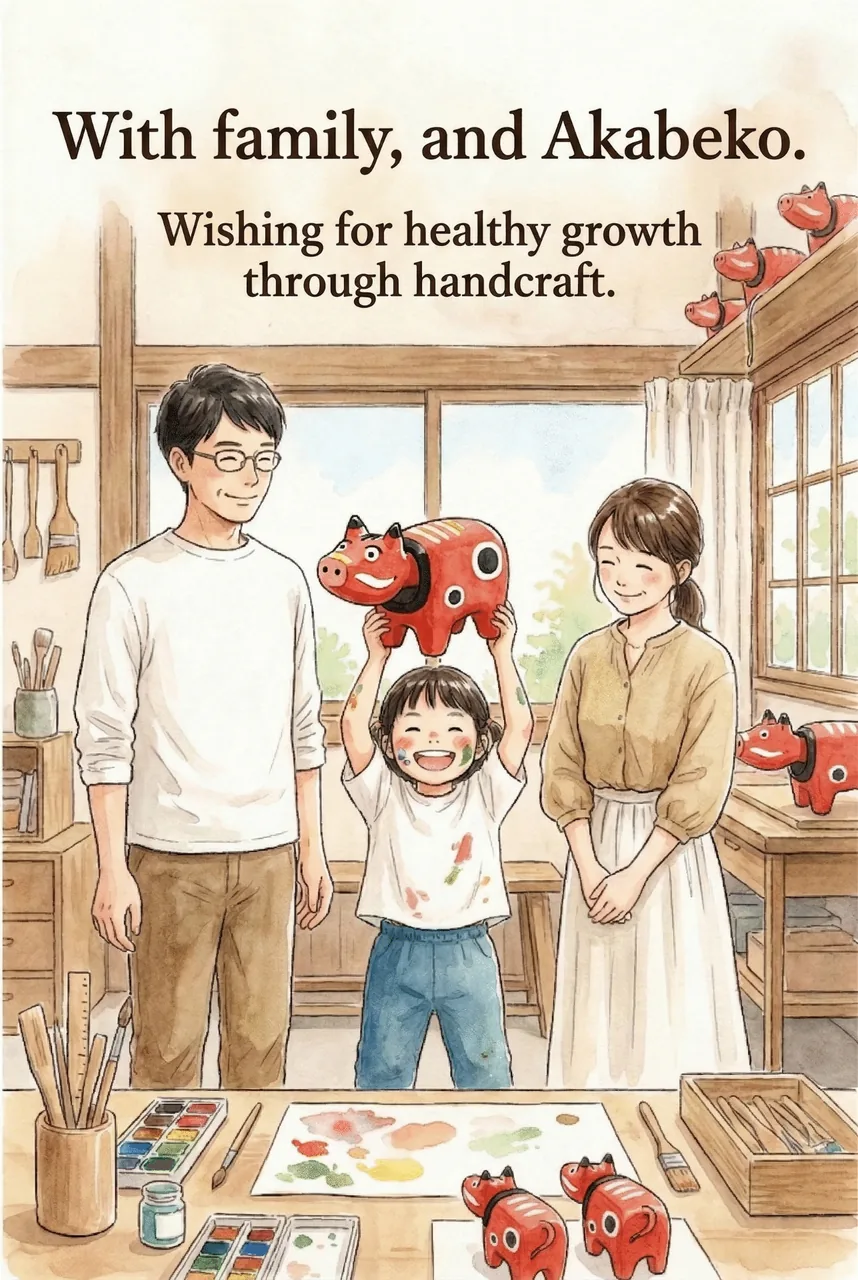
"Dad, my d— I mean, my akabeko, it looks like it's smiling!"
The "my akabeko" completed at an Aizu workshop, covered in paint.
It might not have followed the example — the eyes came out too big, or the pattern got smudged.
But the imperfect face painted entirely by the child's own hands, after swallowing the words "why not do it this way?" — that is the most precious art in the world.
Bringing it home and seeing the little red cow nod, time and again: "May this child continue to grow up healthy and strong" — the parent's quiet prayer fills the room, steadily and surely.
This coming weekend, why not head to Aizu-Wakamatsu City, Fukushima Prefecture to fill up on superb katsu-don and create a "family guardian" that will be a lifelong treasure?