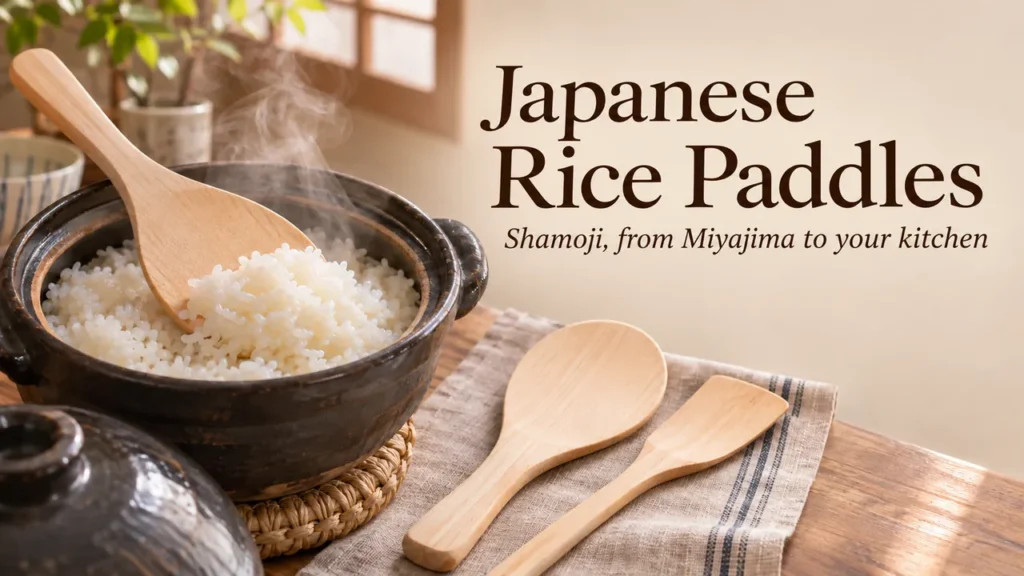
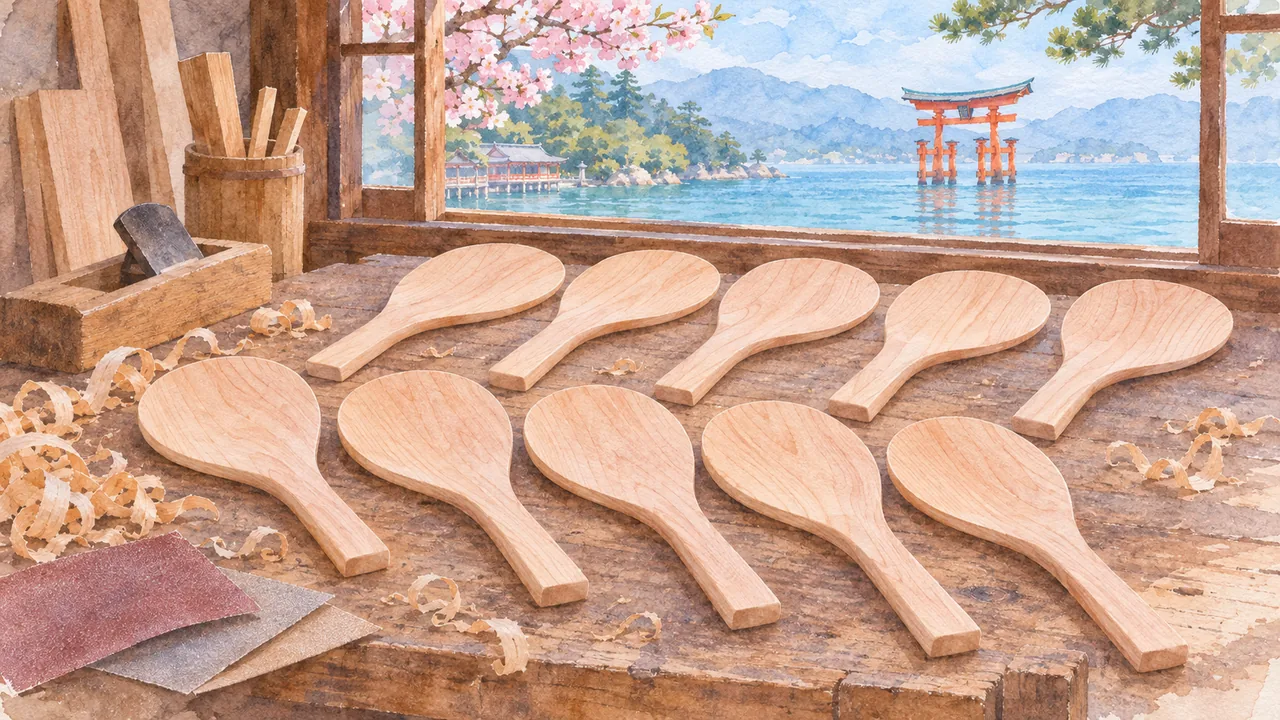
Around 1800, a monk named Seishin lived on Miyajima, the island of the floating torii gate. Worried that the islanders had no trade of their own, he is said to have shaped a rice paddle after the curve of the lute held by the goddess Benzaiten, and taught the people how to carve it. "Serve your rice with this paddle and good fortune will follow."
That is where the Japanese rice paddle, the shamoji, is said to have begun, and Miyajima workshops have been making them for more than 200 years. Today a shamoji is not only wood. For rice from an electric rice cooker, a non-stick plastic paddle is the easy choice. For donabe rice, an ohitsu or sushi rice, wood and bamboo feel right. And for stir-frying, the shamoji has a sibling: the wooden spatula. Decide what you will use it for, and the right paddle follows. This guide covers eight made-in-Japan paddles and spatulas you can buy from outside Japan, plus the Miyajima makers worth knowing.
Quick Reference: Which Rice Paddle Fits Your Kitchen
| If you want... | Pick | Material | Why |
|---|---|---|---|
| ▼ Serving rice from a rice cooker, without sticking | |||
| To fluff rice the way rice experts do | Marna Super Rice Spoon K674 ▾ | TPX resin | Developed with Japanese rice meisters |
| A paddle that stands on its own | Marna Standing Rice Spoon K555CL ▾ | TPX resin | Stands upright, frosted-glass look |
| ▼ Donabe, ohitsu and sushi rice: wood and bamboo | |||
| Plain, unpainted wood | Yamaco Temahima Kobo Hinoki ▾ | Hinoki cypress | Unfinished Japanese cypress |
| Light and gentle on your pots | Morikuru Bamboo Rice Paddle ▾ | Bamboo | Lightweight, non-scratch |
| Mixing sushi rice in a hangiri | Dohkan 14-inch Sushi Rice Paddle ▾ | Wood | Long enough for a sushi tub |
| ▼ Stir-frying, mixing and flipping: wooden spatulas | |||
| One everyday stirring spatula | Takahashi Sangyo Round Spatula ▾ | Beech | Round tip, 24 cm |
| A flat turner in fragrant wood | Nagao Hinoki Turner ▾ | Hinoki cypress | From a Tsubame-Sanjo maker |
| Flipping okonomiyaki or yakisoba | Morikuru Bamboo Okonomiyaki Spatulas ▾ | Bamboo | A pair, for two-handed flipping |
Tap a name to jump to its review.
1. How to Choose: Rice Cooker or Donabe, Serving or Stir-Frying
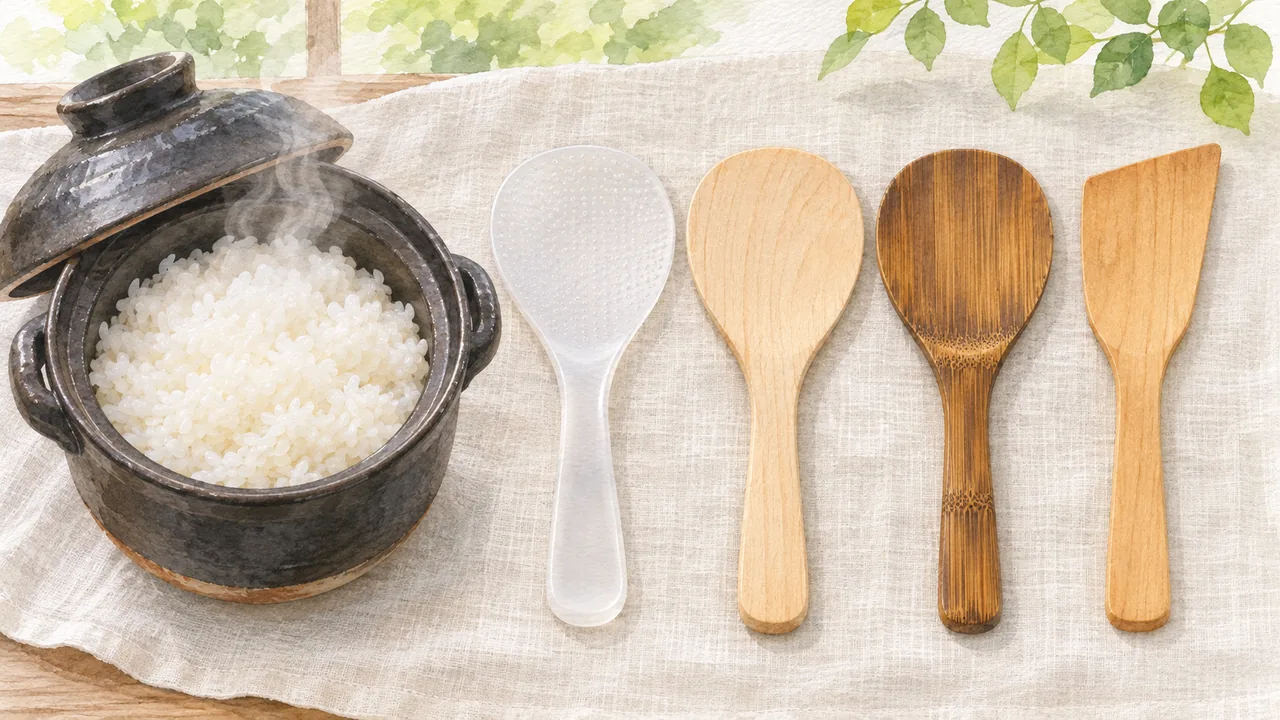
Serving rice from a rice cooker every day: non-stick resin
If you want to scoop rice quickly and wash the paddle just as quickly, a resin paddle that rice grains don't cling to is the easy answer. Some go in the dishwasher. Japanese makers use resins that release rice easily, or embossed surfaces that keep grains from sticking.
Donabe, ohitsu and sushi rice: wood and bamboo
When you move donabe rice into a wooden ohitsu, or cut vinegar into sushi rice, wood and bamboo are the natural match. They are soft against pots and tubs. Dip a wooden paddle in water before you use it and rice won't stick to it.
Stir-frying, mixing and flipping: the wooden spatula
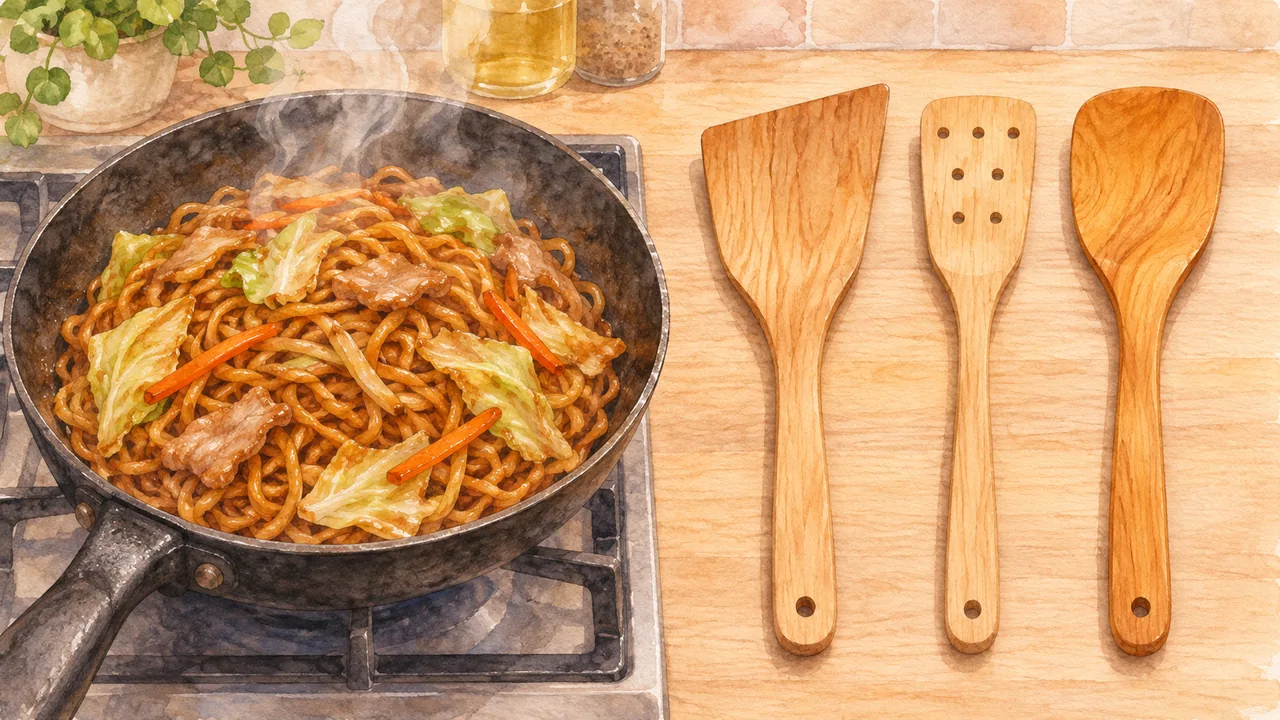
For a stir-fry or for mixing, reach for a flatter, slimmer wooden spatula. In Japan the workshops that carve rice paddles often make these too.
2. For the Rice Cooker: Non-Stick Paddles by Marna
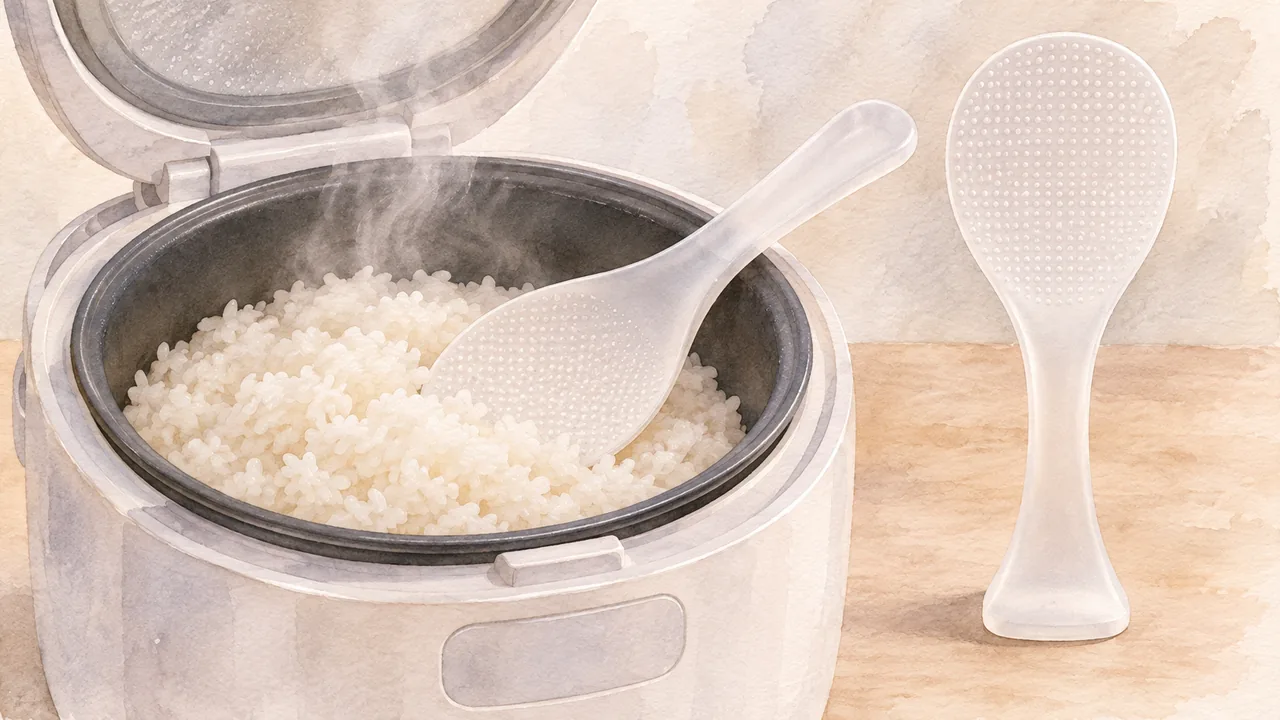
Marna, a Tokyo housewares company, makes both of these paddles in Japan from TPX (polymethylpentene), a resin that releases rice easily. Both are dishwasher safe and heat resistant to 140°C (284°F).
Marna Super Rice Spoon, Premium Clear (K674): Made With Rice Experts
For anyone who wants freshly cooked rice light and fluffy. Marna planned this paddle together with Japanese "rice meisters" (certified rice specialists). The goal was to perfect shari-kiri, the cutting motion used to loosen rice right after cooking so excess steam escapes. The slim blade and embossed surface keep grains from sticking, and it resists stains too.
It is about 21.9 cm (8.6 in) long. A smaller version, K744, is about 18.9 cm.
Marna Super Rice Spoon Premium Clear (K674)
Loading product details…
Marna Standing Rice Spoon, Premium Clear (K555CL): Stands on Its Own
For a counter with no room for a spoon rest. This paddle stands upright by itself, so it takes up almost no space and is always within reach. Marna recently reworked the grip, stability and scooping shape, and the TPX resin gives it a frosted-glass look.
If rice starts to cling after long use, wash the embossed face gently with a soft brush and wet the paddle before use; it goes back to releasing rice easily.
Marna Standing Rice Spoon Premium Clear (K555CL)
Loading product details…
3. For Donabe, Ohitsu and Sushi Rice: Wood and Bamboo
Yamaco Temahima Kobo Hinoki Rice Spoon: Plain Japanese Cypress
For anyone who wants plain, unfinished wood. Yamaco's Temahima Kobo line makes simple wooden kitchen tools in Japan, and this rice spoon is cut from hinoki (Japanese cypress) and left unpainted. Its gentle touch suits a donabe or a wooden ohitsu.
This is the small size. Dip it in water before scooping, and dry it well after washing.
Yamaco Temahima Kobo Hinoki Rice Spoon (Small)
Loading product details…
Morikuru Bamboo Rice Paddle, 200 mm: Light and Non-Scratch
For a light paddle that won't scratch your pots. Bamboo is light and soft against clay and coated surfaces, which makes it a good everyday shamoji for donabe rice and sushi. It comes in 200 mm (7.9 in) and a smaller 180 mm size.
Morikuru Bamboo Rice Paddle 200 mm
Loading product details…
Dohkan 14-inch Wooden Sushi Rice Paddle: Sized for the Hangiri
For mixing sushi rice in a wide wooden tub. At 14 inches (about 36 cm), this paddle reaches across a hangiri, so you can cut the vinegar into the rice with long, slicing strokes instead of mashing it. Wet it first, as with any wooden paddle.
Dohkan 14-inch Wooden Sushi Rice Paddle
Loading product details…
4. Why Japanese: Miyajima, Where the Shamoji Began
A monk, a goddess's lute, and an island trade
The story told by Miyajima's paddle makers goes like this. In the Kansei era, around 1800, Seishin, a monk at Shinsen-ji temple, worried that the island had no industry. Inspired by the graceful lute (biwa) held by the goddess Benzaiten, he carved a rice paddle and taught the islanders how to make it. People called it the "Seishin paddle," and word spread that eating rice served with it would bring good fortune.
In the 1830s a plectrum-shaped paddle appeared that became the model for today's shamoji. Later, the phrase meshi-toru ("to scoop rice") was heard as "to capture the enemy," and the paddle became a lucky charm during Japan's wars of the Meiji era. Visitors to the island can still see a giant paddle on display.
The Miyajima makers, and how to buy from them
Kuramoto Shakushi, founded in 1915 across the strait in Hatsukaichi, still carves paddles in the plectrum shape. For the Tokyo brand Azumaya, it makes an unpainted paddle in mizume cherry that is hand-sanded with six grades of sandpaper, one by one. On the island itself, Miyajima Kogei Seisakusho carves mountain-cherry paddles and spatulas in the traditional "Miyajima shakushi" shape it has made since the early Showa era.
We could not find these Miyajima-made paddles on Amazon.com. To get one, buy on Miyajima itself or at Japanese shops when you visit, or contact Kuramoto Shakushi's site (Japanese). The paddles above are the made-in-Japan options that ship to you today.
5. Wooden Spatulas for Stir-Frying and Flipping
Takahashi Sangyo Round Spatula, Beech 24 cm: The Everyday Stirrer
For one spatula that does most of the stirring. A round-tipped beech spatula, 24 cm (9.4 in) long, made in Japan. It follows the curve of a pot for sauces, curries and stir-fries, and it won't scratch your pans.
Takahashi Sangyo Round Spatula, Beech 24 cm
Loading product details…
Nagao Hinoki Turner, Flat: From Tsubame-Sanjo
For a flat turner in fragrant Japanese cypress. Nagao, a kitchen tool maker in Tsubame-Sanjo, Japan's metalworking town, also makes this flat hinoki turner. Use it to flip and to scrape the bottom of a pan.
Nagao Hinoki Turner, Flat
Loading product details…
Morikuru Bamboo Okonomiyaki Spatulas, Set of 2: Flip With Both Hands
For okonomiyaki, yakisoba and anything on a griddle. In Japan, okonomiyaki is flipped with two spatulas, one in each hand, and this set gives you the pair. At 285 mm (11.2 in), the bamboo blades are non-scratch, so they are safe on coated griddles.
Morikuru Bamboo Okonomiyaki Spatula, Set of 2
Loading product details…
6. Using and Caring for Each Material
Wood and bamboo: wet it before, dry it after
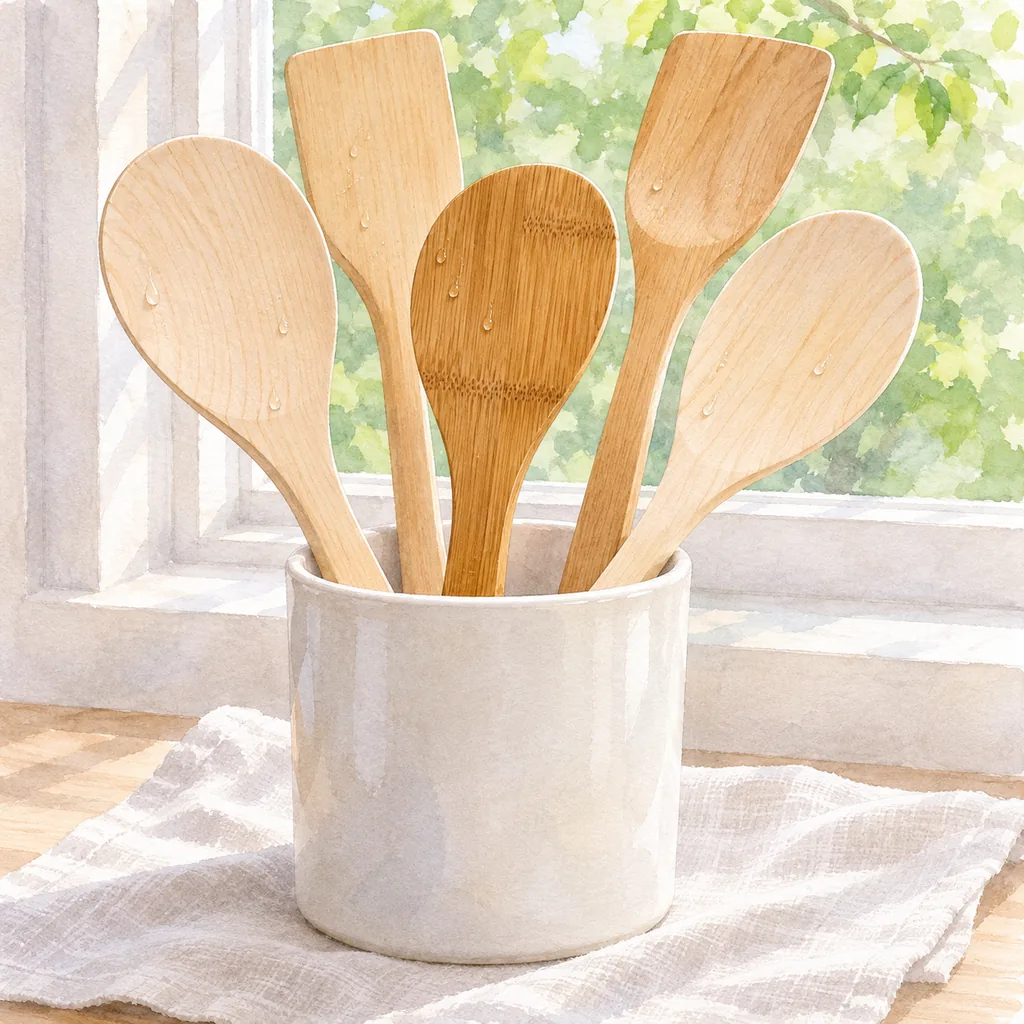
Dip a wooden or bamboo paddle in water just before you use it and rice won't stick to it. Wash it soon after use in water or warm water, rinse well if you use soap, wipe it with a soft cloth and let it dry somewhere airy.
Avoid hard scrubbers, abrasive cleaners, the dishwasher and the microwave; they cause scratches, warping and cracks. Don't leave it soaking. If the surface turns rough or fuzzy, rub in a little food-safe oil.
Resin: be gentle with the embossing
Both Marna paddles are dishwasher safe. Skip scrubbing pads and scouring powder, which scratch the surface. If rice starts to cling, wash the embossed face gently with a soft brush. Don't leave the paddle inside a hot rice cooker for long periods.
7. Frequently Asked Questions
How do I stop rice from sticking to the paddle?
Wet the paddle before you use it. This works for wood and for resin. If you'd rather not bother, choose a paddle made from a resin that releases rice easily, like Marna's TPX paddles.
What does "shamoji" mean?
It is the everyday Japanese word for a rice paddle. The older word is shakushi; "shamoji" is said to come from the polite speech of women at the imperial court, who shortened it to "sha" and added "moji." On Miyajima, the paddles are still called shakushi.
Why is Miyajima famous for rice paddles?
Because the island is known as the birthplace of the Japanese rice paddle. Around 1800 the monk Seishin taught the islanders to carve them, and they spread as a good-luck charm. Workshops on Miyajima and in neighboring Hatsukaichi still make them.
Will a wooden paddle get moldy?
Not if you wash it soon, wipe it and let it dry in the air. Putting it away wet or leaving it to soak invites mold. If the surface gets fuzzy, a little food-safe oil settles it.
What's the difference between a rice paddle and a wooden spatula?
Use a paddle to serve and fluff rice, and a spatula to stir-fry, mix and flip. A shamoji is gently dished so it can scoop rice; a spatula is flatter and slimmer.
Can a rice paddle go in the dishwasher?
The two Marna resin paddles can. Wash wooden and bamboo paddles and spatulas by hand, since dishwasher heat causes warping and cracks.
Final Thoughts: Serve, Fluff or Stir-Fry
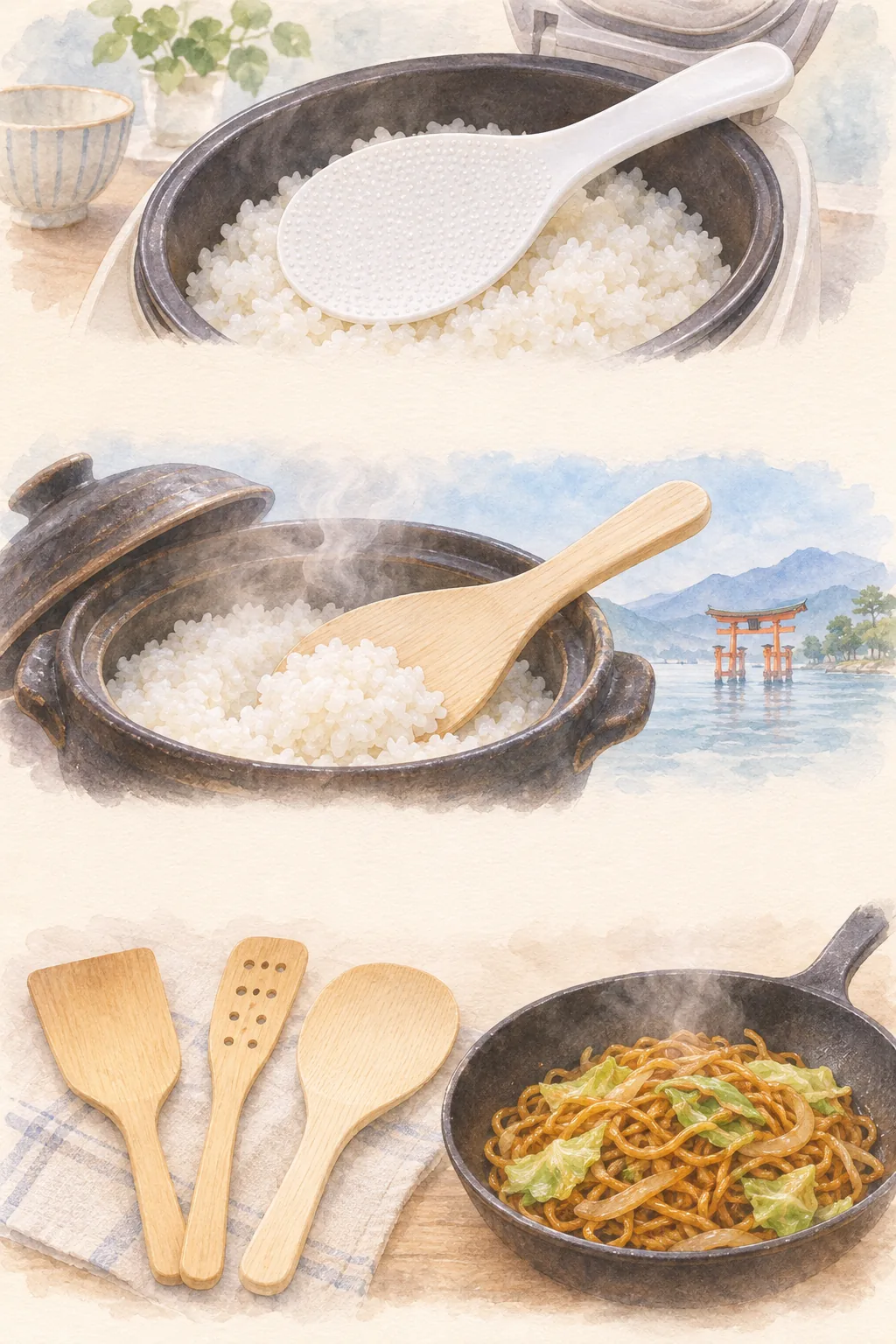
A shamoji is a tool you choose by what you use it for.
For rice from a rice cooker, Marna's K674, developed with rice experts, or the K555CL that stands on its own. For donabe, ohitsu and sushi rice, unpainted hinoki, light bamboo, or a long paddle sized for the hangiri. For stir-frying, a beech or hinoki spatula, and a bamboo pair for okonomiyaki. If you ever visit Miyajima, bring home a hand-sanded paddle from the island where it all began.
The paddle a monk taught islanders to carve 200 years ago still serves rice every day.
Japanese Donabe Clay Pots: 4 Best Picks (Iga & Banko)
Ohitsu: The Wooden Tub That Replaces Keep-Warm