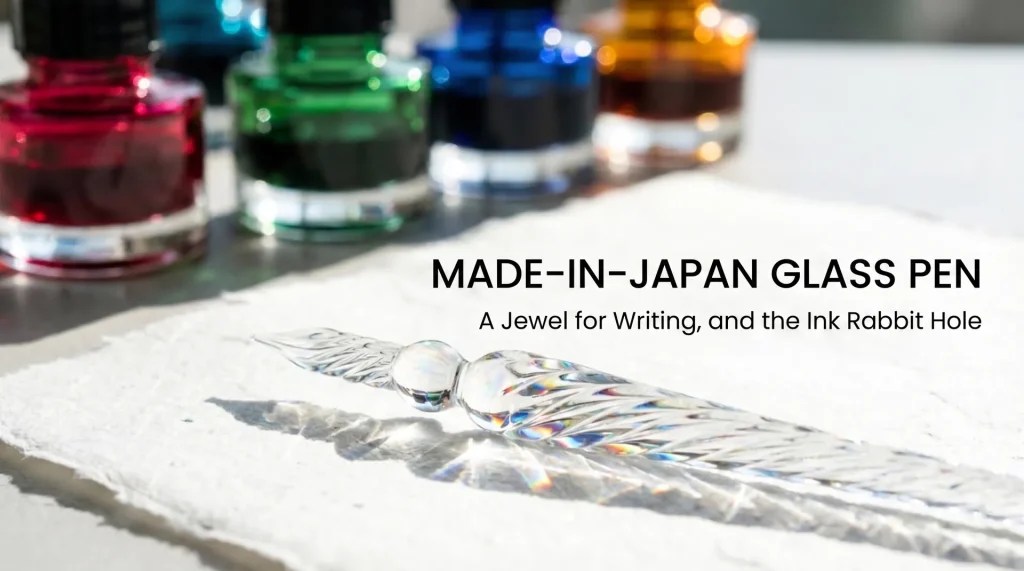
"I keep seeing that beautiful crystal pen on Instagram — but I can't figure out how to use one…"
"I'd love to try fountain pen inks, but cleaning sounds like such a hassle…"
If either of those sounds familiar, a Japanese glass pen is exactly what you're looking for.
Glass pens aren't decorative objects that happen to write. They're a genuinely practical writing instrument — and
one that was invented in Japan during the Meiji era. Japanese artisans hand-polish each nib to a
precision that mass-produced versions can't touch: the grooves are so exact that a single dip holds enough ink for a
full postcard without skipping or dripping.
This guide covers everything you need to know — why Japanese-made glass pens stand apart, how to use and rinse them,
and five studios whose work is worth seeking out.
Quick Reference: Nib Types at a Glance
| Nib Type | Writing Feel | Ink Capacity | Cleaning |
|---|---|---|---|
| Spiral groove | Smooth & stable | High (300–400 characters) | Swirl in water |
| Parallel groove | Even, no quirks | Standard | Swirl in water |
| Pen-with-shaft set | Comfortable grip, close to a fountain pen | Standard–high | Swirl in water |
| Dip nib | Fine lines & delicate strokes | Low (dip often) | Swirl in water |
1. Why Japanese? The 1902 Origin Story & Capillary Magic
Most people assume glass pens came from Europe. In fact, they were invented in Japan — in 1902 (Meiji 35), by Sadajiro Sasaki, a craftsman who made glass wind chimes in Tokyo.
The Capillary Magic That Makes It Work
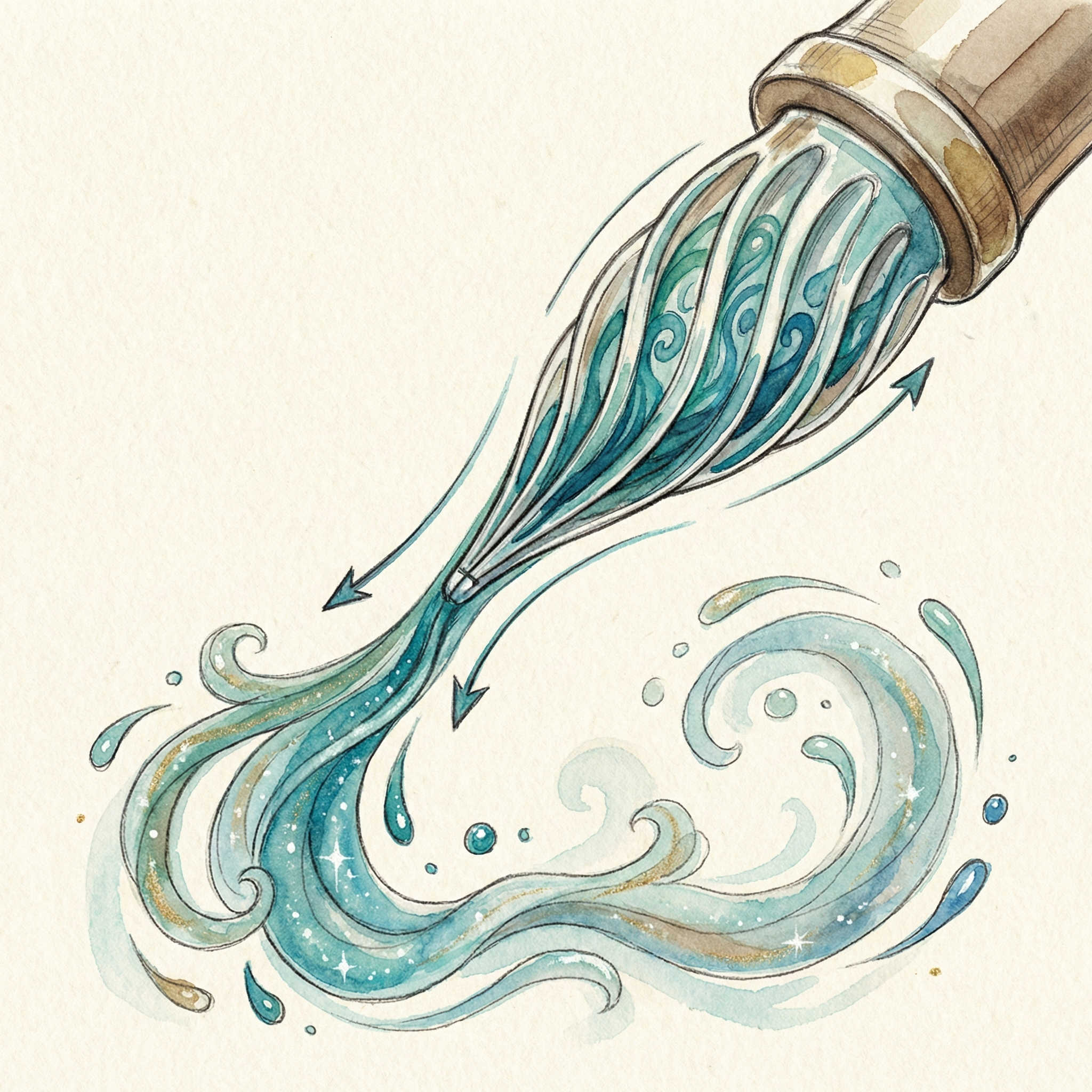
A glass pen nib has 8 to 12 radial grooves cut into it.
When you dip the tip into ink, the ink is drawn up into those grooves by capillary action — the same force that
pulls water up a thin tube.
On Japanese high-end glass pens, the depth and width of those grooves are ground to an extraordinarily precise
tolerance. The result: a single dip gives you enough ink to write a full postcard — roughly 300–400
characters — without running dry or blotting.
That consistency is entirely down to the artisan's polishing skill.
2. How to Use a Glass Pen: Writing, Rinsing & Protecting the Nib
"Glass — surely it'll break the first time I drop it?" That's the most common hesitation. The truth is that with a little care, a Japanese glass pen will last decades.
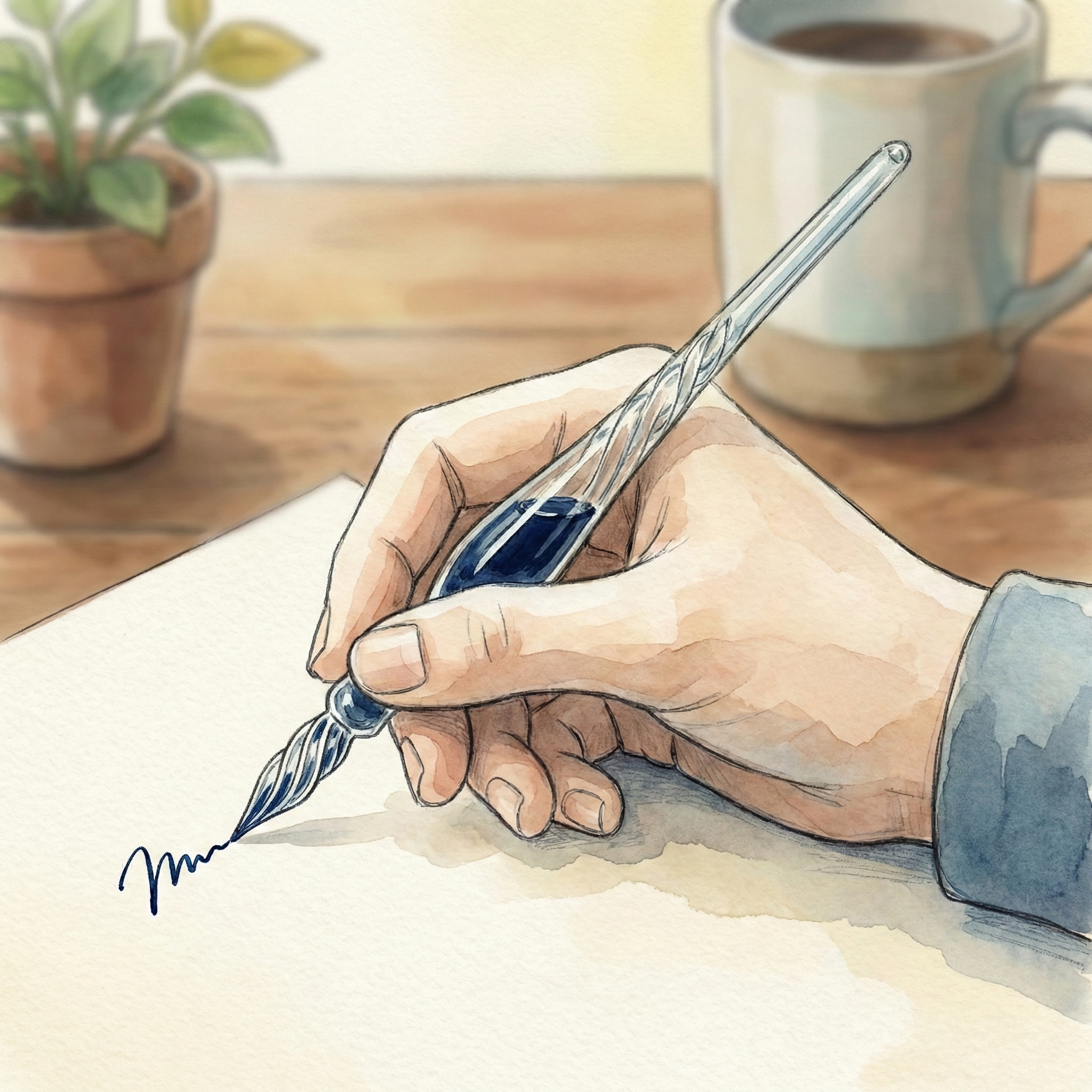
Writing Angle: Hold It at 45–60 Degrees
Unlike a ballpoint, you should never hold a glass pen nearly vertical.
Hold it the way you'd hold a pencil — angled at 45 to 60 degrees.
The most important thing is to use no pressure at all.
Let the pen's own weight glide across the page. Pressing down chips and wears the nib.
Color Switching Takes 3 Seconds — Just Rinse in Water
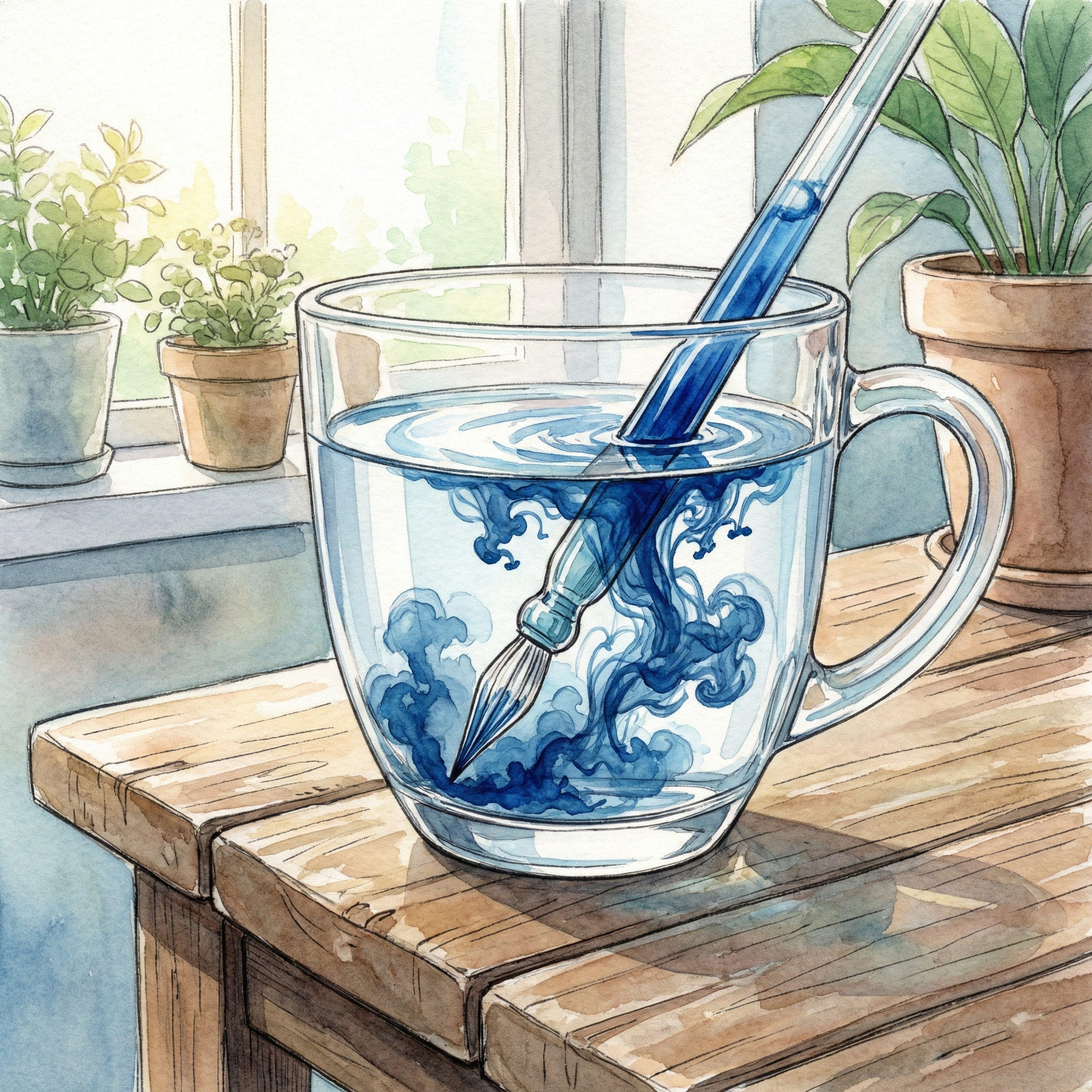
This is the biggest advantage over fountain pens: switching colors is almost instant.
When you're done with one ink, swirl the nib in a cup of water for a few seconds. Once the ink has cleared the
grooves, blot the nib dry with a tissue and you're ready for the next color.
That ease is exactly why collectors who own dozens of ink bottles — the so-called "ink swamp" crowd — love glass
pens so much.
3. 5 Japanese Glass Pen Studios Worth Knowing
From the studios that defined the art to newer makers pushing the form in exciting directions — here are five that combine exceptional writing feel with real availability (or a waiting list worth joining).
Sase Kogyosho — The Original, Going Strong Since 1912
The direct descendent of Sasaki's Meiji-era invention, Sase Kogyosho has been making glass pens in the same Tokyo workshop for over a century. Their signature bamboo-shaft glass pen pairs a hand-ground glass nib with a bamboo barrel — a beautifully retro combination that writes with near-magnetic smoothness. Prices are accessible, making this the ideal first glass pen.
- Based in
- Tokyo
- Founded
- 1912 (direct lineage from the 1902 invention)
- Best for
- First glass pen buyers; outstanding ink capacity and smooth writing feel
Glass Studio aun (Eda Akihiro) — Borosilicate: Lighter, Tougher, Drop-Resistant
Based in Okayama, Eda Akihiro works with borosilicate (lab-grade heat-resistant) glass — the same material used in scientific instruments. The result is a pen noticeably lighter and significantly more impact-resistant than traditional soft-glass pens. The Utsurou (Transition) series has a clean, modern aesthetic that sells out at every stationery fair.
- Based in
- Okayama
- Material
- Borosilicate glass — lighter and more impact-resistant than standard glass
- Best for
- Daily use; those who want a lighter pen with a modern design aesthetic
Kemmy's Labo — Designed for Smaller Hands, Petal-Thin and Elegant
Created by artisan Akiko Fukasawa in Kanagawa, Kemmy's Labo pens are known for their delicate petal-like form and a shorter barrel that balances naturally in slender hands. A thoughtful flat-side detail prevents the pen from rolling off the desk — a small touch that says a lot about the care that goes into each piece.
- Based in
- Kanagawa
- Known for
- Petal-thin form; flat-side grip detail that prevents rolling
- Best for
- Those with smaller or slender hands; elegant gifting
HASE Glass Studio — Wearable Art: Cosmos and Water Trapped in Glass
Based in Saitama, HASE's pens feature opal inclusions, flowing spiral patterns, and swirling color depths that pull you in just to look at them. But these are not merely beautiful objects — the maker is a committed fountain pen enthusiast, and the writing performance (especially the New Crystal nib series) reflects that obsession. It writes as beautifully as it looks.
- Based in
- Saitama
- Known for
- Opal inclusions and spiral color depths; New Crystal nib series
- Best for
- Those who want a glass pen as wearable art with serious writing performance
Paraglass — Architectural Wit and a Nib Sharp Enough for Your Finest Hand
Based in Osaka, Paraglass is known for playful engineering: their Ramune Pen features a glass marble inside the barrel that rattles when you shake it, channeling the spirit of a classic Japanese soda bottle. Beneath the whimsy is a razor-sharp nib — fine (F) and extra-fine (EF) sizes write without any catch, making Paraglass pens ideal for diary-keeping and small handwriting.
- Based in
- Osaka
- Signature
- Ramune Pen — glass marble rattles inside the barrel
- Best for
- Small handwriting and diary use; F and EF nibs with no catch
4. The Magic of Glitter Ink — Best Used with a Glass Pen
Once you have a glass pen, glitter ink is the obvious next step.
Fountain pen enthusiasts tend to avoid glitter inks because the shimmer particles can clog converters and feeds.
With a glass pen — where the entire "mechanism" is open grooves — there's nothing to clog. You can explore the full
dazzle without hesitation.
Tono&Lims — The Brand That Turned Japanese Ink Culture Into an Obsession
Born from a Japanese–Korean creative partnership, Tono&Lims is one of the most talked-about names in Japanese ink circles. Their catalogue is full of glitter-laden, pigment-based, and dramatically vivid inks — precisely the types that fountain pen users avoid, and where a glass pen truly shines. Each bottle is a story; the shimmer effect on paper is genuinely breathtaking.
- Based in
- Japan
- Known for
- Glitter-laden and pigment-based inks; vivid storytelling bottles
- Best for
- Glass pen users exploring beyond safe, standard fountain pen inks
Ferris Wheel Press — Bottled Jewelry You'll Want to Display on Your Desk
Originally from Canada, Ferris Wheel Press has built a devoted following among Japanese stationery enthusiasts — largely because the bottles themselves look like perfume flacons. The inks come in soft, luminous hues with the finest imaginable shimmer particles. Paired with a beautiful glass pen, this makes an exceptional gift that looks as good on the shelf as it writes on the page.
- Based in
- Canada (international availability)
- Known for
- Perfume-flacon bottle design; fine shimmer particles in luminous hues
- Best for
- Gift pairing with a glass pen; desk display as well as writing use
5. Frequently Asked Questions
Can a chipped nib be repaired?
Yes — most Japanese studios offer nib repair.
Sase Kogyosho, Glass Studio aun, and many other Japanese makers accept paid nib-grinding repairs. The damaged
section is ground away, so the nib may end up slightly shorter or write a little broader than before — but your
pen lives on.
Inexpensive imported glass pens are typically treated as disposable and cannot be repaired.
Can left-handed people use glass pens?
Absolutely — glass pens are arguably ideal for left-handers.
Fountain pens often come in left-handed nib variants because the nib must face a specific direction. A glass pen's
radial grooves work from any angle — 360 degrees — so the writing direction doesn't matter at all.
Can I carry a glass pen in my bag?
Yes, with the right protection.
Capped glass pens and purpose-built hard cases are both widely available. Avoid throwing a glass pen loose into a
pencil case with other stationery — the jostling is a fast track to a broken nib. A single-pen sleeve or rigid
case is the right approach. Treat it as fragile, and it rewards you with decades of use.
Does the nib wear down over time?
On a timescale of years or decades, yes — but it's not something to worry about.
Glass is harder than most metals. Paper friction alone won't wear a nib down quickly.
In fact, many owners report that long-term use gradually improves the writing feel as the nib conforms to
their personal stroke habits — the glass pen equivalent of breaking in a shoe.
The nib feels scratchy or rough. What can I do?
A fine-grit sandpaper trick can smooth it out.
If the writing feel bothers you, gently trace a figure-eight on fine-grit sandpaper (#2000–#3000 or higher). This
often removes catches and restores glide.
Take it slow — over-grinding removes the grooves, which reduces ink capacity. When in doubt, send it to a studio
for professional adjustment.
Are glass pens good gifts?
Exceptional ones — especially for stationery lovers.
The visual appeal alone makes glass pens popular as birthday and anniversary gifts. For someone receiving their
first glass pen, a well-priced beginner studio like Sase Kogyosho is a safe and thoughtful choice.
Pair it with a bottle of glitter ink and you have a gift that's immediately usable and genuinely memorable.
Final Thoughts: Writing as Digital Detox
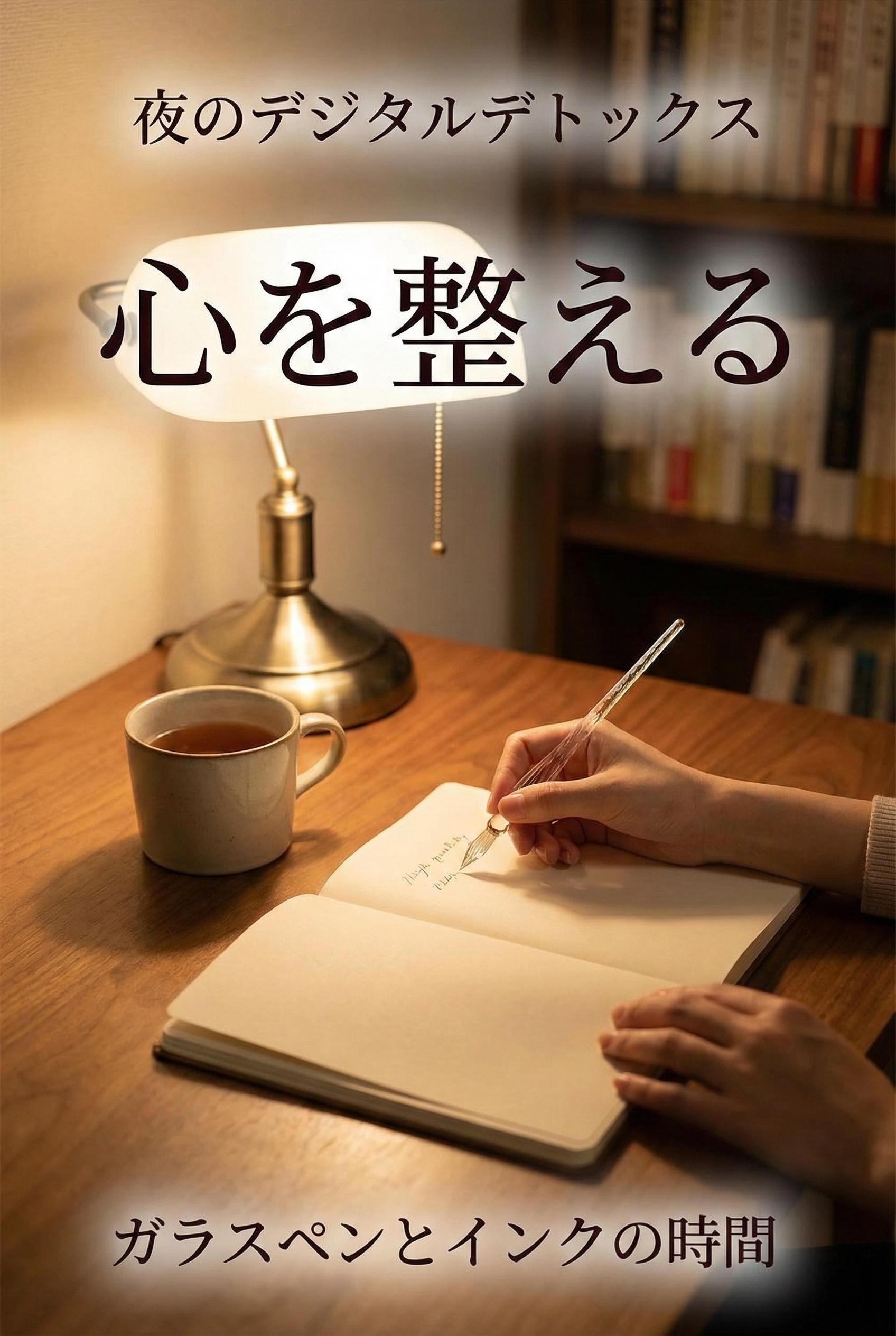
Since I started using a glass pen, even filling out forms has become something I look forward to.
(Genuinely.)
My schedule moved from phone to paper planner. There's now a small ritual at the start of each evening: choosing
which ink bottle to open, watching the color bloom like smoke through the water as I rinse the nib, then the
quiet tapping sound as glass meets paper.
Away from the blue-light glare of screens, just color and letters and the weight of a pen in your hand — it's
one of the most effective ways I know to turn off the mental noise before sleep.
One glass pen on your desk. A handful of small ink bottles. It's not much, but it's enough to carve a little
quiet space out of a busy day.
Japanese Fountain Pens: Pilot, Sailor & Platinum Compared
Japanese Luxury Notebooks: Hobonichi, Midori & What Makes Them Worth It