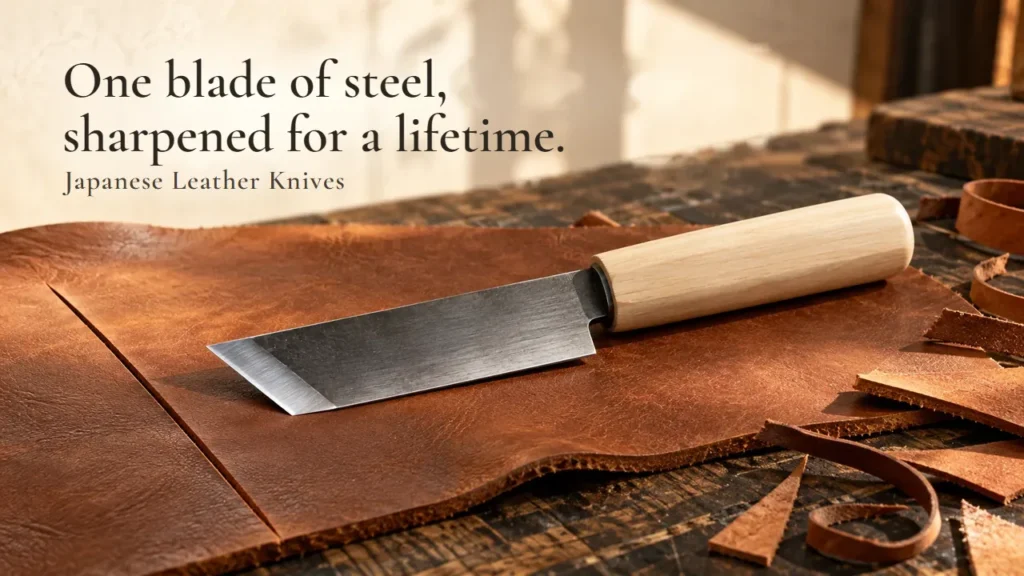
A Japanese leather knife (kawa-bocho, 革包丁) is a single, wide, chisel-ground blade of carbon steel that leatherworkers sharpen and keep for years. Pushed through thick leather, it leaves one clean, straight line.
This guide chooses one by a simple question: which steel, and how often will you sharpen it? It covers Hidetsugu — a knife from Kochi's Tosa blacksmithing region that has been used by Japanese leather and shoe-repair craftsmen since the Taisho era — its left-handed version, and the forged "Nakatsugu" knives in two steels, Aogami (blue paper) and Shirogami (white paper).
It also covers blade width, why handedness matters on a single-bevel blade, how to keep carbon steel from rusting, and how to get one from outside Japan.
Quick Reference: Japanese Leather Knives at a Glance
| Knife | Steel | Blade width | Best for | From abroad |
|---|---|---|---|---|
| Hidetsugu "Ao Gokujo" ▾ | Aogami No. 1, two-layer | 30 / 36 / 39 mm | Your first leather knife | Japan only |
| Hidetsugu, left-handed ▾ | Aogami No. 1, two-layer | 30 / 36 / 39 mm | Left-handed makers | Japan only |
| Nakatsugu, Aogami (forged) ▾ | Aogami (blue paper) | 36 mm (also 42 mm) | Sharpening less often | Japan only |
| Nakatsugu, Shirogami (forged) ▾ | Shirogami (white paper) | 36 mm (also 42 mm) | Learning to sharpen | Japan only |
| KAKURI Japanese Leather Knife ▾ | Japanese steel | Flat blade | Buying outside Japan | Amazon.com |
Click a name to jump to that knife. Choosing by width and hand is covered in How to Choose.
1. Why Japanese: The Blacksmiths of Tosa
A region that forged tools for farms and forests
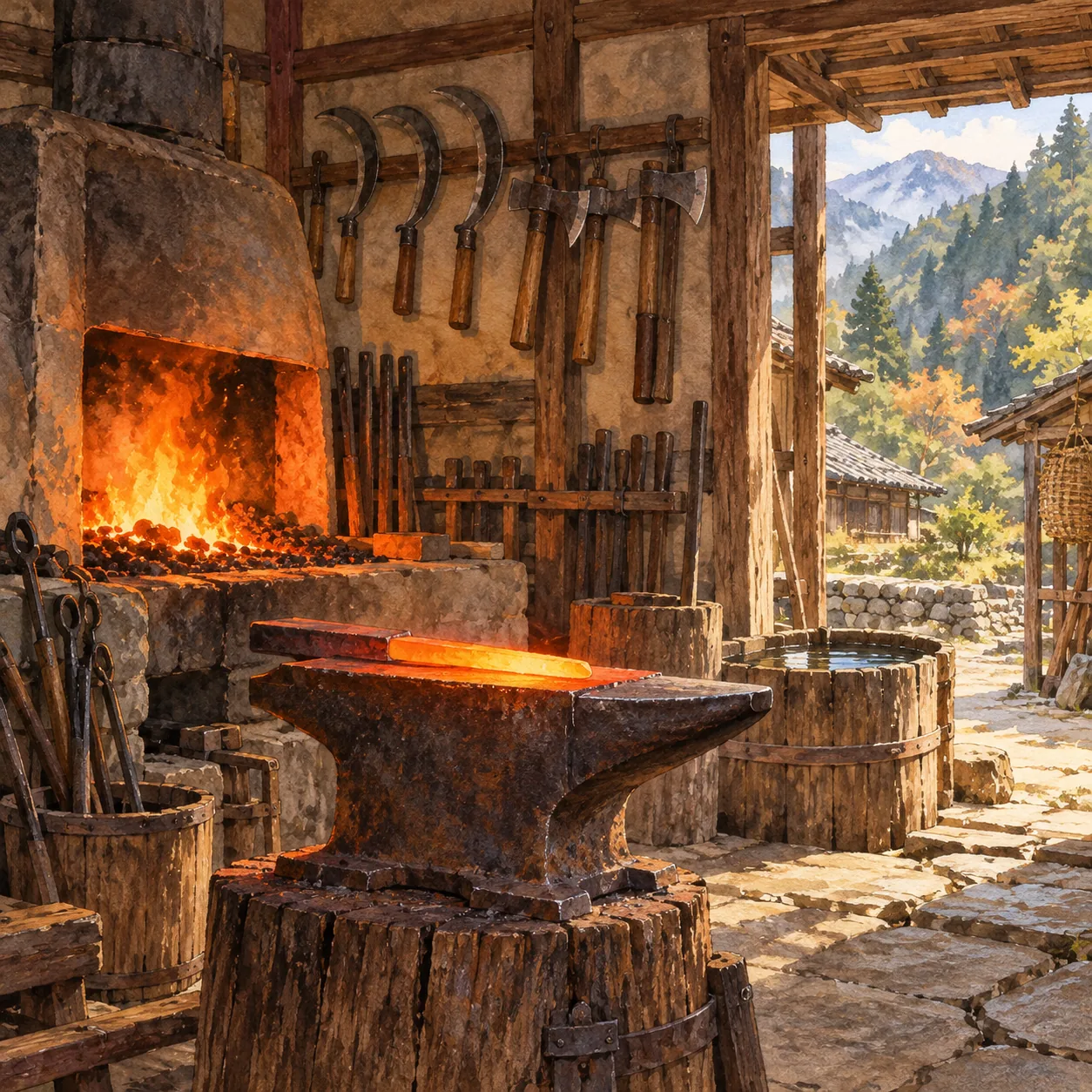
Kochi Prefecture, on the island of Shikoku, is home to Tosa uchihamono — Tosa forged blades. According to Japan's Association for the Promotion of Traditional Craft Industries, a land survey from 1590 already lists 399 blacksmiths in the area. In the early Edo period, the Tosa domain's push to manage its forests and open new rice fields drove demand for farming and forestry tools, and both output and quality grew.
Hidetsugu, the leather knife at the center of this guide, is made by Hokiyama Hamono in Kami, Kochi — a company that makes farm and garden blades and kitchen knives, and describes its leather knives as made with the traditional techniques of Tosa-forged knives.
That is what "Japanese" brings to a leather knife: carbon steel laminated and heat-treated by people who make cutting tools for a living, ground on one side to a keen, straight edge.
2. Hidetsugu, Born in the Taisho Era
The knife behind Japan's shoe-repair benches
A seller of Hidetsugu describes it as "a leather-cutting knife born in the Taisho era (1912–1926) that has supported leather craftsmen and shoe-repair craftsmen." It is used not only in Japan but in other Asian countries too.
The "Ao Gokujo" grade uses Aogami No. 1 (blue paper steel) from Yasugi, in a two-layer construction of hard steel forged to soft iron. The steel gives the edge; the iron makes it easier to sharpen. The handle is magnolia (hoo) wood, which the seller says "settles into your hand the more you use it."
What it is like to use
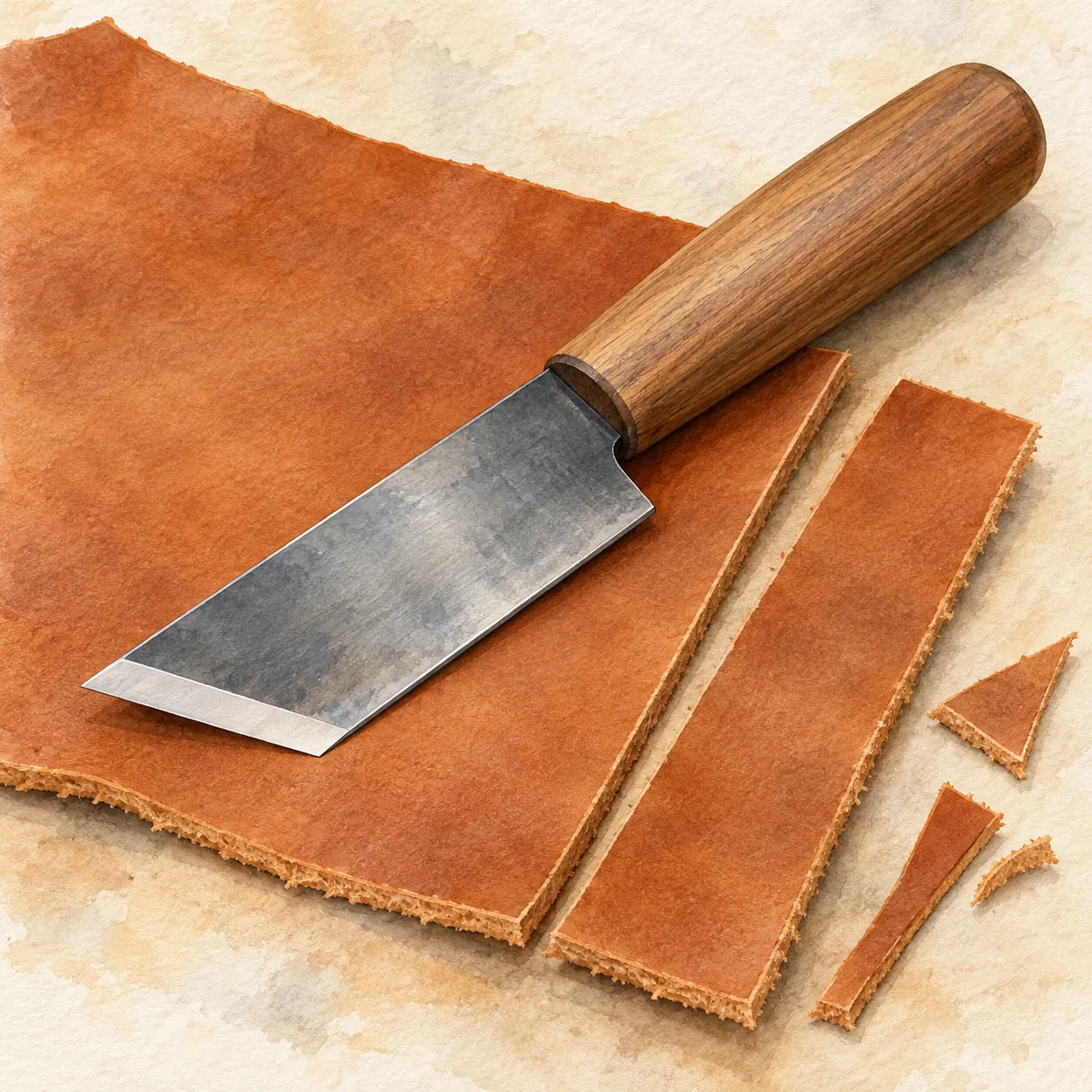
A kawa-bocho is pushed, not sawn. You hold it like a pen at a low angle and push the tip forward along a ruler or a curve. Because it is ground on one side only, the flat back runs against your straightedge and the cut comes out square. A wide blade like this also skives — thins the edge of leather for folding or gluing — once you learn to lay it nearly flat.
In Japan it is sold in 30, 36 and 39 mm widths. If you are not sure where to start, this is the knife many Japanese leatherworkers start with.
3. Hidetsugu for Left-Handers
Same steel, same widths — mirrored
Because a leather knife is single-bevel, a right-handed blade cuts poorly in the left hand: the bevel faces the wrong way, and the cut drifts. Hidetsugu "Ao Gokujo" comes in a left-handed version, with the same Aogami No. 1 two-layer blade, the same magnolia handle, and the same 30, 36 and 39 mm widths.
In Japan it is sold as the bare knife, without a box. If you are left-handed, this is the model to look for rather than a right-handed knife you will fight with.
4. Aogami or Shirogami: The Forged Nakatsugu
An edge that lasts, or an edge that's easy to restore
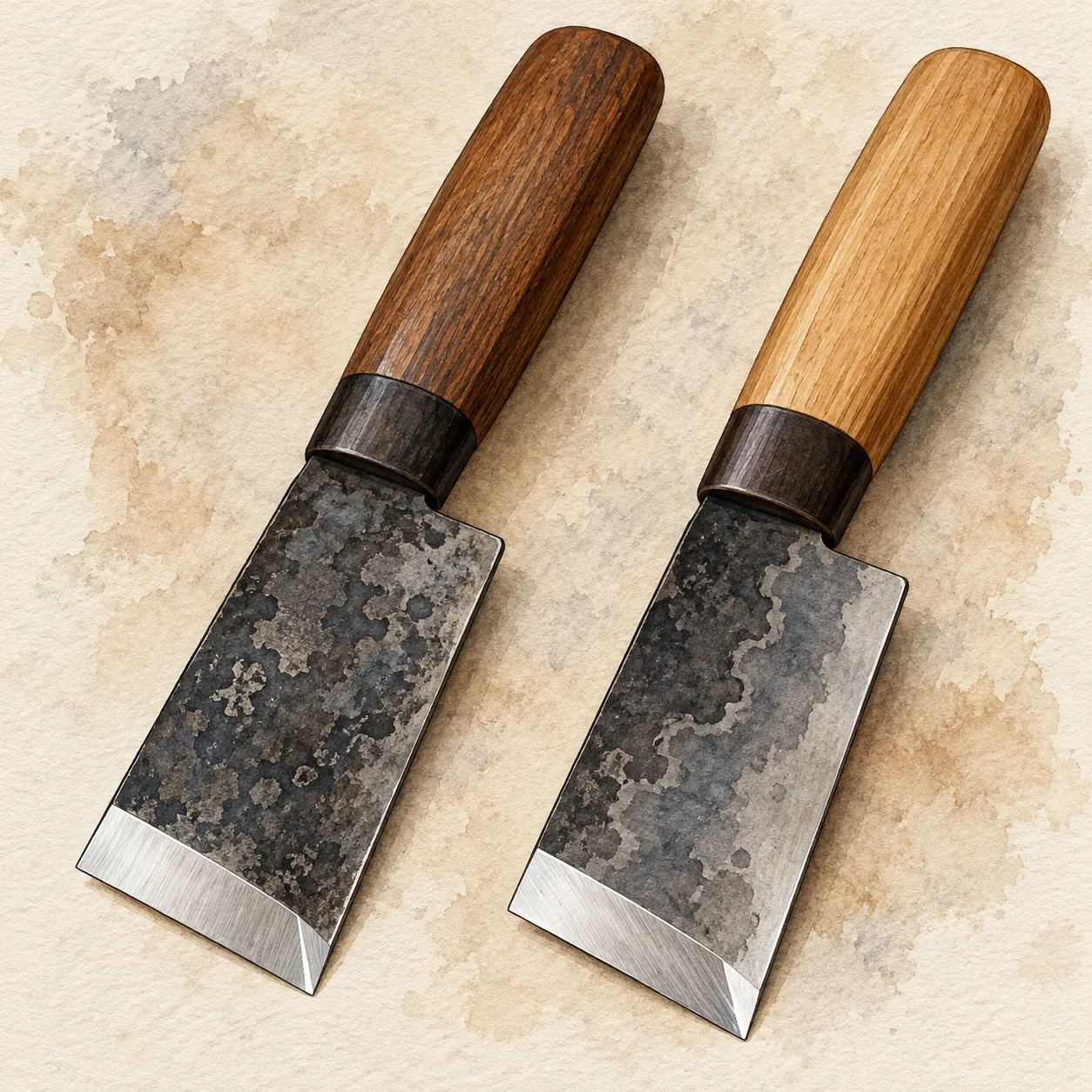
Shinkai Hamonoten, a knife shop in Asagaya, Tokyo, sells "Nakatsugu" leather knives — made in Japan, forged and hand-finished by a craftsman — in two steels: Aogami (blue paper) and Shirogami (white paper).
In the shop's words, Aogami is harder than Shirogami, so the edge lasts longer, but re-sharpening takes more work. Shirogami bites the whetstone readily and is easy to put an edge on.
Because these are forged, each one is a little different: the dark scale left by quenching, and the pattern where steel and iron were hammered together, vary from knife to knife. That is not a defect.
Which one?
If you would rather sharpen less often, Aogami. If you want to learn to sharpen — or you sharpen a little every session anyway — Shirogami. Both are sold in 36 mm, with a 42 mm option.
5. Sharpening and Keeping It Rust-Free
Don't leave it wet; oil it now and then
Aogami and Shirogami are carbon steels, not stainless. Shinkai Hamonoten warns that they keep an edge longer but rust more easily.
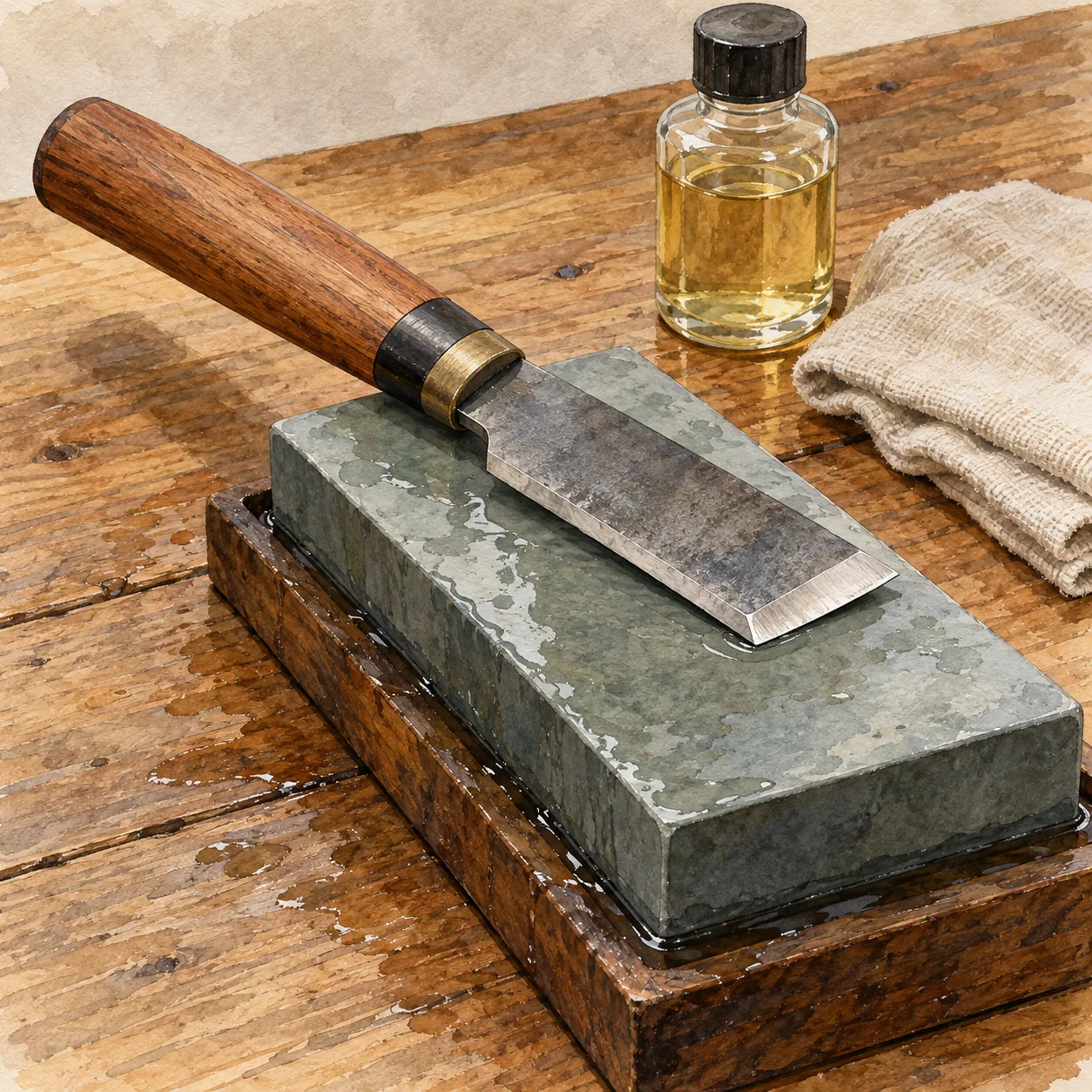
Never leave the blade wet, and don't store it somewhere damp. Keep it dry and wipe a thin film of oil on the steel from time to time. When the edge dulls, sharpen it on a whetstone — the flat back stays flat, and you sharpen the bevel side.
A dark grey patina will form on the steel with use. That is normal, and a stable patina is often said to help slow rust.
6. How to Choose: Width and Hand
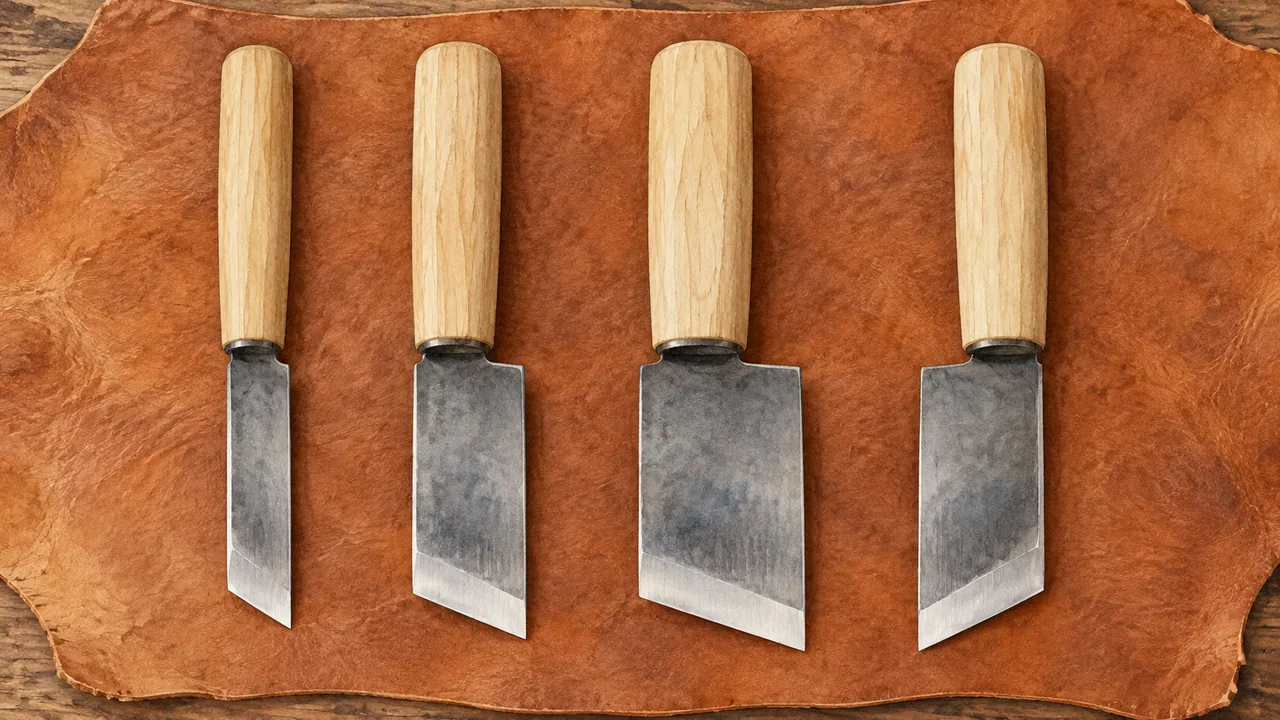
① Your hand: left-handed means a left-handed knife
A single-bevel blade is made for one hand. Hidetsugu "Ao Gokujo" has a left-handed version with the same widths and the same steel.
② The steel: how often you'll sharpen
Sharpen less often — Aogami. Easier sharpening — Shirogami. Hidetsugu's Aogami No. 1 is laminated to soft iron, which keeps it reasonably easy to sharpen as well.
③ The width: 30–39 mm for Hidetsugu, 36 or 42 mm for Nakatsugu
Wider blades are steadier on long straight cuts and better for skiving; narrower blades are easier to steer around curves and into small hands. Match the width to your hand and to the size of the leather you usually cut. For the leathers themselves, see our guide to Japanese leather.
7. Buying From Outside Japan
Hidetsugu and Nakatsugu are sold in Japan. We could not find them on Amazon.com or on an English-language store that ships abroad. If you have a contact in Japan or use a forwarding service, search Japanese stores for 秀次 革包丁 (Hidetsugu leather knife) or 仲次作 革包丁, and check the steel (青紙 = Aogami, 白紙 = Shirogami), the width in millimetres, and whether it is 左利き用 (left-handed).
On Amazon.com, look for a named Japanese maker. Many "Japanese leather knives" sold online are Japanese in style only. The KAKURI knife below is from Kakuri, a tool company in Sanjo, Niigata, and the listing states it is made in Japan.
KAKURI Japanese Leather Knife — Flat Blade
A flat-bladed Japanese leather knife for straight cuts, trimming and precise work, listed as made in Japan with Japanese steel.
It is the most practical way to get a Japanese-made leather knife delivered outside Japan. Care is the same: keep it dry and lightly oiled.
KAKURI Japanese Leather Knife — Flat Blade
Loading product details…
8. Frequently Asked Questions
Aogami or Shirogami — which is better for leather?
Aogami if you want to sharpen less often; Shirogami if you want easier sharpening. Shinkai Hamonoten explains that Aogami is harder and holds its edge longer, while Shirogami takes to the whetstone readily and is easy to put an edge on.
Is there a left-handed Japanese leather knife?
Yes. Hidetsugu "Ao Gokujo" comes in a left-handed version, in 30, 36 and 39 mm. Because the blade is ground on one side, a left-hander should use a left-handed knife.
Where is Hidetsugu made?
By Hokiyama Hamono in Kami, Kochi Prefecture — a blade maker in the Tosa forged-knife region. It is listed as made in Japan.
Do Japanese leather knives rust?
Yes — they are carbon steel. Keep the blade dry, store it somewhere dry, and wipe on a little oil from time to time. A grey patina is normal.
What does "two-layer" mean?
A hard steel edge forged together with soft iron. The steel holds the edge; the iron supports it and makes sharpening easier. Hidetsugu "Ao Gokujo" uses this construction.
My forged knife has dark marks. Is it defective?
No. Shinkai Hamonoten explains that the dark scale from quenching and the pattern where steel and iron were hammered together vary from knife to knife on forged blades.
Final Thoughts: One Blade of Steel, Sharpened for Years
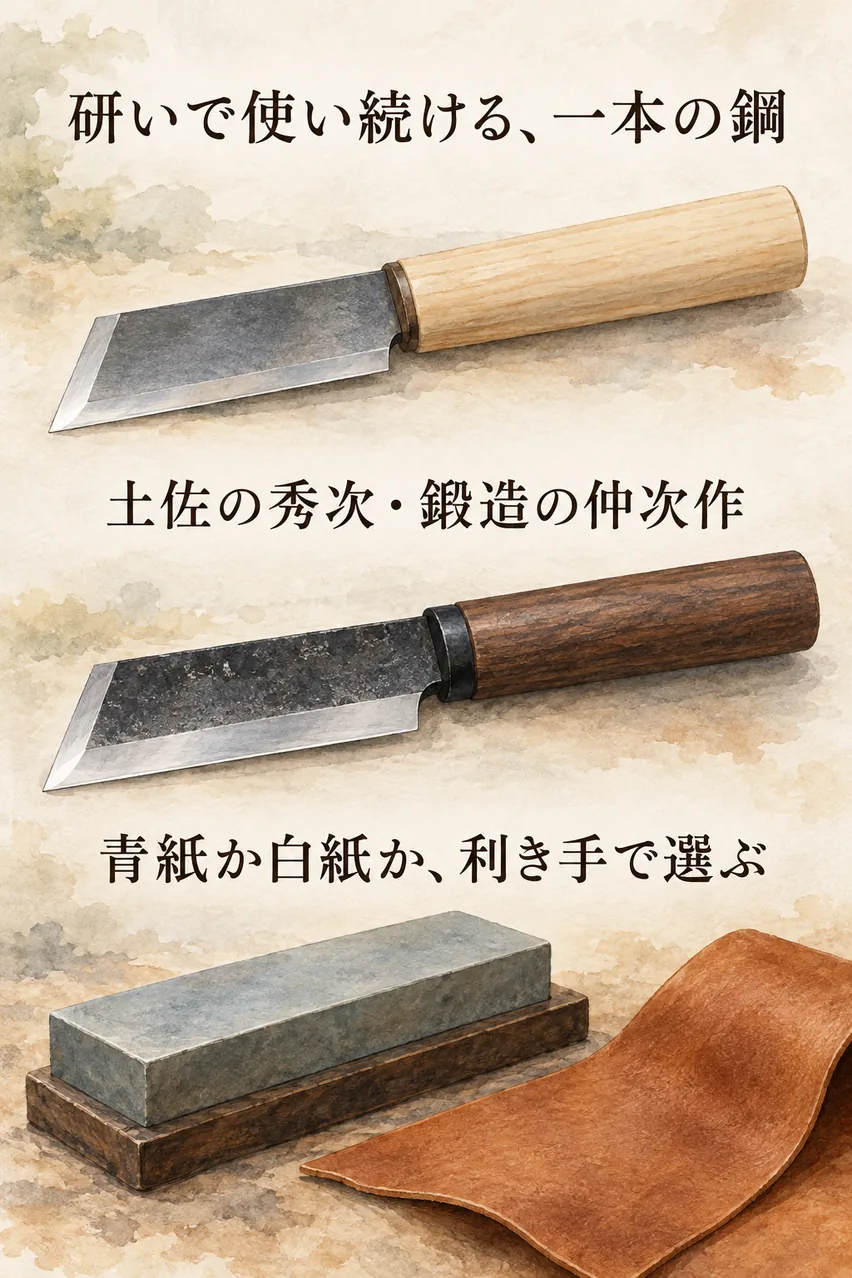
A Japanese leather knife is one blade of steel that you sharpen and keep.
Start with Tosa's Hidetsugu, the knife Japanese leather and shoe-repair craftsmen have used since the Taisho era — or its left-handed version. To sharpen less, choose the forged Nakatsugu in Aogami; to learn sharpening, Shirogami. Outside Japan, the KAKURI knife is the easiest made-in-Japan option to get.
By the time the magnolia handle has settled into your hand, the line it leaves in leather will be straight.
Japanese Leather Guide: Tochigi & Himeji Wallets That Last
Japanese Carving Tools: Seki and Miki Chisels Compared