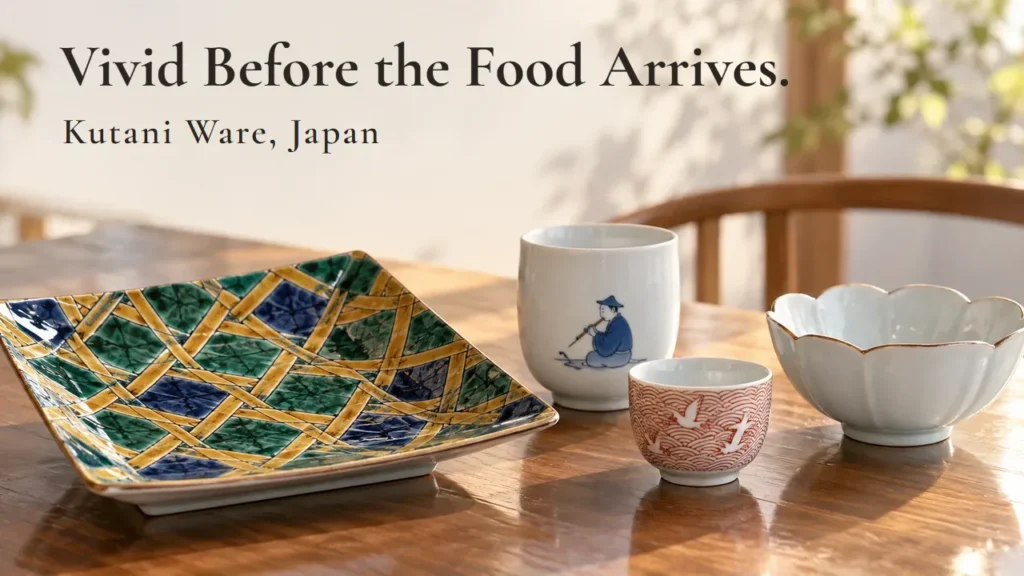
Kutani ware is porcelain made to be painted — and it looks festive before you put any food on it. From Ishikawa Prefecture on Japan's Sea of Japan coast, its character lies in overglaze painting: colours applied after the first firing, then fired again.
Yet "Kutani" covers very different faces. There are dishes filled with thick, glowing colour; red lines painted three to a millimetre; a whimsical flute player painted for decades by one kiln; and white Kutani with no painting at all. This guide introduces four makers, one for each face, and how to choose between them for everyday use.
Quick Reference: Four Faces of Kutani
| Style | Maker | What you see |
|---|---|---|
| Aode (bold colour) ▾ | Kutani Bitoen (Kaga, since 1914) | Thick, translucent yellow, green and deep blue |
| Akae saibyō (fine red lines) ▾ | Fukushima Reiko (Fukushima Buzan school) | Hair-fine red line-work |
| Free-spirited motifs ▾ | Kamide Chōemon (Nomi, since 1879) | The flute player, in 12 variations |
| White Kutani ▾ | Miyayoshi Seito (Komatsu, since 1972) | Bluish white porcelain with relief patterns |
1. Why Japanese: Five Colours, Painted Over the Glaze
The weight and shine of five colours
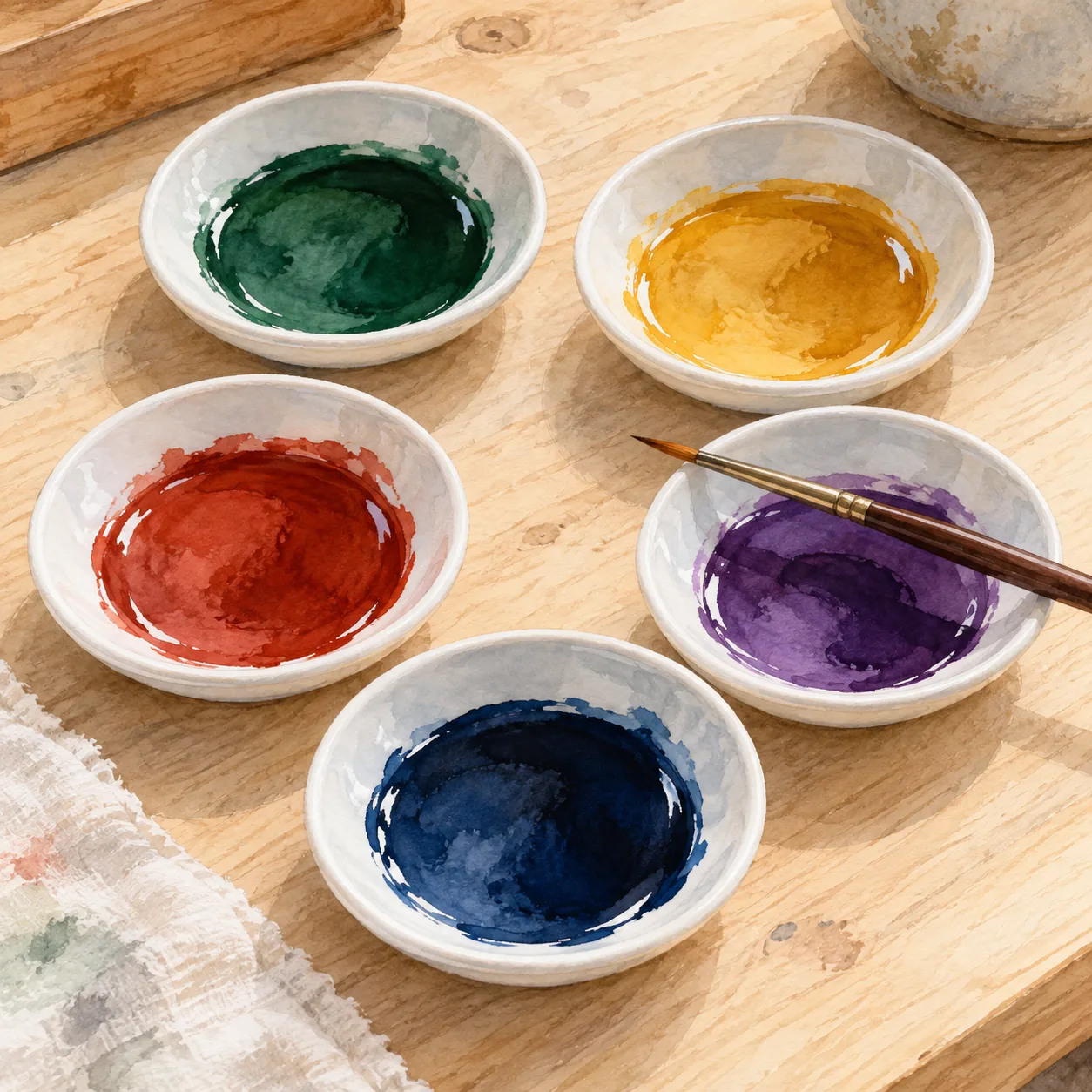
Japan's Association for the Promotion of Traditional Craft Industries describes Kutani ware as bold, free line-work under five colours — green, yellow, red, purple and deep Prussian blue — with a rich, heavy shine. Overglaze painting in many colours is its essential character. The body is fired for about 15 hours up to 1,300°C, then painted and fired again at 800–1,000°C.
Its history has a dramatic break. "Old Kutani" began in the mid-17th century, after porcelain stone was found in the Kutani mines and craftsmen of the Kaga domain learned porcelain-making in Arita — then, around the end of the 17th century, it suddenly stopped being made. In the 19th century Kutani was revived by kilns in many styles, including one devoted to fine red painting. Today it is made in Kanazawa, Komatsu, Kaga and Nomi, and it was designated a Traditional Craft of Japan in 1975.
2. Aode: Thick Colour You Can See Light Through
Kutani Bitoen, at a hot-spring town since 1914
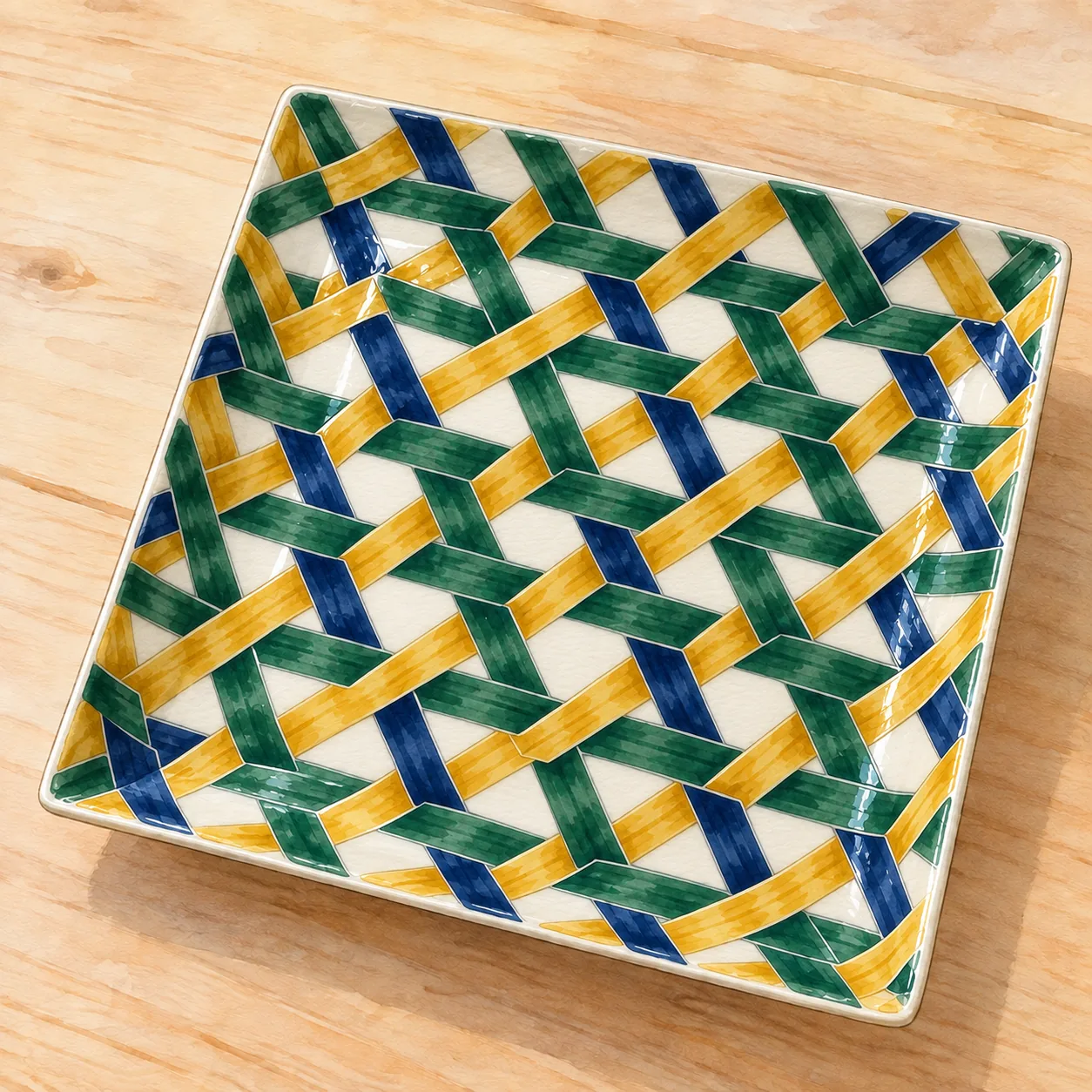
Kutani Bitoen has made and sold hand-painted Kutani from its workshop in Yamashiro Onsen, Kaga, since 1914. It builds on the basics of local Old Kutani and the Yoshidaya style, as well as old Chinese blue-and-white and red painting. In its own words, it makes by hand "warm, easy-to-use vessels for the everyday table" — for Japanese, Western and Chinese food alike.
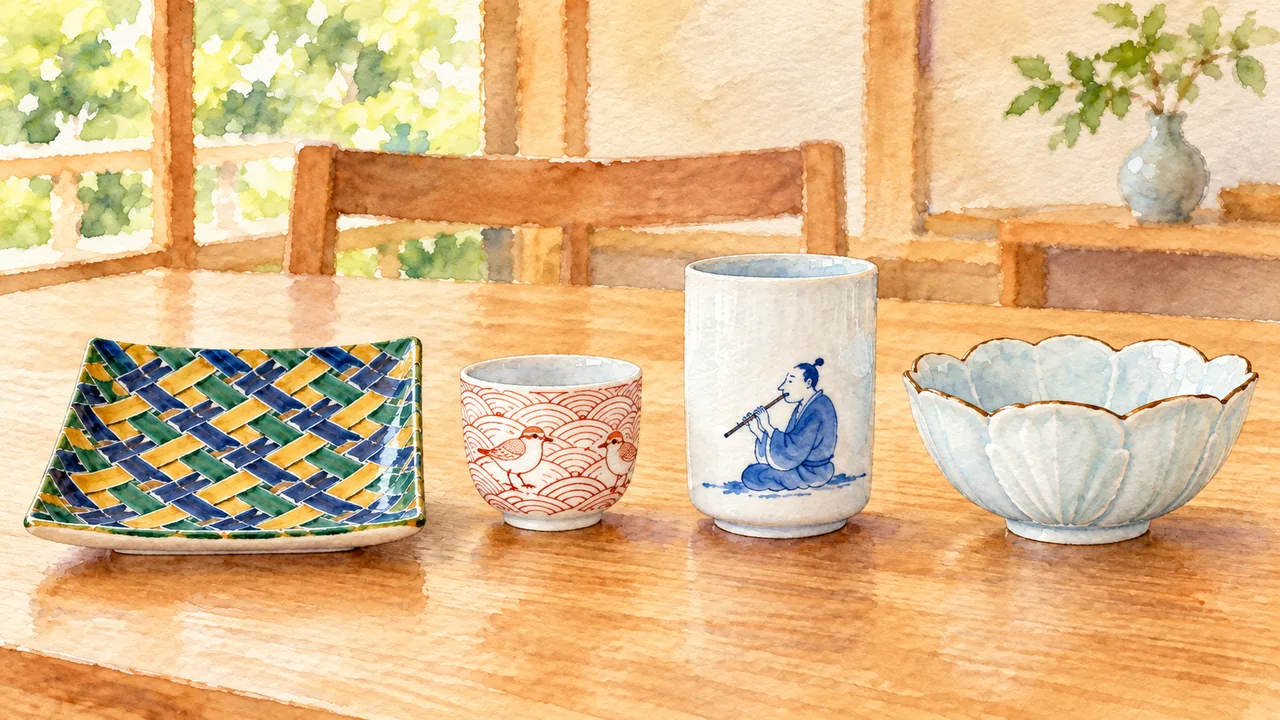
Its seven-sun (about 21.7 cm / 8.5 in) square plate is painted by hand in yellow, green and deep blue with a kagome pattern — the woven mesh of a basket turned into ornament. The retailer invites you to enjoy the thickness and translucency of the colours that only Kutani has.
3. Akae Saibyō: Three Lines to a Millimetre
A name on a grain of rice
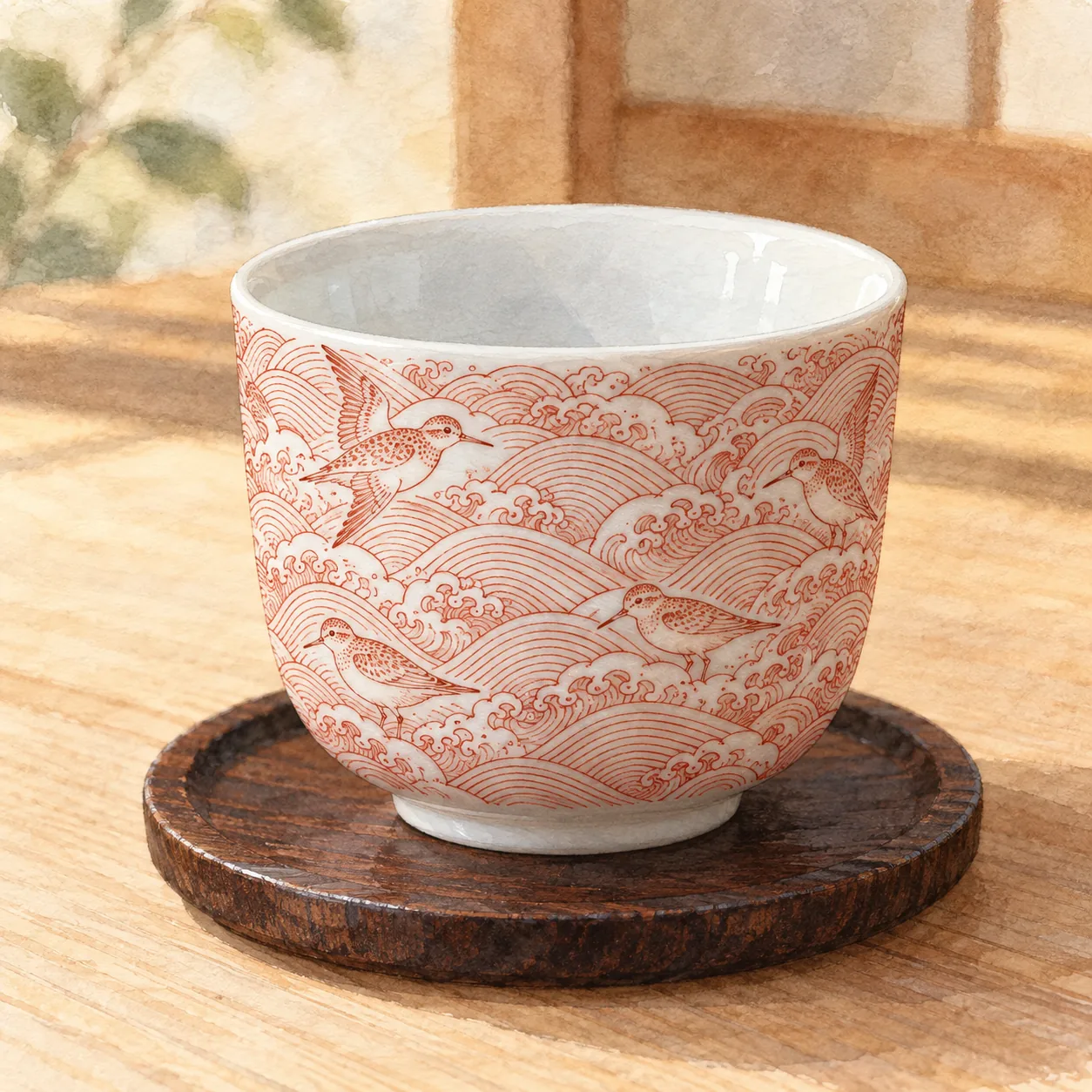
Akae saibyō is a Kutani technique of painting delicate lines in red with a very fine brush. Its leading painter, Fukushima Buzan, born in Kanazawa in 1944, is described by the Hokuriku Chunichi Shimbun as able to paint a name on a grain of rice and three lines within a single millimetre. What he seeks, he says, is "a beautiful line that never breaks."
He won the Prime Minister's Prize at Japan's national traditional crafts exhibition in 1999, and in 2015 painted watch dials for Hermès. His daughter, Fukushima Reiko, is among his students. Her sake cup with a pattern of waves and plovers, 6.4 cm (2.5 in) across and boxed in paulownia, is covered in fine red line-work; each one is handmade, so the depth of the painting varies. The retailer recommends hand washing rather than the dishwasher or microwave.
4. Kamide Chōemon: Sixty Years of the Flute Player
From the 2000 Okinawa Summit to a DJ
Kamide Chōemon kiln was founded in 1879 in Nomi, Ishikawa, as a Kutani wholesaler. According to the history its retailers publish, its tableware was used at the leaders' dinner at the 2000 G8 Okinawa Summit.
Its best-loved motif is the "Fuefuki" (flute player), which the kiln has painted for sixty years — relaxed and free, with a charm quite different from Kutani's vivid colours. The teacups come in 12 variations: the original flute player, and the same figure playing trumpet, drums, saxophone, piano, guitar, a boombox, DJ decks, a skateboard and more. They're made one by one by craftspeople who have carried on the work for generations, and the retailer lists them as microwave- and dishwasher-safe.
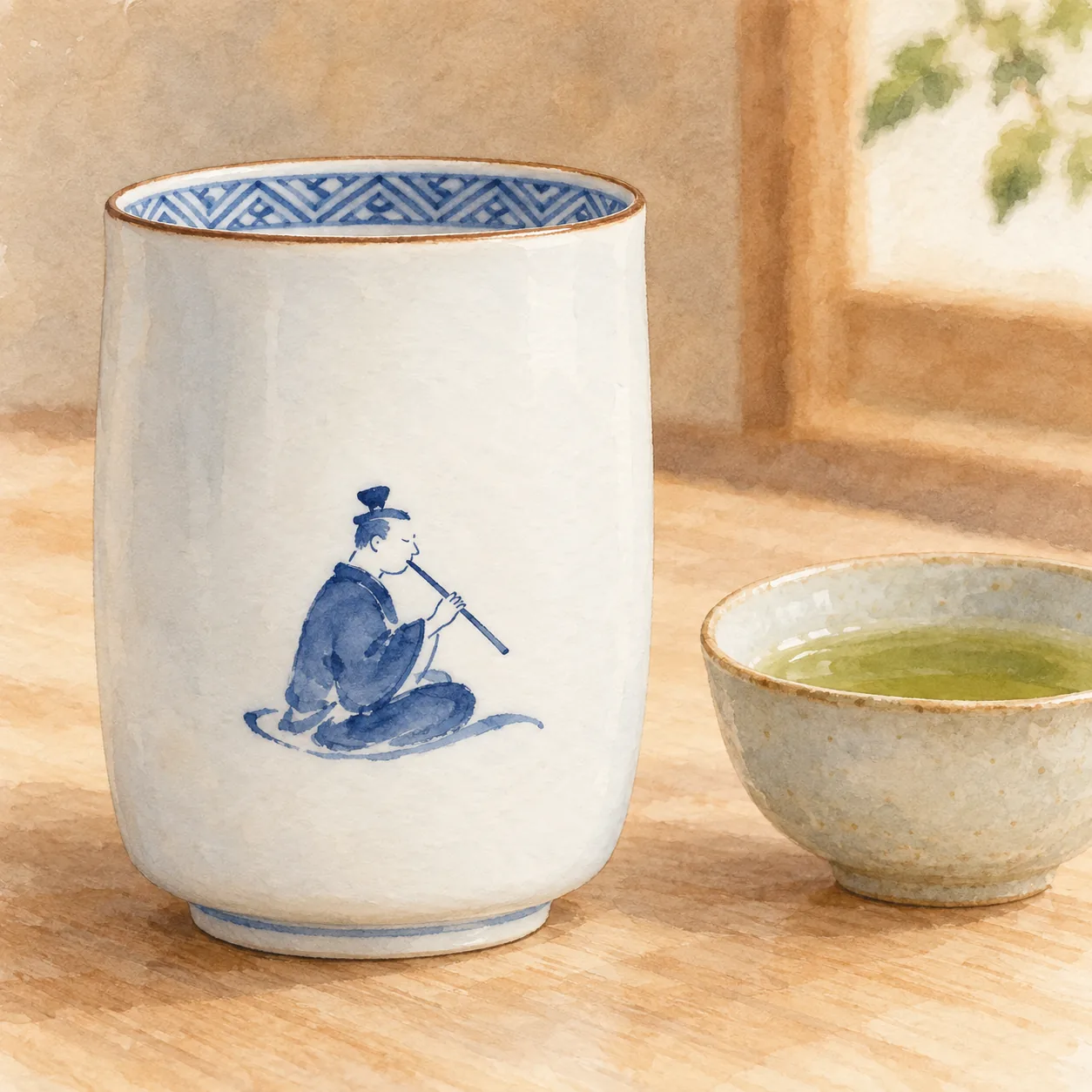
Its rice bowl in deep Prussian blue carries an inscription on the bottom: "吾唯足知" — "I know only contentment", carved on the stone water basin said to have been donated to Kyoto's Ryoan-ji temple by Tokugawa Mitsukuni. Each character shares the central "口" (mouth) to be read. Painted with shading by hand, no two bowls are alike.
5. White Kutani: Porcelain That Isn't Painted
A bluish white from Hanasaka stone
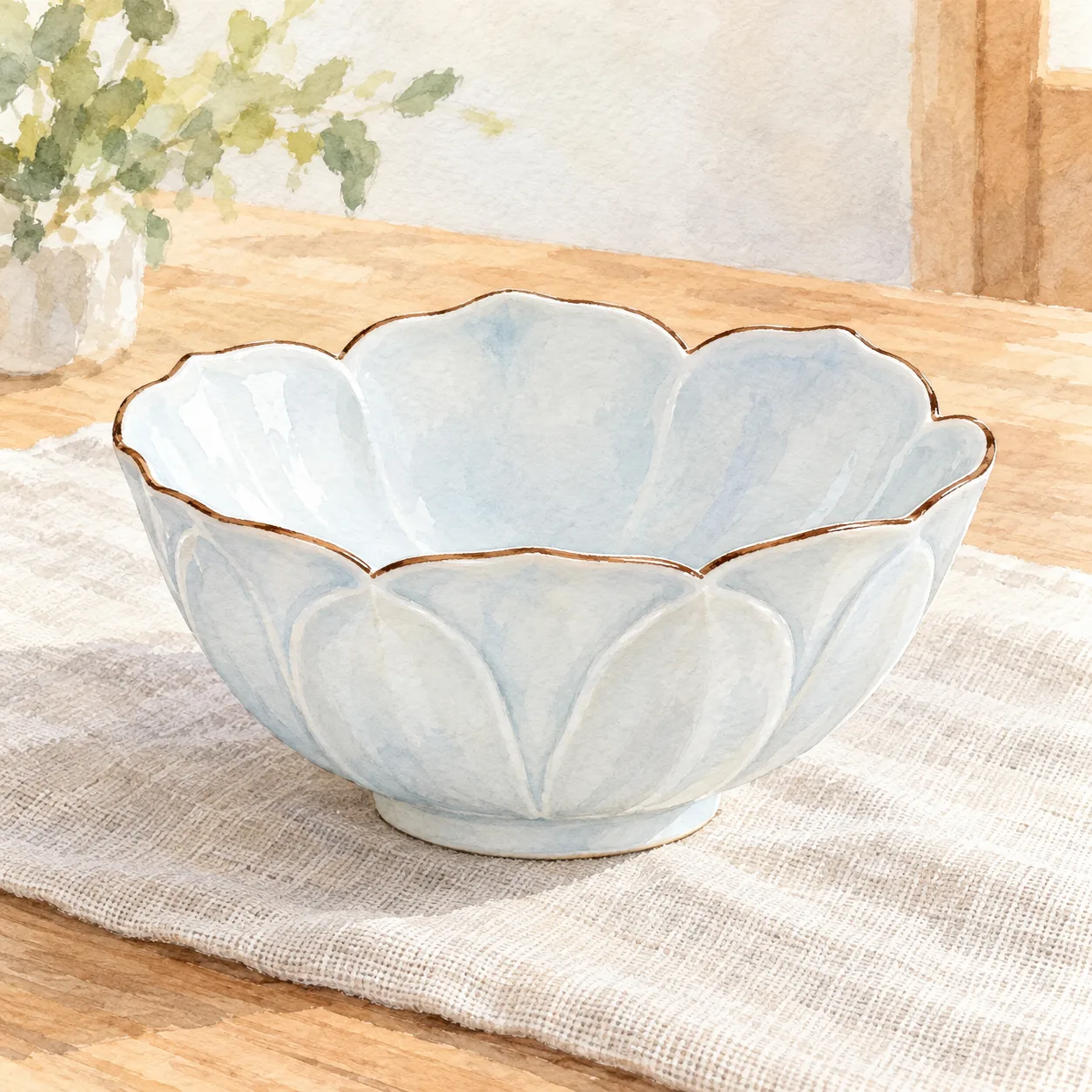
Miyayoshi Seito was founded in Komatsu in 1972, and every piece is handmade by its craftspeople. In 1990 it began throwing on the wheel and pressing into moulds by hand (kata-uchi). In 1989 it helped Myosen Tobo make the porcelain bodies for the Imperial Household Agency's tableware for the Daijōsai, the accession ceremony.
The stone of the Kutani area contains a little more iron, so it fires to a white with a soft blue cast — a quality unique to Hanasaka porcelain stone. Its white Kutani lobed bowls, 23 cm (9 in) across, show a relief pattern pressed in by hand and a thin brown rim (fuchi-sabi), a traditional porcelain finish. Because each is shaped by hand, every bowl differs slightly. They're dishwasher- and microwave-safe.
6. Starting Small: Kutani Chopstick Rests
Kutani painting is easiest to try at a small scale. A chopstick rest puts the overglaze colours on the table every day, at a fraction of the commitment of a plate. Both of these are listed on Amazon.com as made in Japan.
Kutani chopstick rests by Seikou Kiln (set of 4)
Crane, face, stone and peony — four Kutani motifs in one set. Decorated by hand, made in Japan. Mix and match them at the table.
Kutani Chopstick Rests by Seikou Kiln (Set of 4)
Loading product details…
Kutani chopstick rest, plover (CLAYMARK)
A single plover in Kutani porcelain — the same bird that flies across Fukushima Reiko's waves. A small, easy gift.
Kutani Chopstick Rest, Plover (CLAYMARK)
Loading product details…
7. How to Choose: For Display or Daily Use
1. Check each piece's washing notes
Kamide Chōemon's flute-player cups and Miyayoshi's white Kutani are listed as dishwasher- and microwave-safe. Fukushima Reiko's fine red sake cup is best washed by hand. Painted Kutani varies piece by piece, so check each product's own notes.
2. Choose by the role on the table
For a centrepiece, aode. For a cup you'll look at closely, akae saibyō. For a daily teacup with a smile, the flute player. For a table where the food is the star, white Kutani.
8. Buying From Outside Japan
- Chopstick rests: the two in section 6 are on Amazon.com, listed as made in Japan.
- Kutani Bitoen, Fukushima Reiko, Kamide Chōemon and Miyayoshi Seito: sold through Japanese shops; as of November 2026 we didn't find them with international shipping. If you live in Japan and pay resident tax, Miyayoshi's white Kutani bowls are also a furusato nozei (hometown tax donation) gift from Komatsu city.
- Look for the maker's name. "Kutani" appears on many listings; for a particular style, look for the kiln or artist.
9. Frequently Asked Questions
What makes Kutani ware different from Arita ware?
Kutani's essential character is overglaze painting in many colours. Japan's Association for the Promotion of Traditional Craft Industries names its five colours — green, yellow, red, purple and deep blue. Old Kutani itself began after Kaga craftsmen learned porcelain-making in Arita.
What is akae saibyō?
A Kutani technique of painting very fine red lines with a slender brush. Its master, Fukushima Buzan, can paint three lines in a millimetre, and painted watch dials for Hermès in 2015.
What is white Kutani?
Kutani porcelain without painting. The local stone fires to a white with a slight blue cast, and patterns are shown in relief. Miyayoshi Seito in Komatsu shapes its white Kutani by hand.
Is Kutani ware dishwasher-safe?
It depends on the piece. Kamide Chōemon's flute-player cups and Miyayoshi's white Kutani bowls are listed as dishwasher-safe; Fukushima Reiko's fine red sake cup should be washed by hand.
Why did Old Kutani stop?
Its makers suddenly stopped around the end of the 17th century, according to Japan's Association for the Promotion of Traditional Craft Industries, after about half a century of production. Kutani was revived in the 19th century by kilns in many styles.
What's a good first piece of Kutani?
A chopstick rest or a teacup. Small pieces bring Kutani's colours to the table every day; Kamide Chōemon's flute-player teacups come in 12 variations if you want something with a sense of humour.
Final Thoughts: Festive Before the Food Arrives
Kutani ware is porcelain made to be painted — five colours applied over the glaze, with a weight and shine all their own.
Kutani Bitoen fills plates with thick, glowing colour. The Fukushima school paints red lines three to a millimetre, fine enough for Hermès. Kamide Chōemon has painted a free-spirited flute player for sixty years. Miyayoshi Seito lets a bluish white speak for itself.
Set one piece on the table, and the meal is festive before it begins.
Arita Ware: 4 Kilns From Japan's First Porcelain Town
Hasami vs Arita: Japanese Porcelain Compared