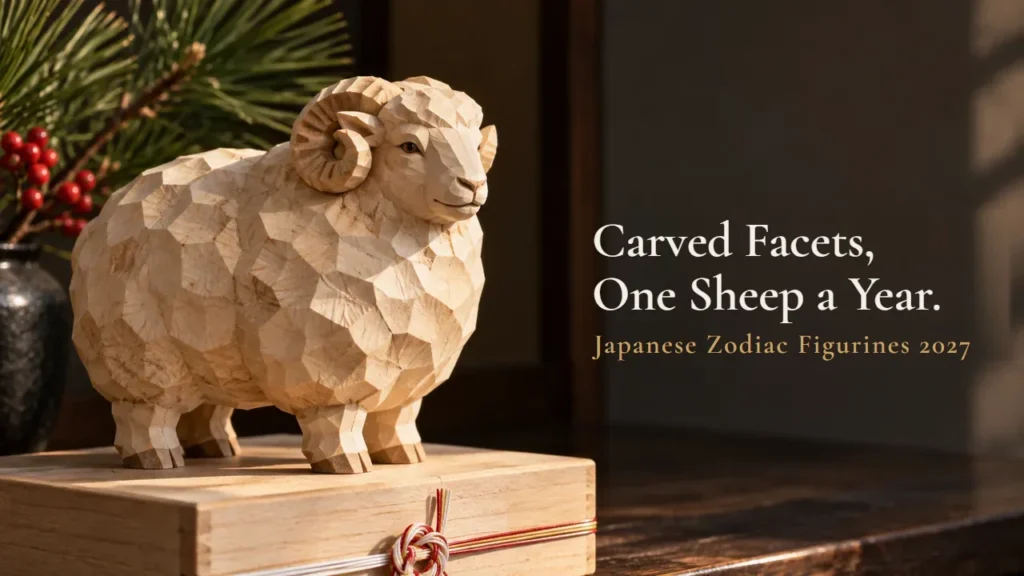
"I collect the zodiac animal every year." That line comes from a Japanese buyer's review of a zodiac figurine. One figurine a year, twelve years to go all the way around — a shelf that slowly fills with a family's years.
In Japan, the zodiac animal for 2027 is the sheep (hitsuji, 未), and small sheep go on display for the New Year. This guide introduces four Japanese ways of making one: Ise ittobori carved to 48 facets, Iyo ittobori from Ehime, Kutani porcelain dotted with tiny raised beads, and cast metal from Takaoka. It also covers how to choose, and how to put each one away when its year is over.
Quick Reference: Which 2027 Sheep?
| Craft and maker | Material | What to look for | Size |
|---|---|---|---|
| Ise ittobori (Miyachu) ▾ | Camphor wood | Knife facets, up to 48 | Palm-sized, in a paulownia box |
| Iyo ittobori (Naun) ▾ | Hiba cypress | Rounded, every unnecessary line removed | Small, with stand |
| Kutani ware (Nakata Kingyoku III) ▾ | Porcelain | Raised white dots over glaze | Size 3 |
| Takaoka casting (Takenaka Copperware) ▾ | Cast metal | Weight and a deep finish; available abroad | 5 or 7.5 cm (2 or 3 in) |
1. Why Japanese: A Figurine That Takes Twelve Years to Complete
One more on the shelf each year
A Japanese zodiac figurine doesn't retire when its year ends. Next year's animal goes beside it, then another the year after. Start with the animal of the year a child was born, and after twelve years the shelf holds that child's first twelve years.
One buyer of an Ise ittobori figurine wrote that they "want to collect this maker's zodiac animal every year." Staying with one maker for all twelve keeps the carving style, colour and size consistent along the shelf.
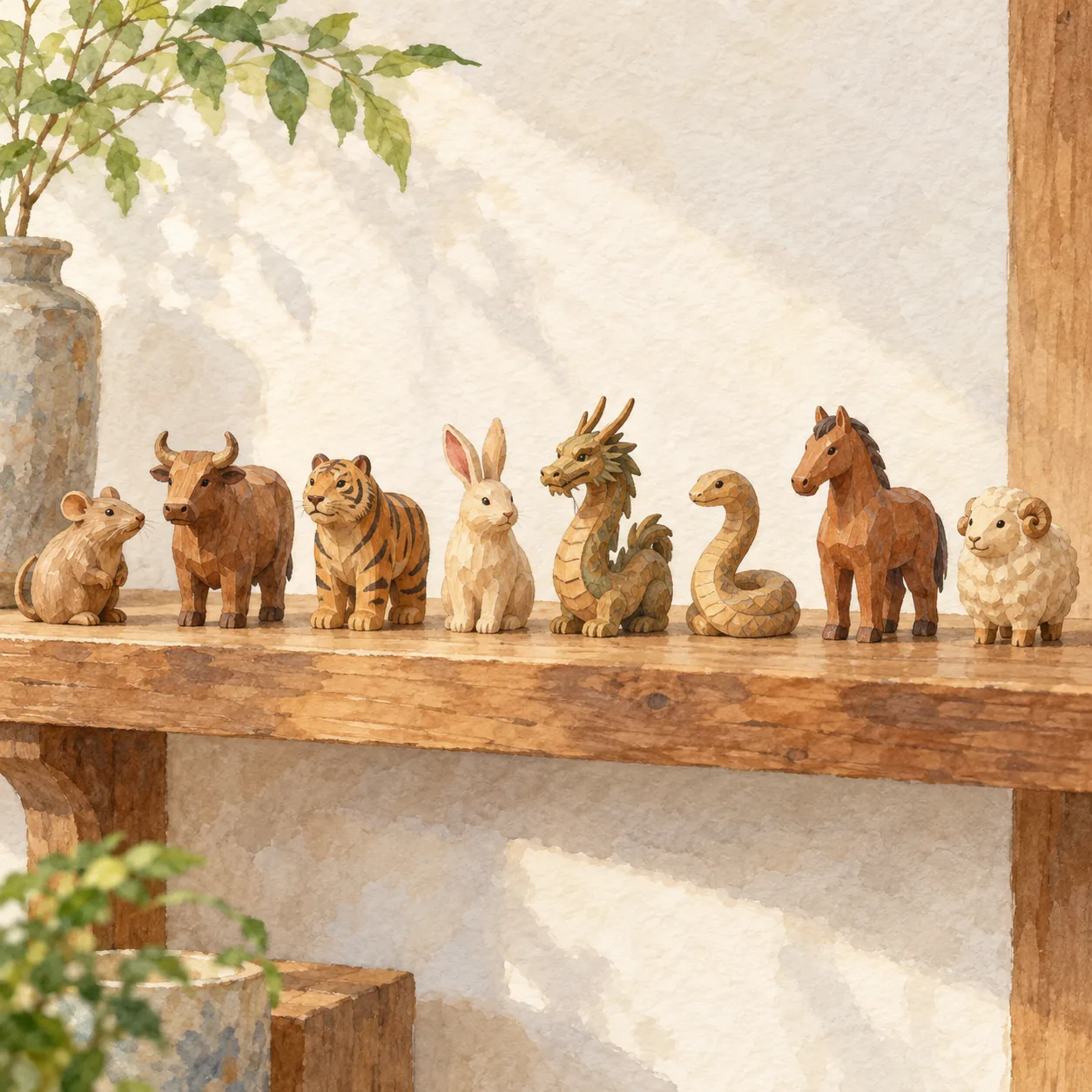
Every region carves its own sheep
What makes the Japanese version special is that the same animal is made in completely different ways from region to region: shrine carpenters' knife-work in Ise, softened shapes in Ehime, raised-dot painting on Kutani porcelain, and four centuries of metal casting in Takaoka. A collector's shelf can become a small tour of Japanese craft.
2. Ise Ittobori: Carved to 48 Facets
From a block of wood, a sheep in 48 planes
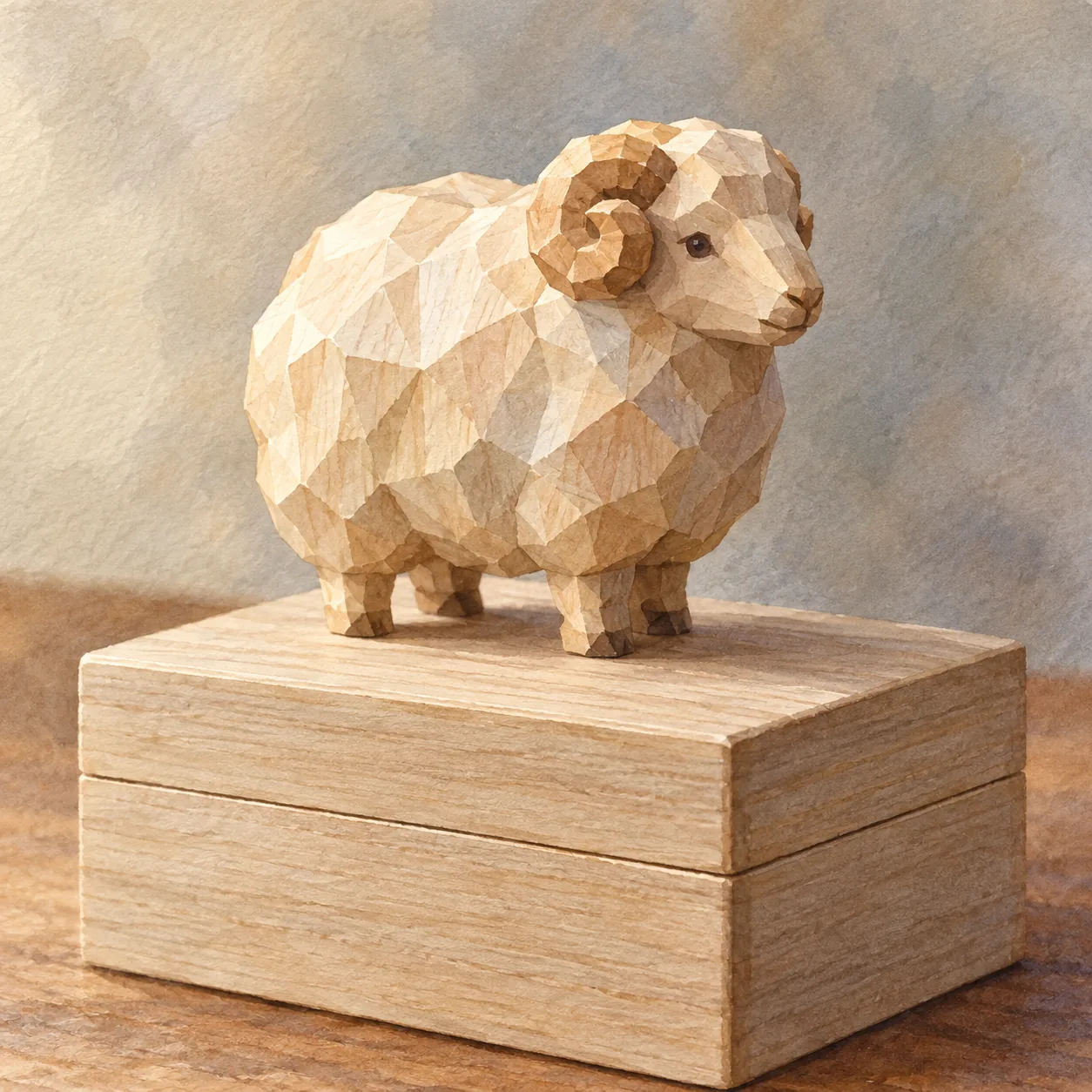
Miyachu, a maker of household shrines and Shinto ritual goods in Ise, Mie Prefecture, describes Ise ittobori ("single-knife carving") like this: a rectangular block is carved down to as many as 48 facets to reach the shape, and the natural knife marks give it strength within its simplicity.
Instead of sanding it round, the faces left by the blade stay as they are. When light falls on it, each facet catches it differently. Hold one and you can trace the knife with your fingers.
Carved by the carpenters of Ise Shrine
According to Miyachu, Ise ittobori is said to have begun as a side craft of the shrine carpenters who rebuild Ise Grand Shrine every 20 years. Netsuke toggles were the first to become popular, followed by lucky gods and sacred roosters.
Miyachu's 2027 sheep is carved from camphor wood and measures 3.3 cm wide, 7.2 cm deep and 5.2 cm tall (1.3 × 2.8 × 2 in) — it sits in the palm of your hand — and comes in a paulownia-wood box. Miyachu makes all twelve animals, so you can stay with one maker for the full cycle. It sells through Japanese shops.
3. Iyo Ittobori: Every Unnecessary Line Removed
A carver near Dogo Onsen
Ehime Prefecture's tourism site describes Iyo ittobori as wood carving that removes every unnecessary line from a shape and expresses it simply. One of its makers is Naun, with a shop close to Dogo Onsen in Matsuyama.
Naun's sheep are round and soft. Where Ise's sheep shows off its facets, this one is about pared-back curves and gentle colour. Both are "ittobori," yet the sheep has a completely different face in each region.
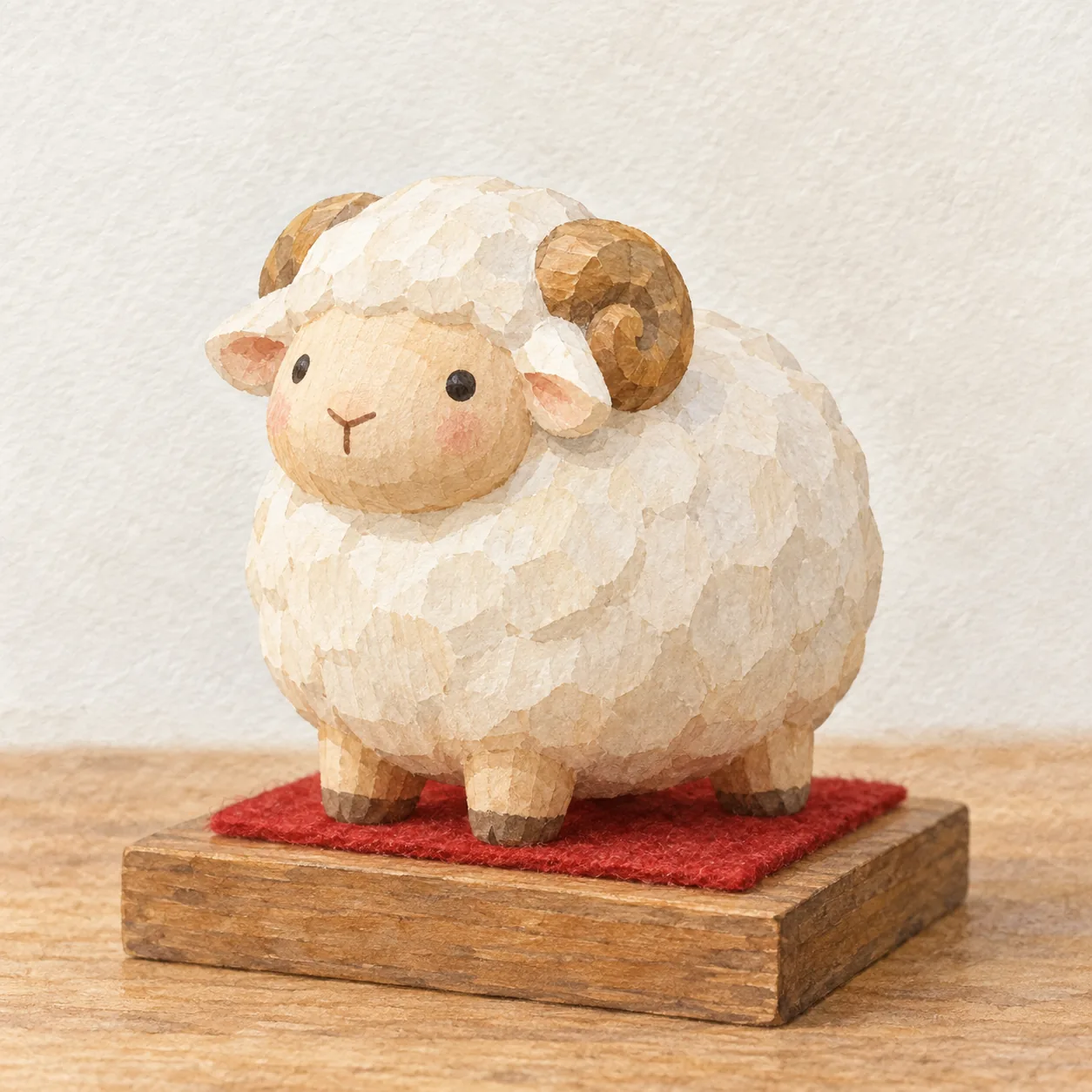
Naun's zodiac series sheep is carved in hiba cypress, about 9 × 6 cm (3.5 × 2.4 in) on a wooden stand. A larger "Hinoto-Hitsuji" version, 12 × 9.5 cm (4.7 × 3.7 in), comes with red felt, a stand and a paulownia box; Naun says it was made "with the wish that the year begins in harmony, moving gently forward like a sheep." Both are sold through Japanese shops.
Did you know: every region has its own folk-toy sheep
A paper maker in Yamanashi printed sheep-year gift envelopes featuring folk-toy sheep from around Japan — papier-mâché sheep, sorghum-stalk craft, and Nogomi dolls. Add the carved sheep of Ise and Iyo, and the same animal takes on a different face in every corner of the country.
4. Kutani Ware: A Sheep Drawn in Tiny White Dots
Minute dots, packed close
Kutani porcelain from Ishikawa Prefecture has a technique called aochibu ("blue dots"): an overglaze method of building up minute dots packed densely together, according to the Kutani ware publication Kutaniyaki MAG. Besides blue there are white dots (shirochibu) and gold dots.
The Nakata Kingyoku family of Komatsu has placed these dots for three generations. The second generation devised "uzu-uchi," in which the dots appear to swirl, and the third generation carries that style on today.
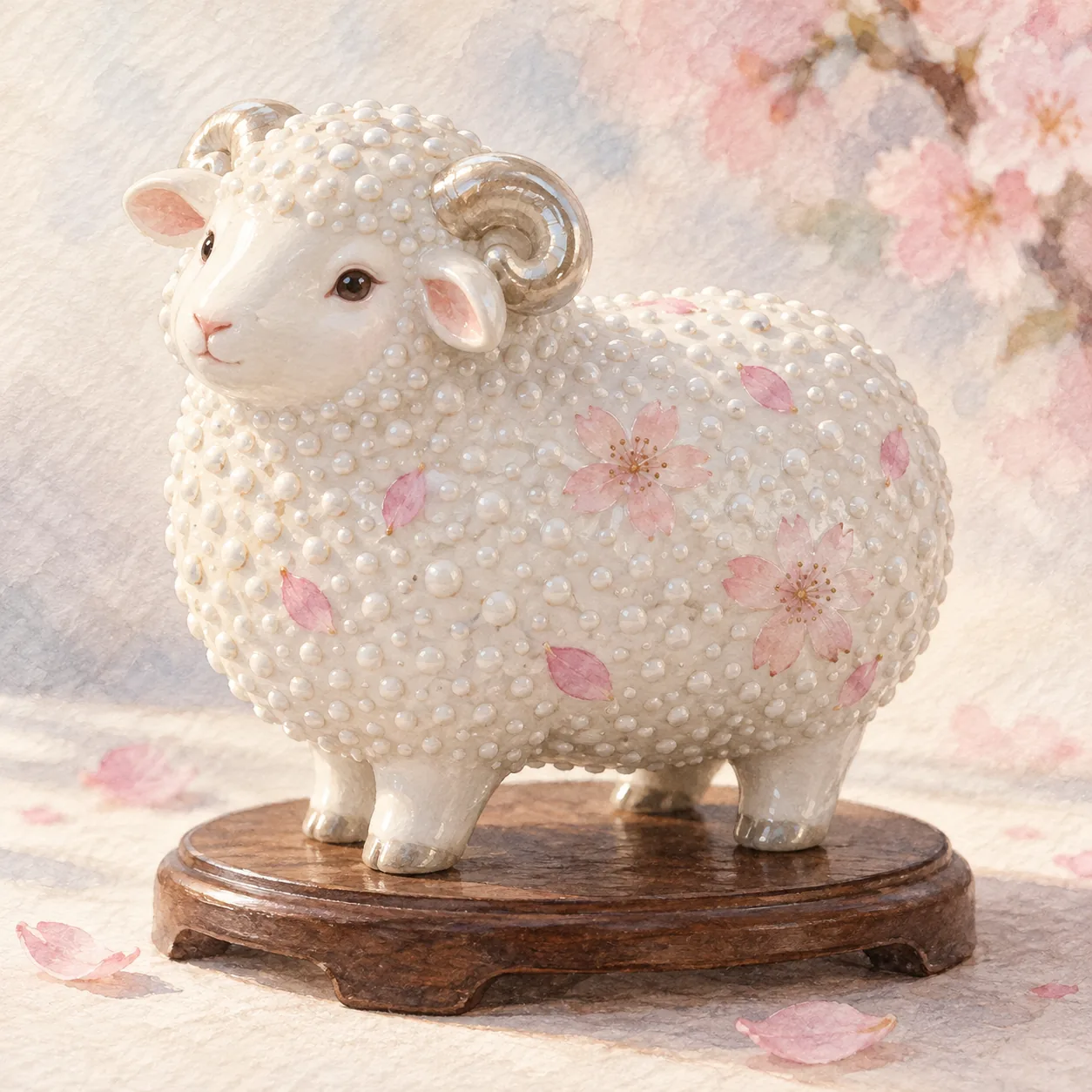
His 2027 sheep is white porcelain covered in white dots, raised platinum and scattered cherry blossoms; up close, every dot stands slightly proud of the surface. This is a zodiac figurine chosen by the artist's name — for anyone who wants their once-a-year piece to carry the same weight as fine tableware. It sells through Kutani specialist shops in Japan.
5. Takaoka Casting: A Sheep You Can Order From Abroad
Four hundred years of metal casting
Takaoka in Toyama Prefecture is Japan's great metal-casting town. Its copperware history goes back more than 400 years, to when Lord Maeda Toshinaga built Takaoka Castle and opened a foundry to bring prosperity to the town. Takenaka Copperware was founded there in 1927 as a copperware workshop in Miyagawa-cho.
Its 2027 sheep is cast metal, listed as a traditional craft made in Japan. Next to wood and porcelain it feels heavier and more solid in the hand. Two sizes are listed on Amazon.com.
Takenaka Copperware 2027 Sheep, small — 5 cm (2 in)
Small enough for a desk or a narrow windowsill. A good first piece if you're starting a twelve-year shelf.
Takenaka Copperware 2027 Sheep, Small (2 in)
Loading product details…
Takenaka Copperware 2027 Sheep — 7.5 cm (3 in)
A little more presence for an entrance or a New Year display. Also a solid gift for someone born in a sheep year.
Takenaka Copperware 2027 Sheep (3 in)
Loading product details…
6. How to Choose: Wood, Porcelain or Metal
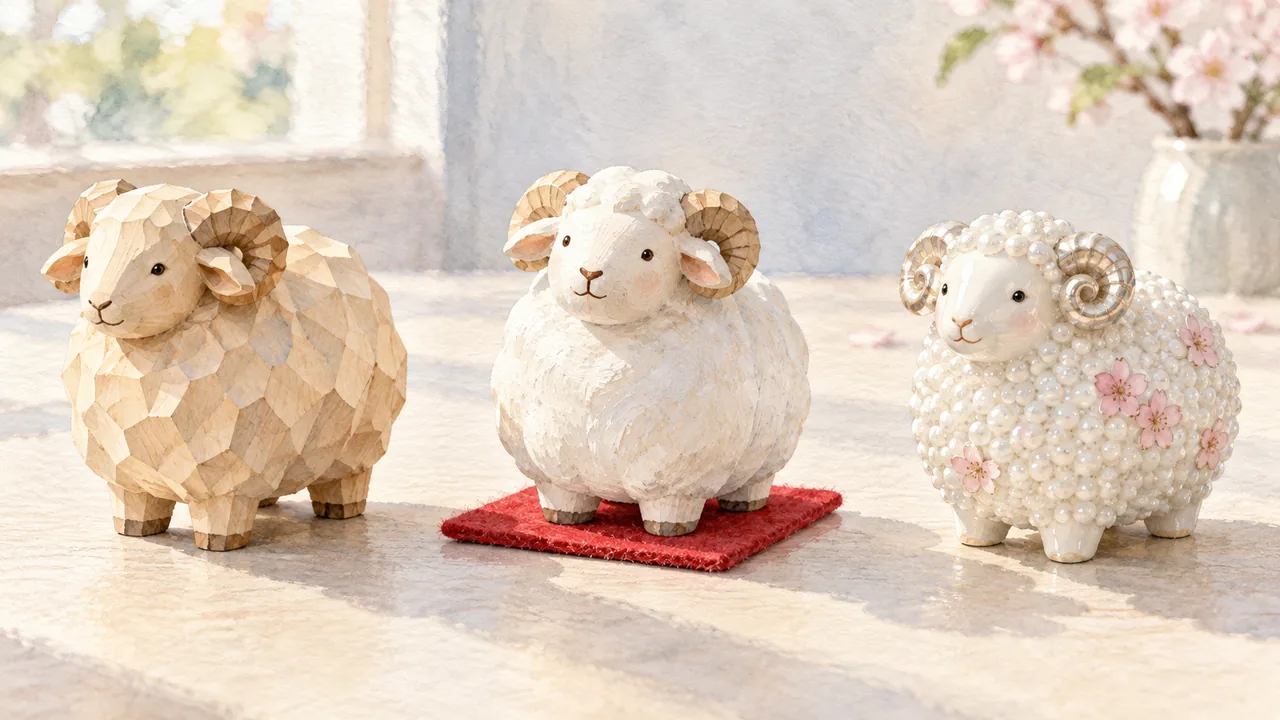
1. For twelve years, choose one maker
If you plan to collect, choose a maker with a full twelve-animal series so the shelf lines up in size and tone. Naun sells its sheep as part of a zodiac series, and Miyachu makes every animal from rat to boar.
2. Measure the depth of the spot
Miyachu's sheep is 7.2 cm (2.8 in) deep; Naun's small stand is 9 cm (3.5 in). On top of a shoe cabinet or a narrow windowsill, that is about what fits. For pieces with felt or a stand, go by the size of the stand.
3. The feel of wood, the shine of porcelain, the weight of metal
If you want to trace the knife marks, choose wood. If you want dots and platinum catching the light, choose Kutani. If you want something solid that you can order from abroad today, choose Takaoka metal. Each is a sheep finished by a Japanese maker.
7. Buying From Outside Japan
- Takenaka Copperware (Takaoka): both sheep in section 5 are listed on Amazon.com as made in Japan. Takumi Japan, a Japanese craft shop with an English site, also carries Takenaka Copperware and ships to the US by FedEx.
- Miyachu (Ise), Naun (Iyo) and Nakata Kingyoku (Kutani): sold through Japanese shops. As of November 2026 we found no English shop or international shipping for these makers.
- Order early. Zodiac figurines are seasonal, and small-batch pieces like Kutani's sell out before the New Year.
8. When the Year Is Over
Brush off the dust, then back in the box
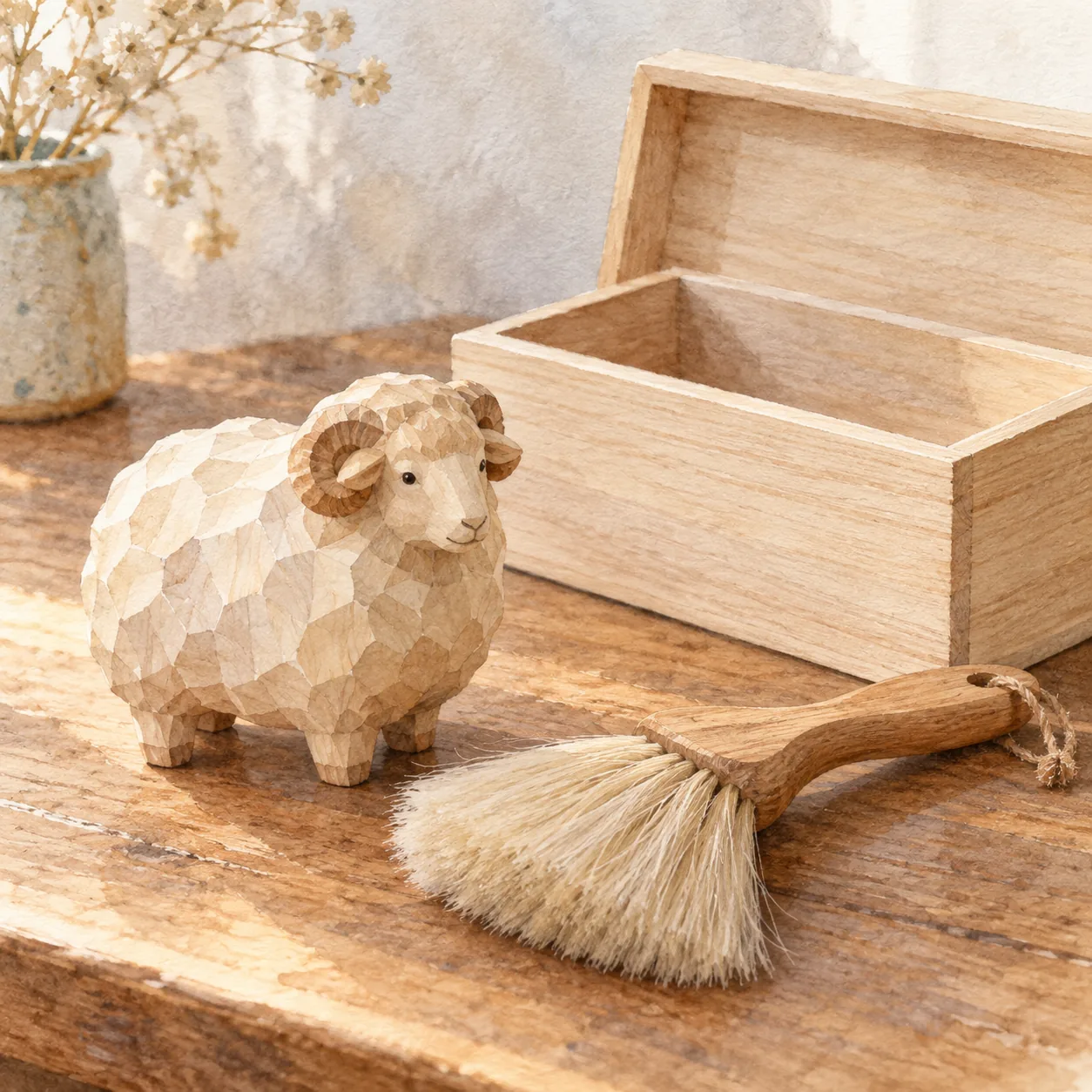
Miyachu's care advice for Ise ittobori is simple: brush away dust with a soft brush, then wipe with a dry, soft cloth. Dust that settles in the carved grooves comes out with a soft brush, like a paintbrush.
To store it, use the paulownia box it came in. If it stays on the shelf, an occasional dusting is all it needs. And if a figurine ever has to go, Miyachu suggests purifying it with a little salt before parting with it — sending it off with care rather than simply throwing it away.
9. Frequently Asked Questions
What is the Japanese zodiac animal for 2027?
The sheep — hitsuji, written 未. Every figurine in this guide is a 2027 sheep.
When should I put a zodiac figurine on display?
There's no fixed rule, but setting it out at the end of December, ready for New Year, is the natural time. If you collect, move last year's animal beside the new one so the line continues.
What does "ittobori" mean?
"Single-knife carving" — wood carving that keeps the knife marks. Miyachu describes Ise ittobori as carving a block down to as many as 48 facets; Ehime's tourism site describes Iyo ittobori as carving that removes every unnecessary line.
Can I collect all twelve from one maker?
Yes. Naun sells a zodiac series, and Miyachu makes every animal from rat to boar. Staying with one maker keeps size and style consistent on the shelf.
Is a zodiac figurine a good New Year gift?
Yes — boxed ones can be given as they are. Miyachu's Ise ittobori comes in a paulownia box, and Naun's larger sheep comes with felt, stand and box. For someone born in a sheep year, it's an especially personal gift.
How do I care for a wooden figurine?
Brush off dust with a soft brush and wipe with a dry, soft cloth. That is the care Miyachu recommends for Ise ittobori. Keep it out of damp places.
Final Thoughts: One Sheep, With the Knife Marks Still There
A Japanese zodiac figurine takes twelve years to complete. Add one each year, and the shelf becomes a record of a family's time.
For 2027, the sheep. Ise ittobori carves it to 48 facets and leaves the knife marks, a craft said to have begun with the carpenters of Ise Grand Shrine. Naun's Iyo ittobori pares it down to soft curves. Nakata Kingyoku III covers Kutani porcelain in tiny raised white dots. And Takenaka Copperware casts it in Takaoka metal you can order from abroad.
This year, welcome a sheep made by a Japanese hand. Pick it up, and you can feel how it was made.
Maneki Neko: Round Tokoname or Slender Seto Lucky Cats
Kokeshi & Japanese Folk Toys