Let us deal with the obvious problem first: you are not going to ship a sofa from
Japan. The volume and weight put the freight above the price of the furniture, and that is
before anyone tries to get it up a staircase.
One maker saw this coming and built separate brands for it — designed with
Copenhagen architects, launched at Danish design week, and sold through European and American
retailers. That is the route in, and it is a narrow one.
What travels freely is the thinking. Japanese sofas are built low, shallow and
firm because Japanese rooms are small — and if your rooms are small too, those are the
right criteria whatever you end up buying locally.
Quick Reference: The Numbers That Matter
| Measurement | Why it decides everything |
|---|---|
| Seat height | Low reads as spacious; high is easier to stand from |
| Seat depth | Too deep and short people cannot use the back |
| Overall depth | What it actually costs you in floor area |
| Back height | Low = the room looks bigger. High = your neck is supported |
| ⚠ The delivery route | Door, stairwell, landing corner, lift |
| Measure the route before the room. A sofa that fits your living room and not your staircase is a sofa you own on the pavement. | |
⚠ The Shipping Problem, and the One Way Round It
A three-seat sofa is roughly two cubic metres of air wrapped in fabric. Sea freight on that from Japan, plus customs, plus inland delivery, plus getting it into a building, routinely exceeds what the sofa cost.
Japanese makers know this, and most of them simply do not sell abroad. Their domestic lines are made for Japanese rooms, sold through Japanese showrooms, delivered by Japanese crews who take doors off their hinges as a matter of routine.
The exception: brands built for export from the start
Karimoku — Japan's largest wooden furniture manufacturer — did not try to export its
domestic range. It created separate brands instead.
Karimoku New Standard, from 2009, pairs the company's craftsmen with
international designers.
Karimoku Case Study was developed with Norm Architects of Copenhagen
and Keiji Ashizawa Design, debuted at Denmark's 3daysofdesign, and has furnished projects
abroad including a house in Sweden.
These are stocked by design retailers in Europe and the US, which means local
delivery, local warranty and a showroom you can sit in — all the things an import
cannot give you.
That is a genuinely smart answer to the problem, and it is worth understanding what it implies: the Karimoku you can buy in London or New York is not the Karimoku sold in Nagoya. Same factory, same joinery, different range — designed with European proportions and European rooms in mind.
If you want the domestic product, you buy it in Japan and you live there. Everyone else is choosing between the export brands and applying Japanese thinking to a local purchase.
Why Japanese — Designed for a Smaller Room
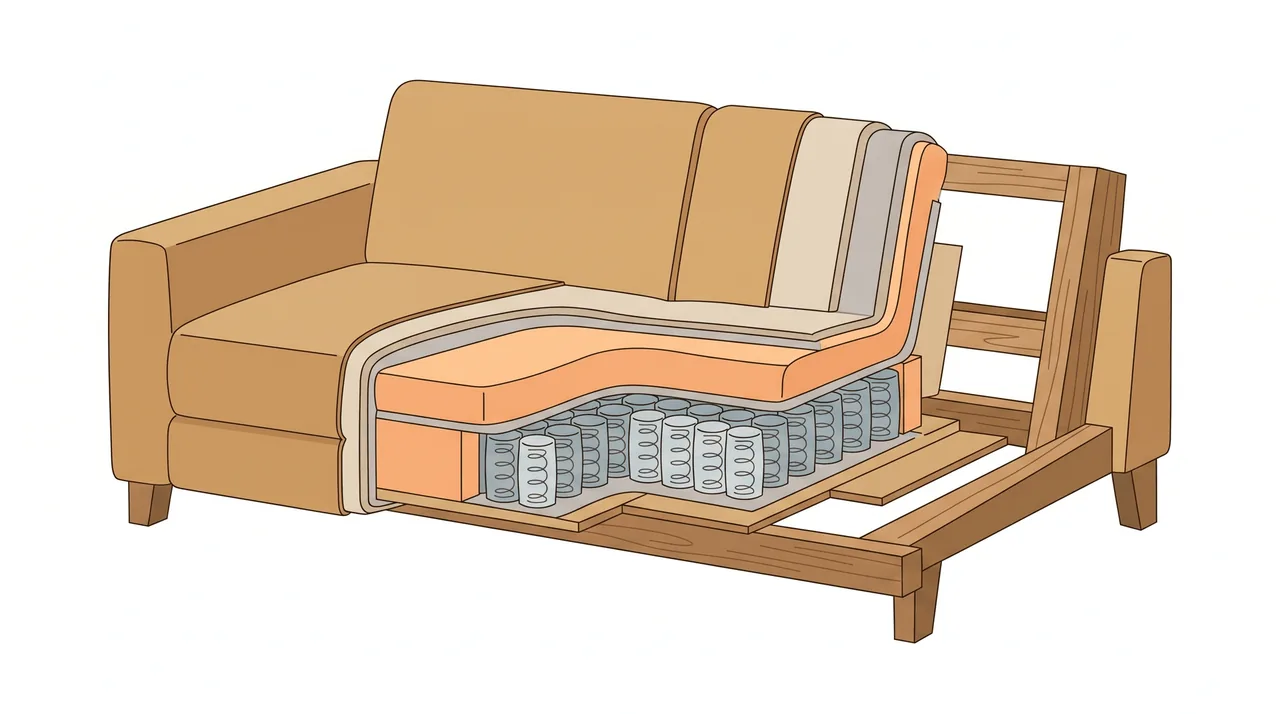
Japanese sofas differ from European ones in three consistent ways, and every one of them follows from the size of the room.
- The seat sits lower. A low seat leaves more visible wall above it, and a room reads as taller and larger when the furniture line is low. It also connects to a culture that sat on the floor — the low sofa is a halfway house, and people routinely sit on the floor leaning against one.
- The seat is shallower. A deep European sofa is designed to be sprawled in; if you are shorter, a deep seat means your feet do not reach the floor when your back touches the cushion. Shallower seats let more people actually use the backrest.
- The support is firmer. Soft sofas swallow you, which is pleasant for an hour and difficult to get out of — and firm support is what keeps a sofa comfortable at year ten rather than year one.
Low back or high back — a real choice, not a style one
A low-backed sofa makes a small room look considerably bigger, because your eye travels over it. It is the default in Japanese living rooms for that reason alone.
A high back supports your head and neck, which matters if you sit for long evenings or have neck trouble. The trade is entirely spatial — you are buying neck support with visual room volume.
All of this transfers to a small flat anywhere. If you live in a converted Victorian room or a city studio, "low, shallow, firm, low-backed" is a better specification than anything a showroom will steer you toward — and you can apply it to furniture you can actually get delivered.
Measure the Route, Not the Room
Japanese furniture buying treats delivery access as a standard checklist item, and English-language furniture writing almost never mentions it. It should.
Measure, in this order:
① The narrowest doorway on the route, with the door removed if it can be.
② The stairwell width, and more importantly the turn at the landing
— that corner is what defeats most sofas, and the constraint is the diagonal, not the width.
③ The lift, both floor area and internal height — a sofa can sometimes go in
standing on end.
④ The ceiling height in the stairwell, which limits how far you can tip it.
Then compare against the sofa's smallest dimension, not its listed width. A three-seater goes through a door on its end, so the number that matters is depth × height.
Modular and knock-down designs exist precisely for this. A sofa that arrives in three boxes and bolts together in the room sidesteps the entire problem — and if your access is genuinely tight, that constraint should decide the purchase before anything about comfort does.
What Is Inside: Springs, Frame, and Why It Sags
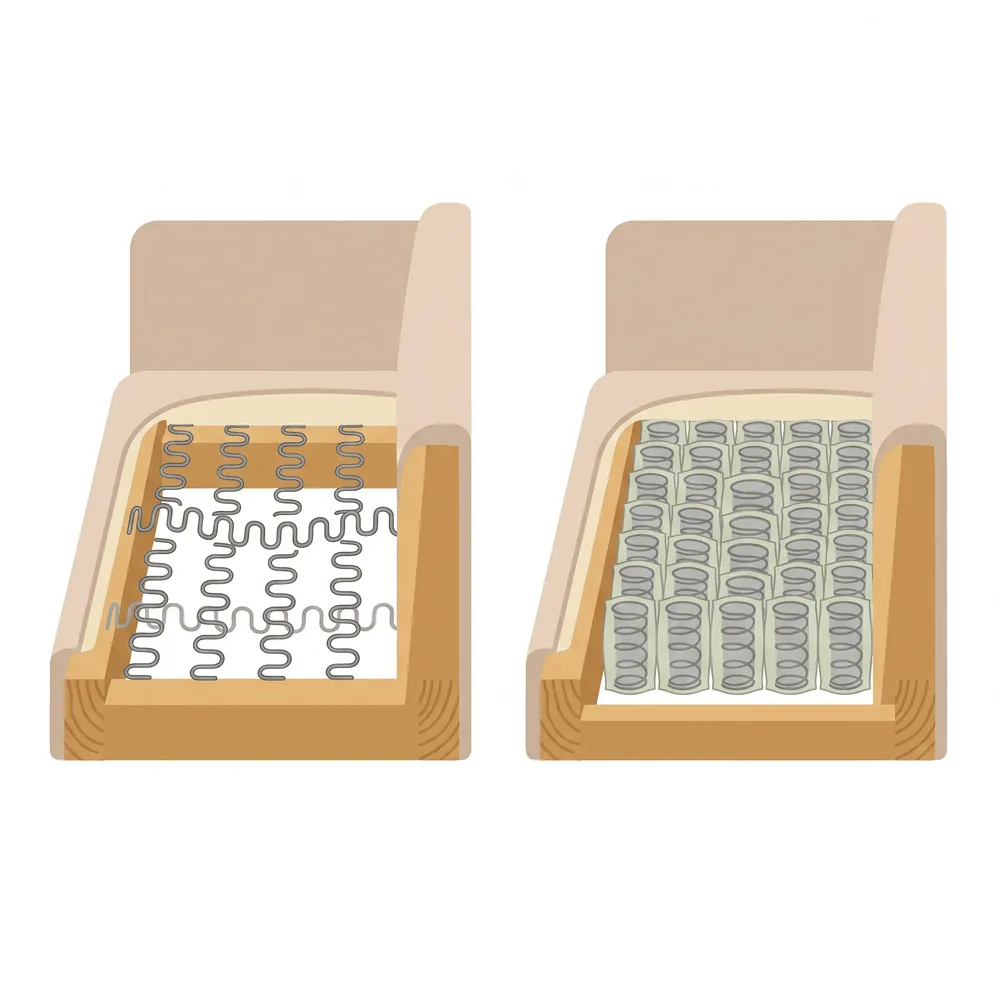
A sofa fails from the inside, and it fails in the seat. The fabric usually outlasts whatever is holding it up.
Cheap construction uses elastic webbing stretched across a frame. It feels fine in a showroom and it relaxes — the sag you see in a five-year-old sofa is webbing that has stretched and will not come back.
Better construction uses steel springs, either serpentine strips or coiled units tied together. They flex rather than stretch, which is why they hold their shape for decades instead of years.
Ask what is under the cushion. It is the single question that separates furniture from upholstered rubbish, and a good manufacturer will answer it happily.
The frame matters equally and is harder to inspect. Solid hardwood, properly
jointed, is what allows a sofa to be reupholstered in twenty years — stapled particle
board is not worth reupholstering and will not survive being taken apart.
This is where Japanese joinery traditions actually show up in a sofa, and it is
covered properly in our wooden furniture guide.
The Question That Decides "Lifetime"
Every premium sofa is sold as a lifetime purchase, and the claim is only true if one thing is available: reupholstery.
Fabric wears out in ten to fifteen years of real use. Leather cracks where it creases. That is normal and it is not the end of a good sofa — unless the maker will not re-cover it.
So the question to ask before buying is: do you offer recovering, and for how long? Japanese manufacturers of this class generally do, and it is the specific reason their furniture gets handed down.
Removable covers are the easier version of the same idea — washable, and replaceable without a workshop. Worth prioritising if you have children or animals.
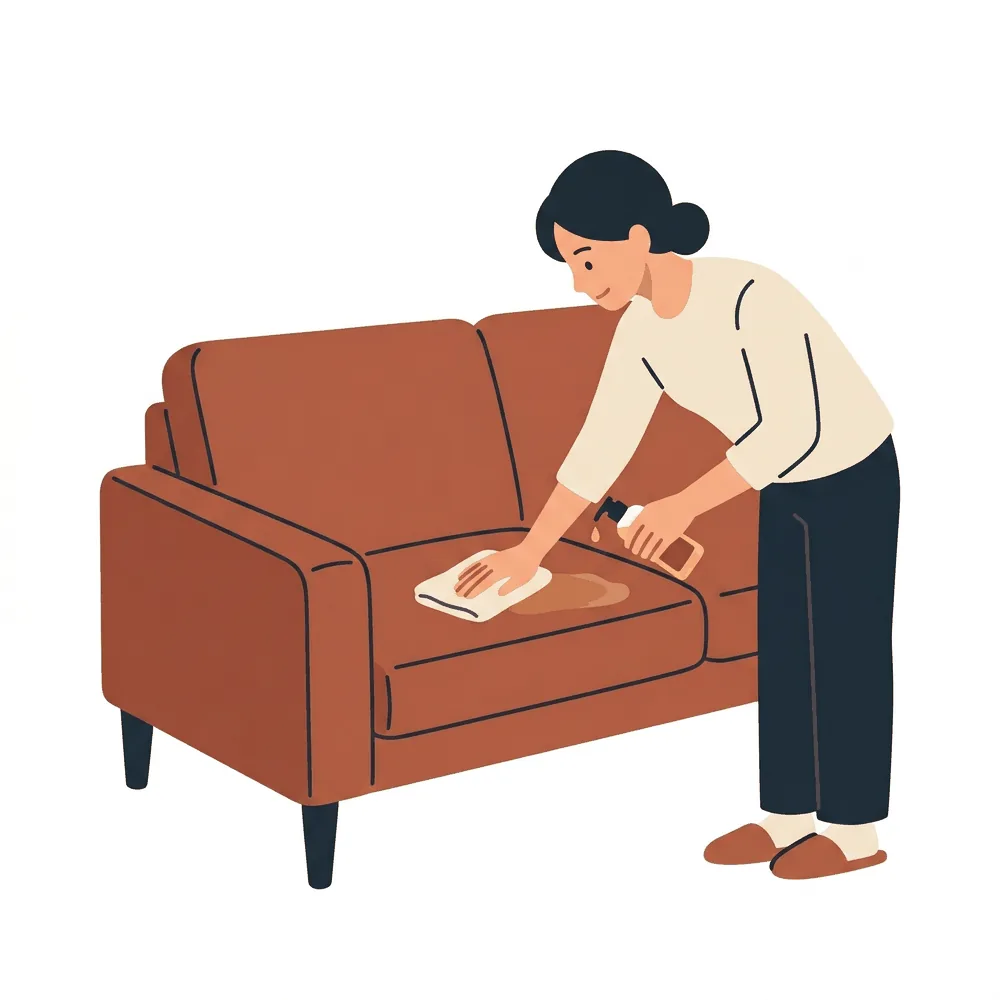
Fabric or leather, with children or pets? Removable washable fabric wins on
practicality; leather wins on wiping clean but shows claw marks permanently.
The honest answer is neither is durable against a cat, and a sofa you can
re-cover is worth more than a sofa marketed as scratch-resistant.
Frequently Asked Questions
Can I buy a Japanese sofa outside Japan?
Realistically only from makers that built export brands. Freight and delivery on
a domestic-market sofa cost more than the sofa.
Karimoku created separate international lines — developed with Copenhagen
architects and stocked by design retailers in Europe and the US — which is the practical route.
Why are Japanese sofas lower?
Because a low furniture line makes a small room read as larger, and because
Japanese living has a floor-sitting tradition that a low sofa sits comfortably alongside.
Shallower seats follow the same logic — they take less floor and they let
shorter people actually reach the backrest.
What should I measure before buying?
The delivery route first: narrowest doorway, stairwell, the turn at the landing, and the
lift. The landing corner is what defeats most sofas.
Then seat height, seat depth and back height — those three decide comfort far
more than overall width does.
Firm or soft, if my back hurts?
Generally firmer, with the seat depth matched to your leg length so your lower
back reaches the backrest while your feet stay on the floor.
A soft deep sofa forces a slumped posture and is hard to get out of — but back
pain has many causes, and this is a question worth asking a clinician rather than a furniture
shop.
How long should a good sofa last?
Decades, if it has a solid hardwood frame and steel springs — with the covering
being the part that wears out first, at ten to fifteen years.
That only makes it a lifetime purchase if it can be recovered, so ask about
reupholstery before you ask about anything else.
Low back or high back?
Low back if the room is small — the difference in how large the space feels is
considerable, and it is the standard choice in Japan for that reason.
High back if you sit for long stretches or want your head supported. You are
trading apparent room volume for neck support, and both are legitimate.
Final Thoughts: The Specification Travels Even When the Sofa Cannot
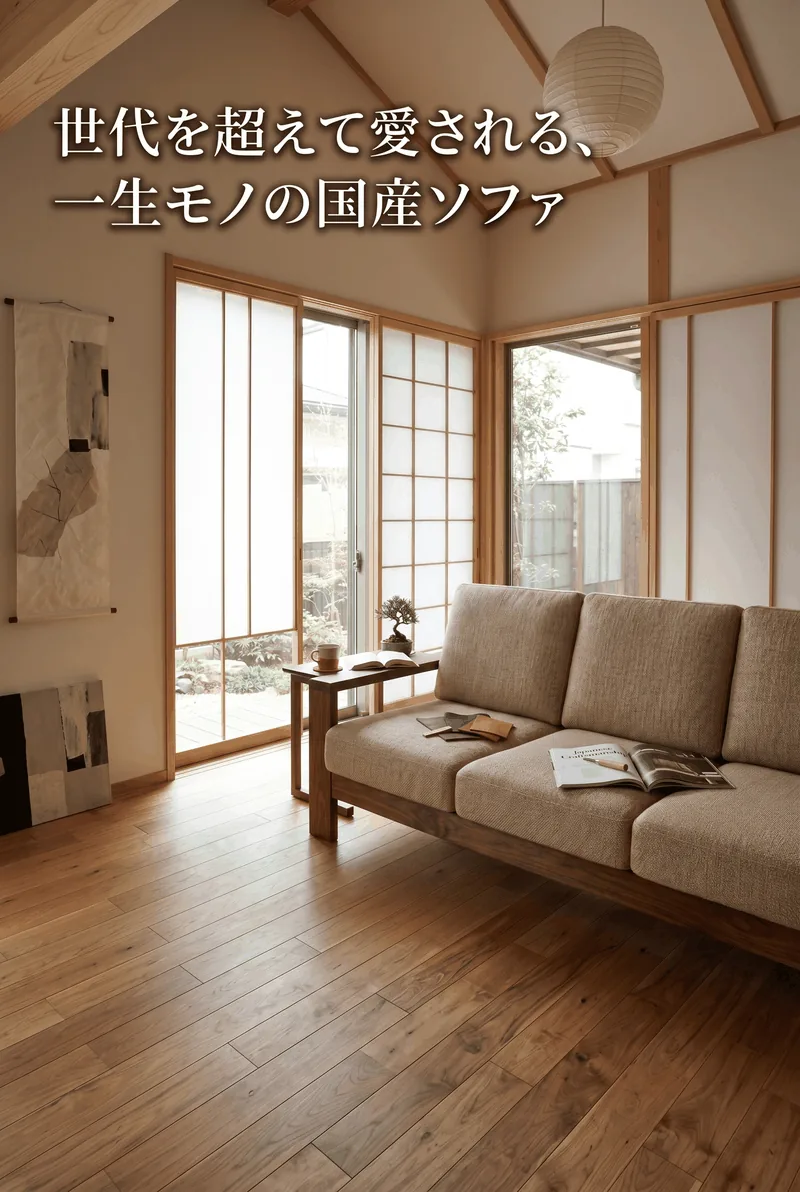
This is the one category on the site where the honest answer is mostly no. Sofas do not post, and Japanese makers overwhelmingly sell at home.
But the reason Japanese sofas are the shape they are — small rooms — is a problem plenty of people share, and "low, shallow, firm, low-backed, steel springs, re-coverable" is a specification you can take into any showroom in the world.
And before any of that: measure the turn on your staircase. It is the number that decides whether the rest of the decision matters at all.
Japanese Wooden Furniture: Hida, Karimoku, Tendo & Maruni
Japanese Office Chairs: Okamura vs the Aeron