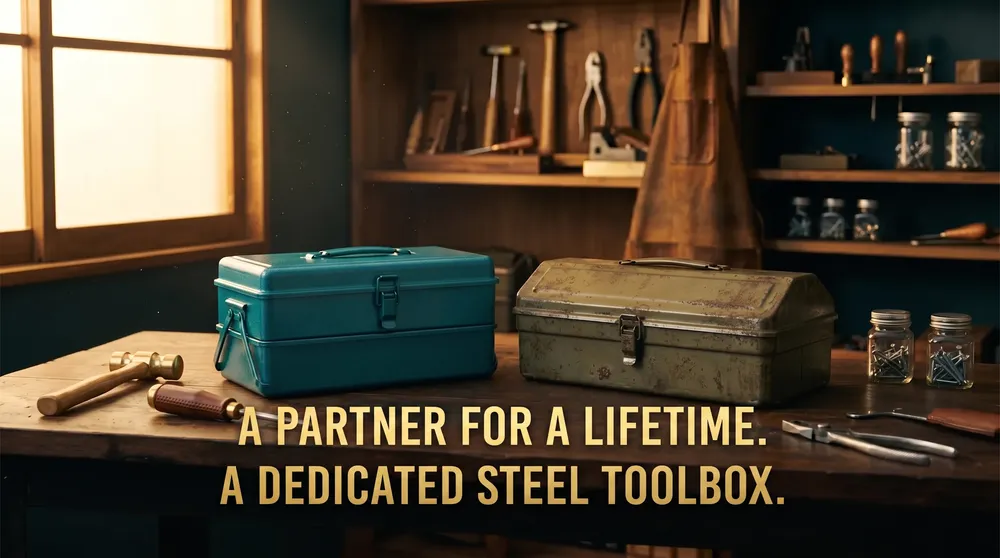
The company that makes Japan's best-known steel toolbox has a corporate slogan:
"DREAMS WILL NOT RUST."
Read it again. It is not a claim that the product will not rust. Their chief
executive says openly that rust is "a characteristic of steel", invokes
wabi-sabi, and talks about finding satisfaction in how the boxes age.
What will not rust is the intent behind them.
That is an unusually honest thing for a manufacturer to say, and it answers the
first question anyone asks about a steel box. The second question — why this one rather than a
plastic case — comes down to a manufacturing process they invented in 1969.
Quick Reference: Steel Toolbox at a Glance
| Question | Answer |
|---|---|
| Will it rust? | Yes, eventually. The maker says so |
| Is it waterproof? | No. Do not leave it in rain |
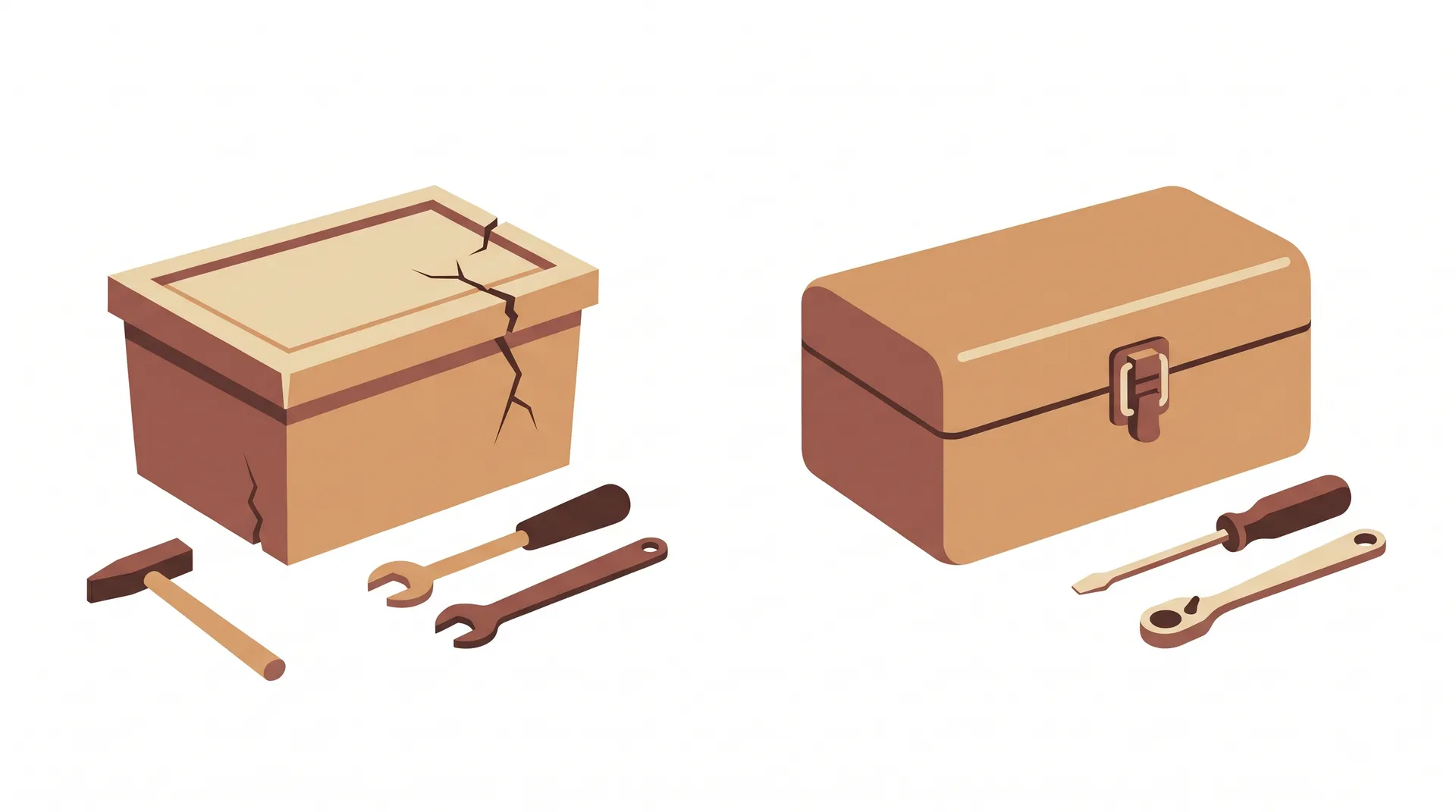
| Why not plastic? | No seams to split; dents, not cracks |
| How heavy? | About 1 kg empty (T-320) |
| Can it lock? | Yes — takes a 4 mm cylinder lock |
| Can I buy one abroad? | Yes — the maker ships to 35 countries |
| At around ¥2,550 this is one of the cheapest genuinely well-made Japanese objects you can buy — and most people abroad end up using it for something other than tools. | |
Rust, and What the Slogan Actually Admits
Steel rusts. A painted steel box rusts more slowly, and then rusts. Any guide that tells you otherwise is selling you something.
What is interesting is that the manufacturer says this first. Their public
position is that rust is simply what steel does, framed through wabi-sabi — the
aesthetic that finds worth in wear and age rather than treating it as damage.
So "dreams will not rust" is a careful sentence. The dreams will not. The box
might. You are being told what you are buying.
In practice, indoors, this is a non-issue
A powder-coated steel box kept in a dry room will look the same in twenty years. Rust needs moisture and time, and neither is present on a shelf in a house.
The problems start when it lives in a shed, a garage or a van — condensation, damp concrete floors, wet tools put away without drying. That is a real working toolbox and it will develop a patina, which the maker considers a feature and you may not.
⚠ It is not waterproof, whatever a shop tells you
Several international retailers describe these boxes as having a "watertight seal".
The manufacturer's own product pages make no waterproof claim at all, and a
hinged lid with a simple latch and no gasket cannot be watertight.
What "seamless" actually means is that the body has no welded joints — so there
is no seam to split and no crevice for water to sit in. That is a durability property,
not a sealing one. Do not leave one out in the rain because a listing implied you could.
Preventing rust is undramatic: dry your tools before putting them away, keep the box off a concrete floor, and wipe out condensation. If surface rust does appear, fine abrasive and a light oil takes it back — and on a matte black box it is barely visible anyway.
Why Japanese — One Sheet, No Welds
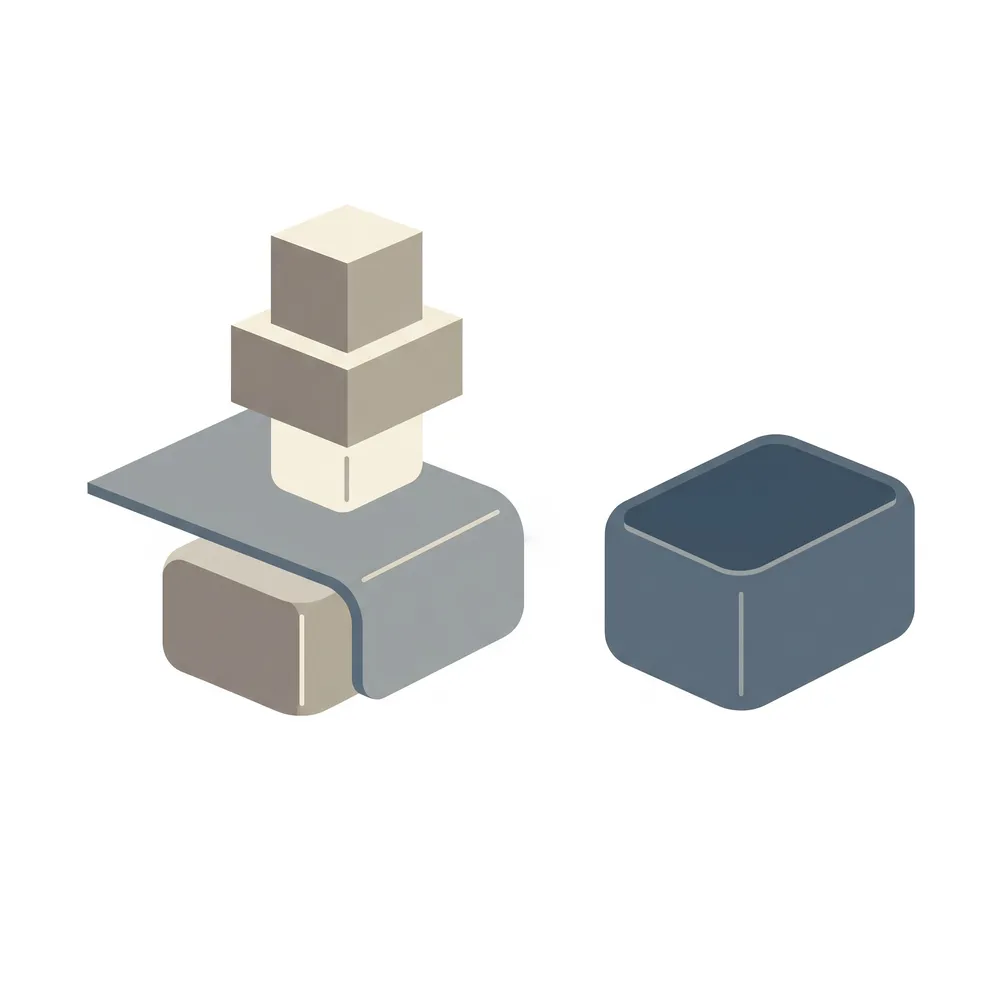
Most steel boxes are made by cutting a flat blank, folding it up, and welding the corners. It works, and the welds are where they eventually fail — they crack, they catch grit, and water collects along them.
Toyo Steel was founded in Higashi-Osaka in June 1969 on a different method: deep drawing, which presses a single flat sheet down into a box shape without cutting it. They state they were the first in the world to make it work for a toolbox.
The result has no corner seams at all. Pick one up and run a finger round the inside — it is a continuous curve where a welded box has a line.
Deep drawing is hard because steel does not want to do it. Pressed too fast the sheet tears; pressed unevenly it wrinkles at the corners. Doing it to this depth, repeatably, in 1969, was a genuine manufacturing achievement rather than a styling decision.
It also connects back to the rust question. Rust starts where water sits, and
water sits in seams and crevices. A box with no seams has nowhere for it to
start — which is why the design has survived fifty-odd years essentially unchanged.
The design awards followed much later: a Good Design Award in November 2009 and
a Long Life Design Award — the latter being explicitly for products that have stayed in
production and stayed good.
And steel dents where plastic breaks
This is the practical case against a plastic case. Drop a loaded plastic toolbox onto concrete and the latch tab snaps or the shell cracks, and it is finished.
Drop a steel one and it dents. The dent stays, the box works, and in ten years it is a record of the thing having been used. That is a meaningfully different relationship with an object you expect to keep.
Which Shape: Trunk, Camber or Cantilever
The shape decides how you get at the contents, which matters more than capacity.
- Trunk — flat lid, top handle. One open space, and the flat top means they stack. The most useful shape if you own more than one, and the best for anything that is not tools.
- Camber — the raised, gently peaked lid. More height inside for tall items, and the shape people recognise as "a toolbox". Does not stack.
- Cantilever — trays that swing out as you open it. Everything is visible at once with nothing to lift out. Heavier, larger, and genuinely better if you are actually working from it.
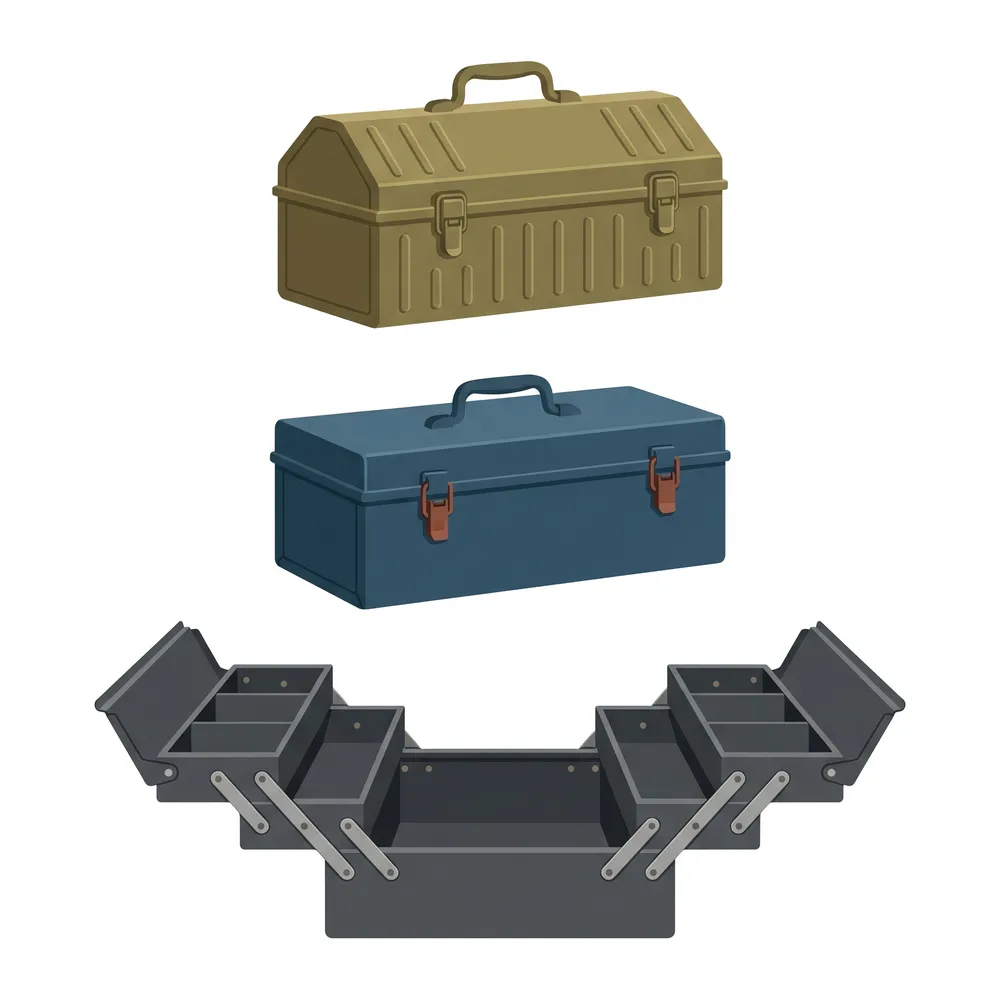
If you are buying your first one and are not sure, buy the flat-lidded trunk. It stacks, it fits on a shelf, and it is the one that works equally well holding spanners, cables, art materials or coffee equipment.
What to Buy
Toyo Steel T-320 — flat lid, stacks, the default
333 × 137 × 96.5 mm and 1.0 kg empty, seamless pressed steel, with a
rounded handle and a matte finish. It takes a 4 mm cylinder lock if you want
one, sold separately.
About ¥2,550 in Japan, which is remarkable for something made this way — and
the reason people who buy one tend to buy three.
- Outer
- 333 × 137 × 96.5 mm
- Inner
- 311 × 115 × 66 mm
- Weight
- 1.0 kg empty
- Lock
- Takes a 4 mm cylinder lock
- Made
- Higashi-Osaka, Japan
Perfect for: A first one. Stacks, fits a shelf, holds anything.
Toyo Steel ships direct from Osaka to around 35 countries — the US, UK, Canada, Australia, New Zealand and most of the EU among them. No P.O. boxes.
Toyo Steel Y-350 — the camber lid, and the award winner
The raised-lid version, and the model that took the Good Design Award in November
2009. More internal height, a top handle that folds flat, and the silhouette most
people picture when they think of a toolbox.
Buy this one if it is going to sit out where you see it. It does not stack,
which is the trade for the shape.
- Shape
- Camber (raised) lid
- Award
- Good Design Award, 2009
- Stacks
- No
- Made
- Japan
What Japanese tradespeople actually carry
On a real Japanese building site you are more likely to see TRUSCO or Ring Star —
bigger cantilever boxes, heavier gauge, made for daily abuse rather than for a shelf.
TRUSCO is the industrial supplier everyone buys from; Ring Star's high-quality boxes are
the ones tradespeople specify.
We could not find an English-language route to either, so we are not sending you
looking. If you are in Japan, any home centre has both — and they are cheaper
than the design-shop route.
What People Actually Put in Them
Outside Japan these are sold by design shops and homeware stores, not hardware shops — which tells you how they are mostly used. Almost nobody buying one abroad is putting spanners in it.
- Art and craft materials — the flat trunk shape suits tubes and brushes, and it stacks by project.
- Cables and chargers — the one drawer in every house that is currently chaos.
- Coffee kit — grinder, scales, filters, in something that looks right on a worktop.
- First aid or emergency supplies — it survives being kept somewhere awkward, and a lock is available.
- Camping and picnic gear — steel does not mind a boot floor, and the flat lid becomes a small table.
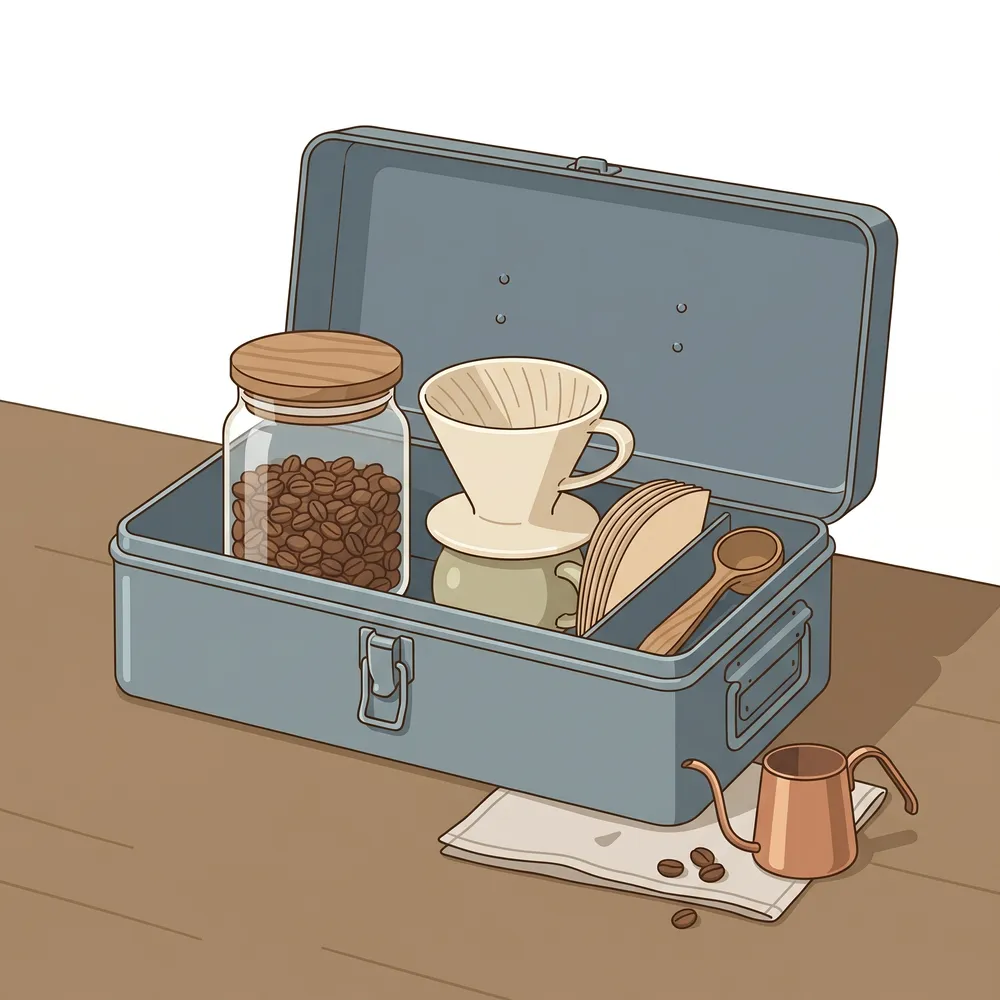
The reason it works as storage is the same reason it works as a toolbox. It is
rigid, it stacks, the lid stays shut, and it costs little enough that you can buy one per
category rather than one big box for everything.
That is the actual argument — not that a toolbox looks nice on a shelf, but that
cheap rigid stackable boxes solve a problem most homes have.
Frequently Asked Questions
Will it rust?
Indoors, in a dry room, effectively no — for decades. In a shed, garage or van
with condensation and damp tools, yes, eventually.
The manufacturer is open about this, describing rust as a property of steel and
the ageing as something to appreciate. Surface rust cleans off with fine abrasive and a wipe of
oil.
Is it waterproof?
No, and be careful what you read. Some retailers describe the seamless
construction as a "watertight seal"; the manufacturer makes no such claim, and a
latched lid without a gasket cannot be watertight.
"Seamless" means no welded joints in the body — a durability feature, not a
seal.
What happens if I drop it?
It dents, and carries on working. That is the actual advantage over plastic,
which cracks or loses a latch tab and is then finished.
A dented steel box is a used steel box; a cracked plastic one is rubbish.
My lid squeaks. Can I fix it?
A drop of light oil on the hinge pivots, worked back and forth. Steel on steel
squeaks; that is all it is.
Wipe off the excess so it does not transfer to whatever you keep inside.
Can I lock it?
Yes — the smaller boxes take a 4 mm cylinder lock, bought separately.
Treat it as a deterrent rather than security. The box is thin steel and a
determined person does not need the lock to get into it.
Can I buy one outside Japan?
Yes, unusually easily. Toyo Steel ships direct from Osaka to around 35
countries, and there is an official US distributor plus a number of design retailers that stock
the range.
Shipping is the main cost, so buying two or three at once is sensible if you
think you will want more.
Final Thoughts: A Box That Admits What It Is
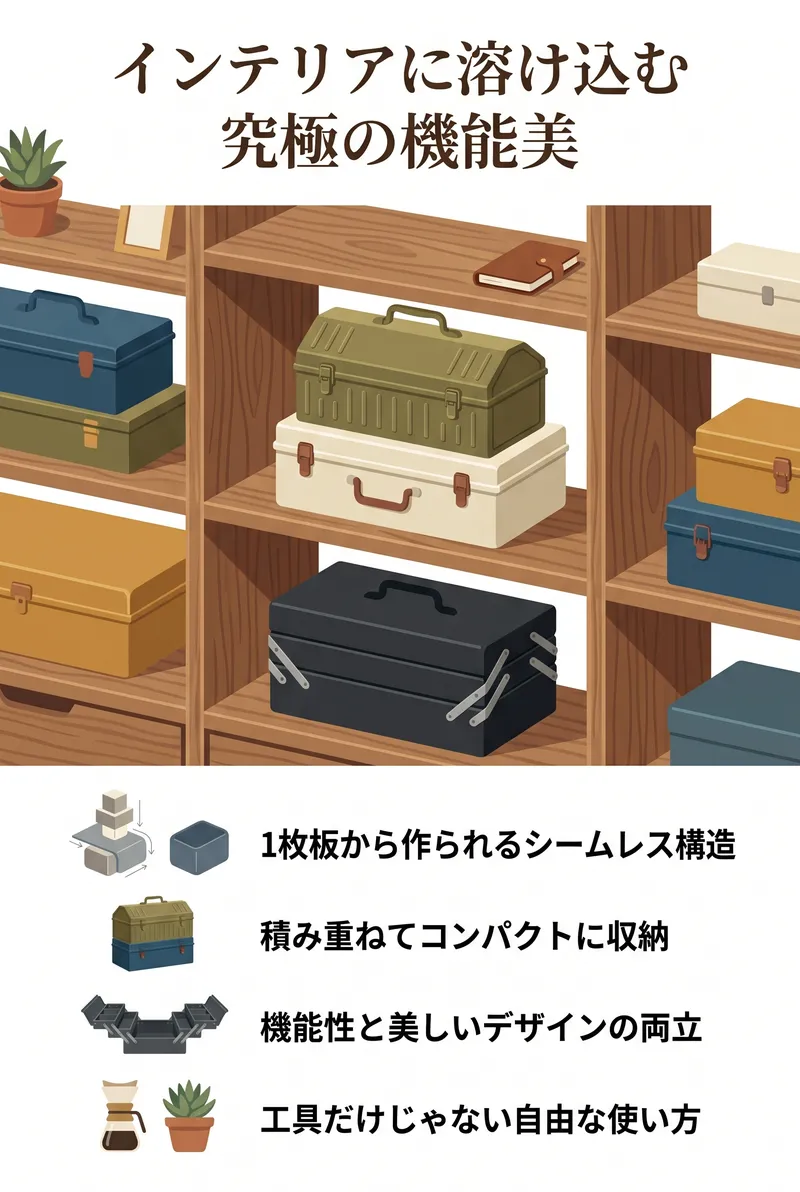
Almost everything sold on durability makes a promise it cannot keep. This one does the opposite: it tells you the steel will age, and then gives you a box with no seams for the ageing to start in.
Fifty-odd years of the same design, a technique nobody had managed before 1969, and about ¥2,550. The price is the surprising part.
Buy the flat-lidded one first, keep it indoors, and expect to buy another. Everyone does.

Tsubame-Sanjo Camp Gear: Beyond Snow Peak — 4 Japanese Brands
Japanese Model Nippers: 5 Best Cutters for Clean Gates