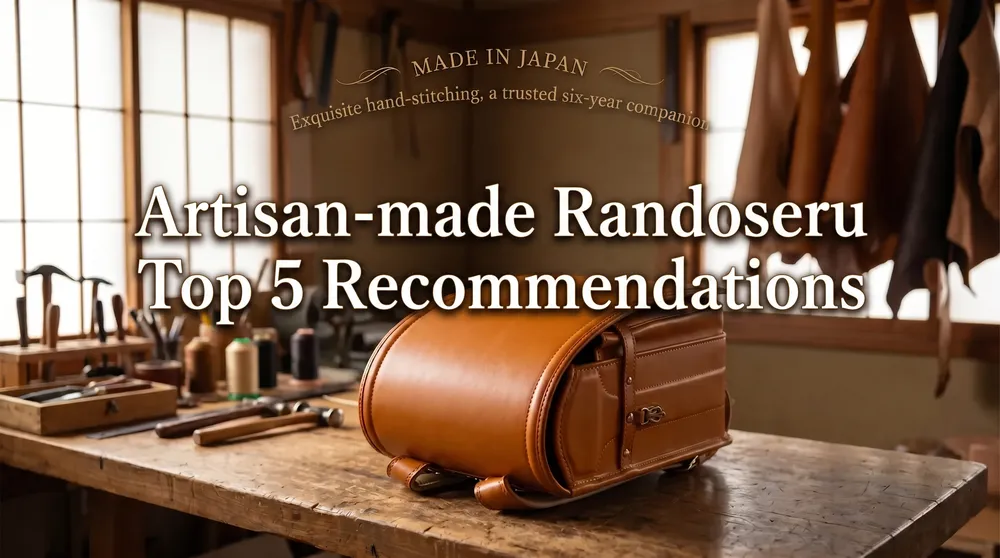
One randoseru is assembled from roughly 150 parts across more than 300 operations.
Which is why the interesting distinction in this market is not brand prestige but
whether a workshop or a factory made it.
Japan has a handful of ateliers producing a few thousand bags a year each, with waiting lists and
devoted followings. Two of them will ship to you in English.
And the component that decides how a randoseru actually feels — the sekan, the
mechanism joining the body to the straps — appears in no product photograph and on almost
no spec sheet. That is where the money goes.
Quick Reference: The Five Workshops
| Workshop | Known for | Reachable? |
|---|---|---|
| Tsuchiya Kaban | Since 1965; the reference workshop | English site, ships worldwide |
| Kaban Kobo Yamamoto | Founded 1949, Nara; hand-finishing | English site |
| Kurokawa Kaban | Cordovan specialist | Resellers / forwarding |
| Ikedaya | No embroidery, by design; 80kg tested | Japanese site; forwarding |
| Murase Kabanko | Small Nagoya workshop | Domestic |
| ⚠ Check "A4 flat file" compatibility, not "A4 clear file." They are different widths, and the school hands out the wider one. | ||
Workshop or Factory: What Actually Differs
Both make good bags. This is not a case where one tier is a trap — Japan's large randoseru manufacturers produce hundreds of thousands of well-engineered bags a year, and most Japanese children carry one.
| Workshop (kobo-kei) | Large manufacturer | |
|---|---|---|
| Volume | A few thousand a year | Hundreds of thousands |
| Strength | Leather quality, hand-finishing, restraint | Engineering, weight, safety features |
| Selling season | Sells out — early summer of the prior year | Available much later |
| Buy it if | You want leather that ages, and to choose slowly | You want lightest weight and to decide late |
The real trade is timing against material. Workshop bags are made in limited runs from better leather and finished by hand — and you have to commit more than a year ahead. Large makers give you the best synthetic engineering and let you decide in autumn.
If you are new to randoseru generally — what they are, what they cost, the weight debate, and the adult model that exists — start with our guide to the randoseru itself. This article assumes you have decided you want one and are choosing a maker.
Why Japanese — 150 Parts, 300 Operations
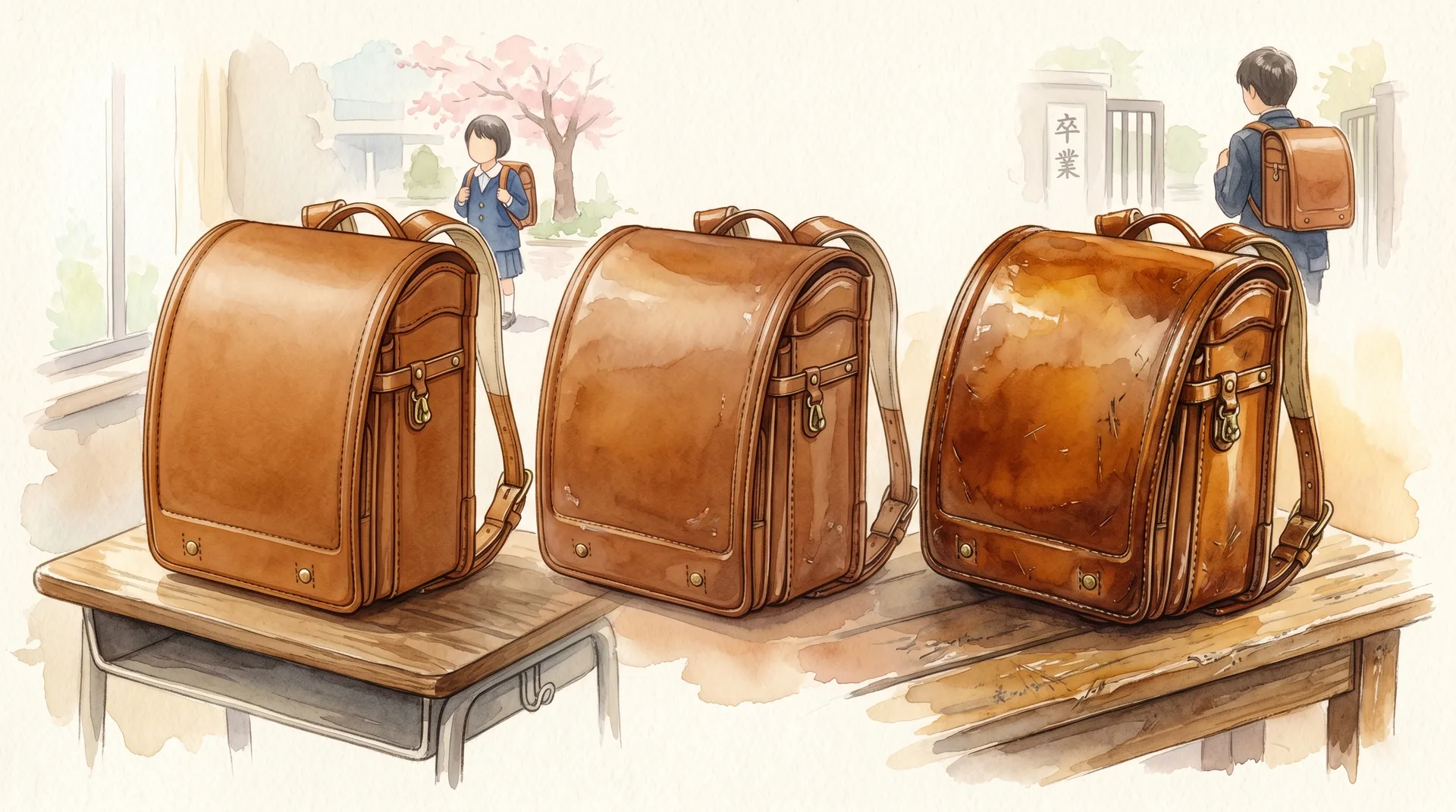
Around 150 components and over 300 separate operations go into one randoseru.
That figure is the answer to almost every question about price.
It is not a bag with a stiffener added. It is a structure — reinforced corners,
a formed back panel, a rigid frame around the opening, a lid that holds its curve unsupported —
built to keep its shape for six years while a child grows into and out of it.
The workshops compete on the parts that wear. Cowhide that softens rather than cracks. Stitching placed where the stress goes. Edges finished so they do not fray against a uniform. Cordovan — the dense shell from a horse's hindquarters, known in the trade as the diamond of leather — for the very top of the range.
The unusual thing is that these are guaranteed for six years and repaired during
them. Workshops mend their own bags, often lending a replacement while the work is
done.
That commitment is what forces the construction quality. A maker who has to fix
every failure for six years, free, builds differently from one who does not.
The Sekan: The Part You Cannot See
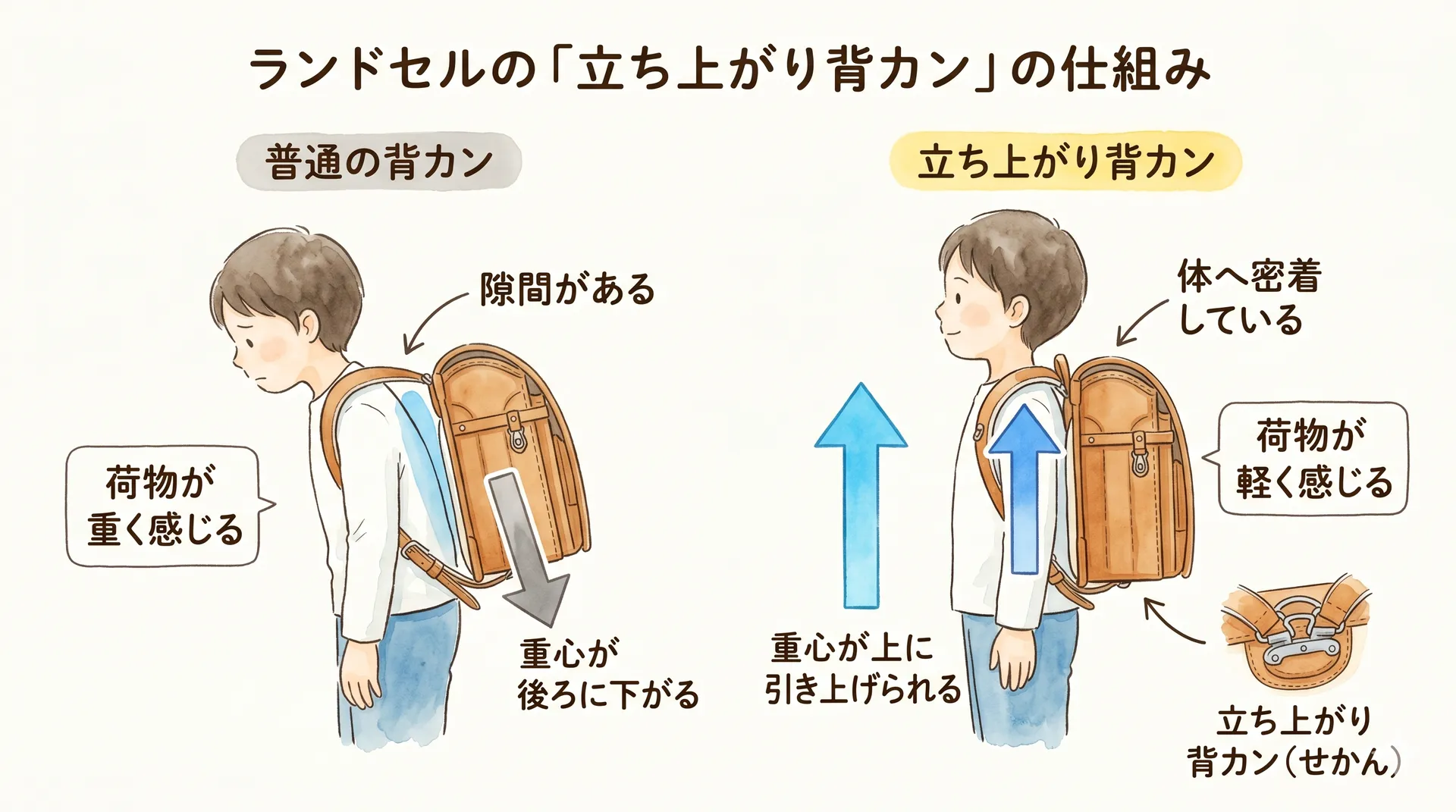
The sekan is the fitting that joins the body of the randoseru to the shoulder
straps and carries the load into them. It sits at the top of the back panel, mostly
hidden, and it decides how the bag feels more than any other single part.
A poor one lets the bag hang away from the back, so the weight pulls backwards and the child
leans forward to compensate. A good one holds the load high and tight against the
spine, where it is carried by the torso rather than by the shoulders.
What to look for
- Straps that stand up and open outward. The better designs angle the strap roots away from each other so the bag opens to meet the child's back instead of being pulled onto it. Manufacturers give this feature proprietary names; the mechanism is the same idea.
- Independent left and right movement. If the two strap roots move separately, the bag follows a twisting torso. If they are linked, it fights it.
- Range of adjustment. Good straps have around eight positions at 3cm intervals, which is what covers a six-year growth span. Some rotate freely so the strap lies flat at any angle.
- Shaped, not flat, shoulder straps. Three-dimensional straps curve over the shoulder rather than bridging it, spreading pressure across a wider area.
- Back-panel contact. Raised pads with channels between them keep the load stable and let air move, which matters in a Japanese June.
This is why a heavier bag can carry more easily than a lighter one, and why
Japanese parents put a loaded bag on the child in the shop rather than reading the specification.
If you are ordering from abroad and cannot do that, the sekan design is the thing
to read about — and it is the reason to buy from a workshop that describes it rather than one that
only lists a weight.
A4 Flat File — The Spec That Catches People
"A4 clear file compatible" and "A4 flat file compatible" are not the same
specification. The flat file is wider — and it is the one Japanese schools hand out.
A randoseru that only takes the clear file will not close over a school folder.
Both hold A4 paper. The difference is the folder itself: a clear file is a thin sleeve, while a flat file has a rigid spine and binding mechanism that adds width. Randoseru interiors are cut to millimetres, so a couple of centimetres decides whether it fits.
- Buy A4 flat file compatible. There is no upside to the narrower size, and modern bags from established makers are all built to it.
- Older stock and cheap imitations are where the problem lives. If a listing says only "A4 clear file," take it as a statement about age or origin.
- Tablet capacity is now worth checking too. Japanese schools issue devices, and newer designs allow for one alongside the folders.
The Five Workshops
Tsuchiya Kaban — the one that ships to you
Making leather school bags since 1965, and the workshop most people mean when
they say kobo-kei. Restrained designs, excellent leather, and the largest colour
range among the ateliers.
Decisively, they run a full English site with international shipping — which
makes them the only workshop where ordering from abroad is straightforward rather than a
project.
- Since
- 1965
- Materials
- Cowhide, synthetic, cordovan at the top
- English
- Yes — full site, ships worldwide
- Guarantee
- Six years, with repairs
- Price range
- $450–$1,000+
Perfect for: Anyone outside Japan. This is where to start, and often where to finish.
Kaban Kobo Yamamoto — Nara, since 1949
A Nara workshop with more than seventy years of randoseru making and a
reputation built on hand-finishing — stitching, edge work, and the interior details that never
appear in a photograph.
They maintain an English randoseru collection page, which puts them second on
the list of ateliers you can actually approach from outside Japan.
- Founded
- 1949, Nara
- Character
- Hand-finishing; classical proportions
- English
- Yes — randoseru collection in English
- Volume
- Limited annual production
- Price range
- $450–$900
Perfect for: Buyers who want an atelier bag that is not the obvious first choice, and who like visible handwork.
Ikedaya — the workshop that refuses to decorate
Ikedaya does not put embroidery on its randoseru, and that is a deliberate engineering
position rather than a style. Embroidery means piercing the leather, which
compromises waterproofing and creates weak points. They also leave off applied
reflective plates, on the grounds that those degrade with age.
What they add instead: a self-developed anti-deformation board in every model, load
testing to around 80kg, and a seamless waterproof resin frame that keeps water out in
heavy rain.
- Philosophy
- No embroidery, no applied reflectors — by design
- Testing
- Around 80kg load capacity
- Waterproofing
- Coated materials; seamless resin frame
- Guarantee
- Six years, free repair regardless of cause
- English
- No — Japanese site, forwarding needed
Perfect for: Anyone who finds the decoration arms race in this market tiresome and wants the engineering argument instead.
"Break it, or have it broken"
Ikedaya's guarantee is worth stating plainly because it is unusual anywhere in the world:
six years of free repair whatever the cause — including damage the child did
deliberately, or that somebody else did to them. If it cannot be repaired they replace
it, and a loan bag covers longer jobs.
That is not a marketing gesture; it is a constraint on how the bag has to be
built. Every workshop in this article guarantees six years, and it is the reason the
whole category is over-engineered.
Kurokawa Kaban, and Murase Kabanko
Kurokawa Kaban is the cordovan house. They are the workshop most associated
with the material at the very top of the market, and their cordovan models turn up through
Japanese sellers on international marketplaces even though there is no English storefront.
Murase Kabanko is a small Nagoya workshop selling domestically. We are not
going to invent a differentiator for it — it is a name worth knowing if you are shopping in
Japan, and out of practical reach otherwise.
- Kurokawa
- Cordovan focus; premium tier
- Murase
- Small workshop, Nagoya, domestic
- Access
- Resellers or a forwarding service
- Note
- Cordovan is heavier — consider the child
Perfect for: Buyers already in Japan, or committed enough to use a proxy service.
The Ordering Calendar
Workshop randoseru are bought roughly a year before they are used, and Japanese families treat it as a project with its own name — ran-katsu.
| When | What happens |
|---|---|
| Winter, two years ahead | Catalogues appear; families start comparing |
| Spring, year before | Showrooms and pop-up events; orders open |
| Early summer, year before | Popular workshop colours sell out |
| April, school year | First day — the bag has been waiting months |
If you cannot attend a showroom
Japanese parents go to pop-up events to put a weighted bag on the actual child, which is the only real test. Ordering from abroad, you cannot — so substitute for it:
- Read the sekan description, not the weight. A maker who explains the mechanism is telling you where their money went.
- Confirm A4 flat file compatibility explicitly.
- Check the guarantee terms and whether repairs are possible from your country — six years of free repair is worth little if the bag cannot get back to the workshop.
- Order earlier than feels necessary. A year ahead is the norm, not caution.
Frequently Asked Questions
Which workshops can I buy from in English?
Two: Tsuchiya Kaban and Kaban Kobo Yamamoto. Tsuchiya runs a full English store
with international shipping; Yamamoto maintains an English randoseru collection.
Kurokawa, Ikedaya and Murase sell domestically, so those need a forwarding service
or a reseller.
What is a sekan and why does it matter?
It is the fitting that joins the bag body to the shoulder straps and transfers the
load. It decides whether the weight sits high against the back or hangs off it — which
matters far more than the bag's own weight.
It is also invisible in photographs, which is why cheap imitations look identical
and carry completely differently.
Why does Ikedaya not use embroidery?
Because stitching decoration into the leather pierces it, reducing waterproofing
and introducing weak points. They leave off applied reflective plates for a similar reason — those
deteriorate over six years.
It is a decision about durability rather than taste, and they test to around 80kg
to make the point.
Is "A4 clear file compatible" good enough?
No — you want "A4 flat file compatible." The flat file has a rigid spine and is
wider, and it is the folder Japanese schools actually issue.
A listing that mentions only the clear file is telling you the design is old, or
that it is not a genuine Japanese-market bag.
How far ahead do I need to order?
About a year, and popular workshop colours sell out by early summer of the preceding
year. Workshops make limited annual runs.
Large manufacturers are available much later, which is a genuine reason to choose
one if you have left it late.
Is cordovan worth it for a child?
Probably not. It is the finest and most hard-wearing leather here — the trade
calls it the diamond of leather — but it is heavier, and the patina that justifies it
takes longer to develop than six years of school.
Buy cordovan for an adult bag, and cowhide or synthetic for the child.
Final Thoughts: Judge the Sekan, Not the Cover
Buy from Tsuchiya Kaban if you are outside Japan — they are excellent and they will actually send you one. Yamamoto is the interesting second option, and Ikedaya is the one to read about even if you cannot buy it.
Then confirm two specifications and ignore the rest: A4 flat file compatible, and a sekan the maker is willing to explain. Everything else — colour, stitching, the small embossed motif on the flap — is preference.
And note what Ikedaya's guarantee implies about the whole market. When every maker has to repair every failure free for six years, over-engineering stops being a boast and becomes arithmetic.
Randoseru: The Japanese School Bag, and the Adult Version
Japanese Leather Shoes: Widths Made for Real Feet