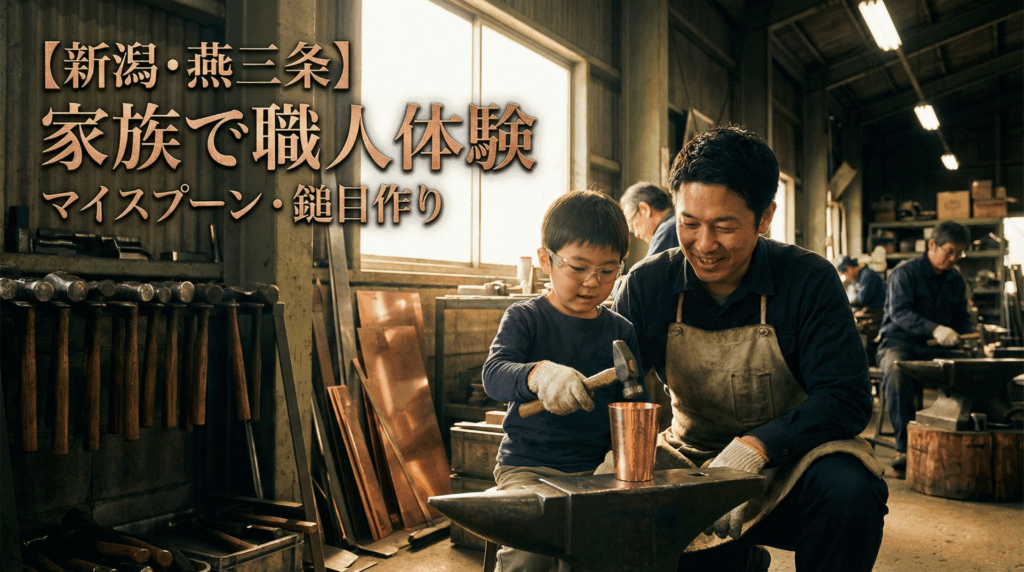
"Clang! Clang! Clang!"
The rhythmic sound of metal being struck echoes through the workshop.
The Tsubame-Sanjo area of Niigata Prefecture is the "holy land of metalworking," revered by top chefs and outdoor enthusiasts around the world. The cutlery (spoons and forks) used at Nobel Prize banquets is actually made right here in this town.
What makes Tsubame-Sanjo truly remarkable is that you can experience this world-class craftsmanship alongside your children. Activities like "hammering patterns into metal" or "magically changing the color of titanium" spark children's curiosity and are a wonderful way to teach them to appreciate the tools we use every day.
In this guide, we'll cover everything from how to choose the right experience spot to the local ramen you absolutely must try — your complete one-day guide to enjoying Tsubame-Sanjo to the fullest.
Tips for Enjoying Tsubame-Sanjo Artisan Experiences as a Family (30 seconds)
- No-reservation facilities are most convenient: Places like the Tsubame City Industrial Museum where you can drop in and experience on the day are recommended
- "Tsuchime (hammered)" works even for toddlers: With an adult guiding their hands, even small children can tap away with a hammer
- Dress casually: Metal shavings and wood chips can fly, so wear washable clothes and easy-to-walk-in shoes
- Lunch: "Tsubame Back-Fat Ramen" is the only choice!: A superb local dish born from the delivery culture of craftsmen — thick noodles with back fat
- Experience fees are extremely affordable: For a few hundred to a few thousand yen, you can make a "lifelong pure copper or titanium tool" — outstanding value
* Experience menus and prices are subject to change. Please check the official information before your visit.
1. [Before You Go] Watch Out for Sparks and Loud Sounds — Clothing and What to Bring
Experiences in Tsubame-Sanjo often take place in real factories or dojos. Here are the basics to ensure a safe and enjoyable visit.
The Three Absolute Rules!
- ① No sandals or heels — wear sneakers
Workshop floors may have metal shavings or wood fragments. Closed-toe sneakers with sturdy soles are a must. - ② Avoid loose or flowing clothing
To prevent clothing from getting caught in machinery or tools, wear fitted clothing with sleeves and hems that stay in place. Denim that doesn't show dirt easily is ideal. - ③ Caution for sound-sensitive children
The "clang! clang!" of metal being struck and the "grrrr" of grinding machines echo through the workshop. For small children who are sensitive to loud sounds, it helps to prepare them in advance by saying "it'll sound a bit like a construction site."
2. [Background Knowledge] Why Do They Hammer It? The Magic of "Tsuchime" and the History of Tsubame-Sanjo
"Tsuchime" (hammered texture) is one of Tsubame-Sanjo's signature experiences. Tell your child about this before the experience and watch their eyes turn as focused as a craftsman's when they pick up the hammer!
It's Not Just a "Pattern" — It's a Strengthening Spell!
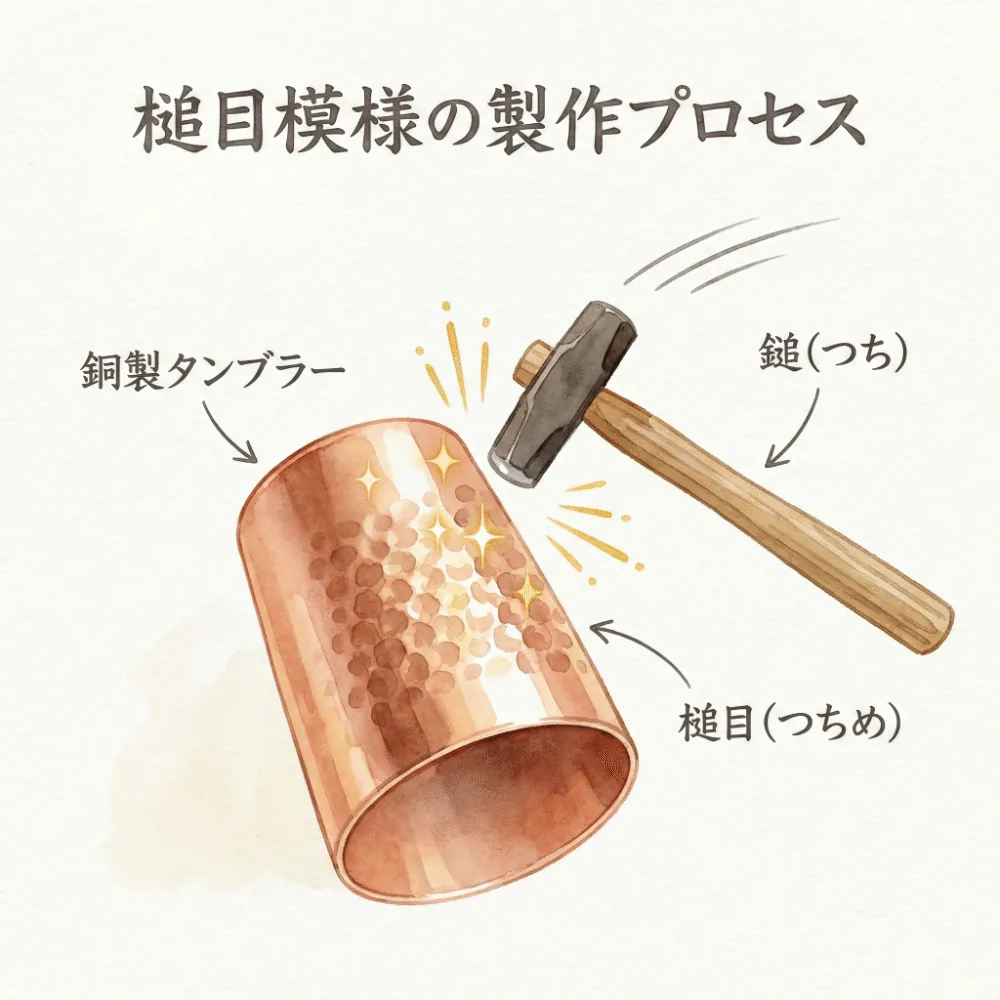
When you tap copper or other metals with a special hammer, beautiful bumpy patterns (tsuchime) appear on the surface.
But this is not merely decorative. Metal has a remarkable property: "the more you hammer it, the denser and harder it becomes" — this is called work hardening.
In other words, by adding the tsuchime texture, a thin, lightweight cup is transformed into a "lifelong, dent-resistant tool" that won't cave in even if dropped!
💡 Fun Fact"Tsubame" and "Sanjo" — they actually have different specialties!
These two neighboring cities actually specialize in different types of manufacturing.
Tsubame City: Excels at "metal pressing and polishing" for Western tableware like spoons and cookware.
Sanjo City: Excels at "forging (heating and hammering)" for knives, pliers, and carpentry tools.
The combination of these two technologies is what makes this the world's most powerful metalworking region.
3. "Pure Copper Tumbler" vs "Titanium Spoon" — Comparing the Top Two Experiences
Two of the most popular options available at the Tsubame City Industrial Museum and other venues. Choose based on your child's age and interests.
| Item | Pure Copper Tumbler (Tsuchime Hammering) | Titanium Spoon (Anodizing / Color Change) |
|---|---|---|
| What you do | Tap with a hammer to create patterns | Use electricity to vividly change the "color" of titanium |
| Recommended age | 3 years and up (with an adult) | Elementary school age and up (great for science lovers!) |
| Duration (approximate) | About 30 minutes | About 5 minutes (it's over in an instant!) |
| School project element | "Why does it get stronger when you hammer it?" | "Why does electricity change the color?" |
| Appeal of the finished product | Drinks get ice-cold in an instant! Barley tea and iced coffee taste dramatically better |
Hypoallergenic and ultra-lightweight. A stunning gradient color found nowhere else in the world |
4. [Niigata - Tsubame-Sanjo] Top 3 Family-Friendly Artisan Experience Spots (with Map)
We've carefully selected facilities that are "family-friendly," "no reservation required (or easy to book)," and guaranteed to let you experience true craftsmanship.
* The pins on the map indicate spots introduced in this article. Please check the official websites for the latest information on pricing and hours.
① Tsubame City Industrial Museum (Tsubame City) | If in doubt, start here — a one-stop experience hub!
A museum dedicated to the history of Tsubame-Sanjo, but the attached "Experience Workshop" is absolutely incredible!
From tsuchime hammering on pure copper tumblers and anodizing titanium spoons to making tin sake cups — all sorts of artisan experiences are available at remarkably affordable prices, no reservation required.
👨👩👧👦 Family Checklist
- Convenience: No reservation needed! If there's space, you can do as many experiences as you like on the spot
- Learning: The exhibition hall has "spoons from around the world" — fascinating even for adults
- Rainy days: Fully indoors, so you can enjoy it comfortably regardless of weather
Basic Information (approximate)
- Experiences: Tsuchime hammering (tumbler), titanium anodizing (spoon), etc.
- Duration: 5 to 30 minutes
- Price range: Spoon anodizing from ¥800 / Tumbler hammering from ¥2,500 (plus separate admission fee)
- Reservation: No reservation needed for individuals (walk-ins welcome)
② Sanjo Kaji Dojo (Sanjo City) | Sparks fly! A full-on "blacksmithing" experience
A dojo where you can experience the full authentic "kaji (blacksmithing)" technique that Sanjo City takes pride in — hammering, stretching, and cutting metal.
Hammering glowing red-hot iron to make traditional Japanese nails (wakugi) or a paper knife. The extraordinary feeling of sparks flying is an unforgettable experience for older children.
👨👩👧👦 Family Checklist
- Authenticity: Working with real fire and iron gives you the full craftsman experience!
- Instruction: An active blacksmith gives you one-on-one patient guidance
- Age: Fire-involved experiences recommended for upper elementary school age and up (e.g., nail-making)
Basic Information (approximate)
- Experiences: Making traditional nails, paper knives, knife sharpening, etc.
- Duration: 30 to 60 minutes
- Price range: Traditional nail-making from ¥500 / Paper knife from ¥1,000
- Reservation: Advance reservation required for some experiences
③ Marunao (Sanjo City) | Like a museum! A tour of an exquisite "wooden chopstick" factory
Tsubame-Sanjo isn't just about metal. Marunao is a world-renowned wooden chopstick maker whose roots go back to crafting handles for woodworking tools — and their open factory is open to visitors.
The beautiful glass-walled factory is filled with the scent of wood, and you can watch craftsmen shave chopsticks to 0.5mm precision with incredible skill. We also recommend browsing the attached direct-sales shop to find a pair of matching lifelong chopsticks for the whole family.
👨👩👧👦 Family Checklist
- Facilities: The factory is as stylish as an art gallery, with a beautiful viewing route
- Learning: The ideal educational experience — learning how the chopsticks you use every day are made
- 📝 Events During summer vacation or the "Factory Festival" in October, hands-on workshops where you can actually make your own octagonal chopsticks are sometimes held!
Basic Information (approximate)
- Content: Open factory tour (self-guided)
- Duration: About 15 to 30 minutes
- Price: Tour is free
- Reservation: No reservation needed for the tour (chopstick-making workshop requires advance reservation and is held at special events only)
🍴 Bring Tsubame-Sanjo Quality Home! Lifelong Cutlery & Tumblers
For those who can't make it to Tsubame-Sanjo... The Tsubame-Sanjo cutlery (spoons and forks) loved by top restaurants around the world has an incredibly smooth feel that makes everyday meals taste so much better! And a "pure copper tumbler" hammered by craftsmen is a magical item that keeps beer and iced coffee stunningly cold. It's also a hugely popular gift for dads!
5. [Model Course] The Sound of Metal & Back-Fat Ramen! A Day-Trip Schedule
A fully satisfying day-trip plan for families driving to Niigata (Tsubame-Sanjo area).
- 10:00 | Arrive at "Sanjo-Tsubame IC" on the Hokuriku Expressway
- 10:30 | Tsuchime tumbler & spoon-making experience at Tsubame City Industrial Museum!
(No reservation needed — great to jump right in upon arrival) - 12:30 | Time for the much-anticipated local "Tsubame Back-Fat Ramen" lunch
(The thick noodles and onions with back fat taste lighter than it looks — and absolutely delicious!) - 14:00 | Shopping at "Michi no Eki Tsubame-Sanjo Jibasancenter"
(Time for mom and dad to find a "lifelong knife or pot") - 15:30 | Head home
6. What to Do After the Experience! Nearby Spots for Food and Shopping
The perfect local cuisine and a shopping spot that will excite both mom and dad to wrap up your Tsubame-Sanjo trip.
① The craftsman's energy source! Head to a famous "Tsubame Back-Fat Ramen" restaurant
You absolutely cannot leave Tsubame-Sanjo without trying the local ramen.
Long ago, this dish was born out of necessity for factory workers drenched in sweat — "put a layer of back fat on top so the soup stays hot" and "make the noodles extra thick so they don't get soggy during delivery." It is truly a bowl of ramen packed with the history of this manufacturing city.
🍜 Recommended family-friendly restaurants in town
- Koushuu Hanten: Said to be the originator of Tsubame back-fat ramen — a super-famous spot with a line out the door!
- Shumented Jun: A hugely popular place where you can choose the amount of back fat from "standard" to a hefty "oni fat." Sure to challenge dad's adventurous side.
- Oomura Shokudo: A popular restaurant with spacious tatami seating — overwhelmingly family-friendly.
* You can find the location of each restaurant on the map in Chapter 4 (🍜 orange pins)!
* There are no ramen restaurants inside the Jibasancenter, so it's best to stop by a restaurant while driving or before shopping.
② Michi no Eki Tsubame-Sanjo Jibasancenter
After filling up on ramen, head to this enormous product hall located right by the Sanjo-Tsubame IC!
Here you'll find knives, pots, cutlery, tools, and more made in Tsubame-Sanjo, lining the walls in the tens of thousands! After the experience has given you a deep appreciation for the craftsmen's skill, ordinary knives and spoons start to look like treasure. The perfect spot to take home a lifelong tool for yourself.
7. After the Artisan Experience, Head to a Famous Hot Spring! Recommended Family Accommodations in Niigata
There are many business hotels near Tsubame-Sanjo Station, but a 30 to 50-minute drive will take you to some of Niigata's proudest, most spectacular hot spring resorts.
After hammering metal and having fun, we highly recommend a two-day, one-night trip where both parents and children can refresh at a famous hot spring with delicious Niigata rice (Koshihikari)!
⛩ Yahiko Onsen Area (The closest to Tsubame-Sanjo! Hot springs at a power spot)
Yahiko Onsen Shiki no Yado Minoya
About 30 minutes by car from the Tsubame-Sanjo area. A long-established inn of over 300 years, located directly in front of Niigata's premier power spot, Yahiko Shrine.
From the panoramic open-air bath on the top floor, you can enjoy a sweeping view of Mt. Yahiko and the beautiful landscape. Guests rave about relaxing in tatami-floored Japanese rooms, savoring Niigata's seafood and delicious rice — making it a hugely popular inn for families with young children.
♨️ Tsukioka Onsen Area (Head to the "walking jewel" — hot springs famous for beautiful skin!)
Tsukioka Onsen Shiratama no Yu Senkei
About 50 minutes from Tsubame-Sanjo via expressway. When people think of Niigata hot springs, this is the one! A massive, super-popular inn representing Tsukioka Onsen, famous for its emerald green waters.
A perennial entry in the "100 Best Hotels and Inns Selected by Professionals," this inn is known above all for its hospitality and cuisine (buffet and kaiseki). With an indoor heated pool (seasonal) and a vast communal bath, this is an inn you absolutely cannot miss if you want to create a luxurious family travel memory.
8. [After You Get Home] How to Care for Your Handmade "Lifelong" Tool
Your finished pure copper tumbler or titanium spoon. Here are tips for keeping your tool — which you'll love even more than a store-bought one — beautiful for years to come.
Caring for Your Pure Copper Tumbler
- No microwave or dishwasher (these can cause discoloration and damage. Wash by hand with a soft sponge)
- Wipe off moisture thoroughly (if water droplets are left on copper, green rust called "rokusho" can develop)
- If the color becomes dull? (Mix equal parts vinegar and salt, apply with a cloth and buff — it'll shine like new! This is also a fun little science experiment)
📝 Tip The titanium spoon is incredibly low-maintenance!
Titanium is extremely resistant to rust and has no metallic smell. Just a quick wash with regular neutral dish soap is all it takes to enjoy the beautiful color for years. Bring it along as an everyday bento lunch spoon and show it off to your friends!
✨ Keep It Shining — Metal Care Products
Pure copper and brass items deepen in color as they are used, developing the beautiful aged look of an antique. But if you ever want to "restore that original brilliant shine," a quick buff with a specialized metal polishing cloth or cream will bring it right back. Make sure to also have a soft sponge on hand that won't scratch your precious metal tools.
Conclusion: A Meal Eaten with a Tool You Hammered Yourself Is the Most Delicious in the World

"These bumps — I made them with a hammer!"
Pour ice and barley tea into the tsuchime tumbler you made yourself, and thanks to copper's high thermal conductivity, the entire tumbler becomes cold in an instant.
That first sip — taken in surprise at how cold it is — will taste better than any drink from the finest glass, and it will stay with you forever.
Many of the "MADE in JAPAN" kitchen tools we use are made by the craftsmen of Tsubame-Sanjo. Why not spend the next holiday heading to the heart of manufacturing with your family, and making a "my very own tool" that will last a lifetime?