Tsukada Shoten — Ibaraki Hoshiimo Shop
Turning Ibaraki-grown "Beni Haruka" into moist, sweet hoshiimo. Tsukada Shoten — where careful handwork shines.
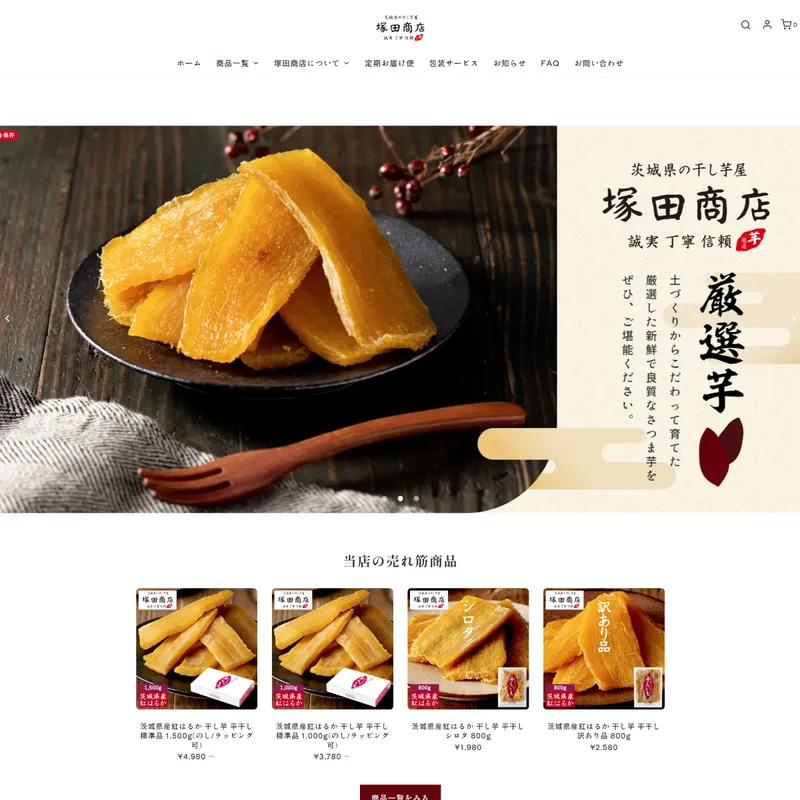
Tsukada Shoten is a hoshiimo brand with a factory in Chikusei City, Ibaraki Prefecture. The raw material is "Beni Haruka" sweet potatoes from Ibaraki. Using contracted farmers' sweet potatoes — layering processes of storage → steaming → drying — the brand finishes into hoshiimo-like "stickiness." A style of competing with material sweetness, not using sugar or additives. Forms are centered on flat-dried and whole-dried — with grades selectable by mood and use also lined up: premium, standard, value (off-spec), cut-offs, and shirota. With cold and frozen storage methods also guided, it's a reassuring presence for those wanting to enjoy little by little.
Why We Love It
For our first pick, the standard grade flat-dried. Easy to grasp as a classic entry — you can straightforwardly enjoy the hoshiimo-like sweetness and texture. On days you want a change, whole-dried is also good. As a type dried over time, stickiness comes out forward — a nice point. If hardness concerns you, warming methods using microwave or oven toaster are also guided. For storage, wrap firmly in plastic and into freezer bags. Estimates of about 2 weeks refrigerated, about 3 months frozen are also shown — also reassurance for bulk buying.


PROFILE About the Company / Workshop
Tsukada Shoten's axis is very simple. Using Ibaraki-grown "Beni Haruka," finishing the rustic snack of hoshiimo straightforwardly and carefully. Sweetness is "drawn out," not "added." That direction comes through from the corners of the text.
At the entrance of the process is storage time. Sweet potatoes — rather than right after harvest — are introduced as having sweetness increase by storing at constant temperature. Tsukada Shoten conducts storage at about 10°C, then moves to the steaming process. The accumulation here becomes the foundation of hoshiimo sweetness.
Steaming takes about 60-90 minutes. After steaming, immediately moving to peeling. From here, handwork is central — a flow proceeding while seeing the state of each one. Fine effort arranges the outline of "stickiness" — that's the impression.
Drying is shown — flat-dried about 2 days, whole-dried about 7 days as a guide. Even with the same Beni Haruka, the way texture comes out changes by form and drying difference. Flat-dried is easy to eat, whole-dried more satisfying. The joy is finding your preferred landing point.
Products are divided into premium, standard, value (off-spec), cut-offs, shirota, and more. With categories prepared for reasons of color, appearance, and texture differences — a design easy to choose matched to use. Accompanying both gifts and home use with the same "hoshiimo."
Eating and storage methods are also in a form easy to match life's tempo. If hardness concerns you, methods of warming in microwave or toaster are guided — and cold/frozen storage procedures are concrete. Dividing into portions with plastic wrap and freezer bags — estimates of about 2 weeks refrigerated, about 3 months frozen. Welcome information for those who want to preserve deliciousness long.
Raw material is Ibaraki-grown "Beni Haruka." Shaping sweetness into "hoshiimo form"
Using Ibaraki-grown sweet potato "Beni Haruka." Sourcing contracted farmers' potatoes, increasing sugar content while inserting storage — connecting to hoshiimo. Without piling on with seasoning, competing with material sweetness. This is the core of Tsukada Shoten.
Flat-dried, whole-dried. The difference in drying time creates the texture's "expression"
Forms are centered on flat-dried and whole-dried. The drying process — about 2 days as a guide for flat-dried, about 7 days for whole-dried — is introduced, and finished nuances also change. Today refreshing, today sticky. Being able to choose like that is also fun.
Premium / Standard / Value / Cut-offs / Shirota. Easy to choose matched to use
Tsukada Shoten's grade classification is clear. For reasons of color, appearance, and texture differences — premium, standard, value (off-spec), cut-offs, and shirota are prepared. For home use a casual option, for gifts a neat expression. Selectable matched to scene.
Storage and eating methods — also living-side. Cold and frozen estimates also guided
Hoshiimo is a snack that suits "little by little." Storage methods of dividing into portions, wrapping in plastic, and putting into freezer bags are introduced — with estimates of about 2 weeks refrigerated, about 3 months frozen also shown. Even touching on warming methods when it hardens — a quietly helpful point.
LINKS Official Links / Social Media
- Official Website https://t-shoten.jp/
- Online Shop https://t-shoten.jp/collections/all
- Contact Form https://t-shoten.jp/pages/contact
- About Tsukada Shoten https://t-shoten.jp/pages/about-us
- Online Shop (All Products) https://t-shoten.jp/collections/all
- Premium https://t-shoten.jp/collections/premium
- Standard https://t-shoten.jp/collections/standard
- Value (B-class) https://t-shoten.jp/collections/b-class
- Cut-offs (Offcuts) https://t-shoten.jp/collections/offcuts
- Shirota https://t-shoten.jp/collections/shirota
- Hoshiimo Subscription https://t-shoten.jp/collections/subscribe
- Subscription Delivery (Guide Page) https://t-shoten.jp/pages/subscription
- Wrapping Service (Noshi / Wrapping) https://t-shoten.jp/pages/wrapping
- How to Store Hoshiimo https://t-shoten.jp/pages/preservation
- Hoshiimo Recipes https://t-shoten.jp/pages/recipe
- FAQ https://t-shoten.jp/pages/faq