Aomori Rice Promotion Headquarters
Sharing Aomori's "clean" rice — grown under cool northern skies and rich water systems — with tables across Japan.
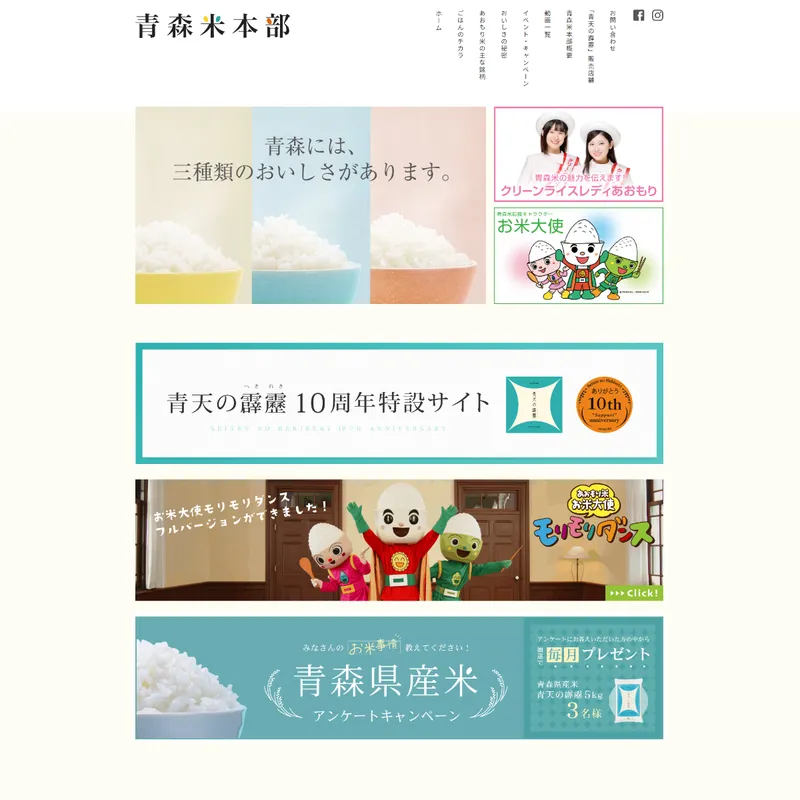
Aomori Rice Promotion Headquarters (Aomori Prefectural Rice Demand Expansion Promotion Headquarters) is a prefecture-wide organization established on May 1, 1980, to expand demand for Aomori-grown rice through campaigns and marketing for both consumers and commercial users. Its core lineup features "Masshigura," positioned for stable supply, "Seiten no Hekireki," Aomori's premium brand rice launched in 2015 with strict cultivation and shipping standards, and "Harewatari," a newer variety introduced as having earned a "Special A" rating and made its nationwide debut in 2023 (Reiwa 5). Supported by long sunshine hours in the growing season and a cool climate that helps curb pests and diseases, Aomori also promotes low-pesticide "clean cultivation" — aiming to connect local fields with everyday tables and professional kitchens alike.
Why We Love It
"The usual side dish becomes a bit of a feast." What Aomori has aimed for is daily-happy rice deliciousness — rather than flashiness. "Seiten no Hekireki" — said to have slightly larger grains and a good balance of stickiness and clean finish; "Masshigura" — holding up stable supply matched to demand; and the new variety "Harewatari" — which made its nationwide debut in 2023. Because the producing region has varieties with different characters, the joy of choosing emerges — for home or commercial use.

PROFILE About the Company / Workshop
Established on May 1, 1980, Aomori Rice Promotion Headquarters brings together the prefecture, municipalities, and agricultural organizations to expand demand for Aomori-grown rice. Its work spans consumer-facing promotion as well as marketing and outreach to commercial users such as prepared-food businesses, restaurants, and retailers.
Aomori's rice culture rests on powerful natural foundations. Forested mountains feed water systems that flow into wide plains — forming a major granary region. The Iwaki River basin supports extensive farming areas and is repeatedly referenced as a key backbone of local rice production.
Sunlight is another defining advantage. During the growing season (May through October), Aomori's sunshine hours are described as the longest in Tohoku — and about 20% longer than Tokyo. Abundant light supports photosynthesis and grain filling, while cooler weather helps suppress pests and diseases — conditions that make it easier to reduce pesticide use and pursue "clean cultivation."
Masshigura — designated as a prefectural recommended variety in 2005 — was named to express a sincere, "straight-ahead" commitment to improving eating quality and overall standards. It is introduced as having strong resistance to rice blast, solid yields, good blending characteristics, and an emphasis on stable supply for food service, prepared foods, and mass retailers.
Seiten no Hekireki, launched in 2015, is Aomori's premium brand rice. It is introduced as slightly larger-grained with a good balance of stickiness and clean finish, leaving an elegant sweetness. To maintain quality, the program limits pesticide components, reduces nitrogen fertilizer, caps brown-rice protein at 6.4%, and registers only growers who comply with cultivation and shipping rules.
To support that management, "Seiten Navi" uses satellite-based data to provide advice at the level of individual paddies — including harvest-timing maps and protein maps. This approach is introduced alongside recognition in Japan's space utilization awards (FY2017, Minister of Agriculture, Forestry and Fisheries Award).
Harewatari is the newer headline variety. It is introduced as a new variety that earned a "Special A" rating and made its nationwide debut in 2023 (Reiwa 5). With planting shares presented across the three pillars, Aomori continues to build a production structure where consumers and industry users can choose the rice that best fits their needs.
A rice region sustained by forests, rivers, and fertile plains
Water originating in forested mountains such as the Shirakami area nourishes broad plains where rice farming has long been central. The Iwaki River basin, in particular, is described as supporting roughly 48,000 hectares of farmland — and remains a foundation for local livelihoods and rice culture.
Long sunshine hours in the growing season, and cool weather that curbs disease
During the rice-growing months (May to October), Aomori's sunshine hours are described as the longest in Tohoku — about 20% longer than Tokyo. Cooler conditions also help suppress pests and diseases — supporting low-pesticide "clean cultivation" as part of Aomori's production approach.
Premium brand "Seiten no Hekireki" — a system designed to protect eating quality
Seiten no Hekireki is maintained through strict cultivation and shipping standards plus a registered grower system. The program promotes soil health with silicate, limits pesticide components to 10 or fewer (8 or fewer for specially cultivated rice), reduces nitrogen fertilizer, and caps brown-rice protein at 6.4%. It also uses the ICT platform "Seiten Navi," leveraging satellite-based data to advise field-by-field management.
Three varieties, three roles — built to meet demand
For the 2024 (Reiwa 6) crop year (based on seed orders), planting shares are introduced as roughly 77% Masshigura (about 30,800 ha), 6% Seiten no Hekireki (about 2,200 ha), and 15% Harewatari (about 6,200 ha). By positioning multiple pillars for different needs, Aomori strengthens its ability to serve both home and commercial markets.
LINKS Official Links / Social Media
- Official Website https://aomori-komehonbu.gr.jp/
- Contact Form https://aomori-komehonbu.gr.jp/contact/
- Organization Profile https://aomori-komehonbu.gr.jp/profile/
- Main Aomori Rice Varieties https://aomori-komehonbu.gr.jp/meigara/
- Why Aomori Rice Tastes Great https://aomori-komehonbu.gr.jp/taste/
- Variety Transition & Planting Shares https://aomori-komehonbu.gr.jp/taste/sakutsuke/
- Seiten no Hekireki (Standards / Seiten Navi) https://aomori-komehonbu.gr.jp/seitennohekireki/
- Where to Buy Seiten no Hekireki https://aomori-komehonbu.gr.jp/seitennohekireki/shop-list/