You bought an air purifier, and the pet smell is still there.
That isn't the machine underperforming. It's a different job.
Dust can be filtered out. Pollen and PM2.5 are particles, and a fine enough filter catches them. Odor can't be filtered. What you smell isn't particles but much smaller molecules — gas — and it passes straight through the mesh.
So odor needs a different method: soak it up in activated carbon, or break it down with a photocatalyst. Those are the two main ways in home units.
This guide covers air purifiers from Dainichi in Niigata and Andes Electric in Aomori — the makers we found that state Japanese production on their own sites — and neither one makes a machine that only filters. Because these are Japanese appliances, it starts with the question readers abroad need answered first: will one work where you live? One of them, it turns out, works almost anywhere.
Quick Reference: Japan-Made Air Purifiers at a Glance
| Model | Room size | Dust | Odor | Power / outside Japan |
|---|---|---|---|---|
| Dainichi CL-HB924 ▾ | 63 m² (678 sq ft) | Electrostatic + filter hybrid | Activated carbon | 100V, 3.8–53 W → transformer |
| Andes BM-S611A ▾ | 24 m² (258 sq ft) | HEPA | Photocatalyst + carbon | Adapter is 100–240V → no transformer |
| Andes BM-H101A ▾ | 32 m² (349 sq ft) | Multi-function filter + ionizer | Photocatalyst | 100V, max 95 W → transformer |
| Andes BM-S711A ▾ | 50 m² (538 sq ft) | HEPA | Photocatalyst + carbon | 100V, max 80 W → transformer |
| Kaltech KL-W01U ▾ | 560 sq ft (52 m²) | Washable filter | Photocatalyst | 120V North American model |
Room sizes and power figures from each maker's official spec sheets (Kaltech from its US listing). Remember: dust can be filtered, odor can't — catalogs list "dust collection" and "deodorizing" separately for that reason.
1. Will a Japanese Air Purifier Work in Your Country?
Short answer: it depends on the model. Andes Electric's BM-S611A runs on an AC adapter rated 100–240V, so it works almost anywhere without a transformer. The others are 100V machines that need a small step-down transformer outside Japan — and in North America, Kaltech sells a 120V version of its wall-mounted purifier.
| Where you live | Voltage | Does the plug fit? | What you need |
|---|---|---|---|
| Japan | 100V | — | Nothing |
| United States / Canada | 120V | Yes — same Type A plug | BM-S611A: nothing. 100V models: a step-down transformer. The plug fits, but the voltage is 20% too high |
| Europe / UK / Australia | 230–240V | No | BM-S611A: a plug adapter only. 100V models: a plug adapter and a transformer |
The exception: an adapter rated 100–240V
Andes Electric's BM-S611A runs on 24V DC from a dedicated AC adapter whose input is rated 100–240V, 50/60 Hz, according to its official spec sheet. Like a laptop charger, the adapter handles the voltage itself. In the US and Canada it simply plugs in; elsewhere it needs only a plug adapter, not a transformer.
The other Japanese models: a small transformer is enough
Dainichi's CL-HB924 and Andes Electric's BM-H101A and BM-S711A are 100-volt appliances. In North America the plug goes straight in and the fan will run — that's the trap: 20% more voltage than the motor was designed for.
The good news is that air purifiers draw very little power: 53 W at most for the CL-HB924, 95 W for the BM-H101A, 80 W for the BM-S711A. Motors need two to four times their rating for the start-up surge, so a 500 W step-down transformer covers all three — a far smaller box than a rice cooker or a humidifier with a heater would need. Use a transformer, not a cheap travel "converter," which can damage electronic controls and motors.
Kaltech KL-W01U — a Japanese photocatalytic purifier built for 120V
For readers in the US and Canada, the simplest option. Kaltech, an Osaka company, sells this wall-mounted photocatalytic air purifier in a 120V North American version, listed as made in Japan, for rooms up to 560 sq ft (52 m²).
It breaks odors down with a photocatalyst rather than storing them, and its filters are washable. It hangs on the wall, leaving the floor clear (the stand is sold separately).
Kaltech KL-W01U Wall-Mounted Photocatalytic Air Purifier (120V)
Loading product details…
120V to 100V 500 W Toroidal Step-Down Transformer
For the 100V Japanese models — Dainichi CL-HB924 (max 53 W), Andes BM-H101A (max 95 W) and BM-S711A (max 80 W) — in the US. Not needed for the BM-S611A.
120V to 100V 500W Toroidal Step-Down Transformer
Loading product details…
2. Dust Can Be Filtered. Odor Can't.
An air purifier has more than one job
Open a Japanese catalog and you'll see "dust collection" and "deodorizing" listed in separate columns. That's not just layout: different parts really do different jobs.
Dust collection catches particles. Dust, pollen, PM2.5 — invisible, but still particles, so a fine enough mesh catches them.
Deodorizing deals with molecules. Odor isn't particles; it's gas mixed into the air, so it passes through even the finest mesh.
Two ways to remove odor
One is activated carbon: charcoal full of tiny pores that soak up odor molecules and hold them. Because it absorbs, it eventually fills up and stops working — which is why carbon filters have a lifespan.
The other is a photocatalyst. Shine ultraviolet light on it and a reaction on its surface turns the organic compounds behind odors into something else. It doesn't store them; it breaks them down on the spot.
One stores, the other converts. That difference comes back later, when we get to replacement parts.
Dust collection has two methods too
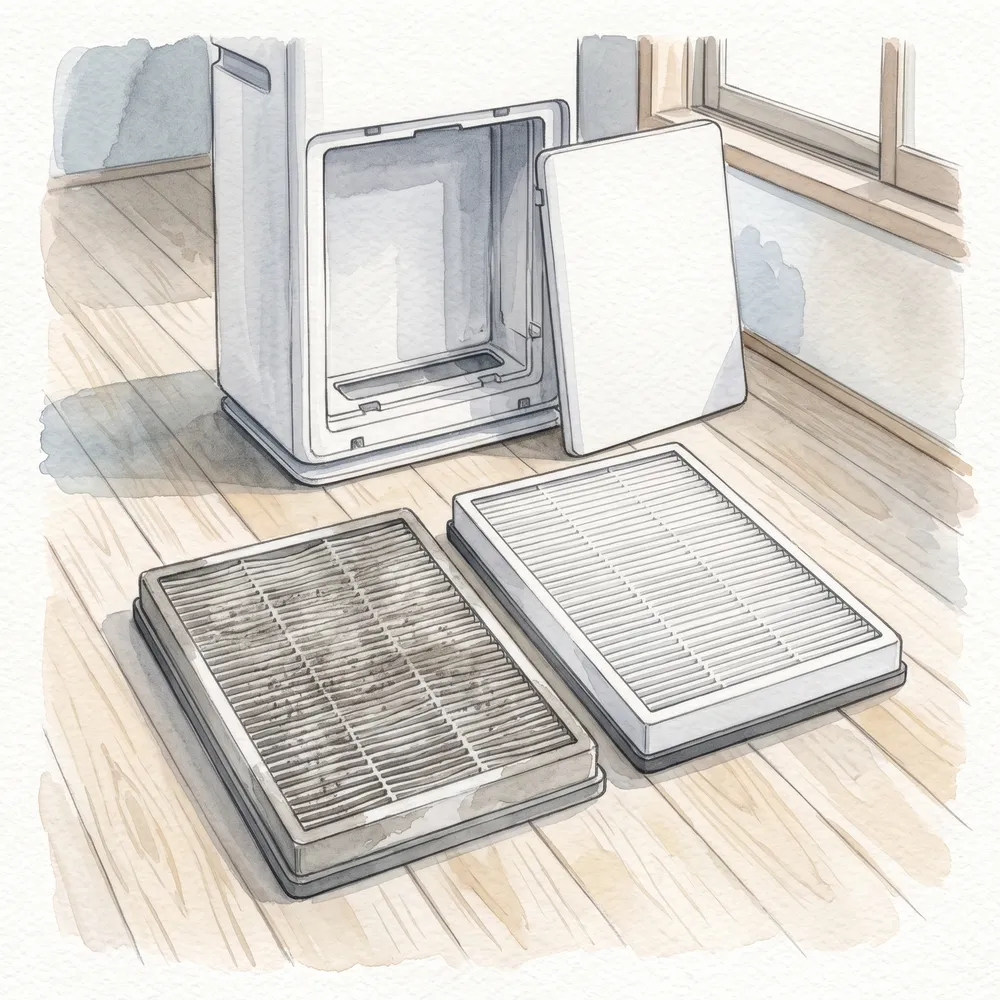
One is a filter that simply sieves the air — a HEPA filter. The other is electrostatic collection: in Dainichi's words, the particles drawn in are "electrically charged and attracted to collector plates."
Its advantage is that the collector isn't a consumable. What sticks to the plates washes off, and because it isn't a mesh, it doesn't clog and lose airflow.
Dainichi CL-HB924 — a collector you wash and put back
For rooms up to 63 m² (678 sq ft). Maximum airflow 8.6 m³/min, quietest setting 15 dB. The most affordable Japan-made model here.
According to Dainichi, it's a hybrid of electrostatic collection and a fine filter, designed to catch particles down to about 0.03 μm. The electrostatic plasma unit is cleaned once every two years — Dainichi's instructions: vacuum off the dust, soak it in lukewarm water for an hour, and give it a quick rinse. It goes back in, not in the bin.
Dainichi says "everything from product design to assembly and inspection is done at our own factories in Niigata." 100V, 3.8–53 W. Sold in Japan.
3. Why Japanese: What We Found Was in Niigata and Aomori
Fewer than you'd think
Japanese electronics stores are lined with air purifiers. Add the condition "the maker's own site says it's made in Japan," and the list shrinks fast. The Japanese-market makers in this guide are Dainichi Industry in Minami-ku, Niigata City, and Andes Electric in Hachinohe, Aomori. For North America, Kaltech of Osaka sells a 120V model listed as made in Japan.
Andes Electric: Hachinohe, Aomori — it makes its own photocatalyst
Founded in 1971 and based in the Kikyono industrial park in Hachinohe, Andes Electric has about 300 employees and five factories, and also makes equipment for railways.
Its wording is clear: "This product is designed and developed in Japan and manufactured under a strict quality control system." A product page calls it "a purely domestic model, developed and manufactured entirely at our own factory in Hachinohe, Aomori," and its feature page says "Made in AOMORI."
At the heart of the company is a photocatalyst it developed itself, called Hikari Crysta (Japanese patent No. 6568402). In Andes's description, "irradiating it with ultraviolet light causes a catalytic reaction that breaks down organic matter."
Both jobs, in one machine
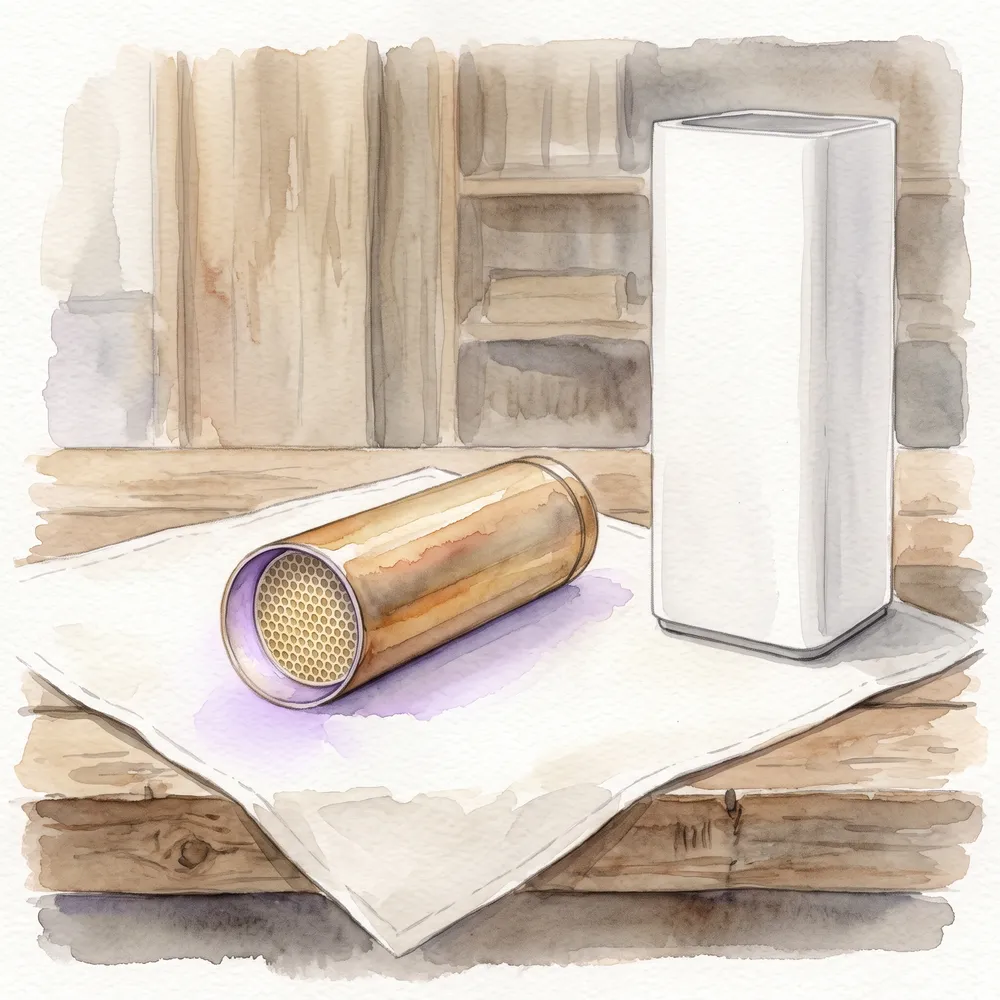
Andes's BioMicron purifiers use an ultra-high-performance HEPA filter for dust, and Hikari Crysta plus porous activated carbon pellets for odor. Particles are sieved; odors are broken down. The two jobs from section 2 are given to two different parts — which is exactly why the catalog has two columns.
The air purifiers on the Shinkansen come from Aomori
Andes Electric supplied equipment for railway cars long before it sold home air purifiers. Its feature page describes the BioMicron Square as bringing together "more than 25 years of Japanese technology, also adopted on the Shinkansen." Shaking, cramped, with people constantly coming and going — technology proven in that setting is now sized for a room.
Andes Electric BioMicron Square BM-S611A — breaks odor down, runs on 100–240V
For rooms up to 24 m² (258 sq ft). 21–53 dB. 25 × 25 × 50.6 cm (9.8 × 9.8 × 19.9 in), about 6 kg (13 lb). A slim tower that takes little floor space.
HEPA for dust; Hikari Crysta and activated carbon pellets for odor. For a room with pets or lingering cooking smells, it's a better fit than a dust-only machine.
Its AC adapter is rated 100–240V, so it works outside Japan without a transformer. The replacement filter is the Circle Filter D600 (HAS306-01X), roughly once a year by running time. Sold in Japan.
4. Decide Where It Goes Before the Room Size
The room size assumes a closed door
The rated floor area is how large a room the machine can circulate — and like a humidifier's rating, it means little with the door open. One unit in the living room won't cover the whole house; think room by room.
Where it actually goes is decided before the size: how much floor is free, where the outlet is, and whether you can move it to vacuum.
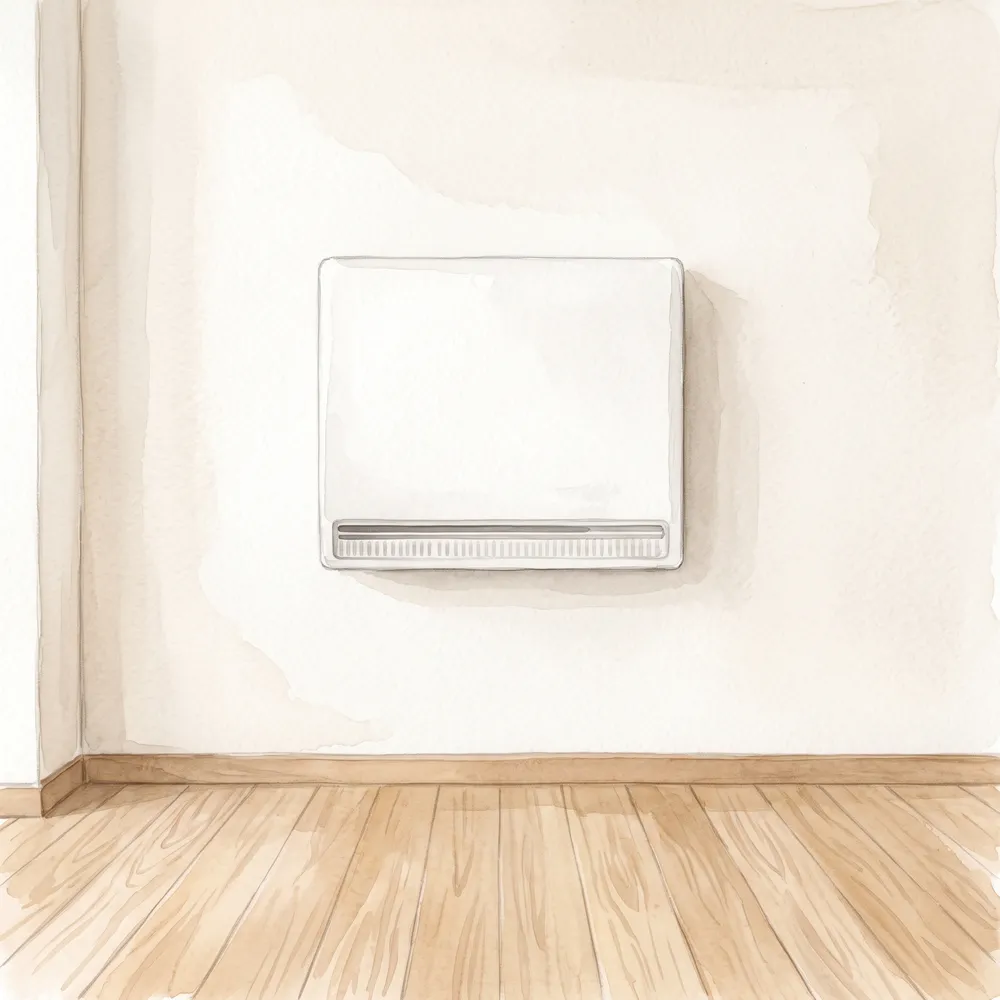
If the floor's full, use the wall
Air purifiers take more space than they seem to: they need room on the intake and outlet sides, and pushed flat against a wall they underperform.
If you want the floor clear, look for a model you can hang. Andes says the BM-H101A "can be used free-standing with the included stand, or mounted on a wall with the optional wall bracket." Kaltech's KL-W01U is wall-mounted from the start.
Try it on the floor; if it's in the way, put it on the wall. In a small room, that option makes a real difference.
Put it near the source
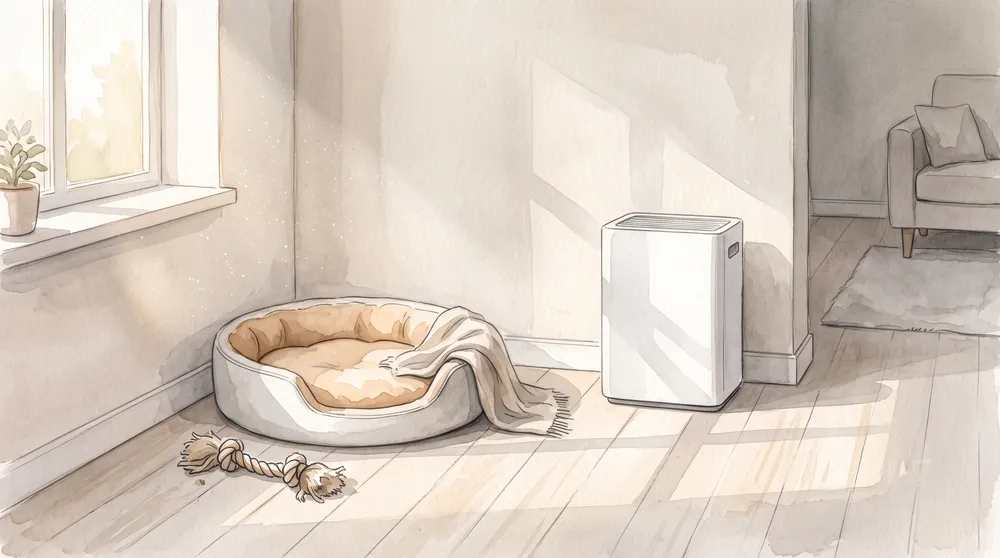
An air purifier doesn't belong in the middle of the room. It only cleans what it draws in, so closer to where the mess comes from is better: next to the pet bed, by the entrance, between kitchen and living room. For pollen, near the door people come in by — pollen carried in gets stirred up right there.
Andes Electric BioMicron BM-H101A — 20 tatami, and it can go on the wall
For rooms up to 32 m² (349 sq ft). 27–60 dB. 55 × 24 × 50 cm (21.7 × 9.4 × 19.7 in), about 9 kg (20 lb) with stand. A wide, shallow shape that doesn't stick out from the wall.
A pre-filter, ionizer and high-performance multi-function filter for dust; a prism-shaped titanium-dioxide photocatalyst unit (Hikari Crysta) for odor. The stand is included; the wall bracket is optional. Replacement filter: multi-function pleated filter (HAS215-01X), about once a year. 100V, max 95 W. Sold in Japan.
5. The More Parts You Can Wash, the Less It Costs Later
The price of the machine is only the first payment
An air purifier keeps costing money after you buy it. Filters are consumables, and the more air they clean, the sooner they wear out. So check three things: the replacement filter's part number, its interval and its price. If you plan to use it for ten years, the real price is the machine plus ten years of filters.
Both makers publish this. Andes's BM-S611A: Circle Filter D600 (HAS306-01X), about once a year. Dainichi's CL-HB924: pre-filter every four months; electrostatic NEOH filter and activated carbon deodorizing filter every two years.
How much can be washed and reused?
Here the methods from section 2 turn into money. Dainichi's electrostatic collector isn't thrown away — it's soaked and rinsed every two years, so the core of the dust collection costs nothing to keep running.
A photocatalyst follows the same logic. Unlike carbon, which fills up, it breaks odors down, so that part doesn't get used up.
Also check that genuine filters can be bought by part number. Compatible filters are sold online, but collection and airflow figures are measured with the filter designed for that machine's airflow.
"0.3 μm, 99.97%" is a standard, not a slogan
The figure you see on HEPA filters isn't marketing copy. In Japan it's the definition of a HEPA filter in the JIS Z 8122 standard: a filter that captures at least 99.97% of 0.3 μm particles at rated airflow, with an initial pressure drop of 245 Pa or less. 0.3 μm is the particle size used for the test. When you compare numbers, check which standard they refer to.
6. Commercial Machines You Can Put at Home
The same machines used in hospitals
For these makers, there's no line between home and commercial. The machines they supply to hospitals and care facilities can go straight into your home — not simplified home versions. Andes's come out of the same Hachinohe factory with the same photocatalyst.
They aren't cheap. Few makers build them, and many came down from commercial use. That's worth saying plainly.
Who they suit
Places where odor is part of the work: hair salons, vet clinics, food prep areas, offices with waiting rooms. At home: rooms with several pets, rooms where someone is being cared for, homes with a smoker.
Choose by how much there is to clean, not by floor area. Even in a small room, a lot of odor is better handled by a bigger machine running gently — which also ends up quieter.
Andes Electric BioMicron Circle PRO BM-S711A — a 30-tatami cylinder
For rooms up to 50 m² (538 sq ft). A cylinder 30 cm across and 60 cm tall (11.8 × 23.6 in), about 8 kg (17.6 lb). 26–66 dB. It draws air in from all 360 degrees.
Ultra-high-performance HEPA (Circle Filter D_PRO) for dust; Hikari Crysta and activated carbon pellets for odor. The replacement filter, HAS293-02X, lasts about two years — longer than the home models. The most expensive machine in this guide, and the answer for places with a lot of odor. 100V, max 80 W. Sold in Japan.
7. Buying One
In Japan, the Dainichi and Andes models are sold through electronics stores and online shops, including Rakuten and Amazon.co.jp. Both makers publish their filter part numbers.
Outside Japan, we couldn't find the Dainichi or Andes models on Amazon.com. If you buy one in Japan, the BM-S611A is the easiest to take home — its adapter is rated 100–240V. For the 100V models, plan on a 500 W step-down transformer, and on ordering filters from Japan.
In the US and Canada, Kaltech's 120V KL-W01U is the Japan-made option that plugs straight in (see section 1).
8. Frequently Asked Questions
Can I use a Japanese air purifier in the US or Europe?
It depends on the model. Andes's BM-S611A uses an adapter rated 100–240V, so it needs no transformer (only a plug adapter outside North America). The 100V models need a step-down transformer; because they draw under 100 W, a 500 W transformer is enough. In North America, Kaltech's KL-W01U is sold as a 120V model.
Why does my air purifier not remove pet odor?
It may only collect dust. Dust and pollen are particles a filter can catch; odor is gas, and passes through. Check the "deodorizing" spec: is there activated carbon, or a photocatalyst? If that column is empty, the machine isn't doing odor.
HEPA or electrostatic — which is better?
They're maintained differently. A HEPA filter is a mesh you replace when it's dirty; an electrostatic collector holds particles on plates you wash and reuse. Dainichi's CL-HB924 combines both. If you plan to use it for ten years, choose by how much of it can be washed.
Should I buy one rated for a bigger room?
If you have the space, it's quieter. A larger machine running gently is quieter than a small one at full speed. But it needs space on the intake and outlet sides — add clearance to the dimensions.
Are compatible filters OK?
This guide covers genuine filters only. Performance figures are measured with the filter designed for that machine. Before buying, check that genuine filters are sold by part number — both Dainichi and Andes publish part numbers and intervals.
Can one unit clean the whole house?
No. The rated area is for one room with the door closed. Air across a hallway doesn't circulate that far. Think room by room — and for a bedroom, check the noise level before the size.
Final Thoughts: Clear About Where It's Made, and What's Inside
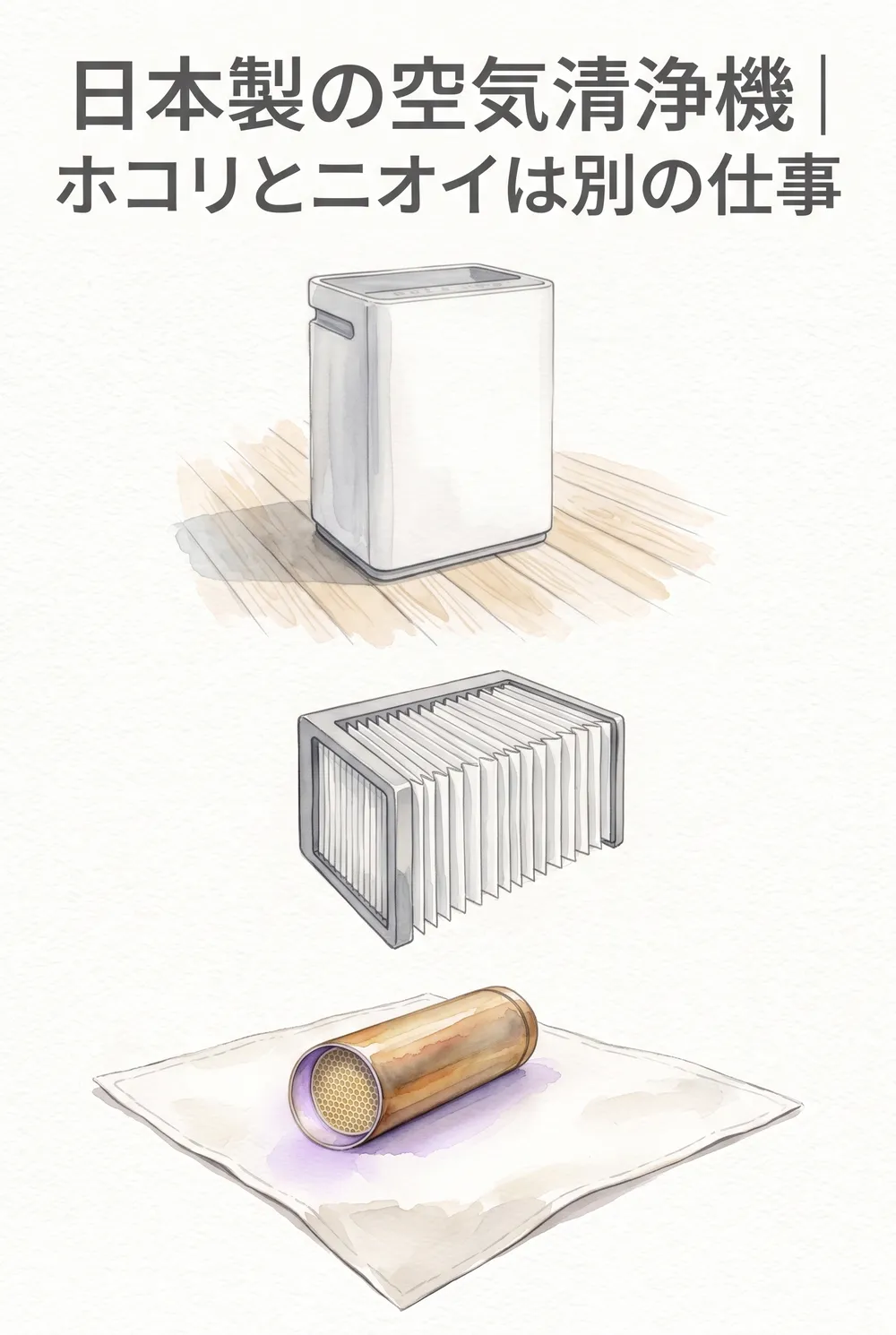
The makers we found stating Japanese production were Dainichi in Niigata and Andes Electric in Aomori — both companies that own the technology inside their machines.
Andes makes its own photocatalyst, Hikari Crysta, in Hachinohe — technology that has ridden the Shinkansen. Dainichi uses electrostatic collection, with a collector you wash and put back every two years.
One thing to remember when you buy: dust can be filtered; odor can't. Check that the "deodorizing" column isn't empty — carbon that stores odor, or a photocatalyst that breaks it down.
Outside Japan, the BM-S611A runs on 100–240V, the 100V models need only a small transformer, and in North America Kaltech's 120V wall unit plugs straight in. Choose your room's air this winter.
Japanese Humidifiers: Dainichi vs Corona, Sizes & Voltage
Japanese Kerosene Heaters: Check Your Local Law First