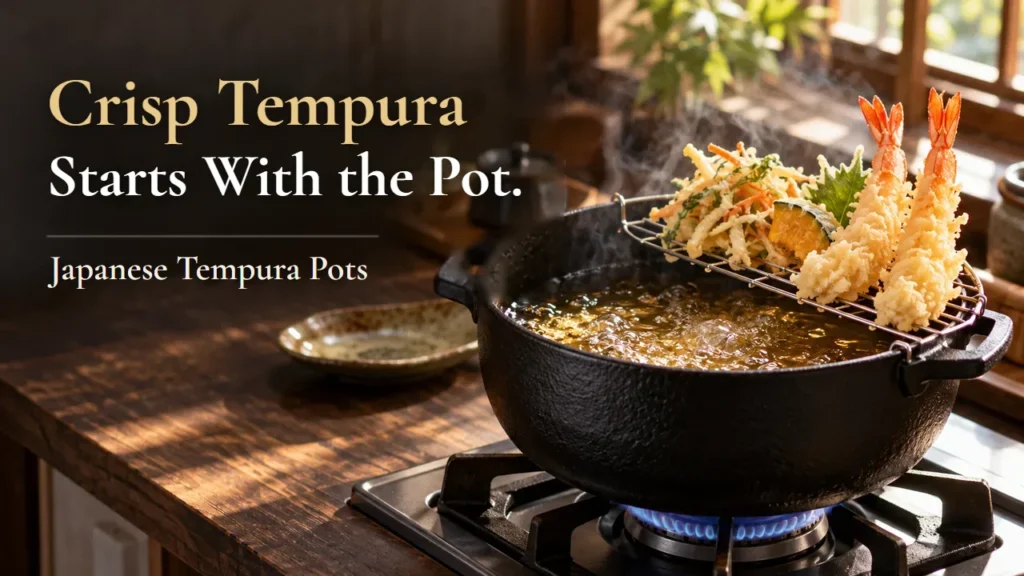
"My tempura never comes out crisp like a restaurant's — it always ends up soggy." The cause usually isn't your technique. It's that the oil temperature drops the moment the food goes in.
Cold batter and ingredients pull the oil temperature down hard. In a thin pot it struggles to recover, and the batter soaks up oil. So a tempura pot is a tool for keeping the temperature up. To that end, Japanese makers have hammered iron 5,000 times, nitrided it against rust, used copper, and sandwiched iron in stainless. This guide introduces seven Japanese tempura and deep-frying pots by material, how to choose by household size, oil volume and stove, and how to handle the oil and pot afterwards.
Quick Reference: 7 Japanese Tempura Pots at a Glance
| Pot | Material | Size / Weight | Induction | For |
|---|---|---|---|---|
| Yamada hammered fryer ▾ | Hammered iron | 24 cm, 2 L, ~900 g | ✕ (flame) | Raising an iron pot |
| Riverlight Kiwame JAPAN ▾ | Nitrided iron | 24 cm, ~2 kg | ◎ | Iron, with easy care |
| La Base iron fryer set ▾ | Iron (coated) | 22 cm, ~850 g oil | ○ (medium or lower) | Basket and screen included |
| Shinko Kinzoku copper ▾ | Copper | 24 cm, 2.4 L | ✕ (flame) | A restaurant-style pot |
| Iwachu mini tempura pot ▾ | Nambu cast iron | 16.3 cm inside, ~2.3 kg | ✕ (flame) | Small batches |
| Miyazaki The Tempura ▾ | Iron-core 3-ply stainless | 18–22 cm, 1.6–3.0 L | ◎ | Seeing the oil colour |
| Arnest Abura-Turn Square ▾ | Stainless (square) | 16 cm square, ~600 g oil | ◎ | Little oil, easy clean-up |
1. Will It Work on Your Stove?
Short answer: on induction, choose Riverlight, La Base (medium heat or lower), Miyazaki's The Tempura or Arnest's Abura-Turn. On gas, all seven work. These are pots, not appliances, so voltage doesn't matter — your heat source does.
| Your stove | Works | Doesn't |
|---|---|---|
| Induction | Riverlight; La Base (medium or lower); Miyazaki The Tempura; Arnest Abura-Turn | Yamada hammered iron; copper; Iwachu mini (no deep-frying on induction) |
| Gas | All seven | — |
Whatever pot you use, never leave hot oil unattended, and never heat the pot empty.
2. Why Japanese: A Tempura Pot Guards the Oil Temperature
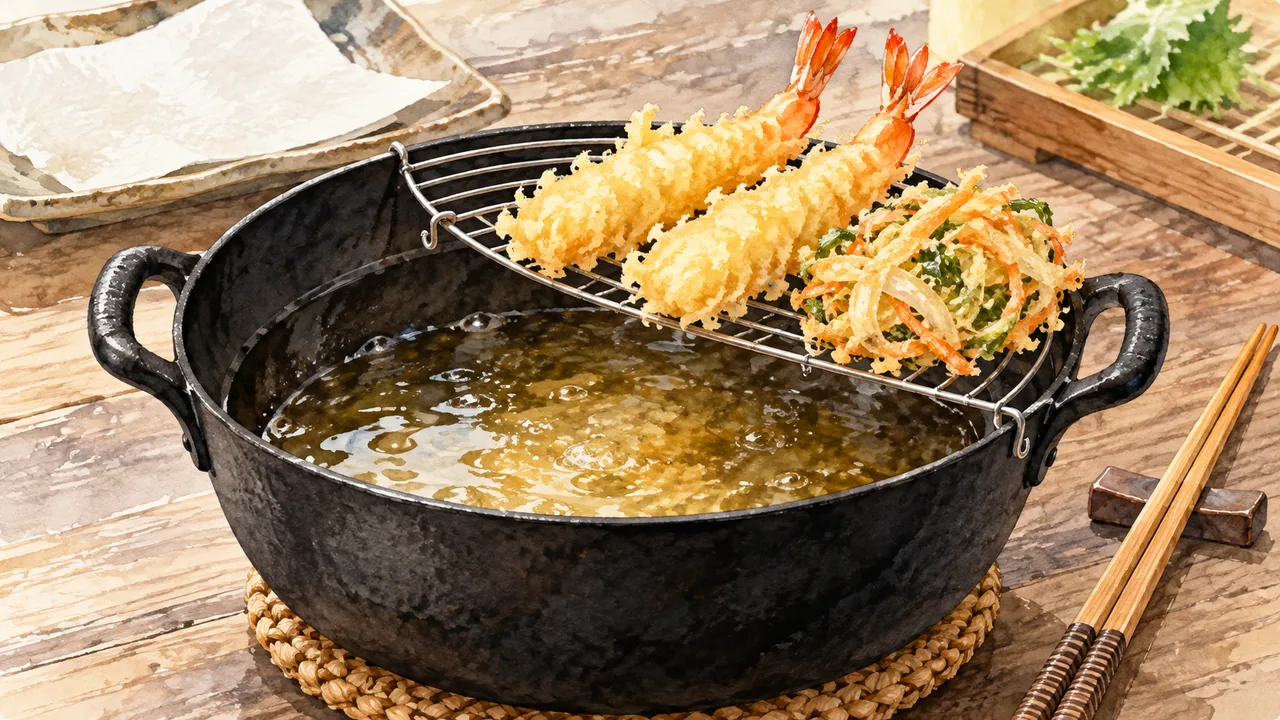
The Moment Food Goes In, the Oil Cools
Riverlight's official shop puts it plainly: "With fried food — especially tempura — temperature is everything."
Put in cold, battered ingredients and the oil temperature falls; add a lot at once and it falls further. Until it recovers, the batter absorbs oil and comes out soggy. So what you want from a tempura pot is that the temperature doesn't drop easily when food goes in. Yamada Kogyosho's fryer is described as having a 1.6 mm wall that "keeps the pot's temperature from dropping even when food goes in." A copper pot spreads heat quickly through the whole pot and keeps the temperature from falling. Different materials — all made for that one purpose.
Did you know: A tempura pot's rim turns slightly inward
Yamada's fryer is described as having "a rim that turns slightly inward to keep oil from spattering." Miyazaki's The Tempura has an oil-guard hood, and La Base comes with a spatter screen. The worst part of cleaning up after frying is the oil sprayed around the stove — so Japanese tempura pots are shaped with spatter in mind, not just temperature.
3. Iron Fryers: Hammered 5,000 Times, Nitrided, or a Full Set
A Fryer Born From 5,000 Hammer Blows
Yamada Kogyosho of Yokohama is known for uchidashi (hammered) pans. Instead of pressing a pot in one go with a die, it shapes a single sheet of iron with thousands of blows from a hammering machine — the same way it makes the woks used by chefs in Yokohama's Chinatown. A retailer's description reads "Yamada's fryer, born from 5,000 blows." Hammered and tightened, the 1.6 mm iron holds its temperature even when food goes in, and like any iron pot it becomes easier to use as oil seasons it.
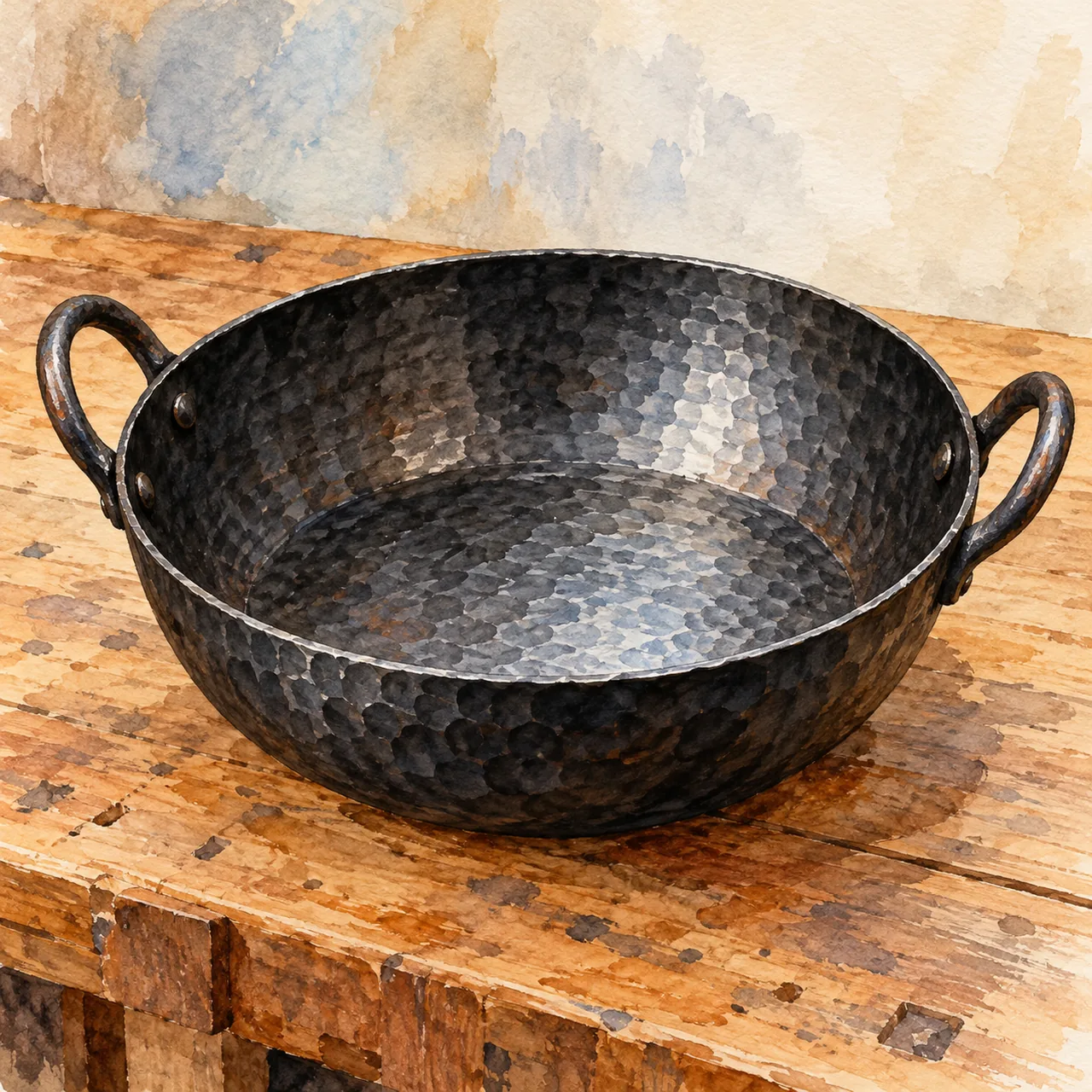
Yamada Kogyosho Hammered Iron Fryer, 24 cm
Black iron, 1.6 mm thick, 2 litres, about 900 g; the retailer calls 24 cm "a size suited to small batches for one or two." It arrives pre-seasoned, ready to use. Direct flame only — use it on gas. After washing, wipe it dry and heat it on the stove to dry completely; that's the secret to a long life.
Iron That You Just Wash and Wipe
Riverlight, of Shiroi in Chiba, has made nothing but iron cookware in its own factory since its founding in 1976; its site says each piece is "made one by one by craftsmen." Its Kiwame series is nitrided and oxidised, so it rusts less than ordinary iron and needs no burn-in before first use. After cooking, just wash and wipe.
Riverlight Kiwame JAPAN Iron Tempura Pot M, 24 cm
The heat retention of iron with easy care. 24 cm across, about 2 kg, 2.4 litres. Thick iron stores plenty of heat, so the temperature holds when you fry batch after batch for a family. Comes with a draining rack and cooking chopsticks. Works on all heat sources, including induction. A smaller 20 cm S size also exists for two people.
Riverlight Kiwame JAPAN Iron Tempura Pot M (J1324)
Loading product details…
Basket and Spatter Screen, All in One
La Base is a brand created by cookery writer Arimoto Yoko with Wahei Freiz of Tsubame-Sanjo. Its iron fryer comes as a set of three: pot, frying basket and spatter screen. Lift food into the basket to drain, lay the screen over to stop spatter — everything you need for frying from day one.
La Base Iron Tempura Pot 22 cm, 3-Piece Set
The 22 cm pot holds 2.7 litres to the brim and takes about 850 g of oil. The pot is iron; basket and screen are 18-8 stainless, and all three nest together. Gas and induction — on induction, the maker says to use medium heat or lower. Wash the screen well after every use so it doesn't clog.
La Base Iron Tempura Pot 22 cm, 3-Piece Set (LB-098)
Loading product details…
4. Copper and Nambu Iron: Spreading Heat, Storing Heat
Copper Spreads Heat Fast
The red copper pots you see at a restaurant's frying station. Copper conducts heat extremely well, so the burner's heat reaches the whole pot quickly — and when the temperature drops as food goes in, it recovers that much faster. Shinko Kinzoku's copper tempura pot has a hammered (tsuchime) finish, and its colour deepens the more you use it.
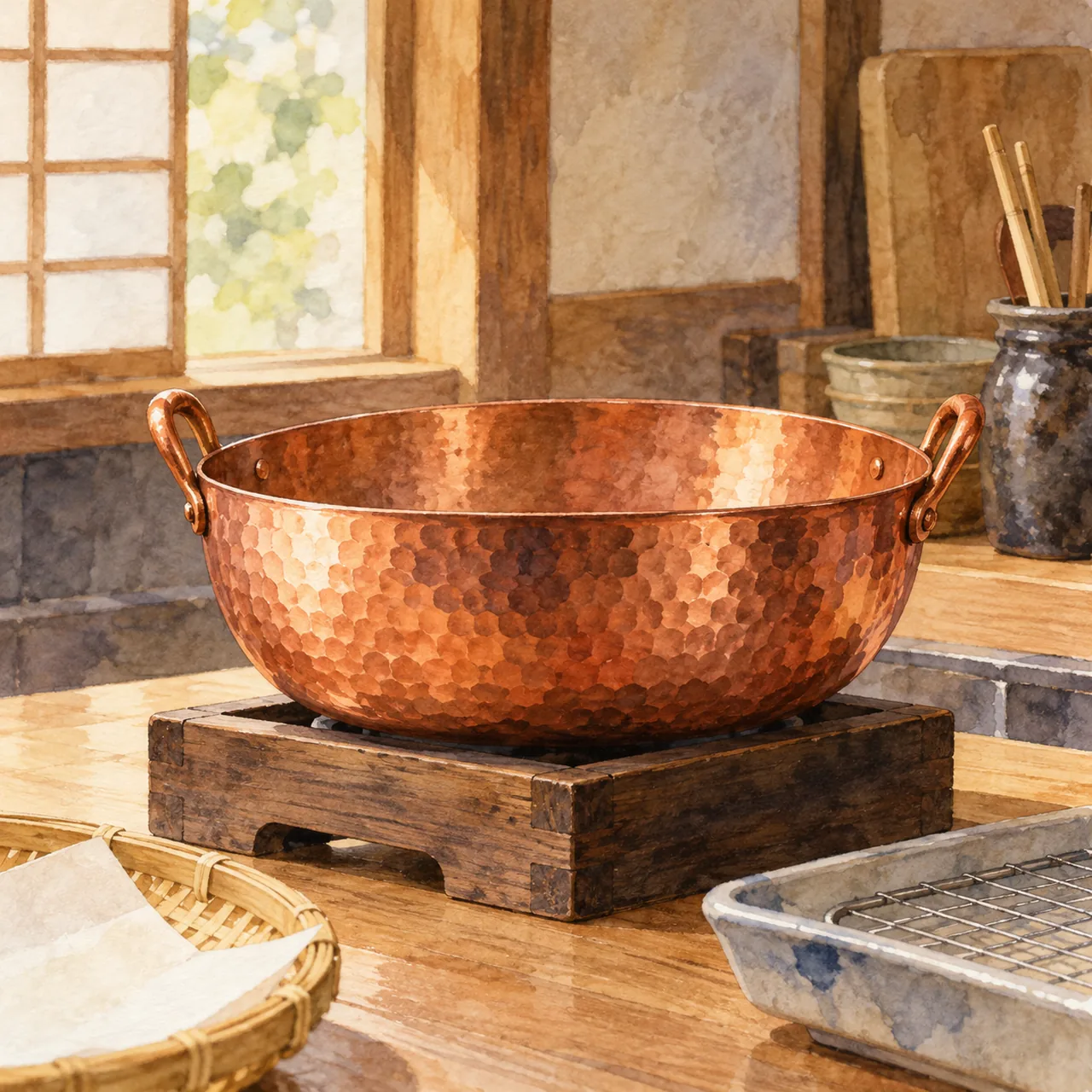
Shinko Kinzoku Copper Tempura Pot, 24 cm
A frying pot that looks good just sitting in the kitchen: 24 cm across, 7 cm deep, 2.4 litres, with a 1.5 mm base. Heat moves fast, so the temperature recovers quickly and colours stay even batch after batch. For gas flames; not for induction. Often chosen as a gift for people who love to cook.
Nambu Iron Stores Heat and Holds It
The opposite of copper: a Nambu cast-iron fryer stores plenty of heat in thick metal. Iwachu's mini tempura pot from Morioka is only 16.3 cm inside but weighs about 2.3 kg — so even a little oil stays at a steady temperature. Iwachu says it's "great for small batches, like lunchbox fried food."
Did you know: This tempura pot is also a fondue pot
The full name of Iwachu's mini tempura pot is "Fondue and Mini Tempura Pot." Cast iron that stores heat and stays warm is good for keeping cheese melted, not just for frying. Lunchbox karaage on weekdays, cheese fondue at the table on weekends — two jobs for one small pot.
Iwachu Mini Tempura & Fondue Pot, Nambu Ironware
Small batches in a little oil. Outside 22 × 17 cm; inside 16.3 × 16.3 cm and 8.7 cm deep. Black silicone-baked cast iron, listed as made in Japan on Iwachu's official site. For gas flames — the retailer notes it can't be used for frying on induction.
Iwachu Mini Tempura & Fondue Pot, Nambu Ironware
Loading product details…
5. Stainless Fryers: See the Oil, Clean Up Easily
The Tempura: Iron Sandwiched in Stainless
Objet, by Miyazaki Seisakusho of Tsubame, Niigata, has been made since 1982. Its The Tempura pot is fully iron-core three-ply: iron spreads the heat evenly and stainless holds the temperature. The bright stainless interior lets you see the oil's colour and condition at a glance. Miyazaki says the pot is "not mass-produced, but carefully made, each one passing through human hands."
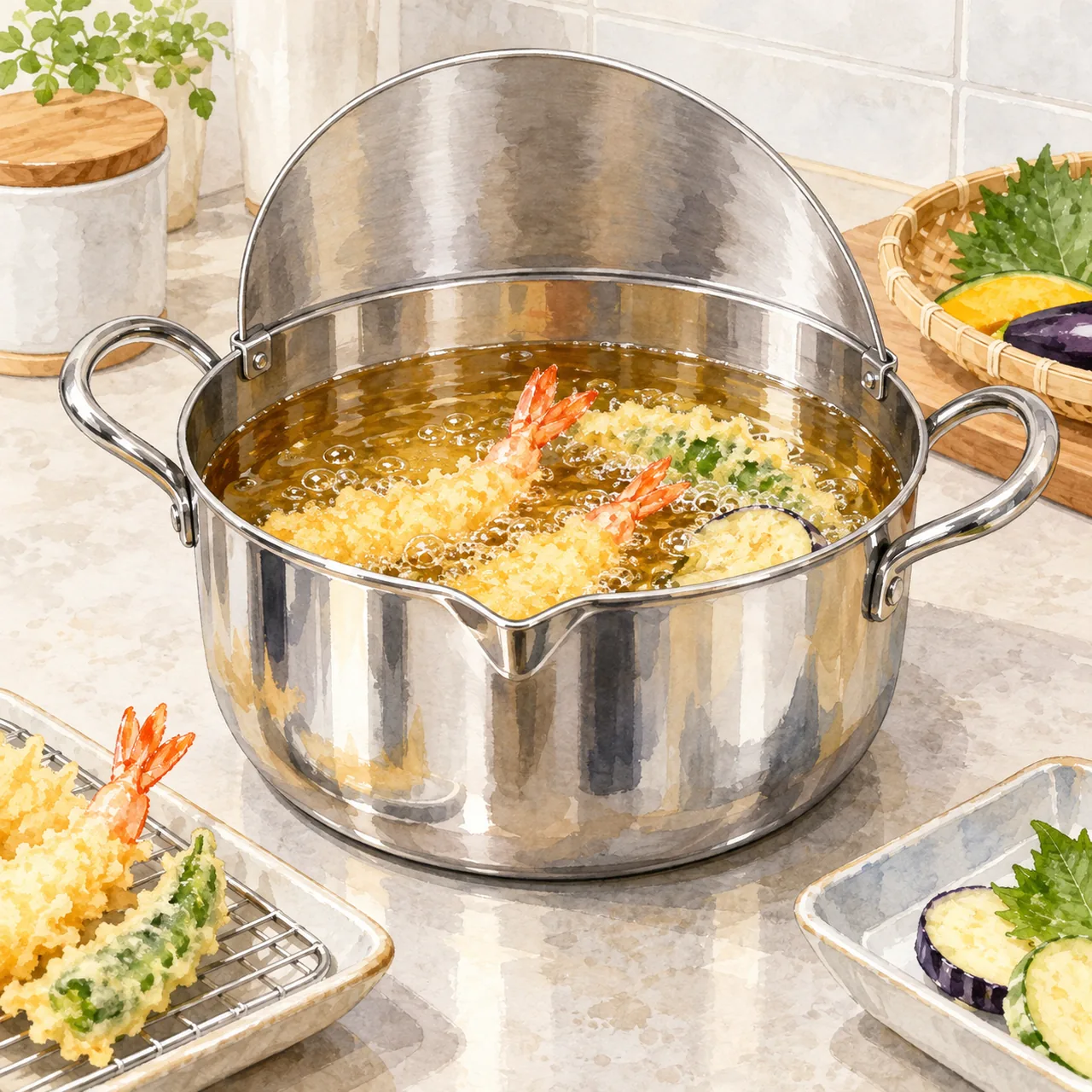
Miyazaki Seisakusho Objet The Tempura Pot, 20 cm
Stops spatter, pours easily, and no rust to worry about. It comes in 18 cm (1.6 L), 20 cm (2.2 L) and 22 cm (3.0 L), with an oil-guard hood, a lid and a pouring lip. Induction compatible. Handles and knobs are screwed on, so you can replace them at home with a screwdriver, and the maker offers re-polishing (at cost) for burns that won't come off. A fryer for the long haul.
Miyazaki Objet The Tempura Pot 20 cm (OJ-44)
Loading product details…
A Fryer That Becomes an Oil Pot
Perhaps the most tedious part of frying is dealing with the oil afterwards. Arnest's "Abura-Turn Square," made in Tsubame-Sanjo, is designed with the clean-up in mind: when you've finished, throw out the crumbs and store the oil right in it — the fryer becomes the oil pot. Being square, even this compact 16 cm pot fries four or five fried prawns, or two tonkatsu cutlets, at once.
Arnest Abura-Turn Square: Fry in 600 g of Oil, Then Store It
16 cm square inside, 7 cm deep, about 600 g of oil. Two stainless pots plus a mesh tray and a rack tray; the handles point upward, so it's compact on the stove and in the cupboard. Gas and induction, and dishwasher-safe. Just right for frying for two to four.
6. Choosing by Household Size and Oil Volume
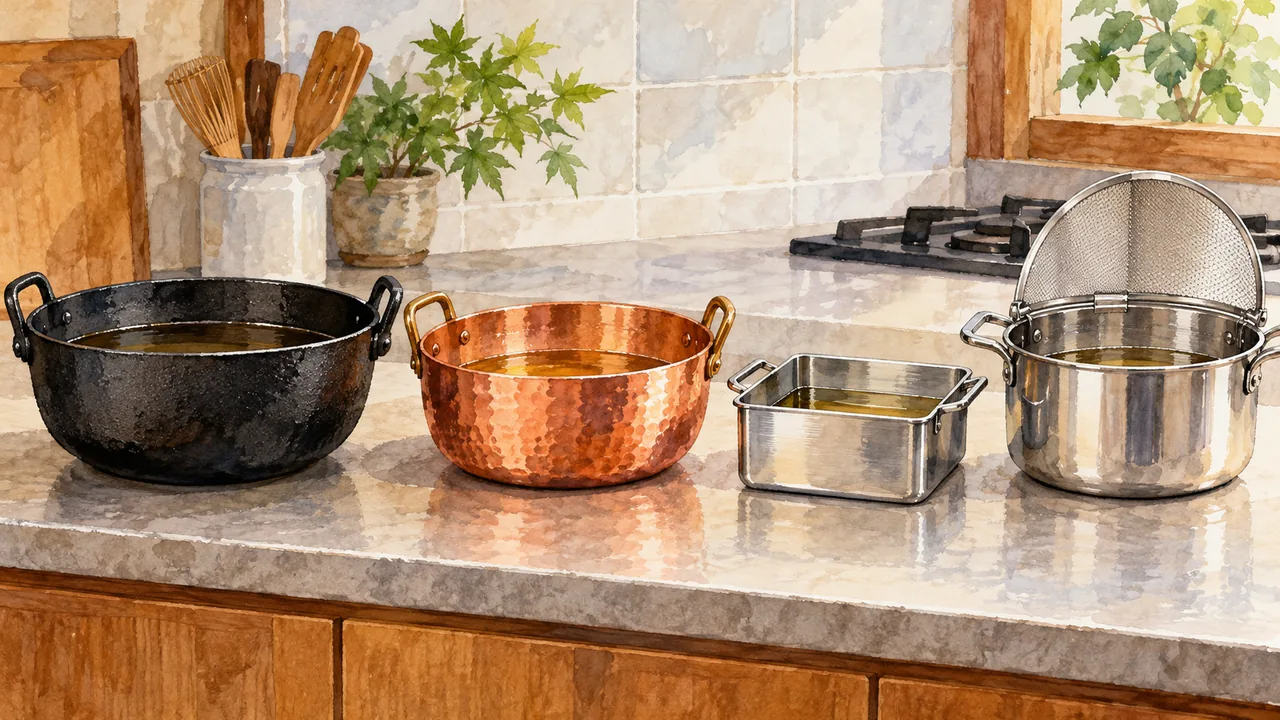
The bigger the pot, the more oil it takes and the steadier the temperature — but the more oil you use. The makers' figures: about 600 g for Arnest's Abura-Turn Square, about 850 g for La Base 22 cm.
- 1–2 people, lunchboxes: Iwachu mini tempura pot; Yamada 24 cm (described as for one or two); Riverlight tempura pot S, 20 cm
- 2–4 people: Arnest Abura-Turn Square; La Base 22 cm; Miyazaki The Tempura 20–22 cm
- Frying batch after batch for a family: Riverlight tempura pot M, 24 cm; Shinko Kinzoku copper 24 cm
And by care: to raise iron, Yamada; for iron you just wash and wipe, Riverlight; to forget about rust, stainless from Miyazaki or Arnest; for a restaurant-style pot in your kitchen, copper.
7. After Frying: The Oil, and Making the Pot Last
Strain the Oil Once It's Cool
Let used oil cool completely, then strain it into a lidded container. With a fryer that doubles as an oil pot, like Arnest's Abura-Turn, you only need to throw out the crumbs. La Base's listing also warns that using a clogged spatter screen can make the temperature inside the pot rise sharply, with a risk of fire when you remove it — wash screens and baskets well every time.
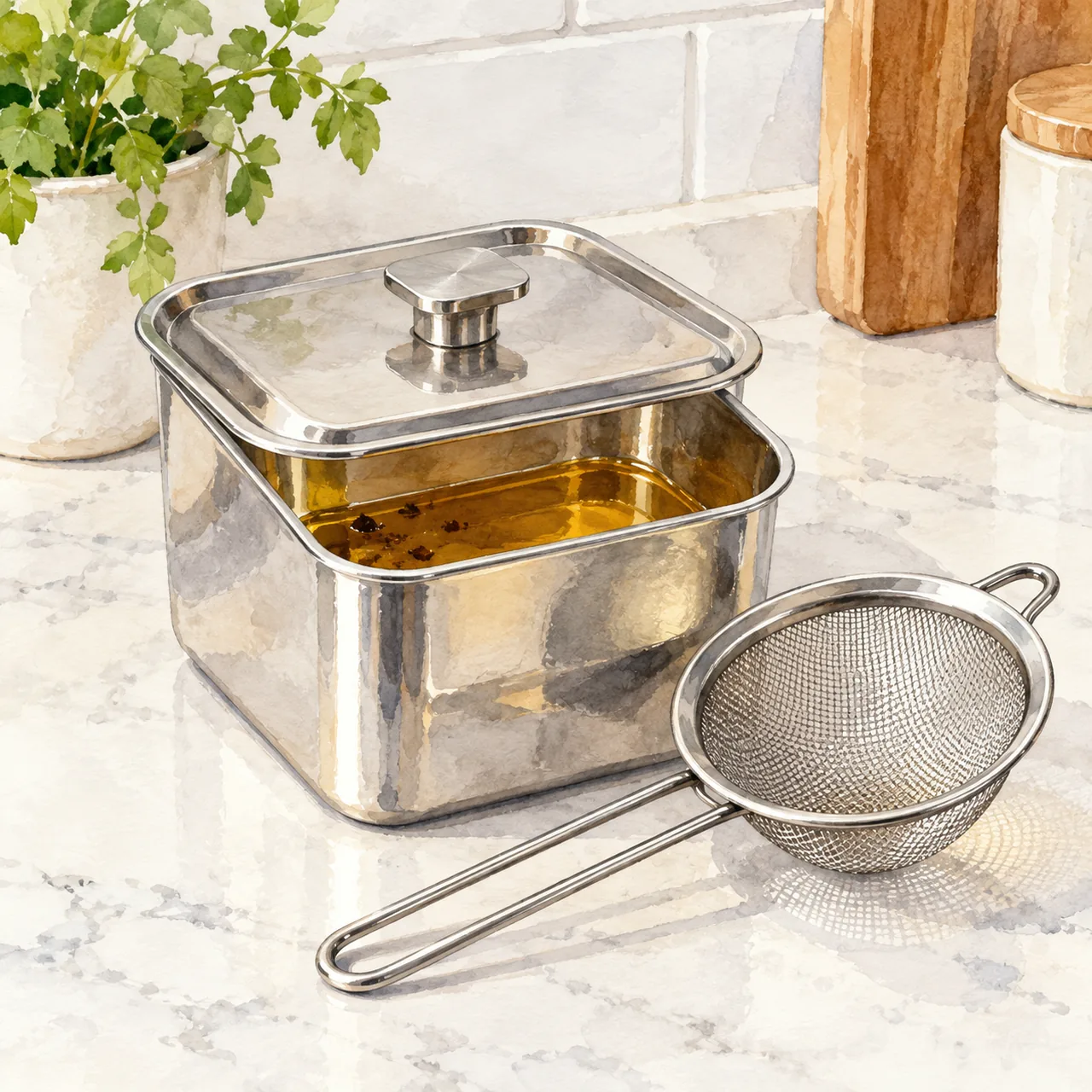
Care by Material
- Iron (Yamada): Wipe dry after washing, then heat to dry completely. It seasons the more you use it.
- Nitrided iron (Riverlight): Wash and wipe. No need to heat it dry or oil it after washing.
- Stainless (Miyazaki, Arnest): Wash with mild detergent. Arnest's Abura-Turn is dishwasher-safe.
- All: Never leave the pot while frying, and never heat it empty.
8. Frequently Asked Questions
Why does my homemade tempura come out soggy?
Because the oil temperature drops when food goes in, and is slow to recover. Adding a lot at once drops it further. Thick iron or cast iron holds temperature; copper recovers quickly. Frying a little at a time helps too.
Iron or stainless for a tempura pot?
Iron for stable temperature and the pleasure of seasoning it; stainless for easy care. Riverlight's nitrided iron just needs washing and wiping, and Miyazaki's The Tempura sandwiches iron in stainless for the best of both.
Which tempura pots work on induction?
In this guide: Riverlight, La Base (medium or lower), Miyazaki's The Tempura and Arnest's Abura-Turn. The Yamada hammered pot, the copper pot and the Iwachu mini pot are for direct flame.
Is a tempura pot worth it if I live alone?
A small fryer lets you fry with little oil. Iwachu's mini tempura pot (16.3 cm inside) suits small lunchbox batches, and Yamada's 24 cm is described as right for one or two.
What should I do with oil after frying?
Let it cool completely, strain it and store it in a lidded container. Arnest's Abura-Turn Square turns the fryer itself into an oil pot, so there's no transferring.
Won't an iron fryer rust?
Not if you don't leave it wet. Yamada advises wiping it dry after washing and heating it to dry completely. Riverlight's Kiwame is nitrided and oxidised to rust less than ordinary iron.
Final Thoughts: Freshly Fried Tempura at Your Own Table
Homemade tempura goes soggy because the oil cools when the food goes in. A tempura pot is the tool that guards that temperature.
Yamada in Yokohama hammers iron; Riverlight in Chiba makes iron rust-resistant; Miyazaki in Tsubame-Sanjo sandwiches iron in stainless. Copper spreads heat quickly; Nambu iron stores it. Different materials — all Japanese pots shaped for frying.
Induction or flame, and how many you're feeding, all but decide it. Try topping your New Year's Eve soba with freshly fried prawn tempura — with one good pot, tempura becomes a feast you make at home.
Soba-Making Tools: Knead, Roll, Cut — 6 Japanese Picks
Oden Pot: Japanese Divided Pots, Donabe and Cast Iron