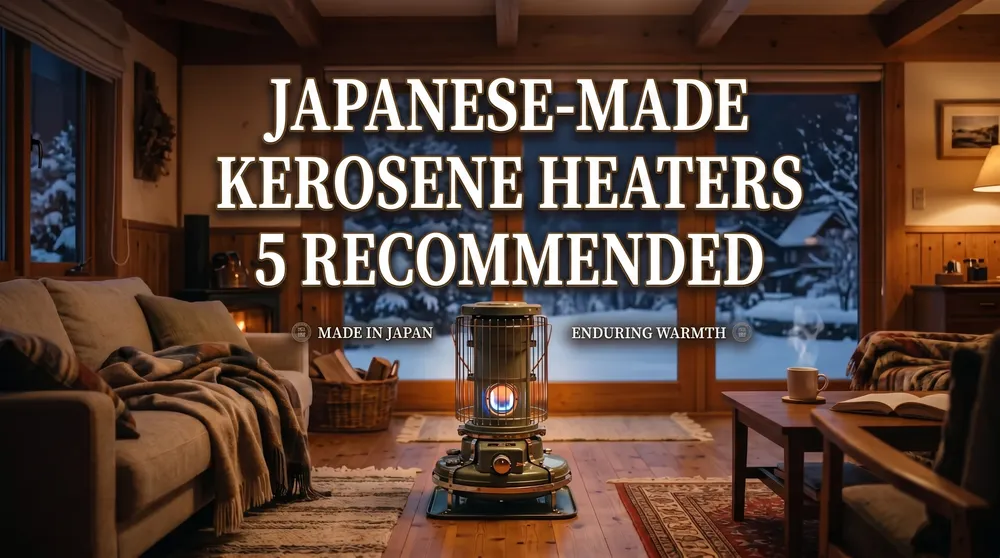
Before anything else: unvented kerosene heaters are prohibited indoors across much of the
United States. Massachusetts makes their use illegal, California bans their sale, and
most states restrict them in the home. The convection and reflector stoves Japan is famous
for are exactly the type covered.
There is a way through it — the largest Japanese maker sells direct-vent models
built for regulated markets, and they burn the same fuel.
So the order is: check the law, check whether you can buy the fuel, then choose the
stove. Doing it the other way round is how people end up with a beautiful blue flame they
are not allowed to light.
Quick Reference: Before Anything Else
| Check | Answer |
|---|---|
| Is it legal where you live? | ⚠ Often not, if unvented |
| Is there a legal version? | Yes — direct-vent models |
| Can you get the fuel? | Check first. Varies by country |
| Carbon monoxide | Real. Two detectors, always vented |
| Convection or reflector? | Whole room, or you. Both are unvented |
| The order matters: law first, fuel second, model third. Deciding which stove you want before checking the first two is how people end up with an expensive ornament. | |
⚠ Is It Legal Where You Live?
This is not a formality. The stoves this article describes are unvented — they burn kerosene in the room and put the combustion products into the room with you. That is exactly what a great many jurisdictions have legislated against.
Massachusetts prohibits their use indoors outright. State regulation is explicit
that no person shall use, allow to be used, sell or offer for sale an unvented liquid-fired space
heater, with fines attached.
California bans the sale of unvented heaters designed for use inside a dwelling.
Most US states restrict unvented kerosene heaters in the home, and cities layer
their own building codes on top — New York's code has a section specifically for portable
kerosene heaters.
Rules elsewhere vary and you have to look them up. Rented accommodation adds another layer: many tenancy agreements and building insurance policies forbid open-flame heating regardless of what the state permits.
The version that is legal almost everywhere
Toyotomi — Japan's largest maker of these, in business since 1948 — sells direct-vent
heaters for regulated markets. They burn the same fuel, but the combustion chamber is
sealed and both the intake and exhaust go through the wall to outside.
Nothing from the flame enters the room, which takes them outside the unvented
restrictions entirely. They also sell in Europe, where the company has been established
for decades.
This is worth knowing before you start improvising: the manufacturer has already
solved the problem, and the solution is a different product rather than a workaround applied to
the wrong one.
And check the fuel before anything
In the United States, K-1 kerosene is sold at hardware stores and filling stations. In the UK it is paraffin and much less commonly stocked; across Europe availability varies by country. In some places you would be buying an appliance you cannot feed.
Find out what a litre costs and where you would buy it before you buy the stove. It is the same trap as a camping stove that takes a gas canister nobody in your country sells.
Carbon Monoxide: Three Rules That Are Not Optional
An unvented kerosene stove consumes oxygen from the room and returns carbon monoxide, nitrogen oxides and a surprising amount of water vapour. Used correctly in a ventilated space it is a normal domestic appliance in Japan. Used in a sealed room or a tent it kills people every winter.
1. Two carbon monoxide detectors, not one
Two, because a single detector that has failed looks exactly like a single detector
reporting clean air. There is no way to tell from looking at it.
Place them at different heights and away from the stove itself. Test them before
the season, not after.
2. Ventilation stays open the whole time
Not opened periodically — open continuously. In a room, a window ajar. In a tent,
the vents at both top and bottom, permanently.
The heat loss is the cost of using it at all, and a stove burning in a sealed
space is the specific situation that produces fatalities.
3. It goes out before you sleep
Every time, without exception. Carbon monoxide is odourless and its early
effects — headache, drowsiness, confusion — are indistinguishable from being tired and warm.
A sleeping person does not notice any of it. Heat the space, put the stove out,
then get into a sleeping bag rated for the temperature.
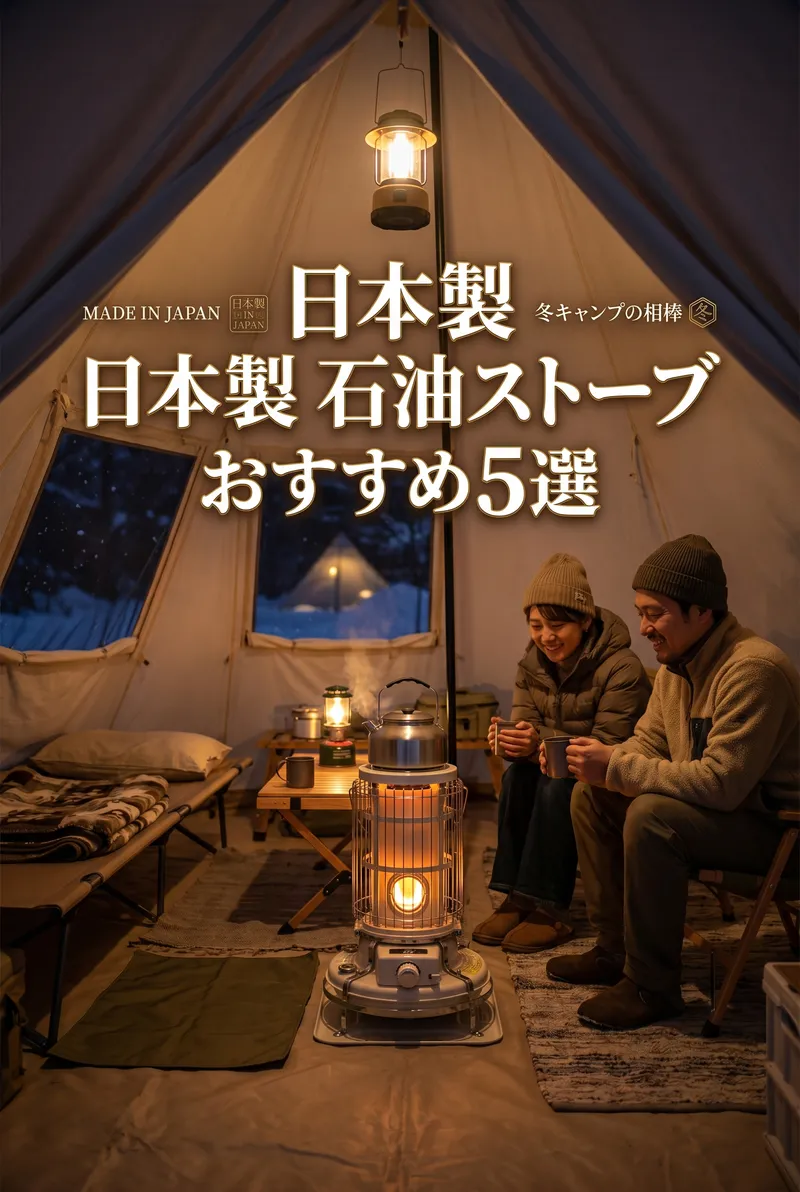
Japanese outdoor media does show these stoves inside tents, and that is where the risk is highest. A tent is small, its fabric is close to the flame, and the temptation to seal it against the cold is exactly what you must not do. If you are not going to follow all three rules, use a better sleeping bag instead.
Why Japanese — An American Design England Stopped Making
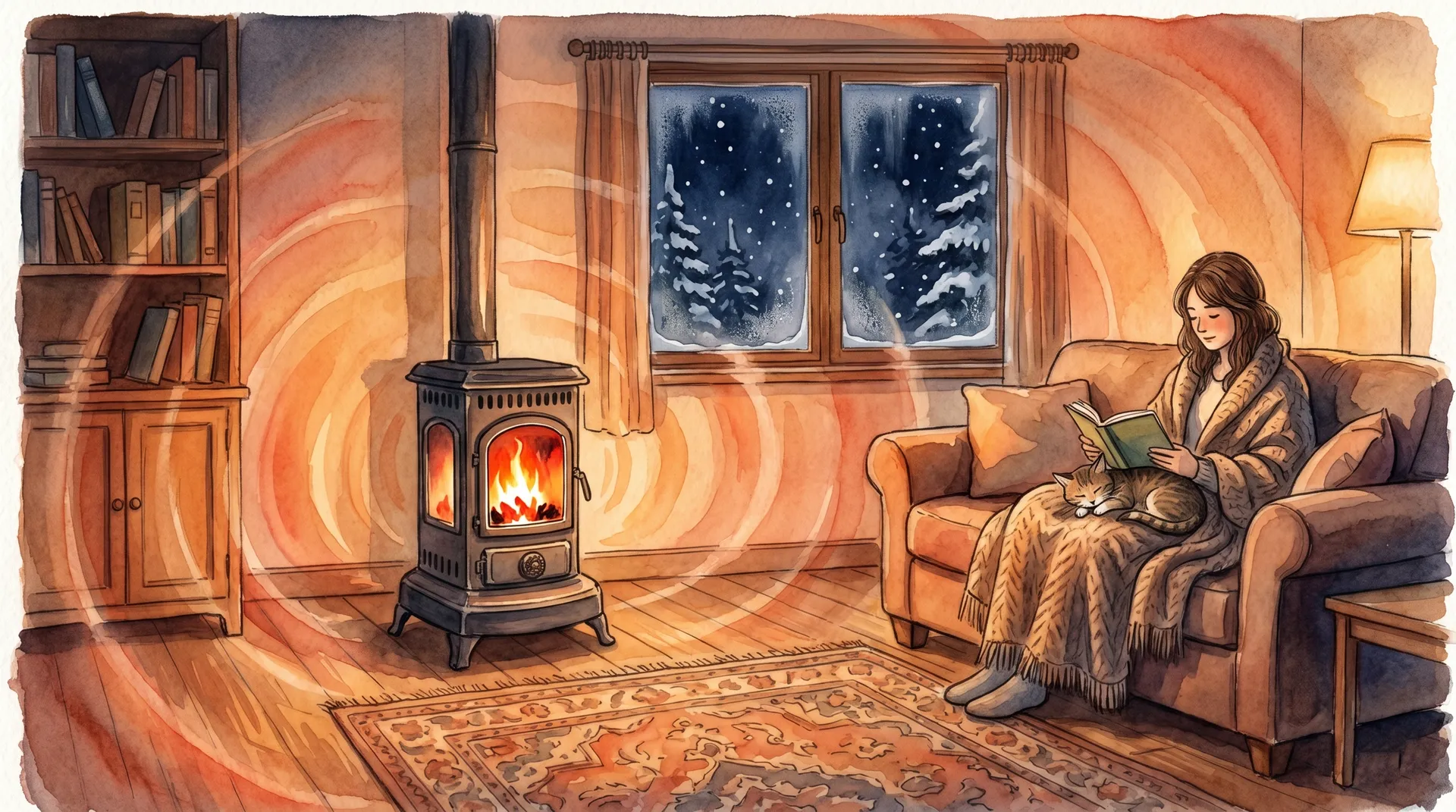
The most recognisable Japanese kerosene stove is not Japanese in origin. Aladdin began in Minneapolis in 1908, and in the early 1930s a joint venture with an English businessman put the first Blue Flame heaters into production in Britain.
Yanase began importing them to Japan in 1957, and after a favourable review in the influential consumer magazine Kurashi no Techō around 1961 they became a fixture in Japanese homes.
Then production moved to Japan, and it has stayed there since the 1960s.
Britain stopped making them. America stopped making them. Japan did not —
the same cylindrical body and the same blue flame ring, in continuous production for sixty
years.
British readers over a certain age may remember the original, and the
disorienting thing is that the only place still building it is a country that imported it in the
first place.
Why the design survived
Japanese homes were, and largely remain, poorly insulated and heated room by room rather than centrally. A portable stove that heats one space, needs no installation and needs no electricity fits that pattern exactly.
Then there is the other reason. Japan has earthquakes, and earthquakes take out the power. A heater that works during a blackout is not a nostalgic object there — it is standard disaster preparation, kept in the cupboard alongside the water.
Convection or Reflector
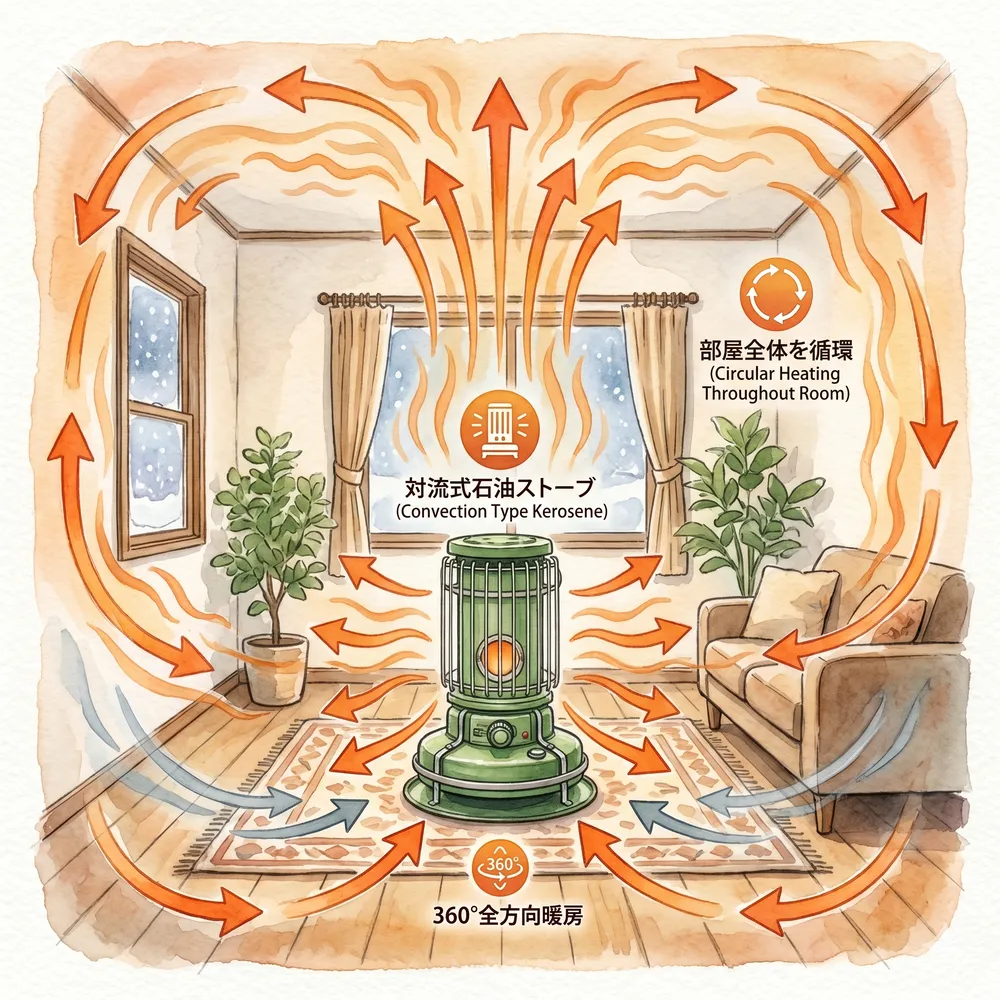
Convection — cylindrical, heats the whole room
A round body with the flame in the middle, throwing heat in every direction and driving air circulation upward. It has to stand in the middle of a space to work properly, which is a real constraint.
This is the shape people want — the visible flame, the kettle on top, the object as much as the heat. It also takes longest to warm a room, because it is heating the air rather than pointing at you.
Reflector — flat-backed, heats you
A curved reflector behind the flame throws heat forward in one direction. It sits against a wall, takes far less floor space, and warms you almost immediately.
You feel it faster and the room stays colder. For a desk, a workshop or a single-person space, that is usually the better trade.
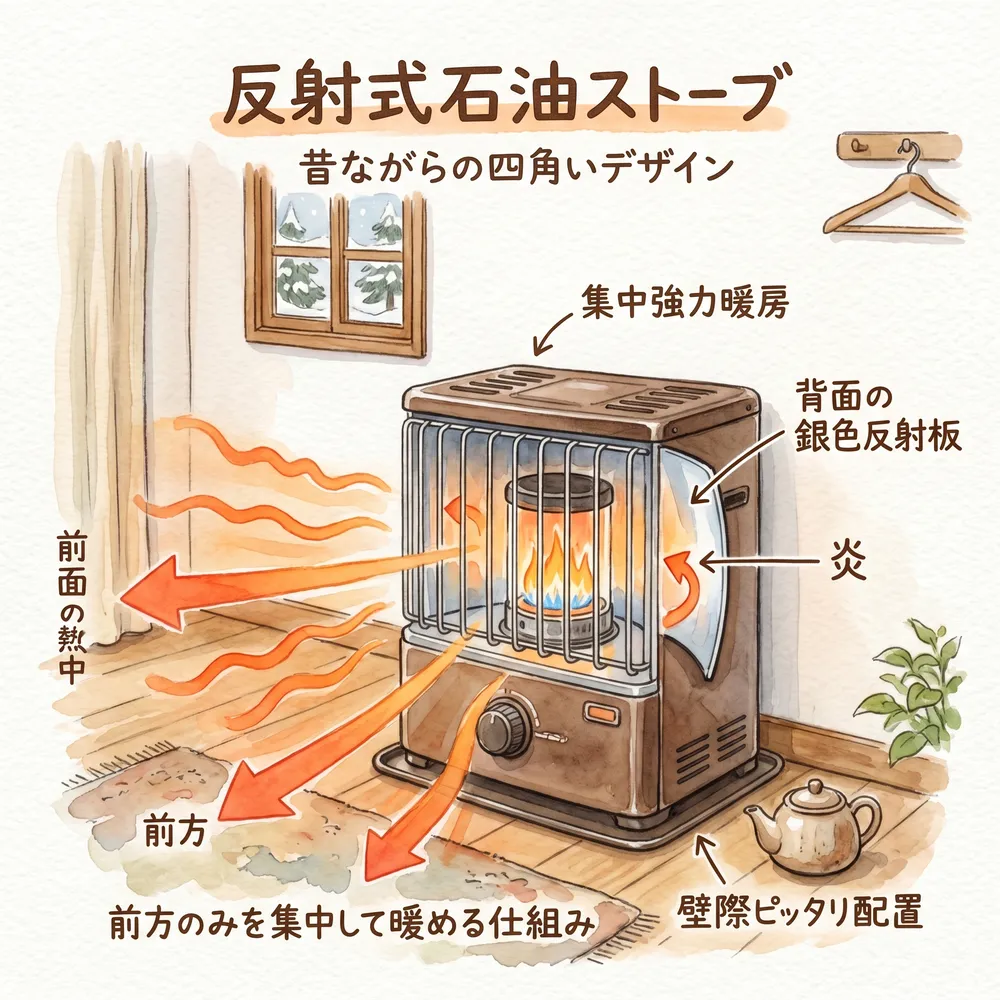
Both are unvented, and both fall under the restrictions above. The choice
between them only arises once you have established that you may use one at all.
A direct-vent unit is neither shape — it is a wall-mounted or floor-standing
sealed appliance, less charming and legal in more places.
What to Buy
A direct-vent Toyotomi — the one you can actually install
Sealed combustion, vented through an outside wall, running on kerosene or
heating oil. Because nothing from the flame enters the room, the unvented
restrictions do not apply — and neither, in normal operation, does the carbon
monoxide question.
Toyotomi has sold in North America and Europe for years and has been in
business since 1948, so parts and service exist rather than being a hopeful assumption.
- Type
- Direct-vent, sealed combustion
- Fuel
- Kerosene, and on some models diesel or heating oil
- Electricity
- Needed for the controls on most vented models
- Legality
- Not subject to unvented bans
Perfect for: Anywhere unvented heaters are restricted, and for a room you heat every day.
The famous unvented ones, and why we are not linking them
The Aladdin Blue Flame and Toyotomi's Rainbow are the stoves people actually want — the visible flame, the round body, the light they throw on a ceiling. Corona's range is what most Japanese households actually own.
We could not find authorised English-language retail for any of them. What
exists is Japanese-domestic stock on auction sites, plus vintage British Aladdins being sold for
restoration.
Sending you to buy an unvented heater that is illegal to use in your state, from a
grey-market seller, with no warranty, would be irresponsible. They are described here so
you know what exists — and if you live in Japan, every home centre has them from autumn onwards.
Wick Care and Summer Storage
- When the flame weakens, burn the wick dry. Let the stove run until the tank is empty and the wick burns off the carbon deposits itself. This is routine maintenance, not a repair, and it restores most of the lost output.
- Do it outdoors or with the room wide open. A wick burning off produces considerably more smell and more combustion products than normal running.
- Empty the tank completely before summer. Kerosene degrades over months, and old fuel is the single most common cause of a stove that will not light in November.
- Never burn last year's kerosene. Take it to a proper disposal point rather than trying to use it up — degraded fuel damages the wick and burns dirty.
- Store it dry, covered, off a concrete floor. Condensation into an empty tank causes rust that you will not see until it matters.
- Replace the wick on the maker's schedule. It is a consumable, it is cheap, and a tired wick is what makes a stove smell.
Kept this way these stoves last for decades — the reason there is a market in restoring sixty-year-old ones is that there is very little in them to fail.
Frequently Asked Questions
Does it need electricity?
An unvented wick stove does not — the igniter runs on a couple of dry cells, and
you can light it with a match if those die. It works through a power cut, which
is why Japanese households keep them for earthquakes.
Direct-vent models usually do need power for the fan and controls, which is the
trade for being legal.
Can I legally use one in the US?
It depends on your state and often your city, and for unvented models the answer is
frequently no. Massachusetts bans indoor use; California bans the sale of unvented
indoor heaters; most states restrict them in dwellings.
Check your state rules and your lease before buying — a direct-vent model avoids
the question entirely.
Is it safe to use one in a tent?
Only with continuous ventilation, two working CO detectors, and the stove out before
anyone sleeps. Those are not precautions to weigh up; they are the conditions under
which it is done at all.
Carbon monoxide has no smell and its early symptoms feel like being warm and sleepy.
If that sounds like too much to manage, a warmer sleeping bag is the right answer.
Will it smell of kerosene?
Briefly at lighting and at extinguishing, and barely at all in between if the
wick is in good condition and the fuel is fresh.
Persistent smell means one of three things — a worn wick, old fuel, or a stove
that needs its wick burning off.
Can I put a kettle on top?
On a convection stove, yes — it is designed for it, and a kettle sitting there
also adds humidity to air the stove is drying out.
Not on a reflector model, where the top is not a cooking surface and the heat
goes forwards rather than up.
How long will one last?
Decades, with wicks as the only routine consumable. There is no compressor, no
circuit board and no software.
Sixty-year-old examples are still running, which is the argument for buying one
at all — provided you can legally use it.
Final Thoughts: The Law Is the Hard Part
This is one of the few Japanese products where nothing about the object is the obstacle. It is simple, it lasts decades, it works in a blackout — and then it runs into fire regulation, which is harder to work around than any technical limitation.
Check the law, check the fuel, then choose the stove. In that order. And if unvented is off the table where you live, the direct-vent version is not a consolation prize — it is the same company solving the same problem for a stricter market.
The blue flame ring was designed in America and built in England, and only Japan still makes it. Which is reason enough to want one, and no reason at all to skip the detectors.
Iwatani Cassette Stoves: Fuel Is the Real Question
NANGA Sleeping Bags: Lifetime Repair, and Real Limits