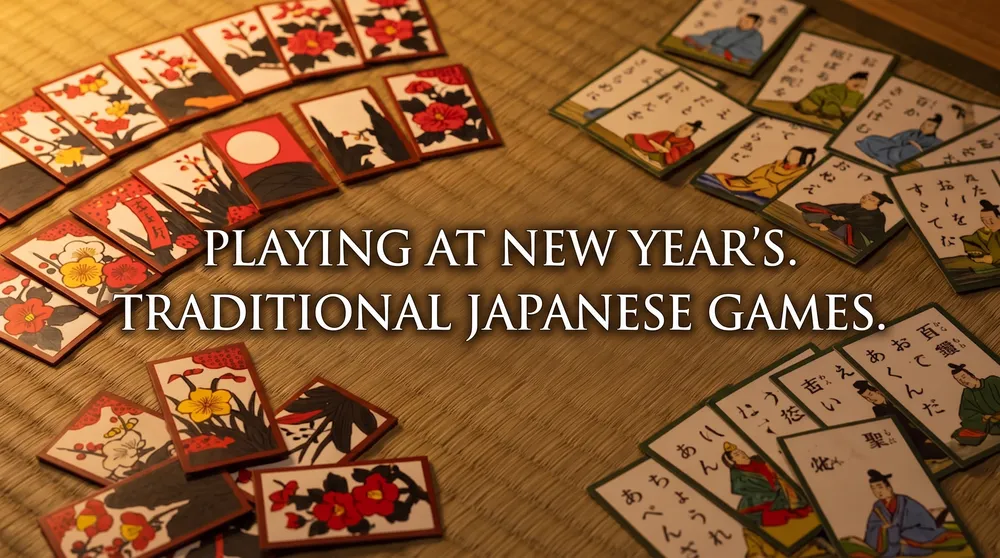
Nintendo was founded in 1889 to make these cards, and it still makes them.
Not as a heritage gesture — hanafuda is a live product line, and their top deck has
been in continuous production for over a century. Their flagship is called
Daitoryo, "President," and the box has a portrait of Napoleon on it, which
tells you something about how seriously 1890s branding took itself.
There are three different card games here and English tends to blur them. This guide
separates hanafuda, karuta and Hyakunin Isshu, explains why the cards are so thick, and points at the
decks you can actually buy.
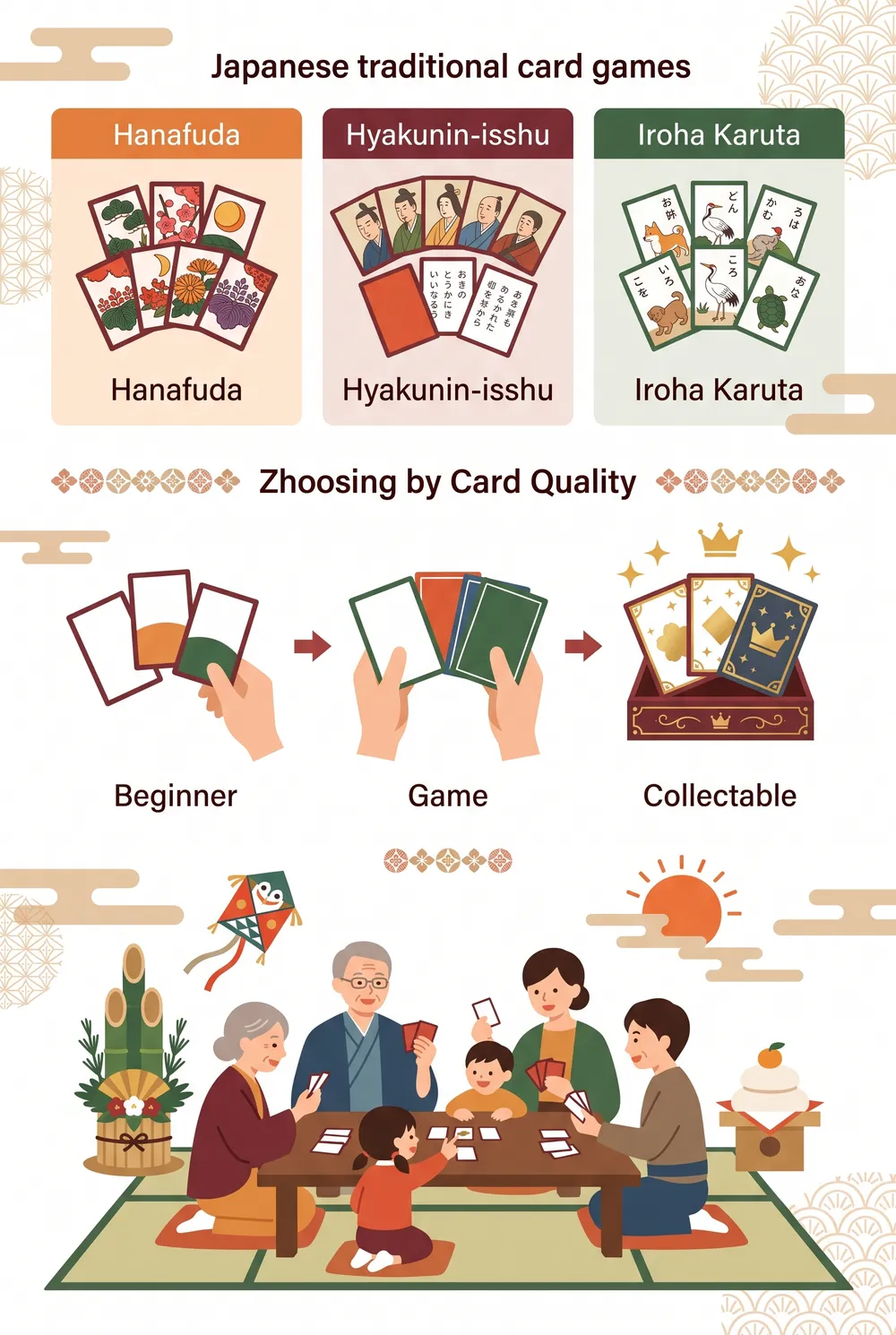
Quick Reference: Three Different Games
| Game | Cards | What you do |
|---|---|---|
| Hanafuda | 48 flower cards, 12 months | Match and build scoring sets. A real card game |
| Iroha karuta | Proverb cards, picture + text | Someone reads; you grab the match |
| Hyakunin Isshu | 100 classical poems | Same, but memorised. Played competitively |
| "Karuta" is the umbrella term — from Portuguese carta — and hanafuda sits under it as hana-karuta, "flower cards." | ||
Nintendo Made These First
In 1889, Yamauchi Fusajiro founded a company in Kyoto called Nintendo Koppai to make handmade hanafuda cards. Everything else — the arcade games, the Famicom, the Switch — came afterwards, and much later.
What is genuinely surprising is that they never stopped. Nintendo remains one of Japan's principal hanafuda manufacturers, and three of their card brands are still in production today.
The Napoleon problem
Nintendo's premium hanafuda deck is called Daitoryo — "President." The
box carries a portrait of a military figure in profile.
It is Napoleon. Who was an emperor. This has been the packaging for well over a
century and nobody has fixed it, which is a small and perfect illustration of how Meiji-era
Japanese branding treated Western imagery: as a general signal of authority rather than a specific
claim.
And Nintendo sells hanafuda through its own official store abroad, including Mario-illustrated decks. That makes this one of the very few traditional Japanese products with a first-party English purchase route — you can buy it from the same shop that sells you a Switch game.
Three Games, One Word
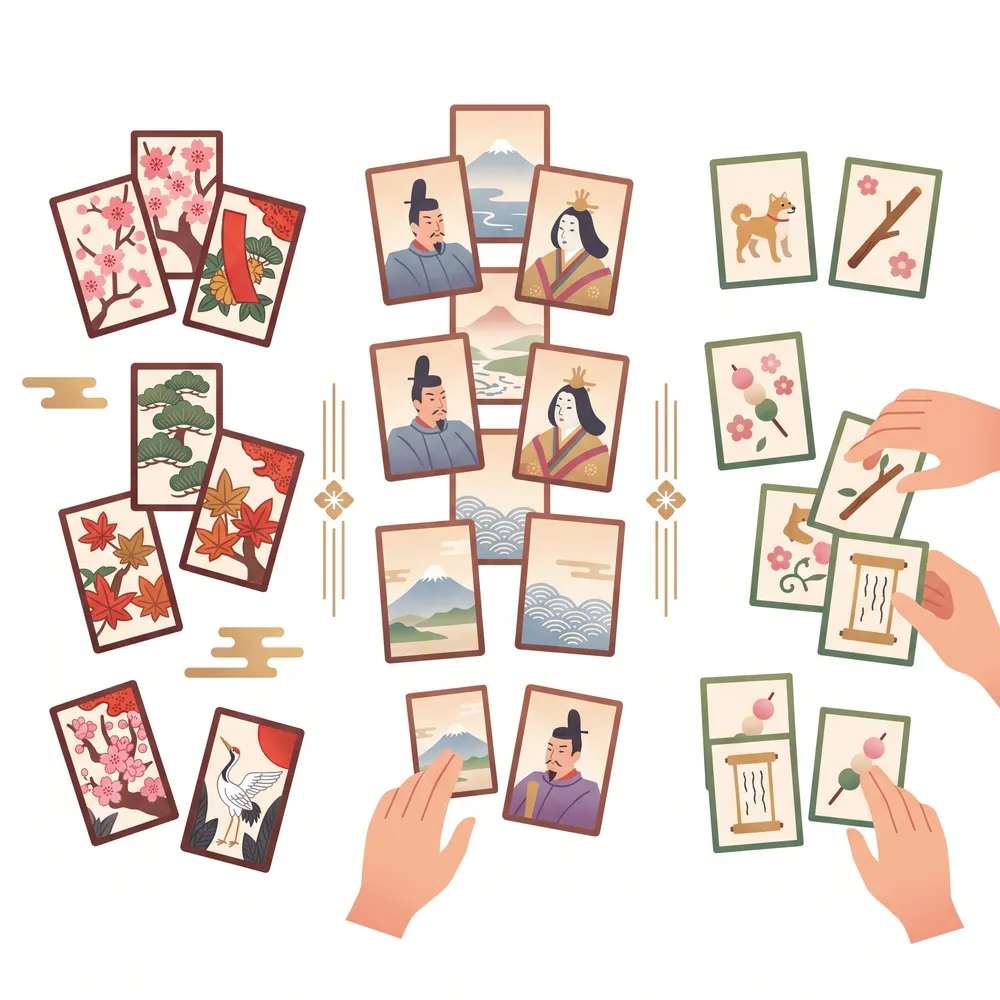
Karuta comes from the Portuguese carta, arriving with sixteenth- century traders, and in Japanese it is the general word for playing cards. So the naming works out like this: hanafuda is formally hana-karuta, "flower cards" — a kind of karuta — even though English treats the two as separate things.
Hanafuda — the actual card game
Forty-eight cards, four for each of twelve months, each month with its own plant: pine for January, plum for February, cherry for March, and so on. No numbers, no suits as a Western player would recognise them — the month is the suit and the artwork is the rank.
You match cards by month and build scoring combinations. It plays like a trick-and-set game rather than a memory exercise, and it is the only one of the three that is a game in the ordinary sense.
Iroha karuta — reading and grabbing
Two matching decks: one of picture cards, one of text cards. A reader reads a proverb aloud; the players race to snatch the picture card that goes with it.
This is a children's game and a family game, and it is genuinely useful for anyone learning Japanese — the proverbs are short, the vocabulary is fixed, and the competitive pressure does more for recall than flashcards do.
Hyakunin Isshu — the same, at speed, from memory
One hundred classical poems, compiled in the thirteenth century. The reader recites the first half; the players find the card carrying the second half.
Played competitively — kyogi karuta — this becomes a serious sport. Players memorise all hundred poems and the layout of the cards, and win by recognising a poem from its first syllable or two before the reader finishes the phrase. There are school leagues and national championships.
If competitive karuta sounds familiar, it is probably from Chihayafuru,
the manga and anime that made the sport known well outside Japan.
The cards in it are real, and there is exactly one officially authorised
manufacturer — see the buying section.
Why Japanese — Why the Cards Are So Thick
Pick up a hanafuda card and the first thing you notice is that it is wrong. Too
small, far too thick, and stiff — closer to a tile than a card.
Good ones are built up from layers of paper laminated together, then finished so
the faces are smooth and the edges are square. They do not bend. You cannot shuffle them
the way you shuffle a Western deck, and you are not meant to.
The thickness is functional. In hanafuda you play cards onto a table and snap them down; the weight makes that satisfying and audible, and it stops cards sliding under one another. In karuta you swipe a card off the floor at speed — a thin card would crumple, and a stiff one skims.
This is where the difference between a good deck and a souvenir deck lives. A cheap printed set on thin card looks identical in a photograph and feels like nothing in the hand. The weight and the snap are the product.
Competitive karuta decks are a specification, not a style. Because players train on card dimensions and how the cards behave when struck, the officially sanctioned cards have to be consistent — which is why one manufacturer supplies them all.
How to Actually Play
Hanafuda: start with Koi-Koi
Hanafuda supports many games; learn Koi-Koi and ignore the rest for now. It is a two-player game and the rules fit on a card.
- Eight cards to each player, eight face up on the table.
- On your turn, match a card from your hand to a table card of the same month and take both. No match, and you discard face up.
- Captured cards form scoring sets — combinations of the special cards, the ribbons, the animals, and plain cards by quantity.
- When you complete a set you either stop and score, or say koi-koi — "come on" — and keep playing for more. If your opponent completes a set first, you get nothing.
That last decision is the whole game. Koi-Koi is a press-your-luck game wearing a matching game's clothes, and it is why the deck has survived four hundred years.
Karuta: the rules are trivial, the skill is not
- Spread the picture or second-half cards face up between the players.
- A reader reads. Players race to touch or sweep the matching card. Most cards wins.
- Touching the wrong card costs you — in competitive play, a penalty card.
With iroha karuta a beginner can play immediately. With Hyakunin Isshu you need to know the poems, which is the barrier and also the point — the game is a memorisation contest disguised as a physical one.
A practical note for learners of Japanese: iroha karuta is one of the better language tools that exists, because you cannot hesitate. Recognition has to be instant, which is a different skill from translation and much harder to practise alone.
What to Buy
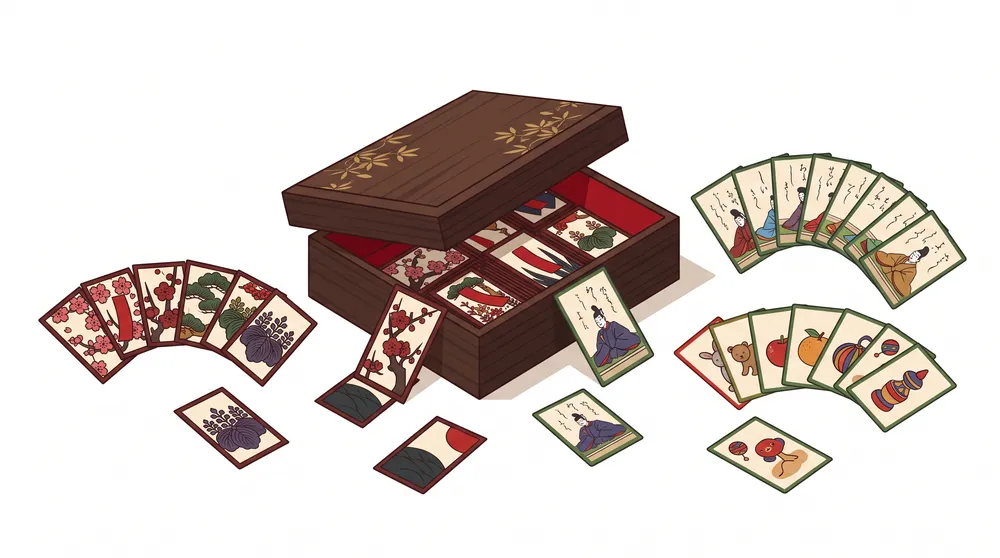
Nintendo hanafuda — including from Nintendo's own store
The historically correct choice, and still one of the best made.
Daitoryo is their premium deck — properly thick cards, the Napoleon box — and it is
what a Japanese household is likely to own.
Nintendo also sells Mario-illustrated hanafuda through its official store outside
Japan, which is unusually convenient: real Nintendo hanafuda, first-party, in English,
without a forwarding service.
- Maker
- Nintendo — making these since 1889
- Premium deck
- Daitoryo — thick cards, century-old packaging
- Also
- Mario decks on Nintendo's own store
- Cards
- 48, twelve months of four
- Price range
- $15–$40
Perfect for: Anyone who wants to play, and anyone who finds the company's origin story irresistible.
Oishi Tengudo — the officially authorised karuta
A Kyoto maker of karuta and hanafuda, and the manufacturer authorised by the All Japan
Karuta Association for competitive play. The standard Ogura Hyakunin Isshu decks used
in official kyogi karuta come from here.
They maintain an English site, which is rare in this corner of Japanese
manufacturing. If you want the cards used in the sport rather than a decorative set, this is
the answer and there is not really a second one.
- Based
- Kyoto
- Status
- Authorised by the All Japan Karuta Association
- Makes
- Hyakunin Isshu, iroha karuta, hanafuda
- English
- Yes — English site
- Price range
- $40–$150+
Perfect for: Competitive play, serious study of the poems, and anyone who watched Chihayafuru and wanted the real thing.
Iroha karuta — the one to buy if you are learning Japanese
Proverb karuta is playable on day one, unlike Hyakunin Isshu, and it is a
surprisingly effective language tool because the game gives you no time to
translate.
Sets aimed at children have furigana over the kanji and simple, high-frequency
vocabulary. Look for a set with both hiragana and the picture cards — some
decorative sets omit one deck, which makes the game impossible.
- Contents
- Two matching decks: pictures and text
- Level
- Playable immediately; children's sets have furigana
- Check
- That both decks are included
- Price range
- $15–$40
Perfect for: Families, classrooms, and anybody practising instant recognition rather than reading speed.
Keeping Them, and Giving Them
- Store them in the box, standing or flat, somewhere dry. Laminated paper cards absorb humidity and the layers can separate at the edges if they get damp repeatedly.
- Do not shuffle them like Western cards. Riffling stresses the lamination. Mix them face down on the table instead — which is how it is done.
- Keep them out of direct sun. Hanafuda relies on strong flat colour, and the reds go first.
- They last decades. A good deck outlives the children who learned on it, which is most of the argument for buying a proper one.
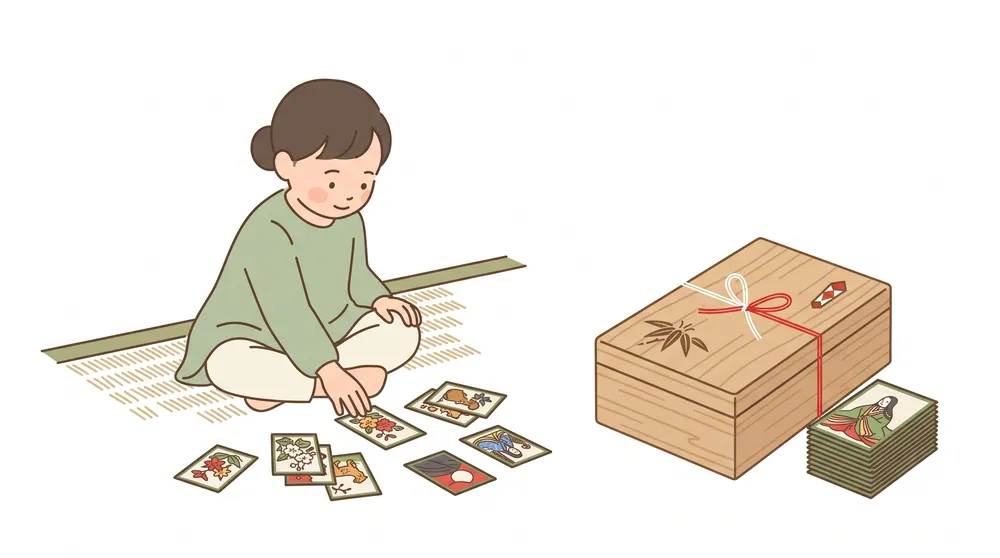
As a gift they work unusually well: small, light, cheap to post, visually striking, and almost nobody outside Japan owns any. A hanafuda deck also comes with a story that lands in one sentence — which is more than most souvenirs manage.
Frequently Asked Questions
Did Nintendo really start as a card company?
Yes — founded in 1889 in Kyoto to make handmade hanafuda, decades before any
electronics. And they never stopped: Nintendo is still a major hanafuda
manufacturer, with three card brands in production.
Their premium deck is called Daitoryo, "President," and the box has Napoleon on
it.
What is the difference between karuta and hanafuda?
Karuta is the umbrella word for playing cards — it comes from the
Portuguese carta — and hanafuda technically sits under it as hana-karuta, "flower
cards."
In practice: hanafuda is a matching-and-scoring card game for two; karuta games
involve a reader and players racing to grab the right card.
Is hanafuda difficult to learn?
No. Learn Koi-Koi and you can play in ten minutes. Match cards by month, collect
scoring combinations, then choose whether to stop and bank your points or press on for more.
That single decision is the entire game, which is why it has lasted — the rules
are simple and the choices are not.
Is Hyakunin Isshu the same as competitive karuta?
The cards are the same; the game is not. Hyakunin Isshu is the hundred-poem deck
that families play with casually. Kyogi karuta is the competitive sport
played with it, where players memorise all hundred poems and react to the first syllable.
Official competitive cards come from a single authorised manufacturer, because
dimensions and card behaviour have to be consistent.
Doesn't hanafuda have a gambling association?
It does, in the same way a deck of playing cards does in the West. Hanafuda and
related decks have been used for betting games, and that history left a faint disreputable edge on
them in Japan.
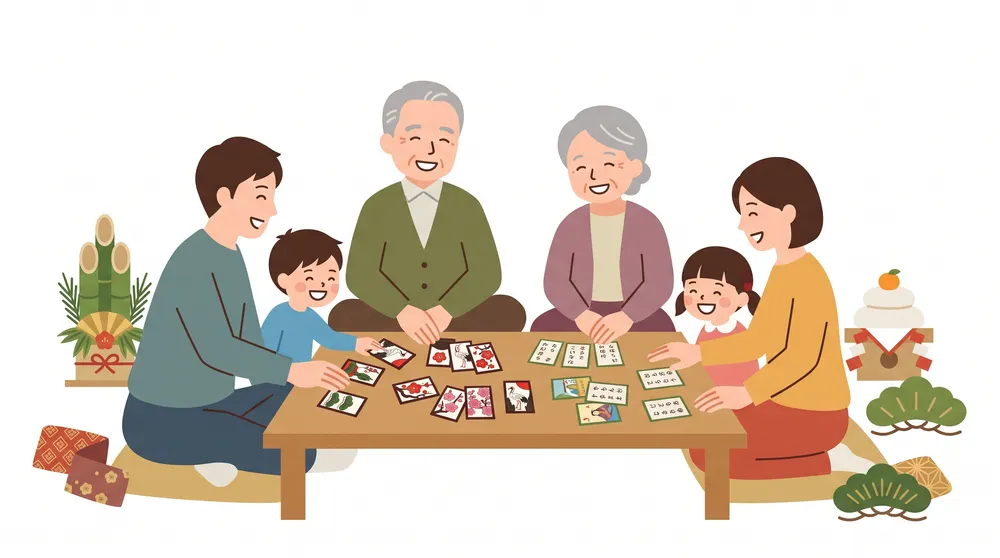
It is also a family game played at New Year, sold by Nintendo in a Mario edition.
Both things are true, and the second is far more common.
How can I tell a good deck from a cheap one?
Weight and stiffness. Proper cards are built from laminated paper layers, are
noticeably thick, and snap when played. Cheap printed sets look identical in photographs
and feel like nothing.
Buy from an established maker — Nintendo or a Kyoto karuta house — and you will
not have this problem.
Final Thoughts: The Weight Is the Product
Buy a Nintendo hanafuda deck and learn Koi-Koi. It costs less than a video game from the same company, it takes ten minutes to learn, and it is the product they were founded on in 1889 and still make.
If the poems interest you, the competitive cards come from one authorised workshop in Kyoto with an English site — an unusually clean answer for something this specialised.
And judge any deck by the weight in your hand. The artwork can be reproduced perfectly on thin card for a fraction of the money. The snap when you play it cannot.
Hanayama Cast Puzzles: Graded by Difficulty
Japanese Colored Pencils and Graphite: Hi-uni to Holbein