The word is a contraction: Yokosuka plus jumper. Yokosuka is the
port city south of Tokyo where the US Navy has been based since 1945 — and the jacket exists because
American servicemen stationed there wanted something to take home.
They took their uniforms to Japanese tailors and had them embroidered with dragons,
tigers, maps of Japan and the names of the places they had been. Local embroiderers, some of them
working with silk from surplus parachutes, obliged. The garment is a collaboration between
two countries that had just stopped fighting each other.
Eighty years later it is a fashion staple, and most of what is sold under the name is a printed
approximation. This guide explains what the real construction is, how to recognise it, and
why it costs what it costs.
Quick Reference: Telling Real From Copy
| Check | The real thing | The copy |
|---|---|---|
| Decoration | Embroidered, with visible thread relief | Printed, or flat machine embroidery |
| Fabric | Acetate or rayon — heavy, fluid drape | Polyester satin — stiff, plasticky sheen |
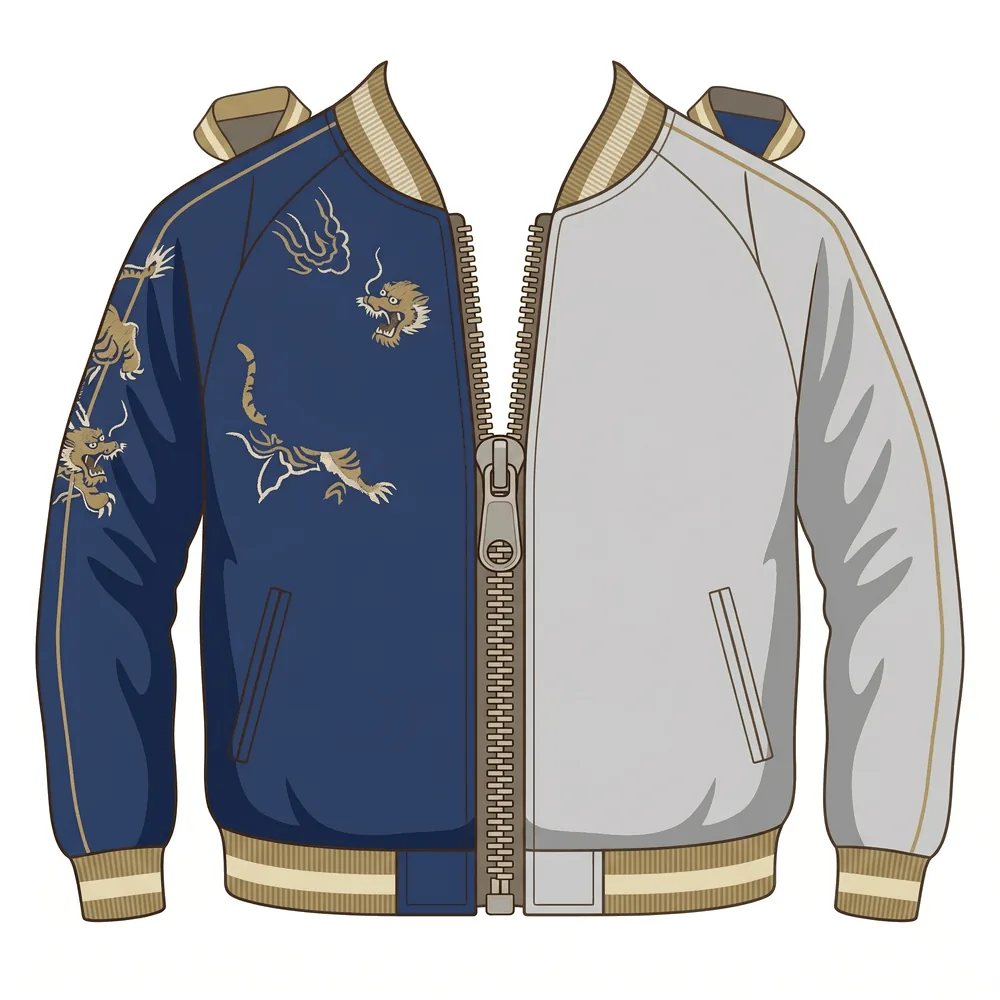
| Construction | Reversible, two complete designs | Single-sided with a plain lining |
| Price | $400–$1,200 | $40–$120 |
| Turn it inside out. If there is a second finished design on the other side, you are holding a real one. That test takes two seconds. | ||
Why Japanese — Yokosuka, 1945 Onwards
The souvenir jacket is not a Japanese traditional garment. It is something that happened when American servicemen and Japanese embroiderers were in the same place at the same time, and it belongs to both.
The centre of it was Dobuita Street in Yokosuka, the shopping street outside the naval base, where tailors and embroidery shops took orders from sailors who wanted proof they had been to Japan. Kosho & Co. — the company that became Toyo Enterprise — was among the businesses that industrialised it, turning bespoke souvenir orders into a product line.
That firm did not just participate in the trade, it dominated it: by the 1950s peak, Kosho held something in the region of 95% of the souvenir jacket supply to US bases in Japan. Which is why its successor still makes these — not as a revival of something lost, but as a line it has never stopped producing.
The imagery came from both directions: eagles and unit insignia from one side, dragons and tigers and Mount Fuji from the other. That is why a sukajan looks the way it does — it was designed to please an American buyer by a Japanese craftsman, and the visual language is genuinely hybrid rather than either one thing or the other.
Not a varsity jacket
English-speaking shops sometimes shelve these next to letterman and varsity jackets, and they are
different garments. A varsity jacket is wool with leather sleeves, ribbed trim, and
appliquéd letters — American school sports. A sukajan is a lightweight satin-weave
shell, reversible, decorated by embroidery.
They share ribbed cuffs and a snap front, and nothing else.
Hand-Guided Embroidery Is the Whole Cost
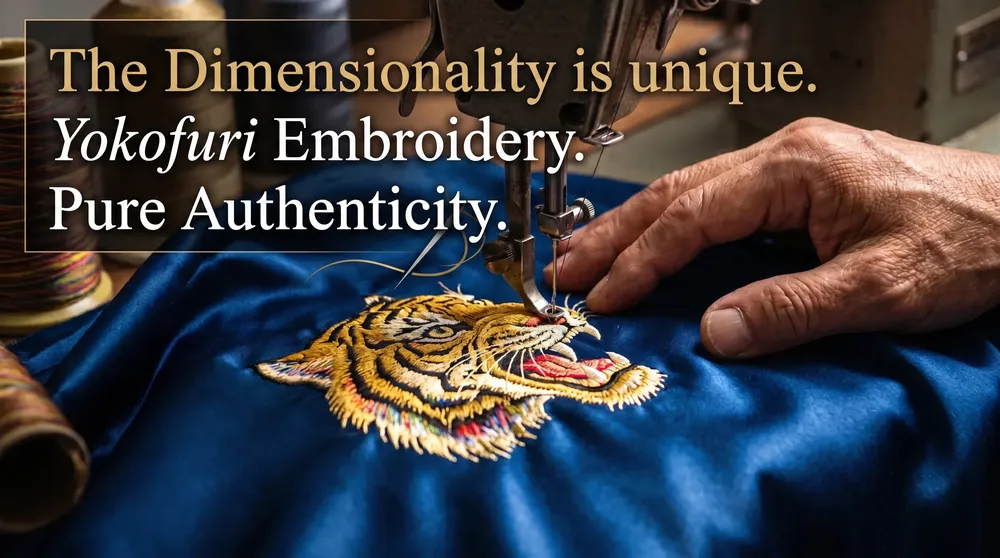
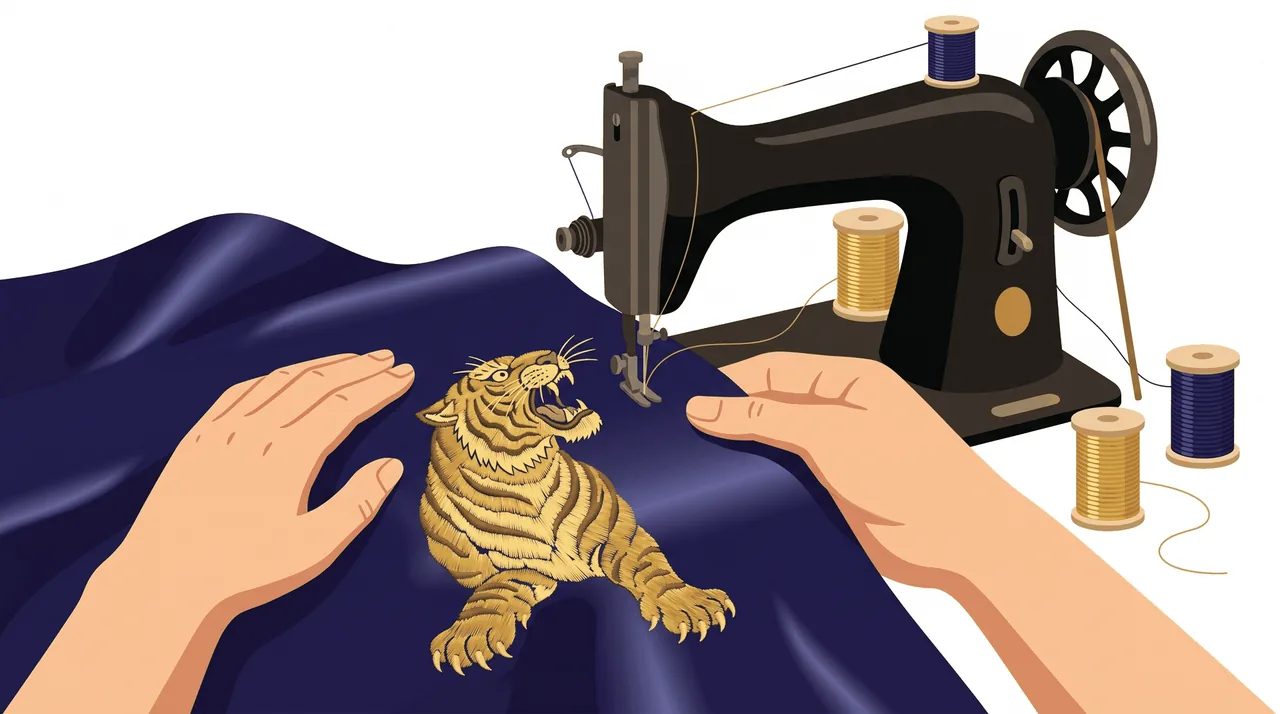
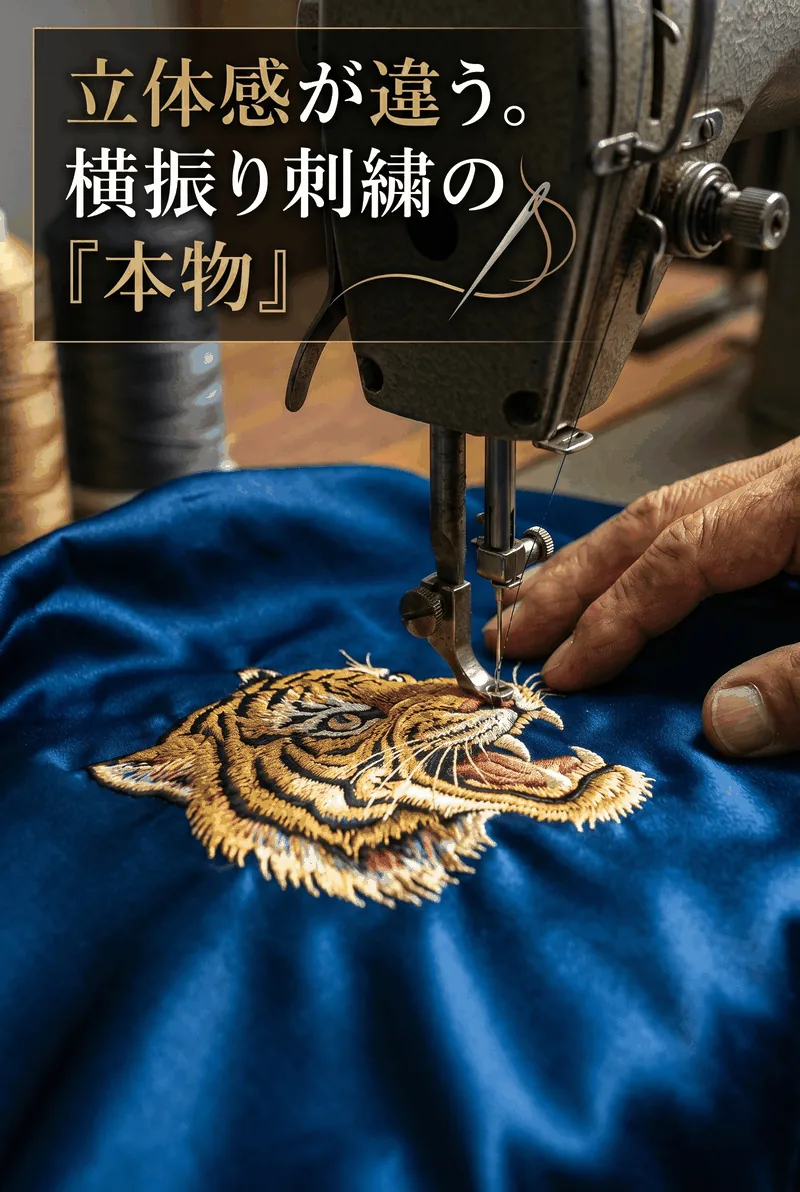
The technique the good makers use is called yokofuri — "side-swinging"
embroidery. The operator works a specialised sewing machine and moves the fabric
by hand under the needle, controlling direction, stitch density and thread build-up in
real time.
A computerised machine follows a digitised file and produces a flat, even, correct result.
A hand-guided operator can pile thread up where a muscle should bulge and thin it where
a shadow falls, so the image has physical relief you can feel with a fingertip.
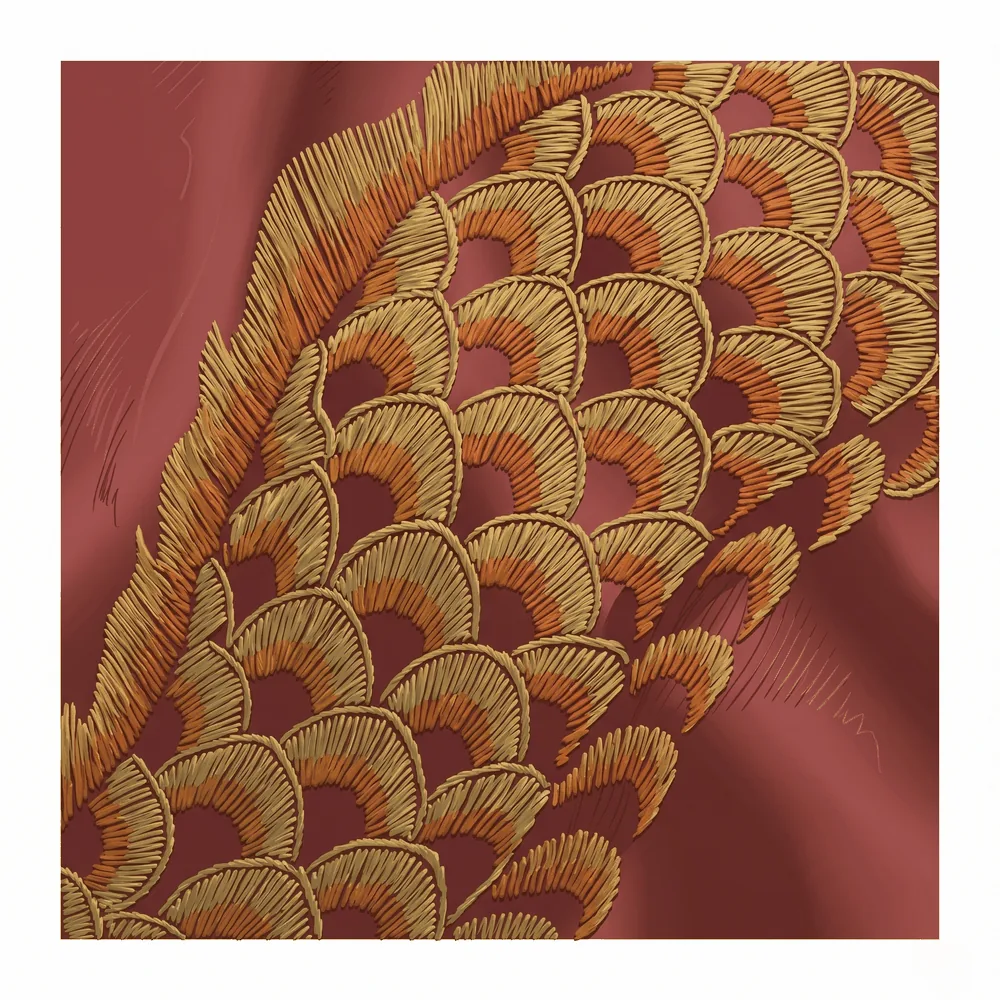
This is slow. A dense back panel is hours of skilled work by one person who cannot be replaced by a file, and there are not many people left doing it. That labour is most of what separates a $700 jacket from a $70 one — not the fabric, not the zip, not the brand.
How to check without expertise
- Run your hand over the design. Real embroidery has topography. Print is flat, and flat machine embroidery is uniformly slightly raised rather than sculpted.
- Look at the back of the panel if you can. Embroidery shows through as thread; print does not.
- Look at where colours meet. Hand-guided work blends by overlapping thread directions; digitised work meets at hard edges.
- Count the design. A reversible jacket carries a complete design on both sides — twice the embroidery, which is exactly why copies are single-sided.
Acetate, Rayon, and Why Polyester Fails
Traditional souvenir jackets are made from acetate or rayon — semi-synthetic
fibres derived from cellulose, which is to say from plants rather than from oil.
They hang differently. Acetate and rayon are heavier than polyester of the same
thickness and much more fluid, so the jacket falls into soft folds instead of standing away from
the body. The sheen is deeper and less reflective — closer to silk than to a shell
suit.
Polyester satin is the giveaway on cheap jackets. It is stiff, it catches light in a hard bright way, and it holds creases where a rayon jacket would drape. Once you have handled both, you can tell across a shop.
The trade is fragility. Acetate and rayon are weak when wet, sensitive to heat, and unhappy about water marks — which drives the care advice further down. Polyester is tougher and looks wrong. That is the choice the original makers made and the good ones still make.
Velveteen and quilted versions
Some makers produce betchin — a dense cotton velveteen — versions,
typically heavier and warmer than the satin ones and with a completely different surface for the
embroidery to sit on. Worth knowing about if you want something that works as an actual coat
rather than a light jacket.
Quilted linings also exist. A classic satin sukajan is a spring and autumn garment,
not winter outerwear.
Sizing: Japanese, and Boxy
Two things work against you at once here, and they partly cancel out — which is why people get it wrong in both directions.
- Japanese sizing runs small. A Japanese L is roughly a Western M. Brands that export usually state both, but domestic-market pieces will not.
- The cut is boxy by design. A souvenir jacket is meant to be short in the body, wide through the chest, with a dropped shoulder. It is not a tailored garment and sizing up "for fit" ruins the silhouette.
Buy on the chest measurement in centimetres, not on the letter. Every serious Japanese retailer publishes a garment measurement table — chest, length, shoulder, sleeve — measured flat. Compare those numbers against a jacket you already own and like.
Sleeve length is the trap
Japanese patterns generally have shorter sleeves relative to chest size than
Western equivalents. Someone with long arms who buys by chest measurement can end up with a jacket
that fits everywhere except the wrists — and ribbed cuffs make that very visible.
Check the sleeve figure specifically, and if it is short, size up and accept a looser body rather
than the other way round.
What to Buy
Tailor Toyo — the one with the archive
Toyo Enterprise's Tailor Toyo line descends directly from the company that was making these in
Yokosuka in the first place, and it reproduces designs from its own archive.
That is a meaningfully different proposition from a brand designing sukajan-style jackets now.
Acetate, hand-guided embroidery, fully reversible. This is the reference standard
against which everything else in the category is judged, and it is available through
the Western heritage-clothing shops that also stock Japanese denim.
- Fabric
- Acetate, rayon, or velveteen depending on model
- Embroidery
- Hand-guided
- Construction
- Reversible — a complete design each side
- Availability
- Heritage retailers in Europe and North America; ships worldwide
- Price range
- $500–$1,200
Perfect for: Anyone buying one souvenir jacket. Historical accuracy and the embroidery both come from the same source.
Buying used — a reasonable route here
Souvenir jackets hold up well and Japan's second-hand clothing market is enormous and honestly
graded. A used Tailor Toyo at half price is a better purchase than a new
reproduction from an unknown brand.
What to check: the embroidery for pulled or missing threads, the ribbing at
cuffs and hem for stretch, and the fabric for water marks — acetate stains permanently and it
will not come out.
- Where
- Japanese used-clothing sites with English support; eBay
- Check
- Thread pulls, ribbing stretch, water marks
- Avoid
- Anything described as having "small stains" on acetate
- Price range
- $200–$600 for good pieces
Perfect for: Getting the real construction at a price that does not require a serious decision.
Japanese makers with a different angle
SATORI works in rayon with elaborate Japanese-motif embroidery — less
reproduction, more maximalism. Hoshihime makes nylon satin jackets at a more
accessible price with domestic embroidery.
Neither has clear international distribution, so these are names for a trip or a
proxy purchase rather than a link to click.
Care: Thread Snags and Dry Cleaning
Acetate and rayon are the fragile part, and the embroidery is the irreplaceable part. Both dislike the same things.
- Dry clean only, and tell them it is embroidered acetate. Never machine wash — acetate loses strength when wet and rayon shrinks unpredictably.
- Never iron the embroidery. Heat flattens the relief that you paid for, and acetate melts at surprisingly low temperatures. Steam from a distance if you must.
- Hang it on a broad hanger. A wire hanger deforms the shoulders of a soft-shelled jacket within weeks.
- Watch what you carry. Backpack straps and shoulder bags abrade embroidery, and a pulled thread on a hand-guided design cannot be invisibly repaired.
- Keep it out of the sun. Rayon and acetate fade, and embroidery thread fades faster than the ground fabric — so the design goes dull while the jacket stays dark.
If a thread pulls loose
Do not pull it, and think before cutting. On dense embroidery a loose loop is
often still anchored at both ends — cutting it can release a run.
The safer move is to push it back through to the reverse with a blunt needle, or
to take it to an alterations shop that does embroidery repair. A jacket like this justifies the
trip.
Frequently Asked Questions
What does "sukajan" mean?
It is a contraction of "Yokosuka" and "jumper". Yokosuka is the port city hosting
the US naval base, and the jackets began as souvenirs made there for American servicemen after
1945 — uniforms and surplus fabric taken to local tailors to be embroidered.
In English the same garment is called a souvenir jacket.
How do I tell a real one from a copy?
Turn it inside out. A traditional sukajan is reversible with a complete design on
both sides — copies are single-sided with a plain lining, because embroidery is the expensive part.
Then feel the design. Hand-guided embroidery has physical relief; print is flat
and digitised embroidery is uniformly raised rather than sculpted.
Why does the fabric matter so much?
Acetate and rayon drape; polyester does not. The semi-synthetics are heavier and
more fluid, so the jacket falls in soft folds with a deep, silk-like sheen.
Polyester satin is stiff, catches light hard, and holds creases. It is the single most visible
difference between a real jacket and a cheap one after the embroidery.
What size should I order?
Buy on garment measurements in centimetres, not on the letter. Japanese sizing
runs about one size small, but the cut is deliberately boxy — so sizing up "for fit" ruins the
silhouette.
Check the sleeve length specifically. Japanese sleeves run short relative to
chest, and ribbed cuffs make that obvious.
Is a sukajan the same as a varsity jacket?
No. A varsity or letterman jacket is wool with leather sleeves and appliquéd
letters, from American school sports. A sukajan is a light satin-weave shell, usually reversible,
decorated with embroidery.
They share ribbed cuffs and a snap front and nothing else.
Can I wash it?
No — dry clean only, and say it is embroidered acetate. Acetate weakens when wet
and rayon shrinks unpredictably.
Never iron the embroidery: heat flattens the relief and acetate melts at low
temperatures. Keep it out of direct sun, because embroidery thread fades faster than the ground
fabric.
Final Thoughts: Turn It Inside Out
This jacket is half yours already. It exists because American sailors wanted a souvenir and Japanese embroiderers were extremely good at making one — and the imagery on the back still shows both hands on it.
The two-second test is to turn it inside out. A complete second design means double the embroidery, which is the one thing a cheap jacket cannot fake. Then feel the surface: real work has topography.
Buy on centimetres rather than letters, keep it away from irons and sunlight, and a used one from a maker with an archive beats a new one from a brand without a past.
Japanese Selvedge Denim: 7 Best Brands for Life
Tochigi Leather Belts: The Tannery, Not the Brand