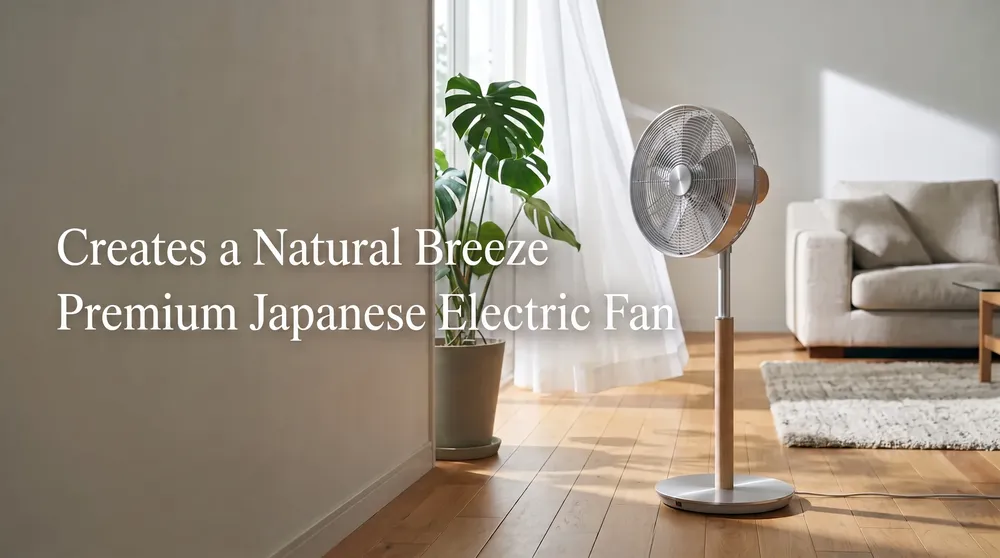
Balmuda's GreenFan is the fan that made people willing to spend $400 on a fan, and the reason is a
genuinely unusual piece of engineering: two concentric sets of blades turning at different
speeds, deliberately producing a wide, slow, soft airflow instead of a narrow jet.
Before anything else, though — most GreenFan models are 100V only, and Amazon sells
Japanese-market units to overseas buyers without making that especially obvious.
The good news, and it is genuinely different from most Japanese appliances: a DC fan draws
so little power that a small step-down transformer costs almost nothing. And one model in
the range takes 100–240V natively. This guide sorts out which is which.
Quick Reference: Which One Can You Plug In?
| Model | Voltage | What you need |
|---|---|---|
| GreenFan S | AC 100–240V, 50/60Hz | Nothing. Plug adapter for Europe, that is all |
| The GreenFan EGF-1600 / 1700 / 1800 |
100V only | A small step-down transformer — and it is genuinely cheap |
| GreenFan C2 / Studio | Check each listing | Assume 100V unless it says otherwise |
| ⚠ Amazon.com listings marked "Japan Domestic" are 100V units. They ship to you, they plug into your wall, and they are not made for your power. | ||
Will a Japanese Fan Work in Your Country?
Short answer — yes, and this is one of the easiest Japanese appliances to bring home. Either buy the model that takes 100–240V, or use a small transformer, which for a fan costs about as much as a takeaway meal.
| Where you live | Voltage | Does the plug fit? | What you need |
|---|---|---|---|
| Japan | 100V | — | Nothing |
| United States / Canada | 120V | Yes — same Type A plug | A small step-down transformer, or buy the 100–240V model |
| Europe / UK / Australia | 230–240V | No | The 100–240V model plus a plug adapter. Simple |
The danger is that it fits and it works
Japan and the United States use the same NEMA 1-15 Type A plug. A 100V Japanese
fan goes straight into an American socket with no adapter and starts spinning.
What is happening is that a motor designed for 100V is running on 120V — about
20% over. A fan will tolerate this better than a heating appliance would, but it runs warmer, the
electronics age faster, and the warranty is void. It is not dramatic, which is
exactly why people leave it plugged in for years.
Why a transformer is fine here, unlike a rice cooker
This is where fans differ from almost every other Japanese appliance, and the difference is simply arithmetic.
- A DC-motor fan draws a very small amount of power — single-digit to low double-digit watts, which is the entire selling point of DC motors.
- A Japanese rice cooker draws around 1,200W, and heating appliances need transformer headroom of three to four times that — which is why the transformer ends up costing more than the cooker.
- A fan needs none of that. Even with generous headroom, a small and inexpensive step-down transformer covers it comfortably.
So the honest advice is model-dependent rather than universal: buy the 100–240V model if you can find it, and if you cannot, a transformer is a perfectly reasonable answer for this particular appliance.
⚠ Read the Amazon listing carefully
GreenFan units appear on Amazon.com marked "Japan Domestic Genuine Products" or
similar. That phrasing means exactly what it says: a unit built for the Japanese
market, sold to you through a marketplace listing.
It is not a scam and the product is genuine — but buying on Amazon does not mean you are
buying a model made for your country's power. Check the voltage specification on every
listing before ordering.
⚠ A plug adapter is not a solution
A plug adapter changes the shape of the pins. It does nothing whatsoever to the voltage. This is the single most common and most expensive misunderstanding in this category, and the two regions get it wrong in opposite ways.
United States and Canada: nothing stops you
Japan and North America use the same Type A plug. A Japanese appliance fits a US socket with no adapter at all — it simply plugs in and turns on.
That is precisely the danger. There is no physical obstacle, no error message, and nothing that feels wrong. 120V into a 100V appliance is 1.2× the voltage, which is about 1.44× the power — so it runs hot, ages fast, and any thermostat inside it is now calibrated for conditions that no longer apply.
Europe, UK and Australia: an adapter alone destroys it
Here the plug shape is different, so you will go looking for an adapter — and travel shops
sell them by the till.
230V into a 100V appliance is 2.3× the voltage, which is roughly 5.3× the power.
That is not shortened life. That is immediate failure, and a genuine fire risk.
You need an adapter AND a transformer. The adapter makes it fit; the transformer
makes it safe. Neither one substitutes for the other.
⚠ And a "travel converter" is not a transformer
Cheap travel converters chop the AC waveform rather than transforming it, and are
meant only for simple resistive loads like a travel iron, for short periods.
They will damage anything with electronics, a thermostat or a motor.
Look for the word "transformer," and ideally "toroidal."
Sizing the transformer
| Appliance type | Transformer rating |
|---|---|
| No motor, no heating element | 1.5× the rated watts |
| Motor or heating element | 2–4× the rated watts — startup draw exceeds the printed figure |
A DC-motor fan draws single or low double-digit watts, so this is the easy case — a small transformer is genuinely sufficient and cheap.
A 500W unit is far more than a fan needs, and it will also run most small electronics. But check whether your model is already 100–240V, in which case you need nothing at all.
Why Japanese Fans — Two Sets of Blades

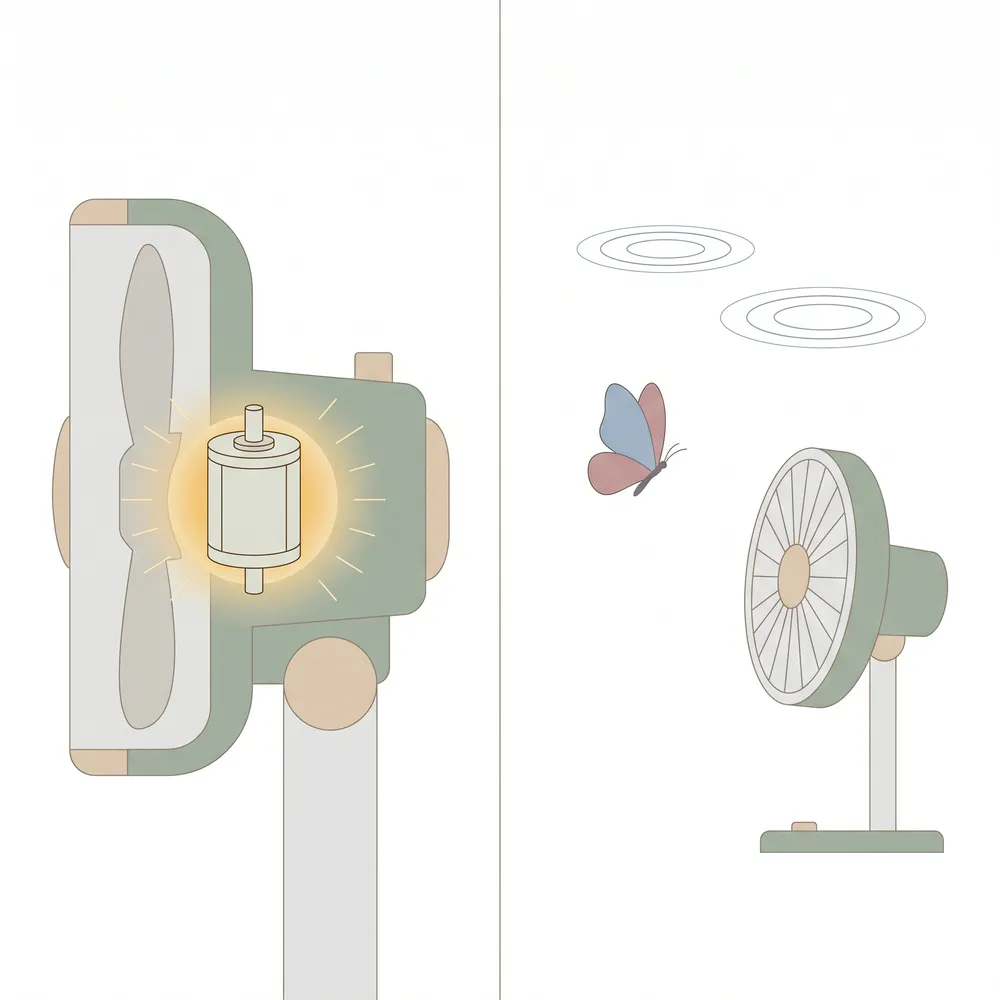
Sitting in front of an ordinary fan for an hour is tiring, and the reason is not imagined. A single set of blades produces a narrow, fast, spiralling column of air — concentrated enough that the skin it hits cools much faster than the rest of you, which the body reads as unpleasant rather than refreshing.
Balmuda's answer was to build the fan with two concentric blade sets rotating at different speeds. The inner set pushes air faster, the outer set slower, and where the two streams meet they interfere and spread. The output is a wide, slow-moving body of air that behaves much more like moving through a room than being pointed at.
The DC motor is the other half
Traditional fans use AC motors, which are cheap and have a small number of coarse speed steps.
A DC motor can be controlled finely, which buys three things at once:
Very low power draw — single-digit watts at low speeds, against ten times that
for a comparable AC fan.
Genuinely quiet operation at the low settings, quiet enough to sleep beside.
Many usable speeds rather than three, so the slowest setting is actually slow.
Made in Yamagata
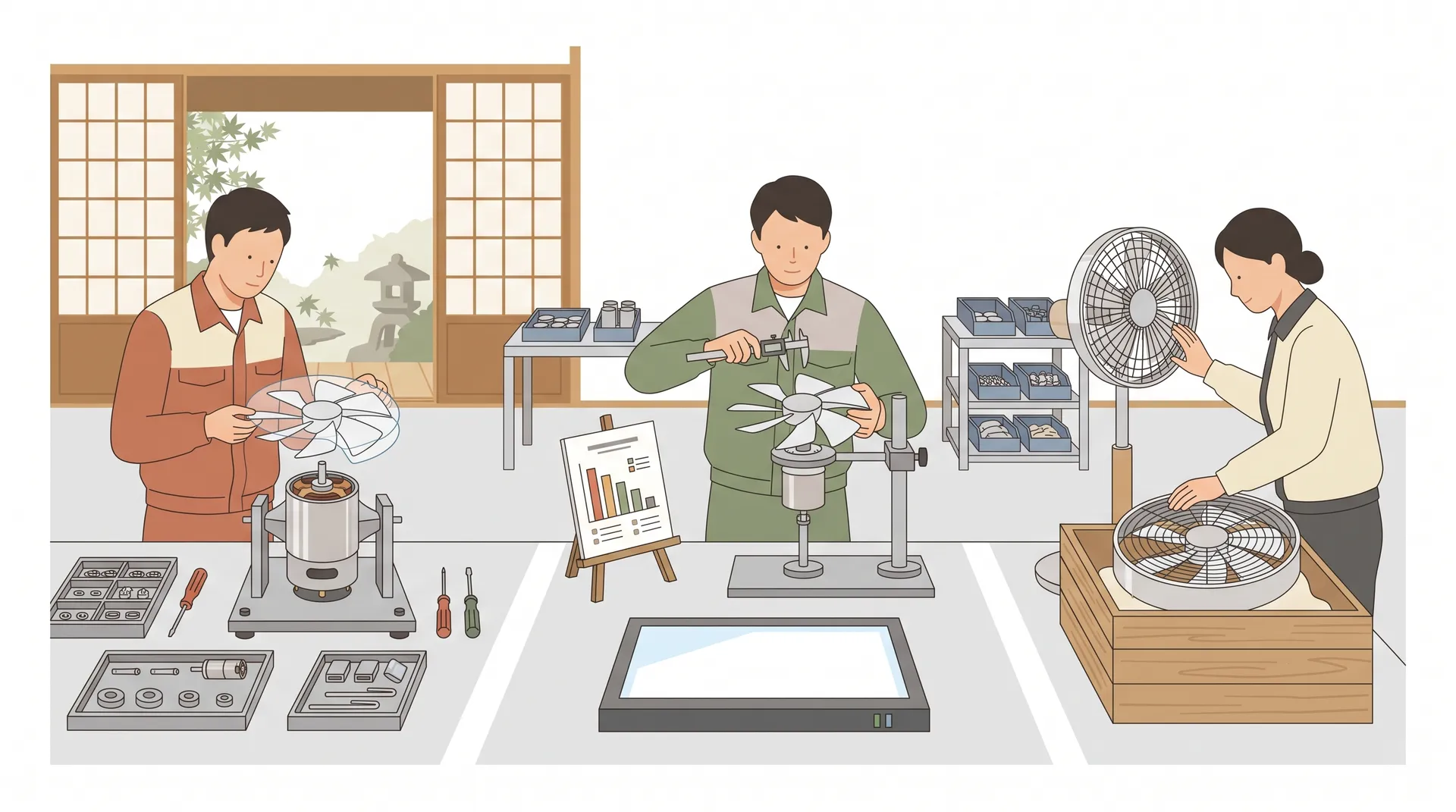
Balmuda is unusual among modern Japanese consumer brands in keeping GreenFan production
domestic, at a factory in Yamagata prefecture.
The stated reason is tolerance control: the dual-blade design only produces the intended airflow
if the two blade sets are made and assembled to tight limits. Move the fan a few percent
away from its design geometry and the effect the whole product exists for stops
happening.
What to Buy
GreenFan S — the one that takes your voltage
Rated AC 100–240V at 50/60Hz, which means it runs anywhere with nothing more
than a plug adapter. If you live outside Japan and want a GreenFan, this is the model
to look for first — and most guides never mention that it exists.
Same dual-blade principle, same DC motor, no transformer, no voided warranty.
- Voltage
- AC 100–240V, 50/60Hz
- Motor
- DC, finely variable
- Airflow
- Dual concentric blades
- You need
- A plug adapter in Europe. Nothing in North America
- Price range
- $300–$450
Perfect for: Anyone buying from outside Japan who would rather not own a transformer.
The GreenFan (EGF-1600 / 1700 / 1800) — 100V, plus a transformer
The flagship line and the one people mean when they say GreenFan. These are 100V
Japanese-market units, including the ones listed on Amazon.com under "Japan Domestic"
wording.
Buy one anyway if you want the top model — just buy a small step-down
transformer with it. Unlike a rice cooker or a kettle, the power draw here is low enough that
this is a genuinely sensible solution rather than a workaround.
- Voltage
- 100V only. Transformer required outside Japan
- Motor
- DC, very low consumption
- Notable
- Battery and dock accessory available for cordless use
- Made in
- Yamagata, Japan
- Price range
- $350–$500, plus $30–$60 for a transformer
Perfect for: Someone who wants the flagship and does not mind a small box on the floor next to it.
GreenFan C2 and Studio — circulator and larger room
C2 is the compact circulator — smaller, cheaper, and aimed at moving air
around a room rather than at a person. Studio is the larger unit for bigger
spaces.
Check the voltage on the specific listing. Assume 100V unless it states a
range, and factor a transformer in if it does not.
- C2
- Compact circulator. Good year-round, cheaper
- Studio
- Larger rooms, higher output
- Voltage
- Verify per listing. Do not assume
- Price range
- $220–$500 depending on model
Perfect for: Circulating air with an air conditioner, or a room the main fan cannot cover.
Other Japanese makers worth knowing
Balmuda is not the only one. Mitsubishi Electric's SEASONS line is the serious
domestic alternative — less design-led, engineered for long service life and with a following
among people who intend to keep a fan for fifteen years. Panasonic and Hitachi
also make well-regarded DC fans.
All are 100V domestic products and reach export markets only through proxy
services, so the transformer arithmetic above applies to them too.
It Is Not Only a Summer Appliance
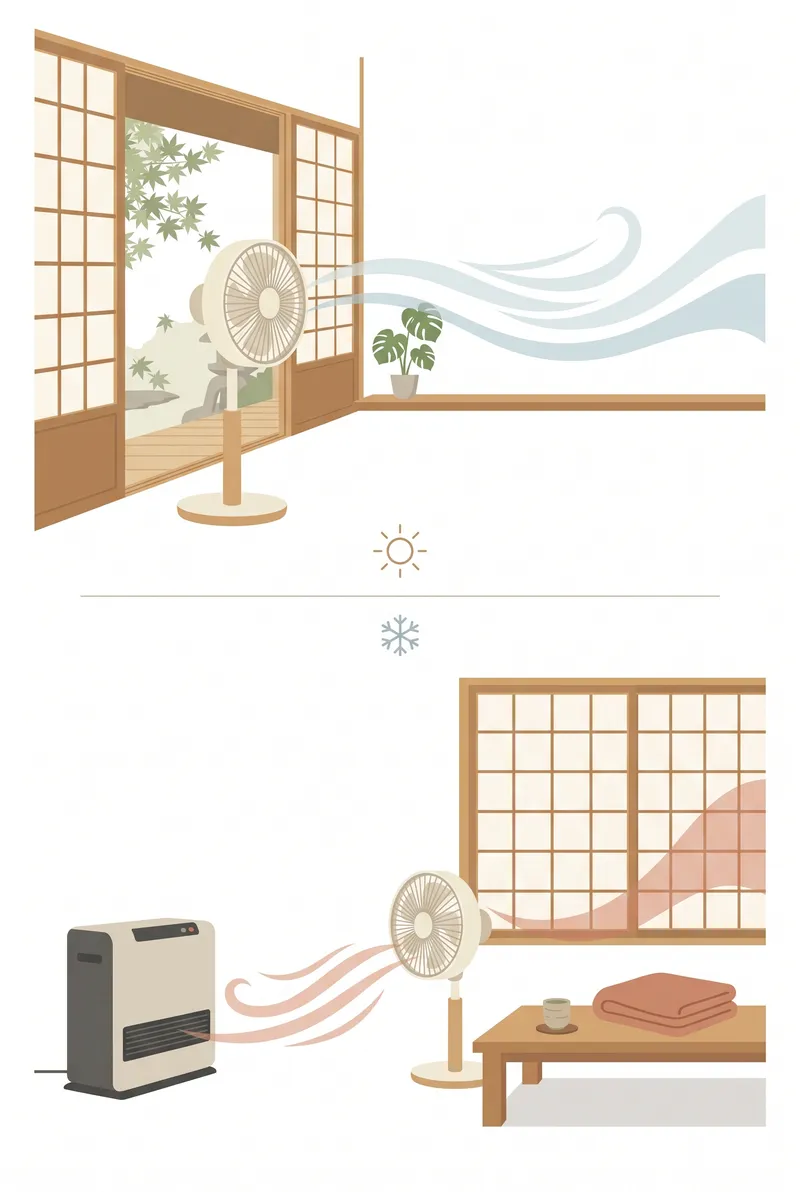
A $400 fan used three months a year is a poor purchase. Used twelve months a year it is a reasonable one, and the winter use is the one most people never think of.
- Winter: point it at the ceiling. Warm air collects at the top of a room and stays there. Circulating it down means the thermostat reaches temperature sooner and the heating runs less — the fan uses a handful of watts to save a heater hundreds.
- With air conditioning: point it away from yourself. Circulating cold air lets you set the thermostat a degree or two higher for the same comfort.
- Drying laundry indoors — the standard Japanese use for a circulator, and dramatically faster than still air.
- Ventilation: one fan pointing out of an open window moves far more air than two fans pointing in.
The models sold as circulators rather than fans are optimised for this — narrower, more directional airflow that carries across a room, which is the opposite of what the GreenFan does for personal cooling. If year-round circulation is your main use, buy the circulator, not the fan.
Frequently Asked Questions
Can I use a Balmuda fan outside Japan?
Yes, and more easily than most Japanese appliances. The GreenFan S is rated
AC 100–240V, so it runs anywhere with just a plug adapter.
The 100V models need a step-down transformer — but a fan draws so little power that a small,
inexpensive one is sufficient. This is not the case with rice cookers or kettles.
I found one on Amazon. Is it the right voltage?
Check the listing — several are Japanese-market 100V units. Wording such as
"Japan Domestic Genuine Products" means exactly that: a genuine product built for Japanese
power.
Buying on your local Amazon does not guarantee a local-voltage product. Read the
specification, not the storefront.
What happens if I just plug a 100V fan into a US outlet?
It fits and it runs — the plug is the same NEMA 1-15 type. The motor is receiving
about 20% more voltage than designed.
A fan tolerates this better than a heating appliance, but it runs warmer, the control electronics
age faster, and the warranty is void. A $30 transformer removes the question
entirely.
Is the airflow really different, or is that marketing?
It is a real design difference. Two concentric blade sets turning at different
speeds produce streams that interfere and spread, giving a wide slow column instead of a narrow
fast spiral.
Whether that is worth the price is a separate question — but it is engineering, not a sticker.
Is it quiet enough to sleep with?
At the low settings, yes. The DC motor is the reason: it can be run genuinely
slowly, whereas an AC fan's lowest setting is still reasonably fast.
If indicator lights bother you at night, check whether the model can dim or disable them — several
Japanese fans include this and it is easy to miss in the manual.
Is it worth $400 for a fan?
Only if you use it more than three months a year. Pointed at the ceiling in
winter it circulates trapped warm air and lets the heating work less; with air conditioning it
lets you set a higher temperature for the same comfort.
Used seasonally it is an expensive fan. Used year-round it is a small appliance that reduces two
larger appliances' running costs.
Final Thoughts: Check the Plate, Then Enjoy It
Look for the 100–240V model first. It exists, most articles do not mention it, and it removes the entire problem.
If you want the flagship instead, buy it and buy a transformer. This is the rare Japanese appliance where that advice is genuinely economical — a DC fan draws so little that the transformer is a small cheap box rather than the reason to give up.
Then point it at the ceiling in January. A fan that works twelve months a year is a different purchase from a fan that works three — and it is the same fan.

Japanese Rice Cookers: Buy the 120V Model

Benriner Mandoline: Which Model, and Which Glove