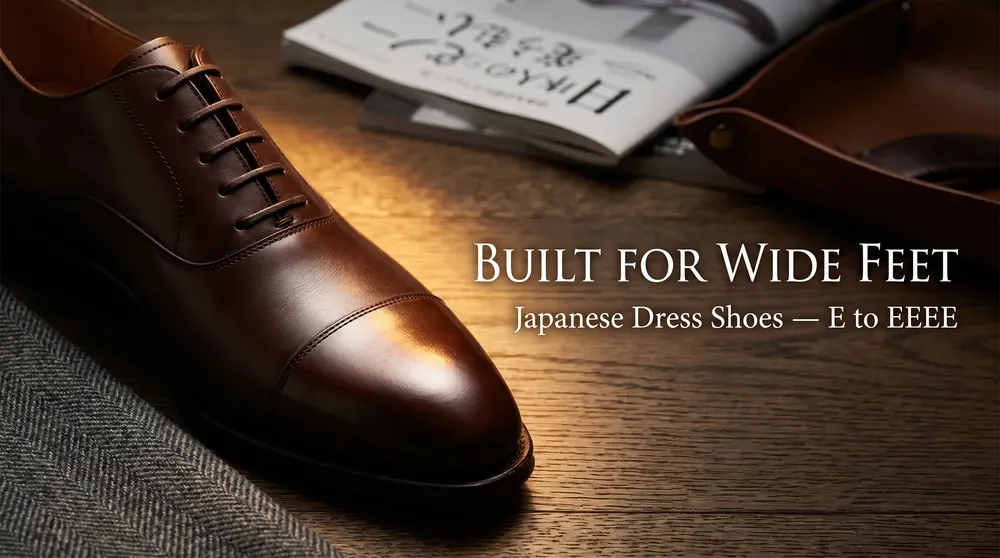
If English and Italian dress shoes have never fitted you across the forefoot, there is a category
you have probably never been shown. Japanese makers sell width fittings from E through to
EEEE as a matter of course — not as a special order, but as the ordinary way shoes are
stocked.
They are Goodyear welted, resoleable, and typically half what a comparable English shoe
costs.
The catch is real and this guide does not pretend otherwise: there is no clean
international retail channel. Buying a pair from outside Japan means eBay, a proxy service,
or the used market — so the practical part of this article is about how to do that without getting
the size wrong.
Quick Reference: Is a Japanese Shoe for You?
| If your feet are… | Verdict |
|---|---|
| Wide across the forefoot | Strongly worth trying. E to EEEE is normal stock, not a special order |
| Low instep / flat on top | Very likely a better fit than European lasts |
| High instep | Be careful. Japanese lasts are cut lower over the arch |
| Narrow, high-arched | Stay with English or Italian lasts. This is not your category |
| ⚠ Japanese width letters are not US width letters. An E in Japan is a different measurement from an E in America — see the sizing section before ordering anything. | |
Why Japanese Shoes — the Last Is Shaped Differently
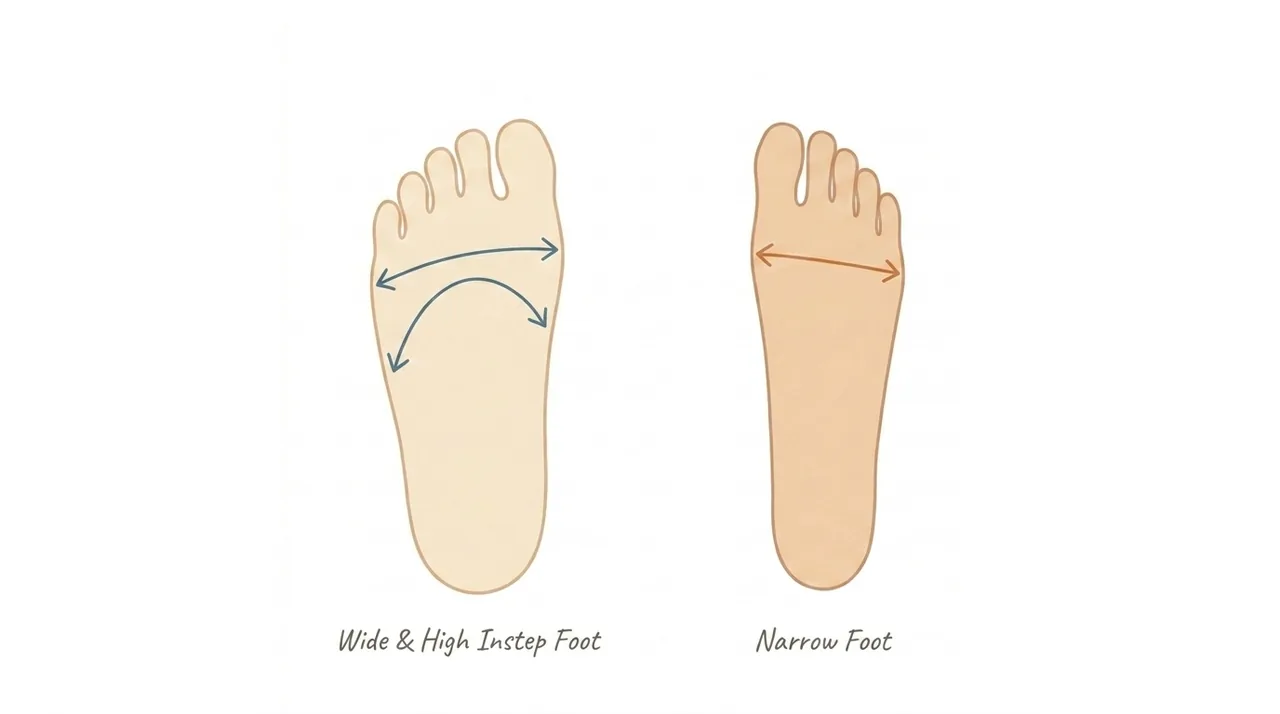
A shoe is built around a wooden or plastic form called a last, and the last is the shoe. Japanese makers develop lasts against the feet in front of them, which on average are broader across the ball of the foot and lower over the instep than the feet English and Italian makers design for.
The Japanese article this guide is based on frames that as "shoes that fit Japanese feet". Read from outside Japan, the same fact means something more useful: if you have wide feet, there is an entire shoemaking tradition built around your problem.
What you actually get
- Width fittings as standard stock. E, EE, EEE and often EEEE, sitting on the shelf rather than requiring a made-to-order slot.
- Goodyear welt construction across the mainstream brands — the shoe can be resoled repeatedly rather than thrown away.
- Roughly half the price of a comparable English Goodyear-welted shoe, because the domestic market is competitive and the brands are not exporting a premium.
- Conservative shapes. Japanese business dress is conservative, and the shoes reflect it — round and semi-square toes, restrained lasts, very few fashion silhouettes.
And the honest downside
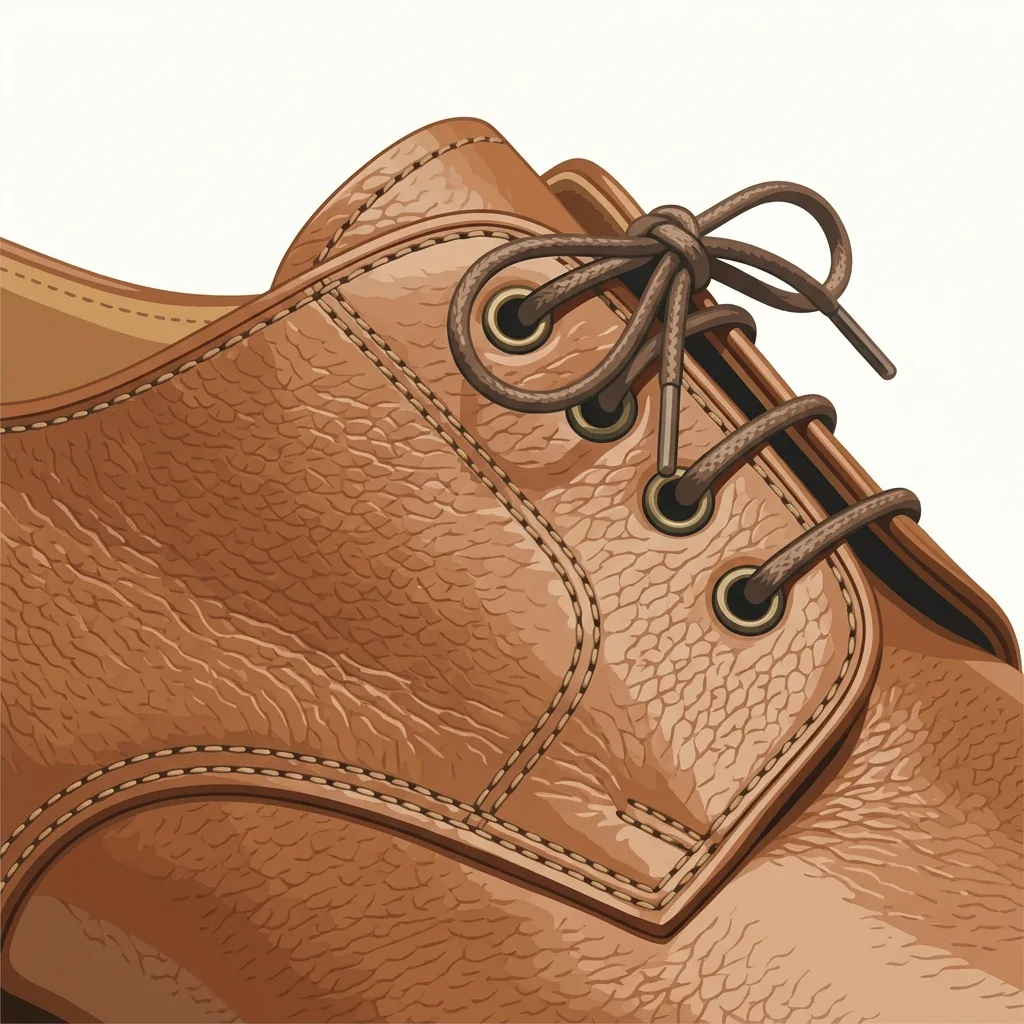
A lower instep is a problem if yours is high. The same cut that makes these
shoes comfortable for flat-topped feet will press across the top of a high arch, and no amount
of width helps with that.
If your complaint about shoes has always been that they pinch over your foot rather
than across it, this category is probably not your answer.
Sizing: Centimetres, and Widths That Are Not US Widths
Two things to understand before you spend money, and the second one catches almost everybody.
1. Length is in centimetres
Japanese shoes are sized by foot length in centimetres — 26.0, 26.5, 27.0. That is a measurement of your foot, not a shoe code, which makes it more honest than either the US or UK system.
Measure your foot properly. Stand on paper against a wall, mark the longest toe, measure, and do it in the evening when your feet are at their largest. That number in centimetres is your starting size.
2. ⚠ The width letters are a different system
Japanese E / EE / EEE / EEEE and American E / EE / EEE are not the same measurements,
even though the letters look identical. The Japanese system is based on the circumference around
the ball of the foot; American widths measure differently.
Do not assume your US width letter transfers. Measure the circumference of your
foot at the widest point with a tape, and match that number against the maker's own chart — every
Japanese brand publishes one.
For reference, each step up — D to E, E to EE, EE to EEE — adds roughly 4.5mm of circumference. That is small enough that one step in the wrong direction is genuinely uncomfortable, and large enough that getting it right is transformative.
Buying without trying: what to do
- Measure length and ball circumference in the evening. Both numbers, in centimetres and millimetres.
- Find the maker's own size chart and match against it rather than converting from your usual size.
- When in doubt on width, go one wider. A slightly loose shoe can be managed with an insole or a thicker sock; a tight one cannot be fixed.
- Leather stretches across, not along. Width eases with wear. Length never does.
How to Actually Buy Them
This is the weak point and it deserves a straight answer. Japanese dress shoe brands are not set up for international retail the way Japanese knives or keyboards are. The English shoe community's own summary is that several of the best domestic makers simply cannot be bought from overseas through normal channels.
What does work, in rough order of preference:
| Route | Good for | Watch out for |
|---|---|---|
| Brand English sites | REGAL and Scotch Grain both run English-language sites | International shipping is not clearly stated. Ask before assuming |
| eBay, Japanese sellers | The realistic route. EEE and EEEE widths do appear | Condition varies; ask for the insole length measurement |
| Proxy buying services | Access to Japanese online stores that do not ship abroad | Fees stack up; no returns if the size is wrong |
| Japanese used market | Large reuse chains have English sites and ship internationally | Used. But Goodyear welted shoes are resoleable, so this is less mad than it sounds |
The used market deserves a second look
Buying used dress shoes sounds unappealing until you remember what Goodyear welting is for.
A welted shoe with a worn sole is a shoe that needs a resole, not a shoe that is
finished — and a resole costs far less than the price gap.
Check the upper rather than the sole: creasing across the vamp is normal, cracks
through the leather are not. And check the heel counter still holds its shape.
If you are ever in Japan, buy them there. Every department store carries these brands with staff who will measure your foot properly, and the width range on the shelf is the whole point of the exercise.
The Makers
Scotch Grain — the value benchmark
Made by Hirokawa Shoes at its own factory in Sumida, Tokyo, and the brand most often held up
as the sensible answer in Japan: Goodyear welted, integrated production, and a wide
fitting range including EEE and EEEE.
Conservative oxfords, derbies and loafers. Not fashion shoes — office shoes intended to be
resoled for a decade or more.
- Made in
- Sumida, Tokyo — own factory
- Construction
- Goodyear welt. Resoleable
- Widths
- Wide range, up to EEEE
- Buying abroad
- English brand site exists; realistically eBay or proxy
- Price range
- $220–$450
Perfect for: A first Japanese shoe, and anyone whose forefoot has never fitted a European last.
REGAL — the one you are most likely to find
The largest and most recognised name in Japanese footwear, with a history stretching back to
1902. The widest distribution, the widest range, and consequently the widest quality
spread — REGAL covers everything from affordable cemented shoes to the Goodyear
welted Shoe & Co. line at the top.
Check the construction before buying. The name alone does not tell you
whether a given pair can be resoled.
- Founded
- 1902
- Construction
- Varies by line. Goodyear welt at the upper end
- Widths
- EE common; wider available on many models
- Buying abroad
- English site for the premium line; eBay for the rest
- Price range
- $150–$600 depending on line
Perfect for: Finding something in your size on the used market — sheer volume means REGAL turns up more than anything else.
The makers you will have to go to Japan for
These are what Japanese enthusiasts actually rate, and none of them has meaningful international distribution. Listed so you know the names, not because you can order one tonight.
- Sanyo Yamacho — the domestic high end. Exceptional fit, heel cups that genuinely grip, and priced accordingly.
- Miyagi Kogyo — a Yamagata factory known for made-to-order at surprisingly reasonable money.
- Union Imperial — uses French Annonay calf and its own approach to Goodyear welting.
- Otsuka and Yoshinoya Ginza — old Tokyo names, essentially domestic-only.
Making Them Last Twenty Years
A Goodyear welted shoe is a repairable object, and the reason to buy one is that it outlasts several cheaper pairs. That only holds if you do three unglamorous things.
- Shoe trees, every time you take them off. Cedar, unvarnished. They absorb moisture and hold the shape while the leather dries — creases set permanently otherwise, and a set crease eventually cracks.
- Never wear the same pair two days running. Leather needs a full day to dry out. This one habit roughly doubles the life of a shoe and costs nothing but owning two pairs.
- Brush after each wear, cream every ten to fifteen wears. Brushing removes the grit that abrades the finish; cream replaces the oils the leather loses. Polish is for shine and is optional.
Resole before the welt is damaged, not after. Once wear reaches through the sole into the welt stitching, a straightforward resole turns into a rebuild — and that is the point at which a repairable shoe stops being repairable.
If they get soaked: stuff with newspaper, dry slowly at room temperature, away from any heat source. A radiator will cook the oils out of leather and crack it, and there is no coming back from that.
Frequently Asked Questions
Can I actually buy Japanese dress shoes from outside Japan?
Yes, but not through normal retail. REGAL and Scotch Grain run English-language
sites, though international shipping is not clearly stated on either — ask before assuming.
The realistic routes are eBay sellers in Japan, proxy buying services, and the Japanese
used market, which has English-language options that ship internationally.
Is a Japanese EEE the same as a US EEE?
No. The Japanese width system is based on the circumference around the ball of
the foot and is not interchangeable with American width letters, despite using the same
characters.
Measure your ball circumference with a tape and match it against the maker's own
chart. Every Japanese brand publishes one.
Will they fit me if I am not Japanese?
Fit follows foot shape, not nationality. Japanese lasts are generally wider
across the forefoot and lower over the instep.
Wide feet with a low instep: very likely an improvement. A high instep: probably
not, and no width fitting solves that.
How do I choose a size without trying them on?
Measure length and ball circumference in the evening, when your feet are largest,
and match against the maker's chart rather than converting from your usual size.
If you are between widths, take the wider one. Leather stretches across but never
lengthways — a tight shoe stays tight.
Is buying used a bad idea?
Less than you would think, for Goodyear welted shoes. A worn sole is a resole,
not a write-off, and the resole costs much less than the saving.
Judge the upper, not the sole. Creasing across the vamp is normal wear; cracks
through the leather are terminal. Check the heel counter still holds its shape.
Are all REGAL shoes Goodyear welted?
No — the range is broad. REGAL spans affordable cemented construction through to
the Goodyear welted premium line, and only the welted shoes are resoleable.
Check the construction on the specific model rather than trusting the brand name.
Final Thoughts: Worth the Hassle If Your Feet Are Wide
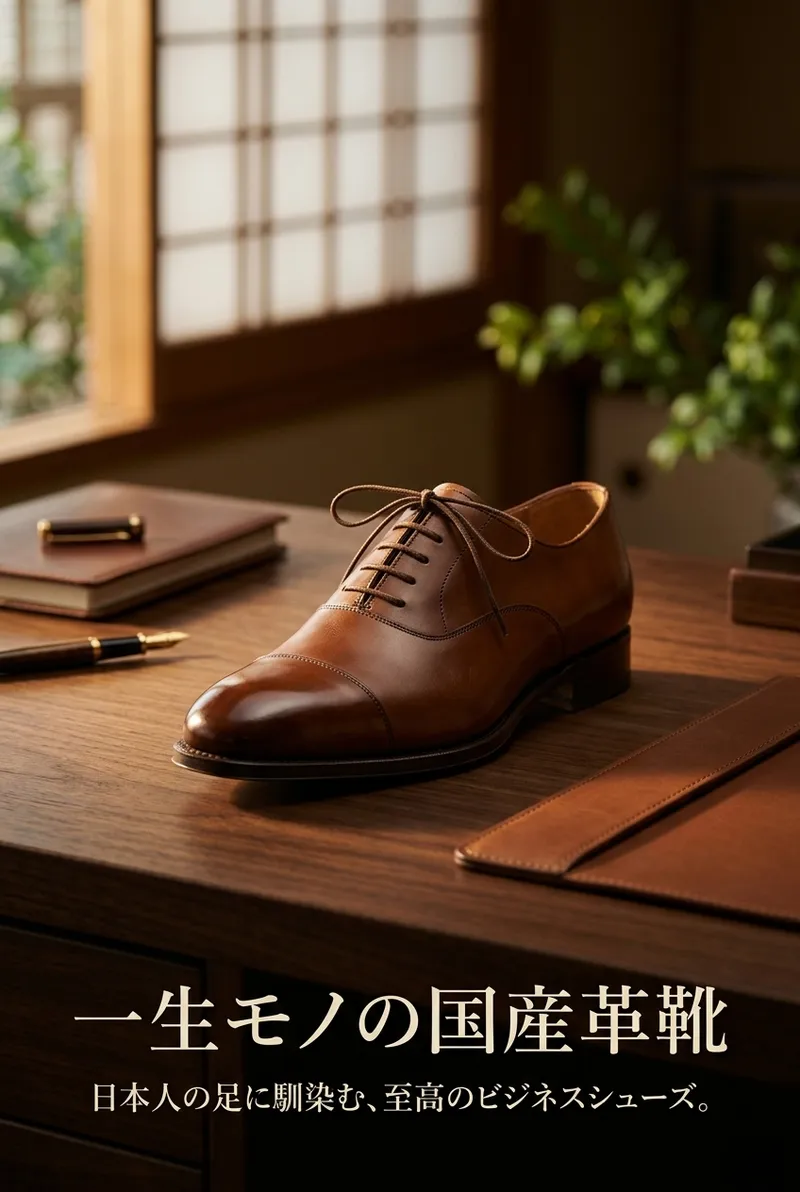
This is the least convenient category on this site, and for the right feet it is worth the inconvenience. Goodyear welted shoes in EEE and EEEE, at half English prices, from an industry that treats wide feet as normal rather than as a problem to be accommodated.
Measure both numbers before you order — length in centimetres and ball circumference in millimetres — and remember the width letters are not the American ones. That single check is the difference between a great pair and an expensive mistake with no returns.
Then shoe trees, alternate days, and resole before the welt goes. Do that and the inconvenience of buying them is a one-off cost spread over twenty years.
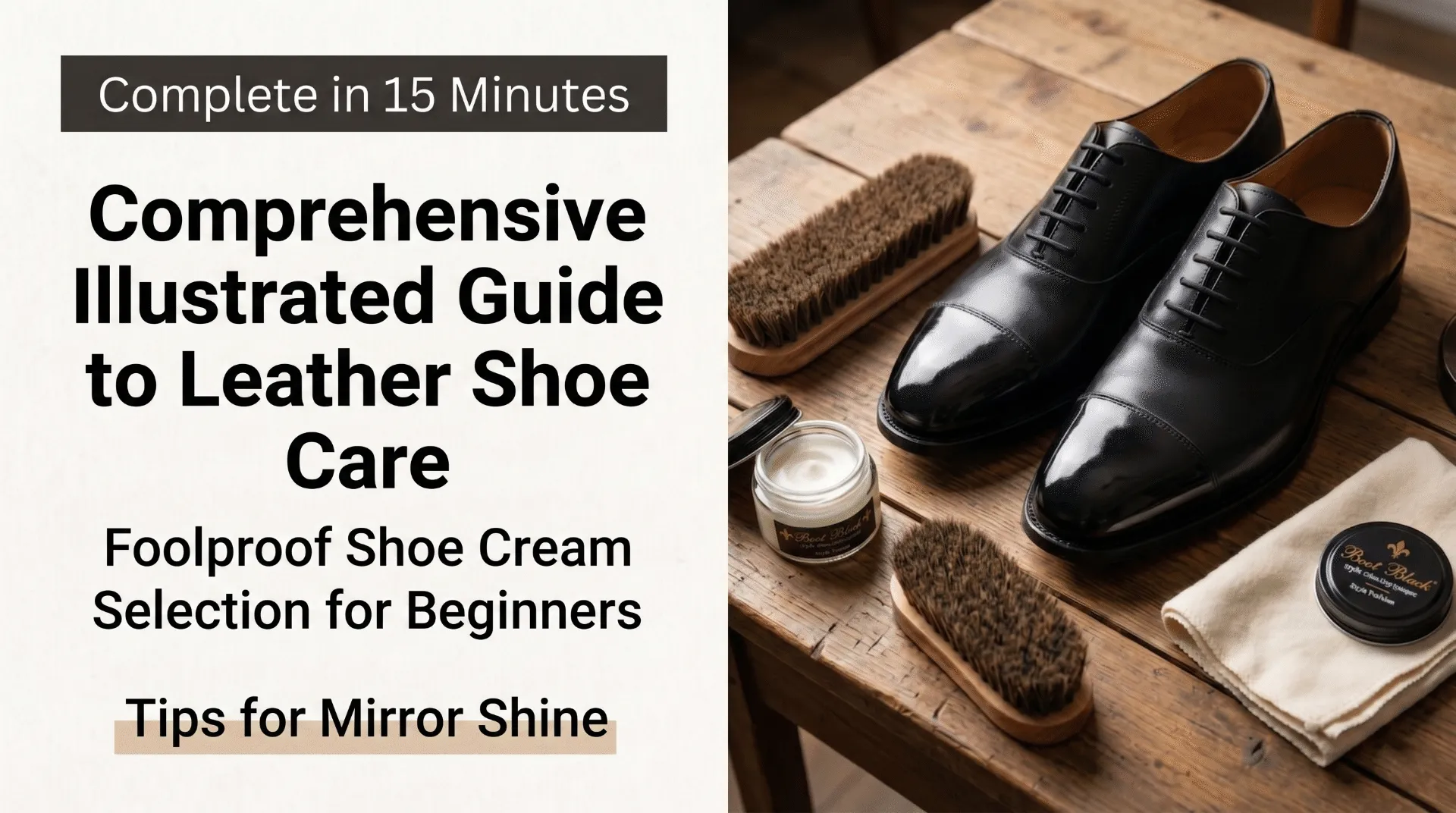
Leather Shoe Care: What Actually Matters
Japanese Leather Wallets: Brands Worth Buying