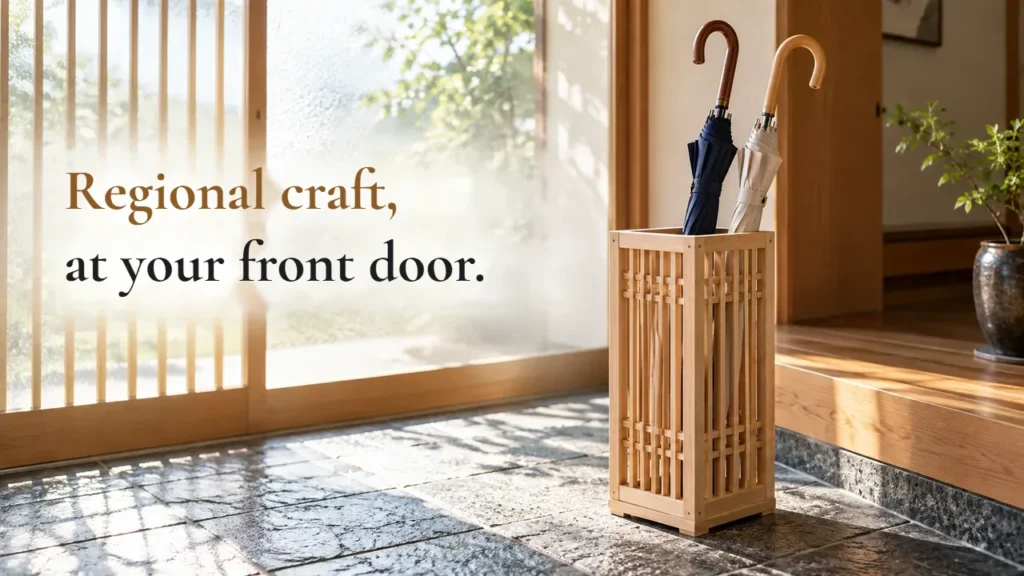
In a Japanese home, the genkan — the entryway where you take off your shoes — is the first thing you see when you open the door, and the umbrella stand stands there.
Something you see every day is worth choosing with care.
Japanese makers bring regional craft to the umbrella stand: a folding-screen and kumiko workshop in Kamo, Niigata, a woodworking town that began when temple carpenters gathered about 1,300 years ago; Shigaraki potters firing clay laid down in a lake bed about 4 million years ago; furniture craftsmen in Asahikawa; and the metalworking town of Tsubame-Sanjo.
This guide covers four Japan-made umbrella stands, and how to choose by entryway depth and number of umbrellas.
Quick Reference: 4 Japan-Made Umbrella Stands at a Glance
| Umbrella stand | Material | Made in | Depth |
|---|---|---|---|
| Lattice stand OM-181 ▾ | Akita cedar | Ominato Bunkichi Shoten (Kamo, Niigata) | 17.6 cm (6.9 in), only 1.2 kg |
| Shigaraki ware stand ▾ | Stoneware | Shigaraki (Koka, Shiga) | 23 cm (9.1 in), solid weight |
| Walnut stand ▾ | Solid walnut | Asahikawa (Hokkaido) | 17 cm (6.7 in) |
| KUROSHIRO steel stand ▾ | Steel | Tsubame-Sanjo (Niigata) | 12 cm (4.7 in), slim |
Click an umbrella stand to jump to it.
1. Why Japanese: Regional Craft for the Face of the Home
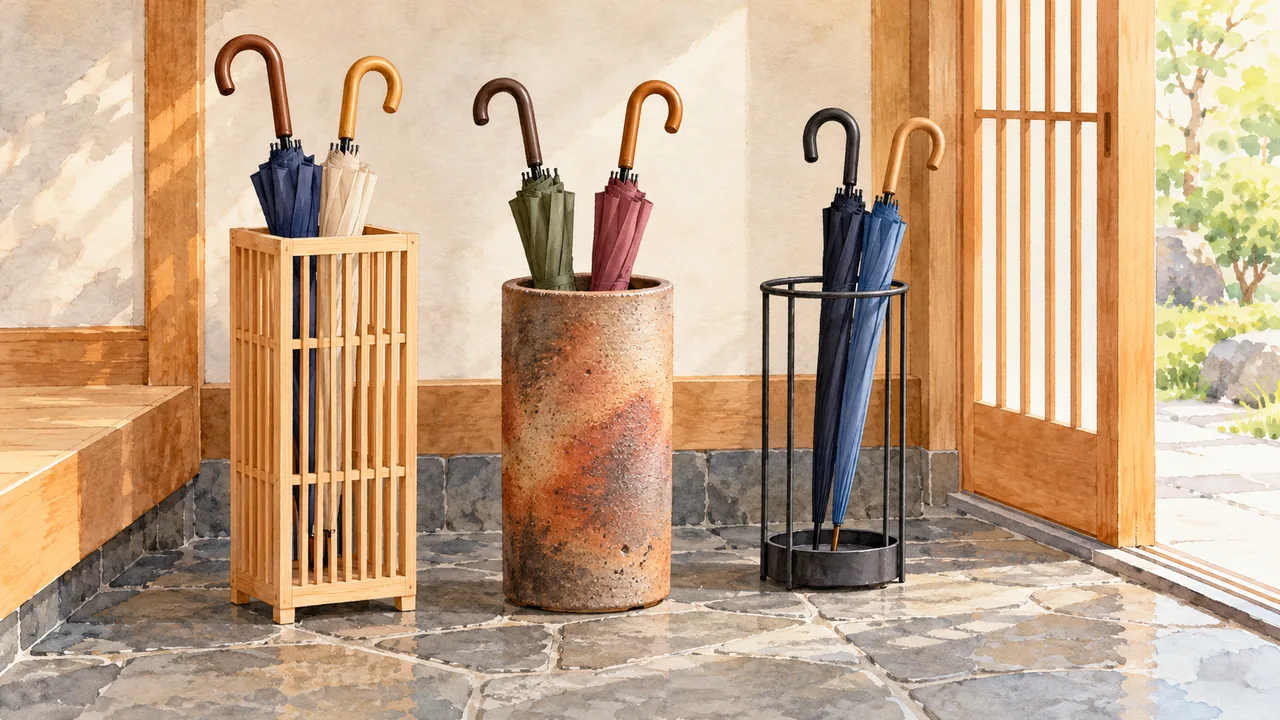
The first thing you see when you come home
An umbrella stand isn't only for rainy days. It's a piece of furniture you see in the genkan every morning and night, and one of the first things a guest sees.
Each of the four stands here grew from a craft its region perfected doing other work: a woodworking shop that made folding screens and kumiko lattice, a pottery town that fired large vessels, furniture craftsmen, and a metalworking town. Choosing the material is choosing that craft.
2. Kamo's Lattice Stand: A Folding-Screen Workshop, in Akita Cedar
A woodworking town that began with temple carpenters
Kamo in Niigata is a woodworking town that began about 1,300 years ago, when temple carpenters gathered to build Aomi Shrine. Known for paulownia chests, folding screens and fittings, it's also called "the little Kyoto of Hokuetsu."
Ominato Bunkichi Shoten has worked wood there for more than 100 years. It began in the early Meiji era making and wholesaling shibugami (persimmon-tannin paper), then made folding screens, Buddhist altar fittings and kumiko — the fitting craft of planing wood to perfect precision and assembling it without nails or glue.
Kamo's folding screens grew from a paper town
Folding screens took root in Kamo partly because papermaking thrived there. Kamo paper is said to have begun as tribute paper made in place of rice tax in the Edo period, and from Meiji to Taisho Kamo produced more paper than anywhere else in Niigata. As the company's head puts it, "Japanese culture is something that can be renewed."
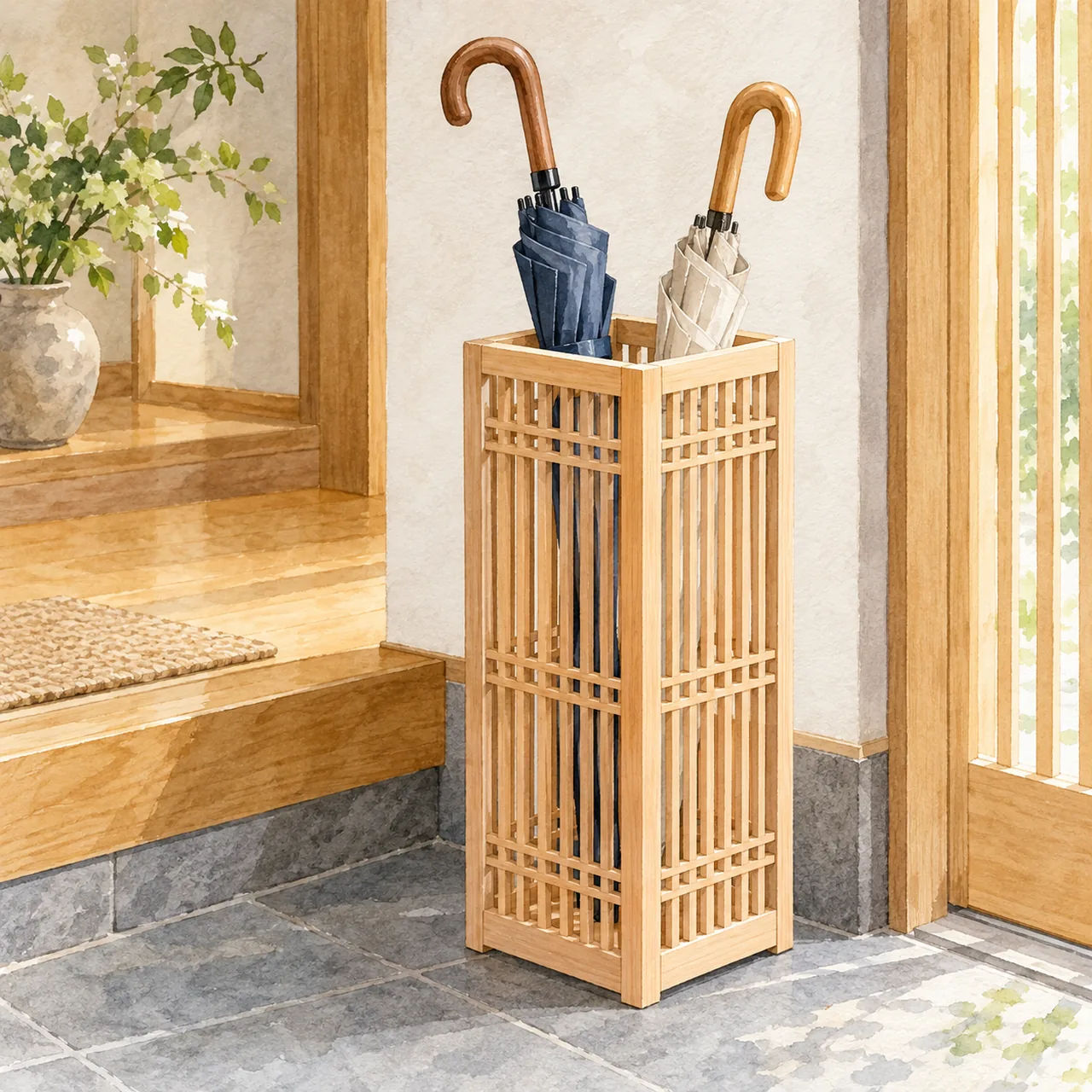
Ominato Bunkichi Shoten Akita Cedar Lattice Umbrella Stand OM-181 — cedar grain through the lattice
A lattice umbrella stand in Japanese Akita cedar, body and bars alike. A slender square that suits a traditional or modern entryway. 30.2 × 17.6 × 60.2 cm (11.9 × 6.9 × 23.7 in).
Only about 1.2 kg (2.6 lb), so it's easy to lift when cleaning, with a removable drip tray. Sold in Japan.
3. Shigaraki Ware: Fired from a 4-Million-Year-Old Lake Bed
A heat-tough clay for small things and large
In Shigaraki, Koka City, Shiga, potters use clay that settled on the bed of a predecessor of Lake Biwa about 4 million years ago. Shiga Prefecture describes it as a dependable clay that gives a rustic surface and warm "hi-iro" (fire color), resists heat, and can be made into small pieces and very large ones.
Shigaraki has fired the tools of daily life through the ages — water jars, mortars, tea wares, braziers — and now umbrella stands, lamps and garden basins. A clay that can fire big pieces is what makes an umbrella stand possible.
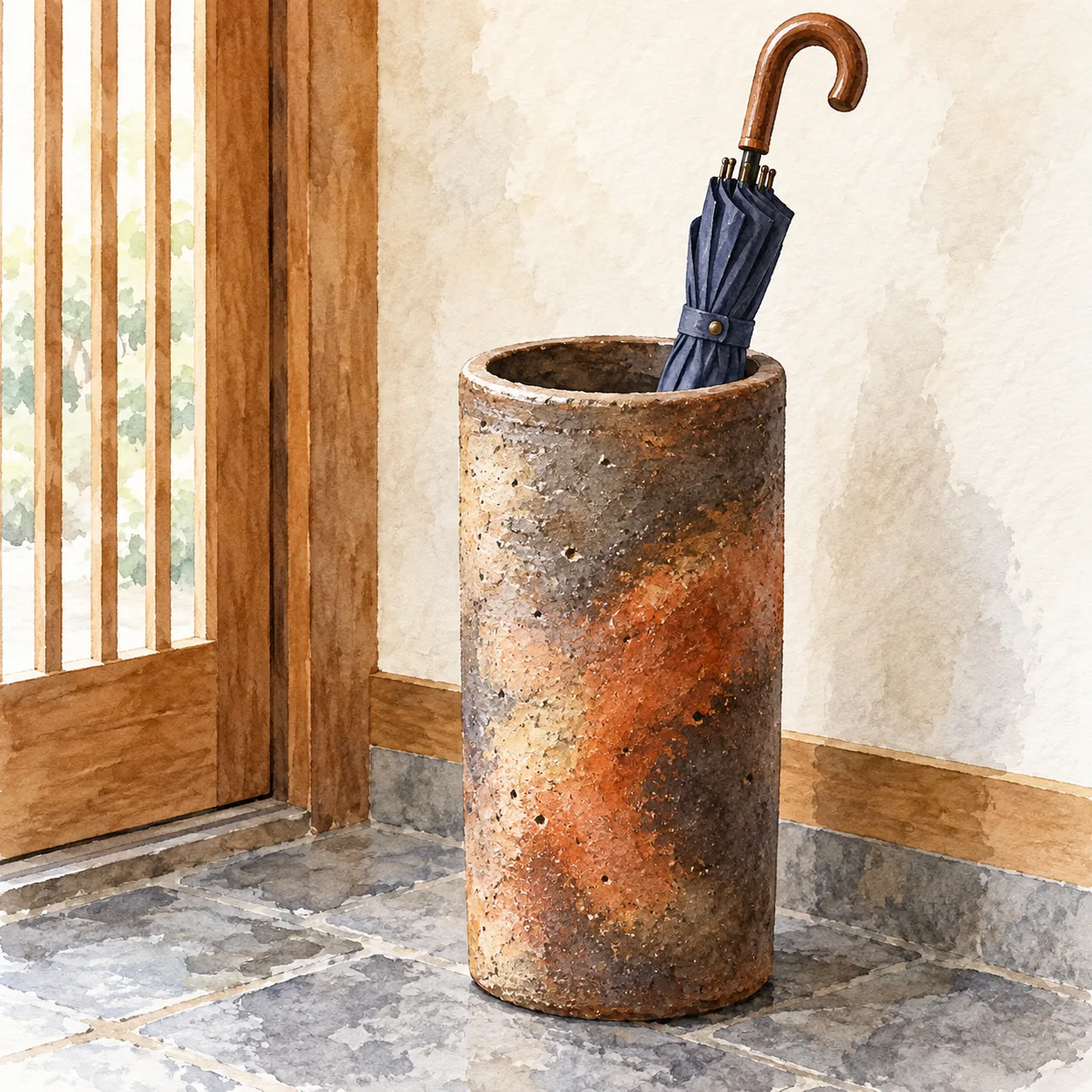
Shigaraki Ware Umbrella Stand, Hi-iro Chirashi — fire color scattered on clay
A Shigaraki umbrella stand that shows off the clay. A cylinder at home in a traditional house or a modern one: 21 × 23 × 40.5 cm (8.3 × 9.1 × 15.9 in), with the heft of fired clay.
Each is handmade, so color, size and shape vary slightly — you get your own fire color. Sold in Japan.
4. Asahikawa Furniture Makers: In Solid Walnut
Made one by one by furniture craftsmen
Asahikawa in Hokkaido is known as a furniture-making region. This umbrella stand is made by hand, one at a time, by an Asahikawa furniture craftsman, in solid walnut — the deep brown grain gives it the presence of a piece of furniture in the entryway.
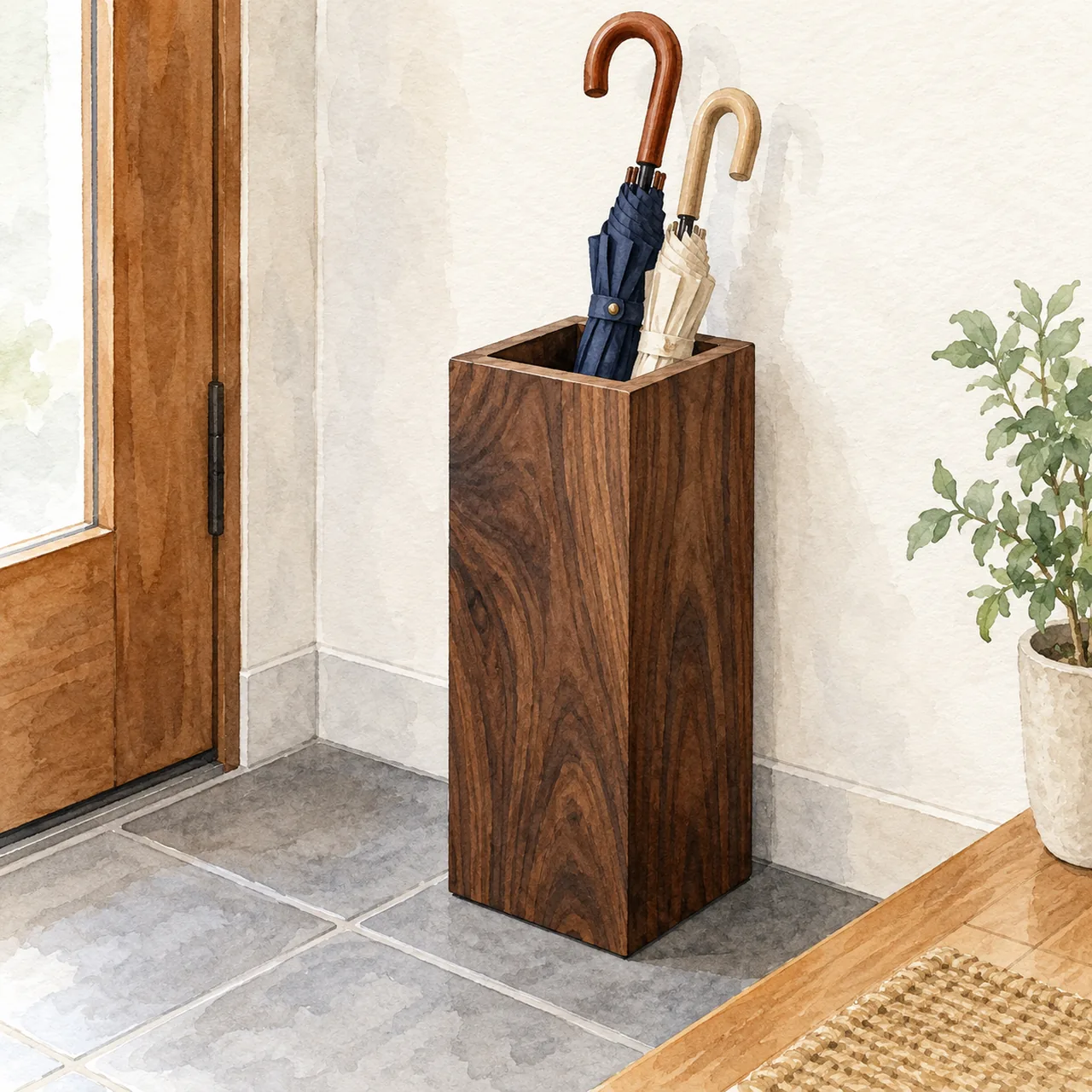
Asahikawa Furniture Craftsman's Umbrella Stand, M, Walnut — furniture for the entryway
Solid walnut, finished by a furniture craftsman. 30 × 17 × 58 cm (11.8 × 6.7 × 22.8 in); made in Japan. A housewarming gift, or a way to match the entryway to your furniture's wood. Sold in Japan.
5. Tsubame-Sanjo Steel: Just 12 cm Deep
A slim frame from a metalworking town
Tsubame-Sanjo in Niigata is known for metalworking. KUROSHIRO's umbrella stand is a simple frame of steel made in Tsubame-Sanjo. Its best feature is a depth of only about 12 cm (4.7 in), so it sits flat against the wall in a narrow entryway. Black or white.
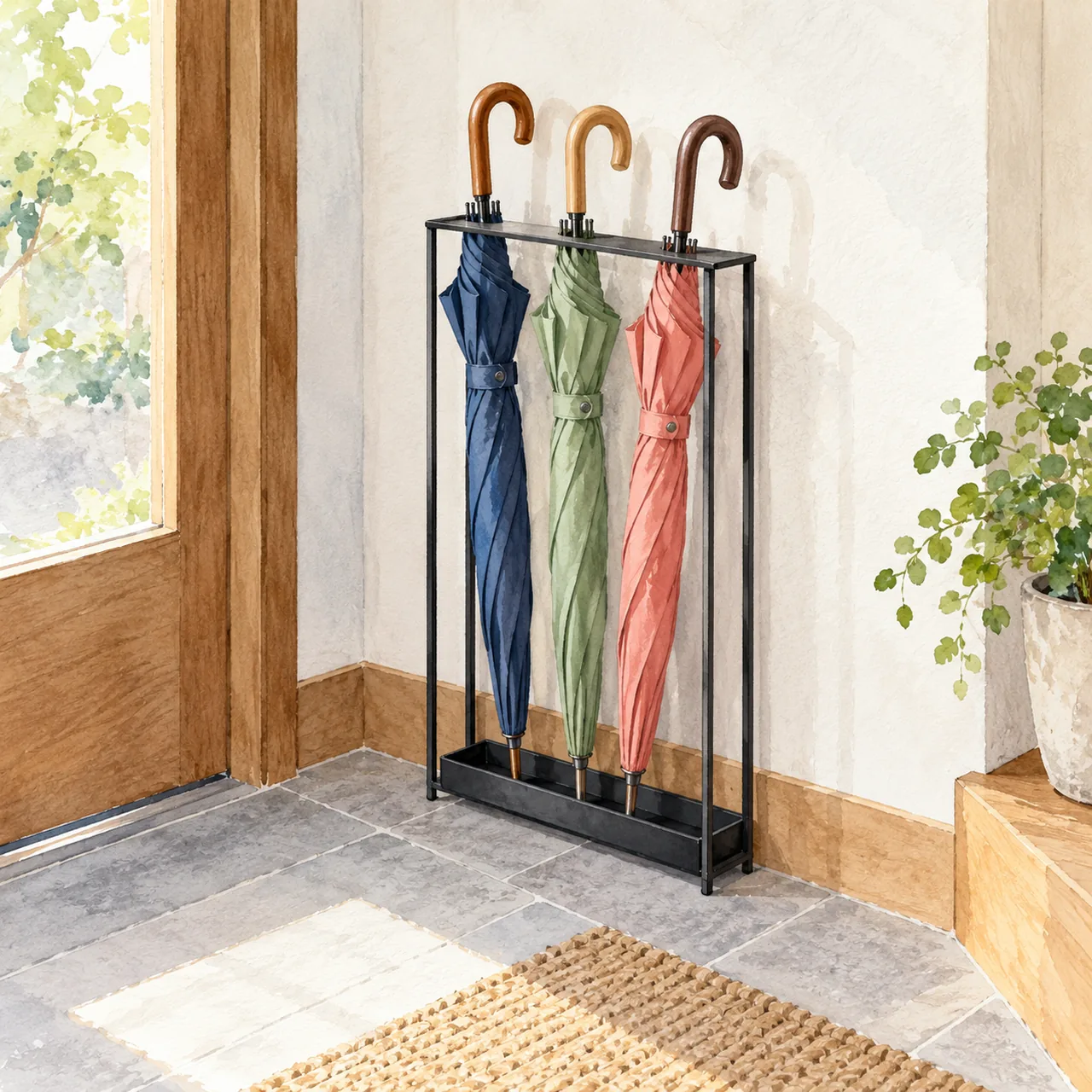
KUROSHIRO Umbrella Stand — against the wall of a narrow entryway
12 cm deep, for one to six umbrellas. About 40 × 12 × 50 cm (15.7 × 4.7 × 19.7 in); country of origin Japan, made in Tsubame-Sanjo. Arrives assembled. With no decoration, your umbrellas' colors become the decoration. Sold in Japan.
6. Choosing and Caring for an Umbrella Stand
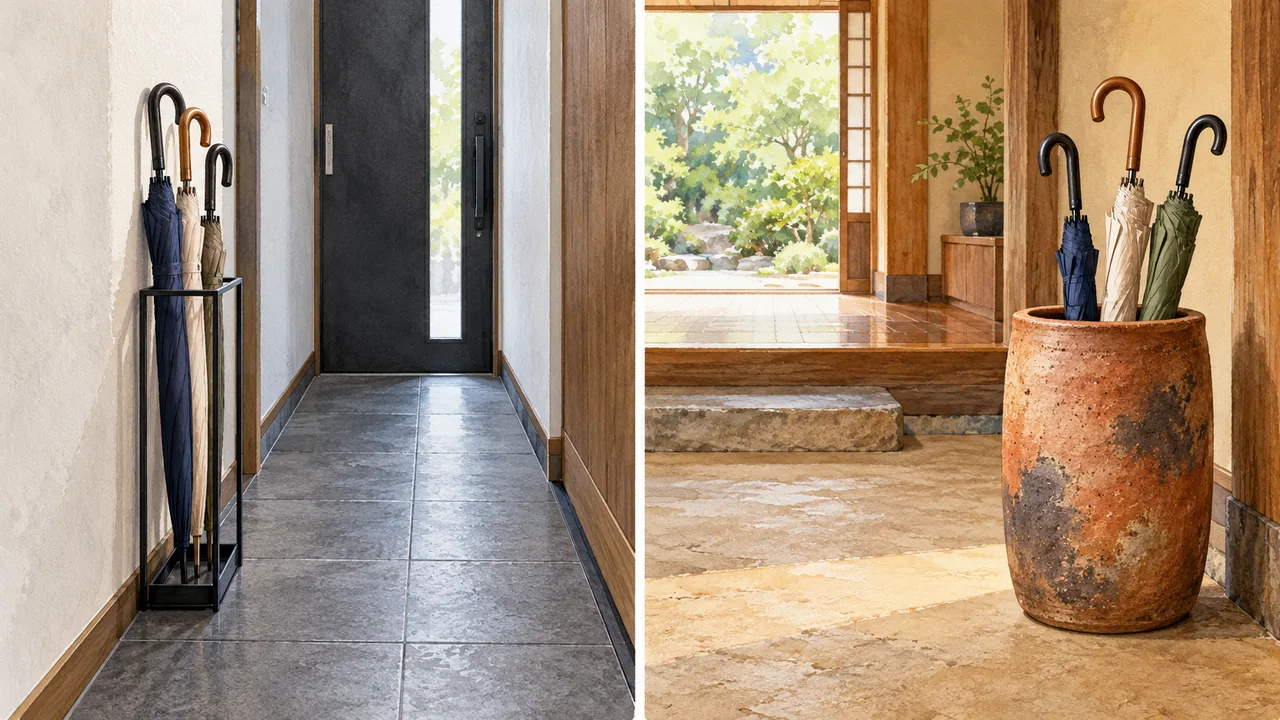
First, measure the depth you have
The first thing to check is how deep a stand your entryway can take. Here, the Tsubame-Sanjo steel is about 12 cm, the cedar and walnut about 17 cm, and the Shigaraki about 23 cm. Narrow entryways suit shallow stands; a broad entry floor shows off a substantial ceramic one. Count the umbrellas you usually keep, too.
Shake off wet umbrellas first
With a drip tray, take it out to dry now and then. Shake wet umbrellas outside before standing them so water doesn't collect. Ceramic stands sit solidly but are heavy — lift with both hands so they don't slip.
Shigaraki's tanuki became famous in 1951
Shigaraki is famous for its ceramic tanuki (raccoon dog) figures. According to Shiga Prefecture, they became known nationwide in 1951, when the Emperor visited Shigaraki and the roadside was lined with tanuki holding flags in welcome — and the Emperor wrote a poem about them. The tanuki carries eight good-luck meanings, such as gaining virtue from the sake flask it holds.
7. Buying a Japanese Umbrella Stand
The four stands above are sold in Japan; we couldn't find them on Amazon.com, and the stands listed there under Japanese brand names didn't state Japan as the place of manufacture. Umbrella stands are bulky to ship, so the realistic route is buying in Japan or through a Japanese online shop that ships abroad.
Look for 傘立て (umbrella stand), 信楽焼 (Shigaraki ware), 秋田杉 (Akita cedar), 燕三条 (Tsubame-Sanjo) and 日本製 (made in Japan).
8. Frequently Asked Questions
Is there a stand for a narrow entryway?
KUROSHIRO's Tsubame-Sanjo stand is only about 12 cm deep. It sits against the wall and holds one to six umbrellas.
Won't a wooden stand be damaged by water?
The Akita cedar stand has a removable drip tray. Take it out to dry now and then, and shake umbrellas off before standing them.
Is every Shigaraki stand different?
Yes — each is handmade, so color, size and shape vary slightly, and the fire color comes out differently every time.
Which is least likely to tip over?
The Shigaraki ceramic stand is heavy and sits solidly. Wood and steel stands are light, which makes them easy to move when cleaning.
Which is best as a housewarming gift?
For a traditional entryway, the Akita cedar lattice or Shigaraki ware; for a modern one, Asahikawa walnut or Tsubame-Sanjo steel.
What kind of woodworking town is Kamo?
A town that began about 1,300 years ago when temple carpenters gathered to build Aomi Shrine. It's known for paulownia chests, folding screens and fittings.
Final Thoughts: Regional Craft at Your Front Door
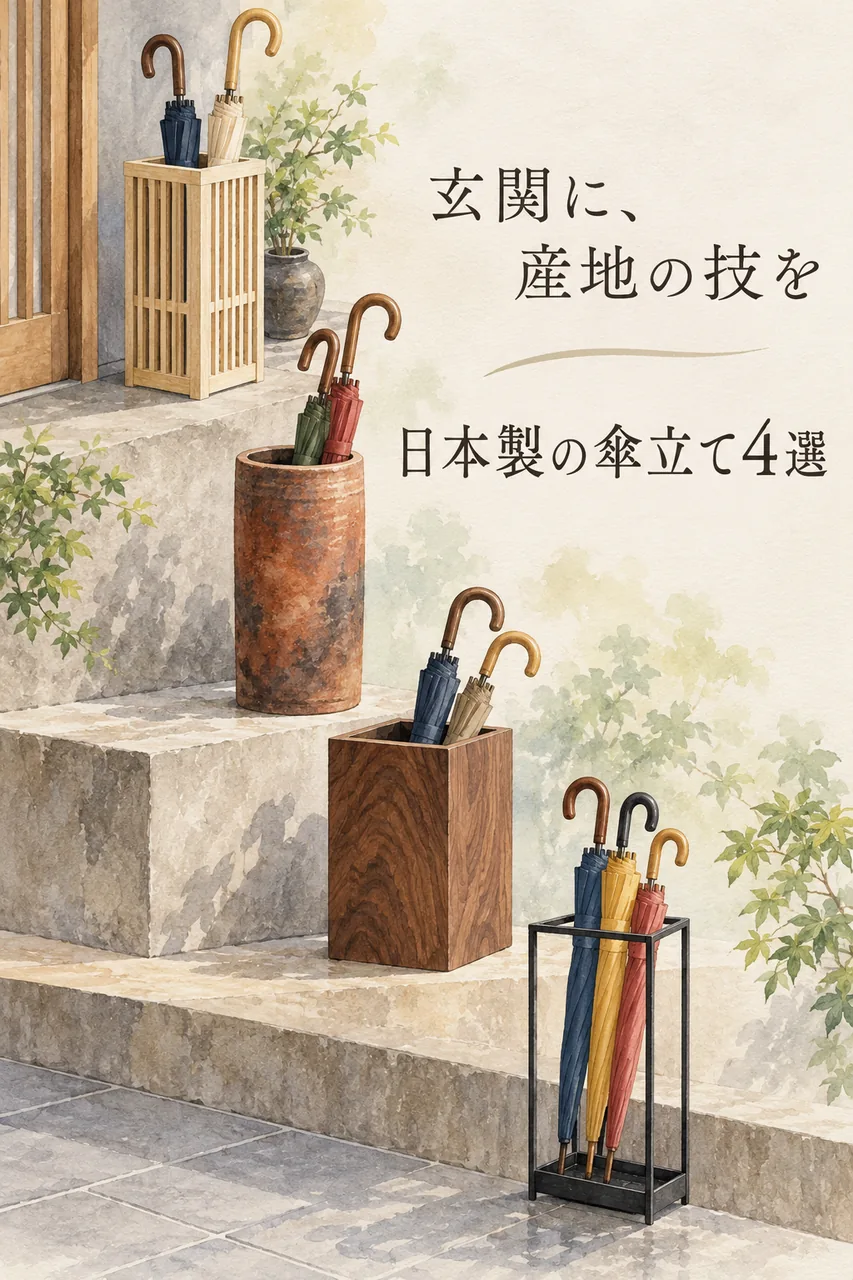
The umbrella stand is the face of the entryway — something you see every day.
Akita cedar lattice from a Kamo folding-screen workshop. Shigaraki ware fired from a 4-million-year-old lake bed. Solid walnut from Asahikawa's furniture makers. Slim steel from Tsubame-Sanjo.
Measure your entryway, and let regional craft greet you when you come home.

Japanese Umbrellas: 7 Best Brands, Compared

Wagasa: Japanese Paper Umbrellas You Can Use in the Rain