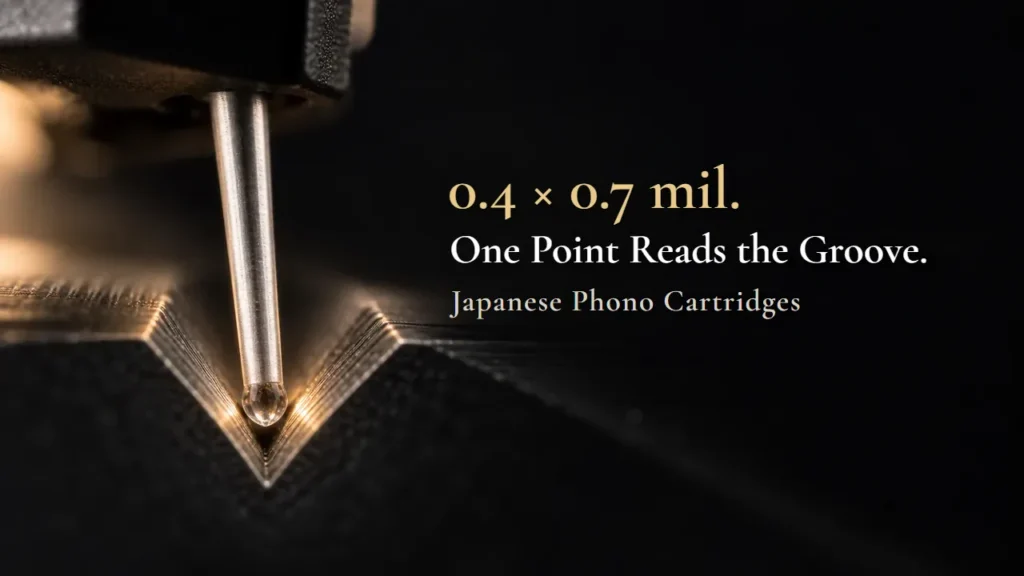
The tip of a phono stylus is polished to 0.4 × 0.7 mil. A mil is a thousandth of an inch, so 0.7 mil is about 18 micrometres — 0.018 mm. At that single point, it reads the bumps cut into the walls of a record's groove.
And thinner isn't the whole story. The shape the tip is polished to changes how it meets the groove: at a point, across a surface, or along a line. A stylus that touches along a line reads faithfully and wears more slowly — and one of those line-contact styli was invented by a Japanese engineer in the 1970s, shaped from the diamond up to reproduce 40 kHz, beyond human hearing. This guide walks through stylus shapes, cantilever materials and what changes at each step, checked against the makers' official specs.
Quick Reference: One Change per Step
| Model | Stylus | Cantilever | Tracking force | Frequency response |
|---|---|---|---|---|
| MP-110 ▾ | 0.4×0.7 mil elliptical, bonded diamond | Aluminium alloy | 1.5–2.0 g | 20 Hz–20 kHz |
| MP-200 ▾ | 0.4×0.7 mil elliptical, diamond | Boron | 1.5–2.0 g | 20 Hz–23 kHz |
| MP-500 ▾ | Line contact, diamond | Boron | 1.3–1.8 g | 20 Hz–25 kHz |
| How to read it | 110→200 keeps the stylus and changes only the cantilever; 200→500 keeps the cantilever and changes only the stylus. Start with stylus shape ▾ | |||
Figures are from Nagaoka's official specification tables.
1. Will It Work With Your Turntable and Amp?
Short answer: the Nagaoka MP cartridges work with any standard phono (MM) input; the Denon DL-103 is a moving-coil (MC) cartridge and needs an MC input, a step-up transformer or a head amp. Cartridges aren't powered, so voltage doesn't matter anywhere in the world.
| Cartridge | Type | What your amp needs | Stylus replacement |
|---|---|---|---|
| Nagaoka MP-110 / 200 / 500 | MP (moving permalloy) | A normal phono (MM) input | Pull out and swap yourself |
| Denon DL-103 / 103R | MC (moving coil) | An MC input, step-up transformer or head amp | Not user-replaceable; ask the maker |
Both mount on a standard half-inch headshell. Before buying the DL-103, check whether your amplifier or phono stage has an MC setting.
2. Why Japanese: A Point, a Surface or a Line
A Conical Stylus Is Polished to a Sphere
The most basic tip is the conical (spherical) stylus. Audio-Technica explains: "a stylus whose tip is conical, with the end of the cone polished to a sphere — a radius of 0.7 mil is standard." Being a sphere, it touches the groove wall at a point; with a small contact area, the force on that point is large.
Polish It Elliptical, and It Touches a Surface
Next comes the elliptical stylus: "polishing the tip into an ellipse that's flatter seen from the front increases the contact area between groove and tip, aiming for more stable playback." That's what 0.4 × 0.7 mil describes — thin from the front, broad from the side, thinned only in the direction that follows the groove wall. With more contact, it misses fewer fine undulations, which is why it's said to reach higher than a conical tip.
A Line-Contact Stylus Is Faithful — and Wears Less
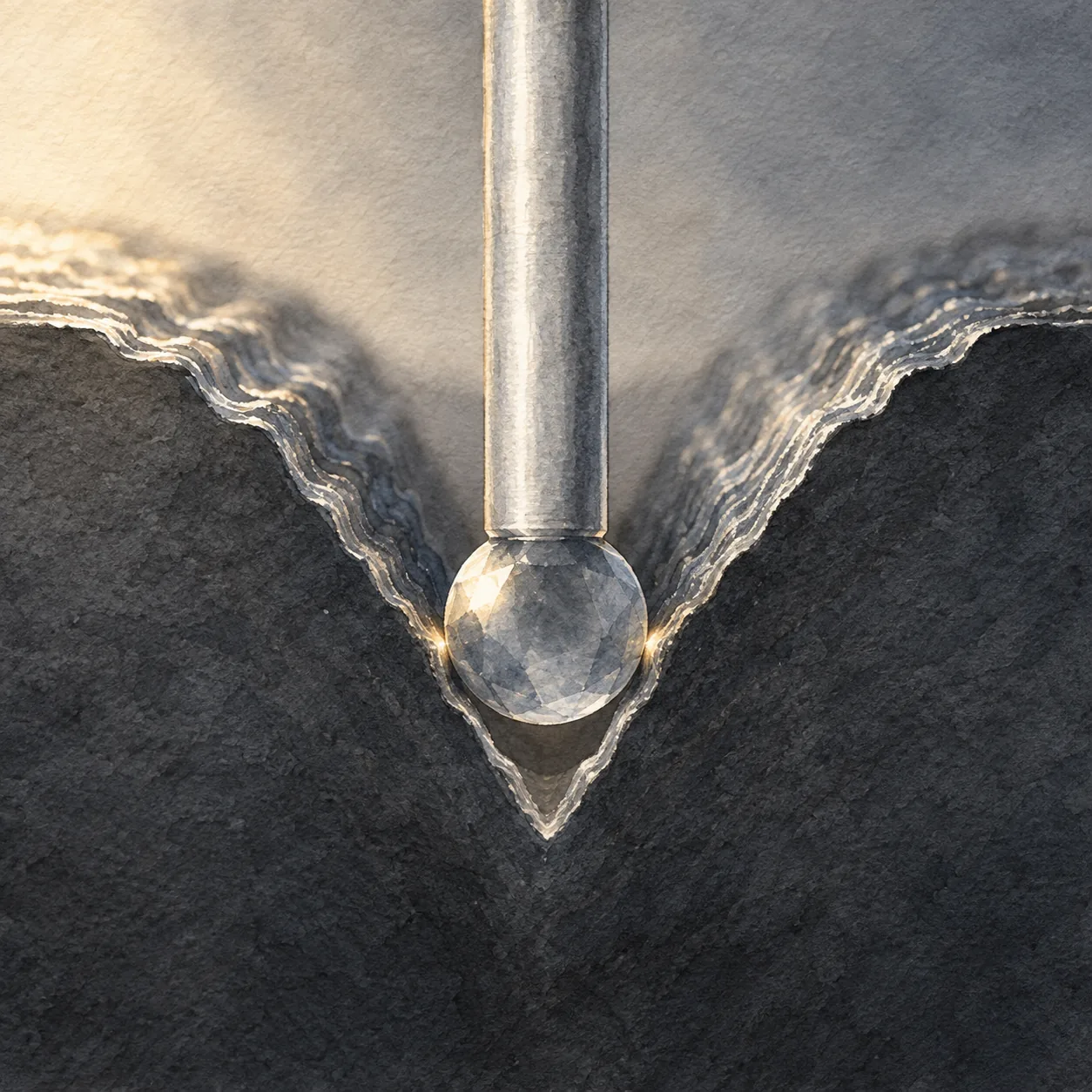
Beyond that is the line-contact stylus: "by polishing the tip into a very complex shape, it can touch the groove in a long, streak-like contact." Not a point, not a patch, but a tall line along the groove wall — so it "can read an even more faithful music signal from the groove." And: "with a larger contact area, the load per unit area on the tip is lighter, which can greatly extend its life." The stylus that reads best is also the one that lasts.
Did you know: The Shibata stylus is named after a person
One line-contact shape is the Shibata stylus. Audio-Technica writes: "a tip shape developed by a Japanese engineer, Norio Shibata." And why: "When Japanese audio makers announced four-channel stereo in the 1970s, some systems couldn't reproduce four channels correctly without reaching 40 kHz, so this tip was developed to extend the high range." 40 kHz is outside what people can hear as sound — yet without pulling that band from the groove, four-channel playback didn't work, so they reshaped the diamond. Four-channel stereo is gone; the tip shape it gave birth to lives on in today's cartridges. (Between elliptical and line contact there was also a "super-elliptical" tip — higher resolution, but shorter life. Line contact answered both at once.)
3. The Cantilever Has Its Own Grades
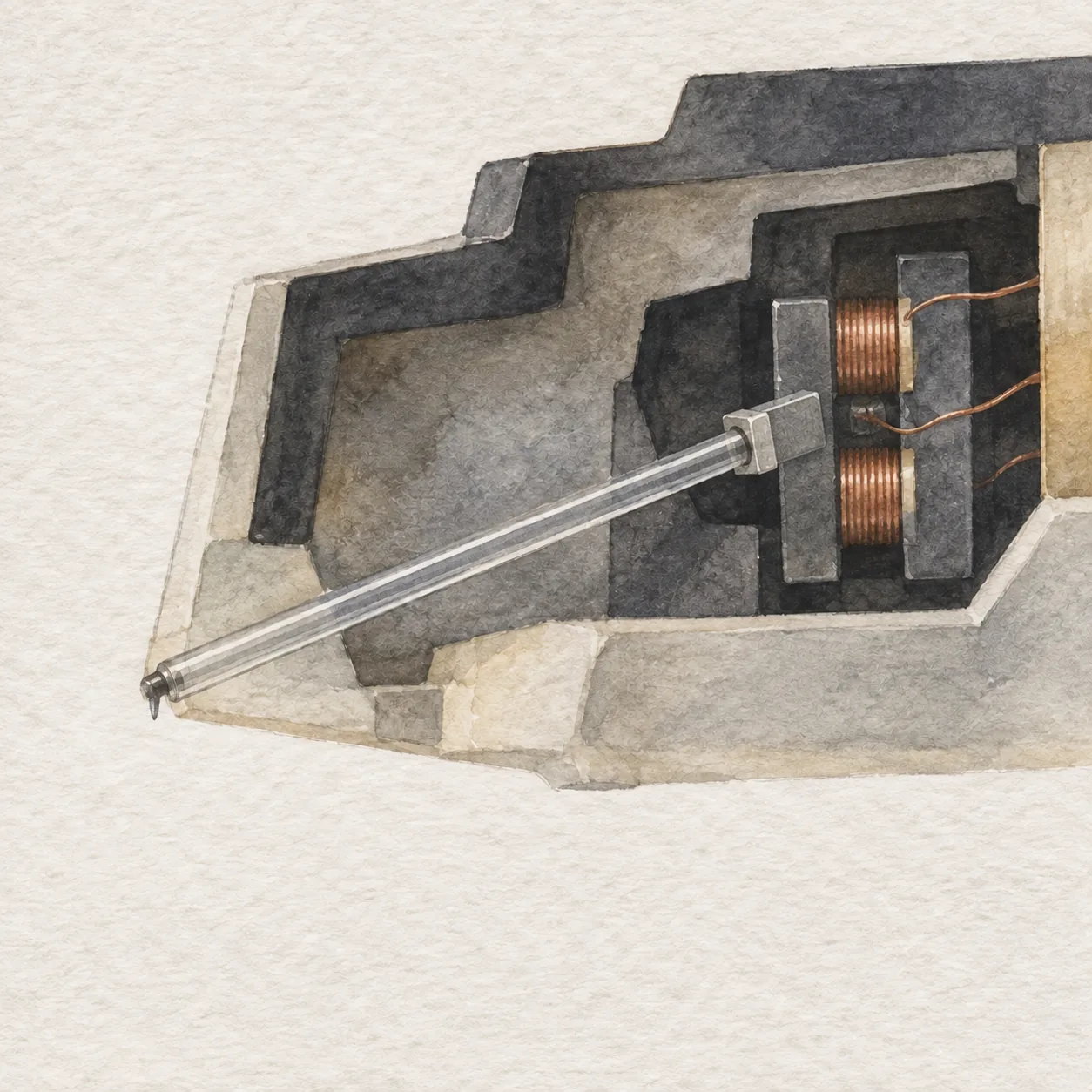
The tip sits on the end of a fine rod called the cantilever, which carries the vibration picked up from the groove back to the generator. Too heavy, and it can't follow fine movements; too soft, and the vibration dulls on the way. It has to be light and stiff at once.
Nagaoka's MP series uses aluminium alloy or boron. The MP-200's description says: "The cantilever uses boron, tracing the groove accurately." And the "MP" itself stands for Moving Permalloy: "MM cartridges attach a heavy magnet to the cantilever, but MP attaches a piece of permalloy, lighter than a magnet, giving the cantilever more freedom of movement for delicate yet high output." Material and parts alike are made light, so the 0.018 mm movement isn't blunted.
4. Nagaoka MP Series: One Change per Step
Nagaoka publishes a spec table for each model. Line up three, and each step up changes exactly one item. MP-110 → MP-200: same tip; only the cantilever changes, aluminium alloy to boron. MP-200 → MP-500: same cantilever; only the tip changes, elliptical to line contact. And the upper frequency limit climbs 20,000, 23,000, 25,000 Hz — each change showing straight up in the numbers.
Nagaoka MP-110: It Starts With a 0.4 × 0.7 mil Ellipse
Elliptical 0.4 × 0.7 mil bonded diamond on an aluminium-alloy cantilever; 1.5–2.0 g tracking, 20 Hz–20 kHz. The entry of the three — but already on the surface-contact side, not point contact. Introduced as the successor to the MP-11, which won a grand prix in Europe.
Nagaoka MP-110 Phono Cartridge
Loading product details…
Nagaoka MP-200: Same Tip, Boron Cantilever
The same 0.4 × 0.7 mil ellipse as the MP-110; only the cantilever changes, to boron, with the same 1.5–2.0 g. Just switching the rod lifts the upper limit from 20,000 to 23,000 Hz — one step that shows what changing only the transmission does.
Nagaoka MP-500: Same Cantilever, Line-Contact Tip
Boron stays; the tip becomes a line-contact diamond, and the upper limit reaches 25,000 Hz. Tracking force also drops a step to 1.3–1.8 g — touching along a line, it needs less pressure. It's the only one of the three where the numbers move lighter. Nagaoka's description: "overwhelming resolution… almost no sense of distortion, like standing on the conductor's podium."
Two Things to Read in a Spec Table
First, read the tip description as written: the MP-110 says "bonded diamond," the MP-200 says "diamond." Different words mean a difference. Second, tracking force — set it outside the range and the tip can't trace the groove properly. It differs by model, so note it when you buy.
5. A Diamond-Cutting Company That Made Styli
Nagaoka is in Higashine, Yamagata, established in 1969. Its company profile says: "Since our founding, we have built our record around the precision machining of gemstones." It didn't start working diamond to make styli — a company that worked diamond made styli. Its business today lists carbide cutters, diamond tools, measuring probes and micro-precision parts alongside styli: cutting hard things to the micron, of which the phono stylus is one.
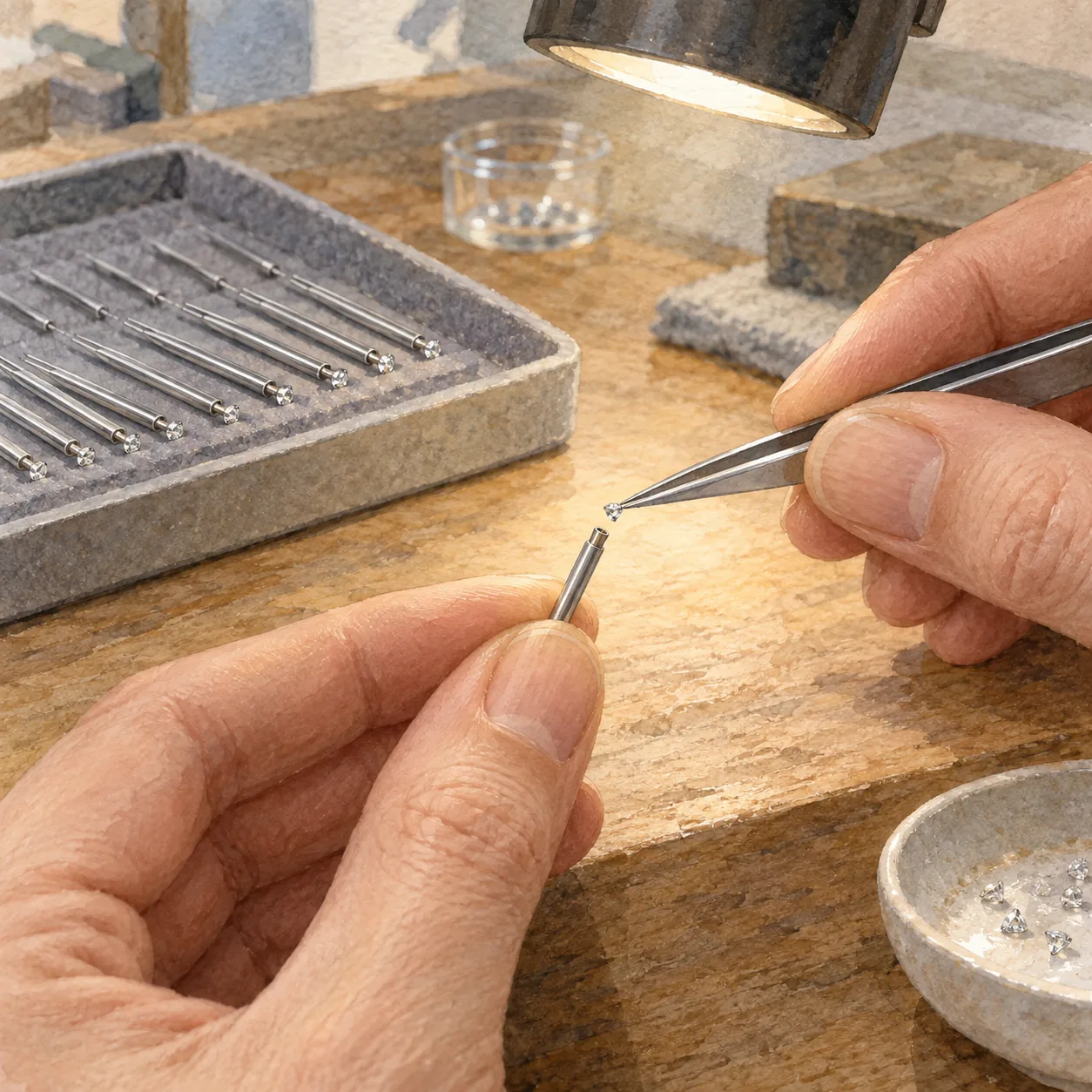
Its product page describes the process: "Drawing from sheet, forming aluminium pipe, welding the diamond, polishing — every step is 100% inspected, each one made by hand." Not sampling — every piece. When you're polishing a 0.018 mm sphere, any one out of tolerance can't read the groove. The same page adds that Nagaoka is "the only maker able to produce everything from the record groove to the amplifier connection in-house."
Nagaoka JN-P110 Replacement Stylus: Renew Just the Tip
The replacement stylus for the MP-110 — cantilever and tip in one piece that pulls out of the body and slides back in. Only the part touching the groove wears; the body with the generator keeps going. Note this model number when you buy the body — it's numbered differently and takes time to find later.
Nagaoka JN-P110 Replacement Stylus (MP-110)
Loading product details…
Nagaoka JN-P200 Replacement Stylus: New Boron Cantilever Included
For the MP-200. Swap it in and the boron cantilever is new too — cantilevers tire over long use, and an all-in-one replacement renews both together.
Nagaoka JN-P200 Replacement Stylus (MP-200)
Loading product details…
6. Denon DL-103: Built for Broadcasters, Unchanged Since 1964
Denon's DL-103 was developed in 1964 with NHK's cooperation to meet the specifications broadcast equipment required, and delivered to NHK for professional use that same year. What a broadcaster wanted was good sound and the same behaviour every day — reading the groove tomorrow exactly as it did yesterday, however many thousands of plays. Stability and reliability weighed as much as sound.
For fifty years, 1964 to 2014, it was made under the same model number without changing performance or specifications, becoming the standard cartridge of Japan's broadcasters. Today it's assembled by hand, one at a time, at Denon's own factory, Shirakawa Audio Works in Fukushima. A spec set over sixty years ago still holds — which says it was refined to the point where nothing needed changing before it was released.
Denon DL-103: The Spec Set for Broadcasters
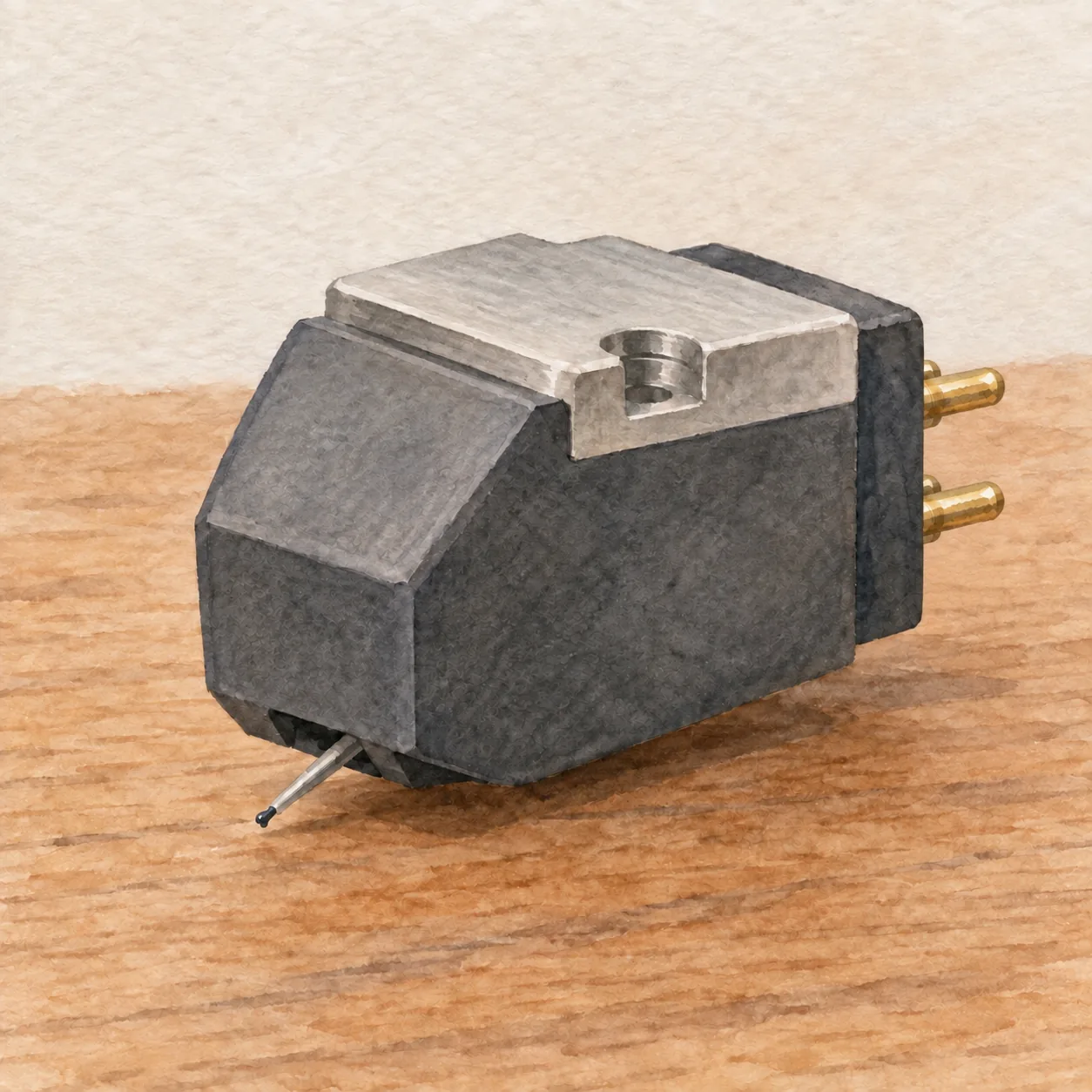
An MC cartridge made in 1964 and still sold under the same model number, assembled at Shirakawa Audio Works. MC output is low, so you may need a step-up transformer or head amp; check your amp for an MC input first. The stylus can't be swapped by the user — when it wears, the maker replaces it. A cartridge you choose once and live with.
Denon DL-103 MC Phono Cartridge
Loading product details…
Denon DL-103R: The Coil Copper Changed
A derivative of the DL-103 with high-purity copper in the coil, almost identical in form and made in the same factory. You can start with the standard model and compare later.
Denon DL-103R MC Phono Cartridge
Loading product details…
7. A Worn Stylus Can't Read the Groove
A tip performs because it's polished to a set shape. As it wears, it can no longer meet the groove as designed. It only wears while it's running in the groove, so playing hours, not years owned, decide when it's due: an occasional listener's stylus lasts for years; a daily spinner's comes due sooner. Replacing it isn't about saving money — it's about getting back the precision you bought.
Dust collects on the tip; running it with dust trapped strains both stylus and record. Brush with a stylus cleaner from back to front, in one direction only — scrubbing sideways or back and forth can bend the fine cantilever. Brush the record before playing too; looking after a stylus is mostly looking after your records. And note two things when you buy: the replacement stylus model number, and the tracking force (1.5–2.0 g for MP-110 and MP-200, 1.3–1.8 g for MP-500).
8. Frequently Asked Questions
Conical or elliptical?
Elliptical touches more of the groove, missing fewer fine details and reaching higher than conical. Many entry cartridges today are already elliptical — check the tip description.
Do line-contact styli really last longer?
Yes — more contact area means lighter load per unit area, which can greatly extend life. Fidelity and lifespan rise together, which is unusual; the old super-elliptical traded life for resolution.
Does the cantilever material matter that much?
Nagaoka's MP-110 and MP-200 share a tip and differ only in cantilever — aluminium alloy vs boron — and the upper limit moves from 20,000 to 23,000 Hz. The lighter and stiffer the rod, the more directly the tip's motion carries through.
Do I have to set tracking force exactly?
Keep it within the stated range. Too light and the tip can't trace properly; too heavy and both stylus and record wear faster. Set it on the tonearm from the manual's figure.
Can I replace the stylus myself?
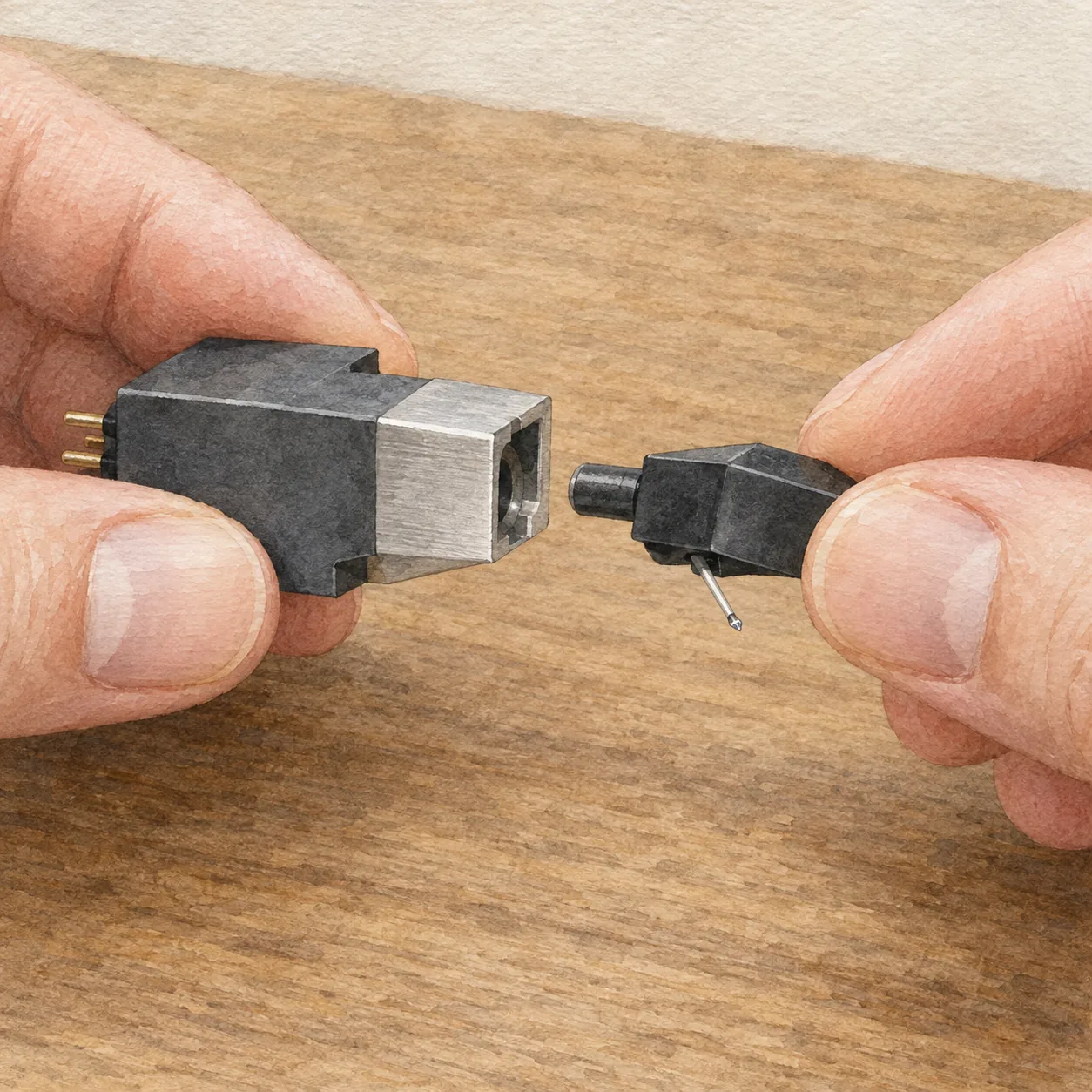
With MP and MM types, yes — pull the old one out, push the new one in, no tools needed. MC types like the DL-103 generally can't be; the maker does it.
How do I know the stylus is worn?
It's said to show as a clouded sound or less extended highs — but it changes gradually and is hard to notice while listening. Keeping a rough count of playing hours is more reliable; a shop can also inspect the tip.
Final Thoughts: Choose by How It Meets the Groove
Point, surface, line: the tip's shape decides how it meets the groove. Line contact reads more faithfully and lasts longer — and one such shape, the Shibata stylus, was invented by a Japanese engineer in the 1970s to reach 40 kHz.
Nagaoka's MP series changes one thing per step — cantilever, then tip — and the numbers climb with it, made with 100% inspection by a Yamagata company that began by cutting gemstones. Denon's DL-103 has kept a 1964 broadcast spec, now hand-assembled in Fukushima.
Read the tip shape, the cantilever and the tracking force — and the spec table starts to make sense.

Japanese Headphones: From the E3000 to Flagships

HHKB and Realforce: The Layout Decides, Not Topre