Why Japanese Kids Go to School Alone (From Age Six)
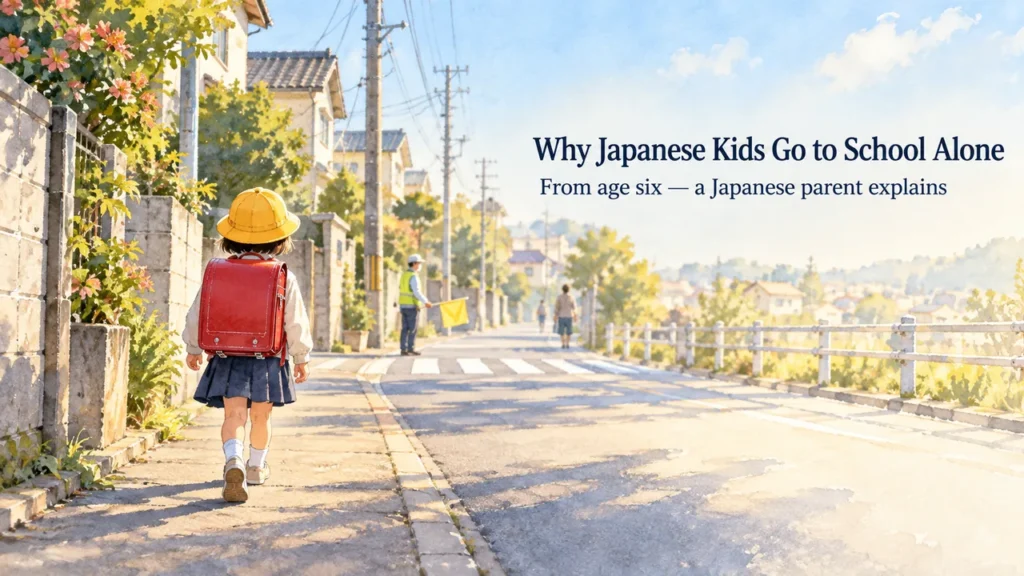
On a weekday morning in Japan, you may see a small child riding the train alone — school
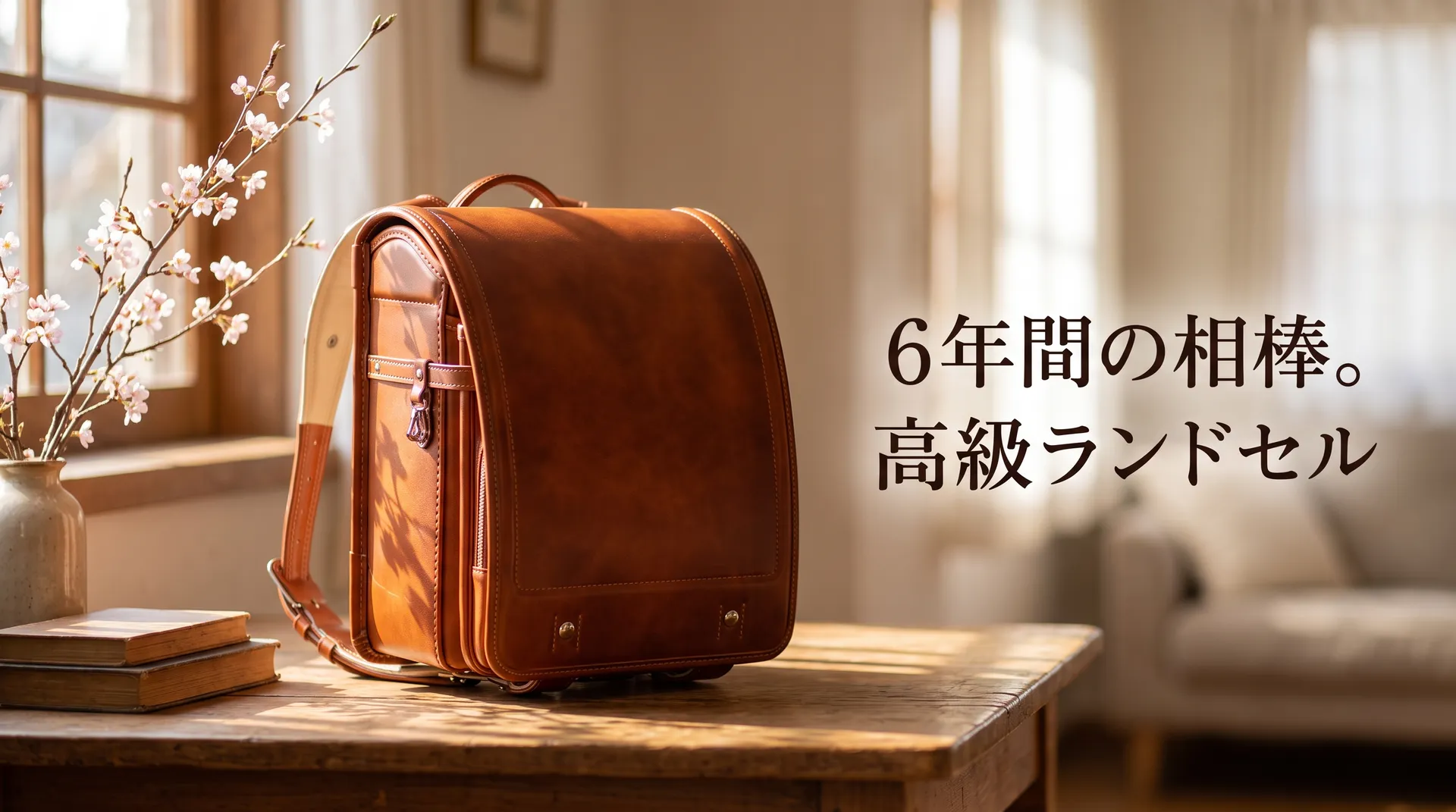
uniform, yellow hat, a randoseru backpack that looks bigger than they are. No parent anywhere nearby.
If you have watched Old Enough! on Netflix, you have seen toddlers sent out on errands by
themselves, and you may have wondered how much of it is real.
Here is the short answer, from a Japanese parent who walked to school alone from first grade:
Japanese kids are not unusually brave. Their schools are close, their routes are watched,
and they are prepared for it step by step — and all of that is so ordinary in Japan that
hardly anyone thinks of it as a system.
A friend of mine teaches at an elementary school in Japan. Some time ago, my friend had the chance
to spend time with a group of American teachers. What surprised them most in Japan was
exactly this sight: young children commuting to school by train with no adults. They were so
worried that they nearly went over to talk to one of the children. Then someone in Japan gave them a
piece of advice:
"If you do that, people here will think you are the suspicious one."
To Japanese people, it is simply an everyday scene. From the outside, apparently, it is anything but.
So why can a six-year-old in Japan go to school alone? I want to answer that as someone who grew up
here, and who is now the parent doing the sending off.
I Walked to School Alone from First Grade, Too
The kids on trains stand out. But most Japanese elementary school children simply walk to school from home. I will come back to the train kids later.
Some of you reading this may come from places where children walking to school alone is perfectly normal. Even so, I want to share my own story — one ordinary childhood in one ordinary Japanese family.
I went to elementary school in the countryside. Well, the region was rural, but the house we lived in was in a brand-new residential development at the time. The walk to school took about 25 minutes.
On the very first day, of course, my mother walked there with me. From the next day on, I went alone. If I happened to meet a friend on the way, we walked together; if not, I walked by myself. Once I got used to it, that was all there was to it. It never felt like I was doing anything special.
That doesn't mean it was easy from the start.
I clearly remember one afternoon, walking home alone, when I started to cry. I was lonely.
A few weeks into first grade, the shortened school days end and the regular timetable begins, so you get home much later than before. The randoseru, now packed with textbooks, is heavy. And home is 25 minutes away. I was a small, slight six-year-old, and it was a kind of tiredness I had never felt before.
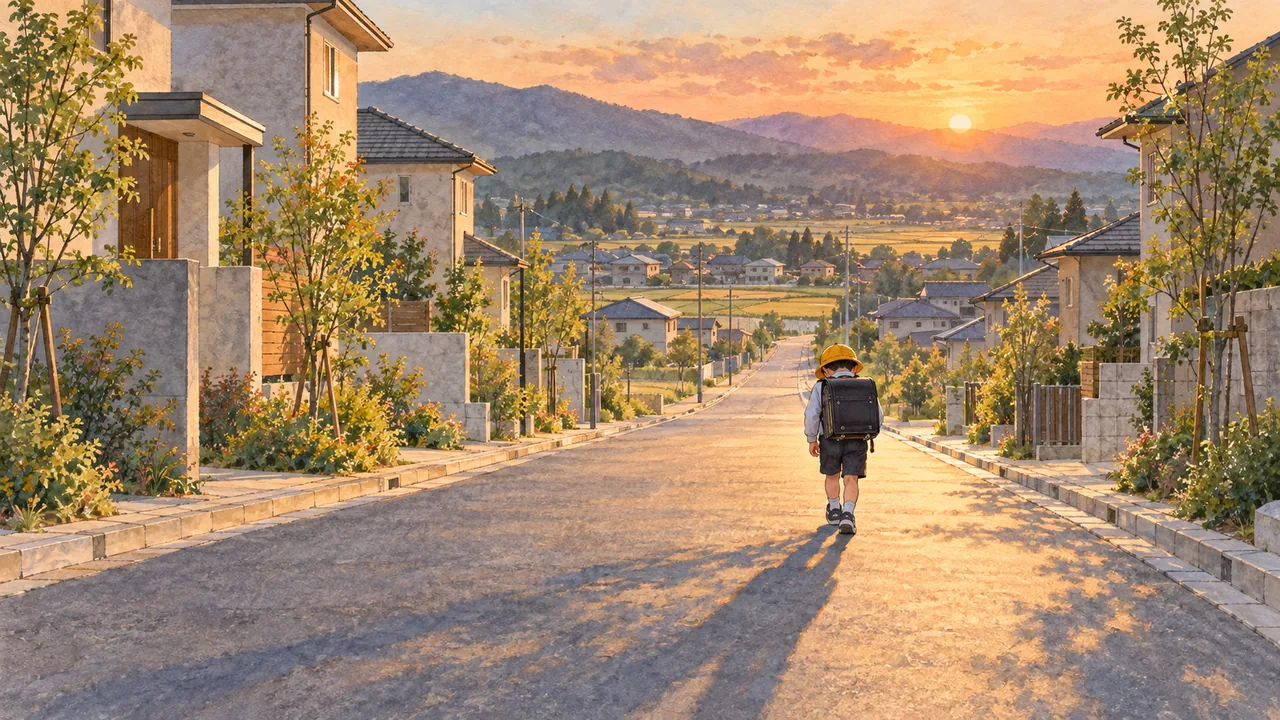
When I finally got home in tears, my mother hugged me. I still remember how warm that felt.
And the next morning, without a hint of mercy, she sent me off to school again.
But I remember that morning, too. I left the house having decided that today, I would not cry.
The School Is Within a Child's Walk
So why can a six-year-old get to school alone? People often say, "Because Japan is safe." I think that is part of it. But it only explains half.
The first reason is simpler: the school is close.
Japanese public elementary schools are spread out so that each one serves an area children can cover on foot. Where you live decides which school you go to, and that area is, roughly, within a child's walking distance. Some kids walk 25 minutes like I did; in a city, some are there in under five.
There is no starting assumption that you will drive your child to a school far away. A school is something in your neighborhood.
That said, even this is starting to change.
Japan's population is aging fast and the number of children is falling, so elementary schools are closing one after another across the country. In my own town, two elementary schools were closed and merged into the largest one in the area — the school my son attends.
Fewer schools means a longer way to school. For the children who now come from distant neighborhoods, our town introduced a school bus. Even in Japan, "a school you can walk to" is slowly becoming something you can no longer take for granted.
Alone, but Never Really on Their Own
The second reason is that there are adults on the road.
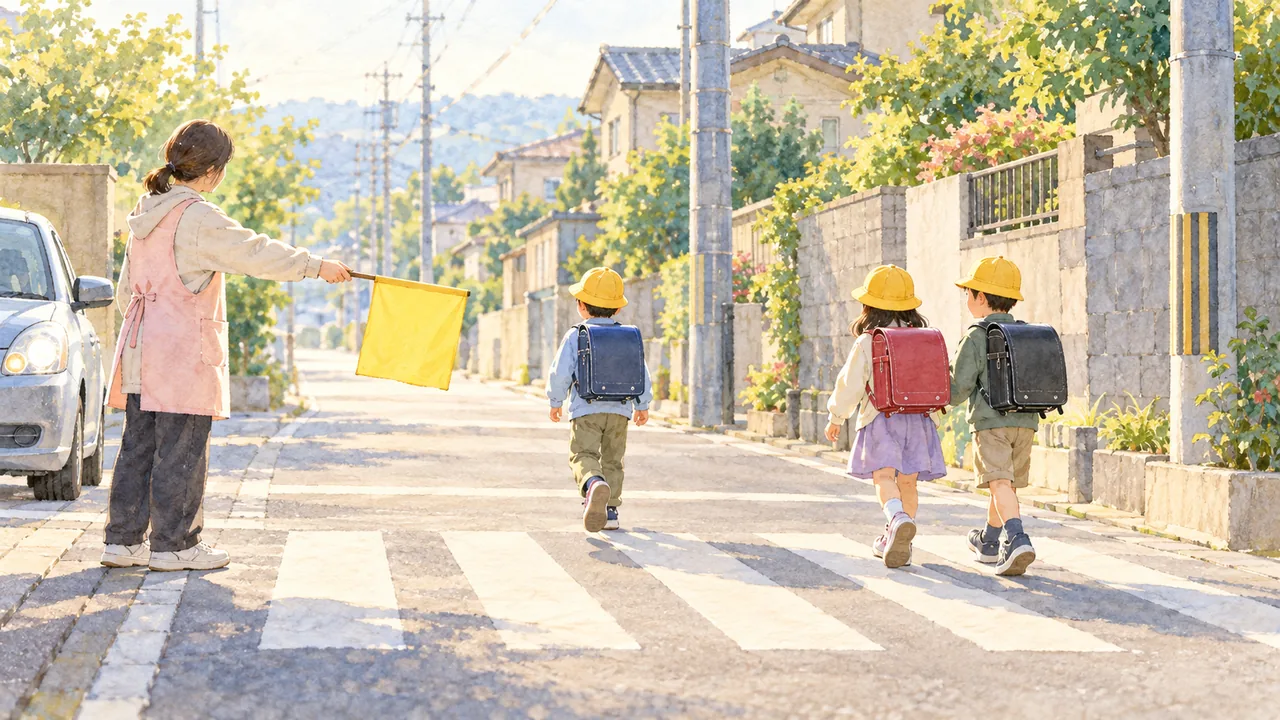
When I was in first grade, parents stood at points along the route holding yellow flags — at stretches where more cars passed, at crosswalks. Parents took turns on a rota, every morning, so that first graders could get to school safely without getting lost. Even walking alone, I almost never lost my way.
It isn't only in the morning. Adults stand at the same spots when school lets out, too. That is what lets parents send their children out the door alone without worrying.
My mother took her turn standing there with a flag. Now that I am a parent, I have done the same many times. You end up watching over the very road you were once watched over on. In Japan, the job gets handed down like that, from parent to child.
Because it is a rota, it is not always the same face each morning. In some neighborhoods, though, a retired grandmother or grandfather volunteers every single day. There, the children learn that person's face, and that person learns theirs.
Along the route, some homes and shops display a sticker that says Kodomo 110-ban no Ie — roughly, "a 110 house for kids" (110 is Japan's police emergency number). It means: if anything frightening happens, you can run in here. Some children also clip a personal alarm to their randoseru. The randoseru itself is a tough bag, built on the assumption that a child will carry it every day for six years.
Plenty of kids meet up with friends on the way. In some areas, children from the same neighborhood gather at a meeting point and walk together, with the oldest kids leading the line — this is called shūdan tōkō, group walking to school.
So yes, Japanese children go to school "alone." But they are never really on their own. There are adults watching, and other children walking beside them. A child can walk that road alone less because the child is strong, and more because of what kind of road it is.
Six Years Old, Commuting Like an Adult
Back to the children on the train.
Some Japanese children attend private elementary schools and similar schools some distance from home. They are not a large group, but in big cities you see them every morning, commuting by train. These were the children that surprised the American teachers most.
What they do is no different from an adult's commute. They tap a pass at the ticket gate, line up on the platform like everyone else, ride a crowded train, get off at the right station, and walk to school. A six-year-old, doing it alone.
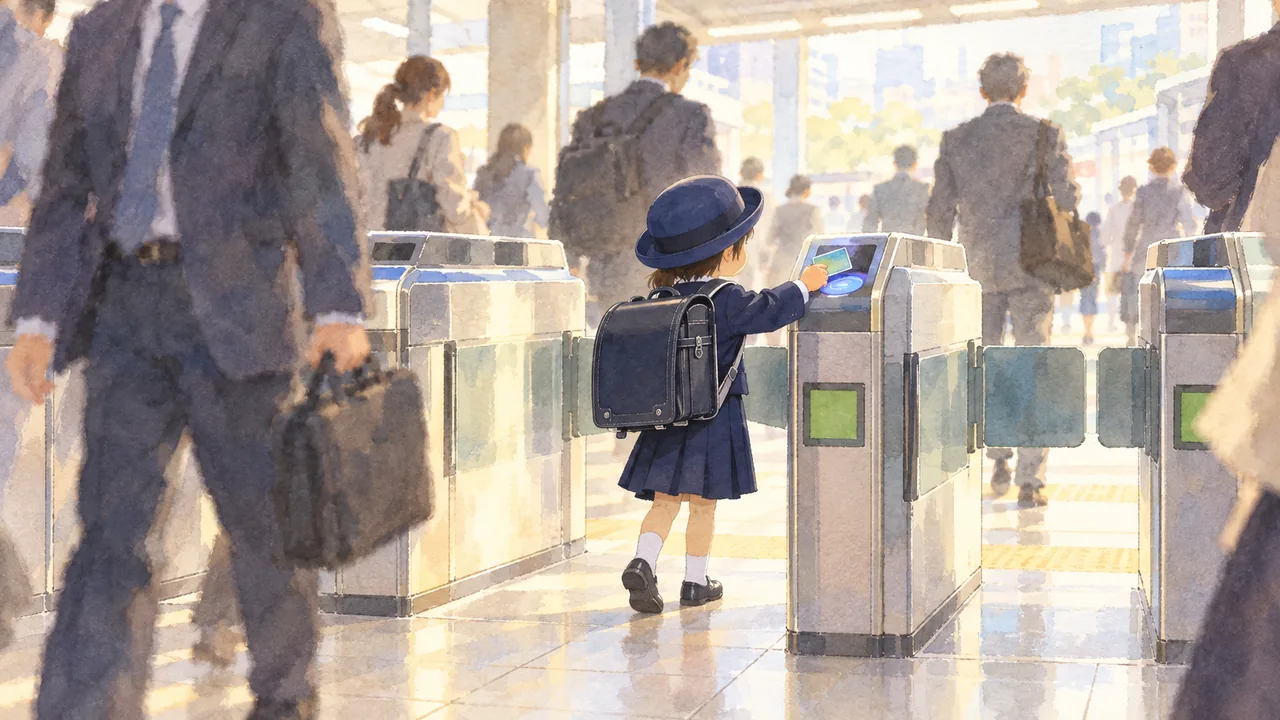
I don't think they can do this because they are unusually mature children. They can do it because the preparation is in place — and in Japan, that preparation is simply taken for granted.
How it works varies from school to school. But when you listen to parents whose children commute by train, it tends to go something like this.
The support comes off in stages
For the first few weeks, teachers may ride the train home with the first graders. Once the children get used to it, the teachers only go as far as the platform. Then only as far as the ticket gate. Little by little, the part the children handle by themselves grows. Some schools set a period during which parents meet their child at the nearest station.
There are rules about which train
First graders ride local trains only, never the express. Some schools assign each after-school group a specific car and even a specific door. At some schools, older students accompany the younger ones in the morning. And even where there are no rules, children from the same school tend to catch the same train, so they rarely end up riding entirely alone.
Families have their part, too
At the information session before school starts, parents are reportedly told, firmly, to teach train manners at home: don't sit down even if a seat is free, don't make noise, stay quiet. All obvious things — but parents are expected to ride the train with their child and check them in practice. Some parents tell their child to always ride in the car with the conductor.
The children commute in their school uniforms and hats, so any adult nearby can tell at a glance which school they attend. That uniform is a marker, but it also means being watched. Make a fuss on the train, and people will remember the name of your school along with it. That is why schools and parents care so much about manners.
Did you know: some train passes text the parents
In the Tokyo area, JR East and other railway operators run a service that sends a parent an email the moment their child's registered IC card passes through a ticket gate — which station, and what time. The child just taps in as usual; the message goes home on its own.
And then there is the railway itself. Trains arrive on time. Lines on the platform show where to queue. Every station has staff. The systems adults take for granted turn out to be easy for a six-year-old to understand, too.
Parents say the first month is nerve-racking, but once kids get used to it, they ride like it is nothing. If they leave an umbrella or a water bottle on the train, they learn to go to the station office by themselves and report it. Even at schools that allow parents to ride along in any grade, apparently almost no child keeps doing so. Even when a parent is heading the same way, it is the child who pulls away — because riding with Mom or Dad is embarrassing.
I am not trying to say Japan does this better. The point is that schools, families, and the railway each do a little preparation so that a child can ride a train alone — and in Japan, that is not special. It is just how things are done. I suspect that is what the American teachers were really surprised by.
The same teachers were just as surprised by what they saw inside the school: children serving lunch to their classmates in white smocks, and cleaning their classroom floor on their hands and knees. I wrote about that in why Japanese students serve lunch and clean their school.
How Do Kids Get to School Where You Live?
I want to be clear: this section is not about which way is better. It is about understanding why things differ.
And to be honest, almost everything I know about how children get to school in other countries comes from foreign TV shows and movies. So please read what follows as what I found when I looked into it a little.
In American shows and films, you often see a parent dropping a child off at school by car. When I looked it up, that turned out to be accurate: in the United States, the most common way to get to school is being driven by a parent. Next comes the school bus. Comparatively few children walk.
That is less about parents being overprotective and more about this: schools are often simply far away. Many towns are built around the car, and it is not unusual for a family to live miles from the school. In American surveys, the reason parents most often give for not letting their children walk is not crime — it is that the school is too far. Children who live close to their school do walk, in America too.
Look at Europe and the picture changes again. In Finland and Denmark, a large share of children cycle to school. In the UK, many children walk, but in primary school it is normal for a parent to walk with them.
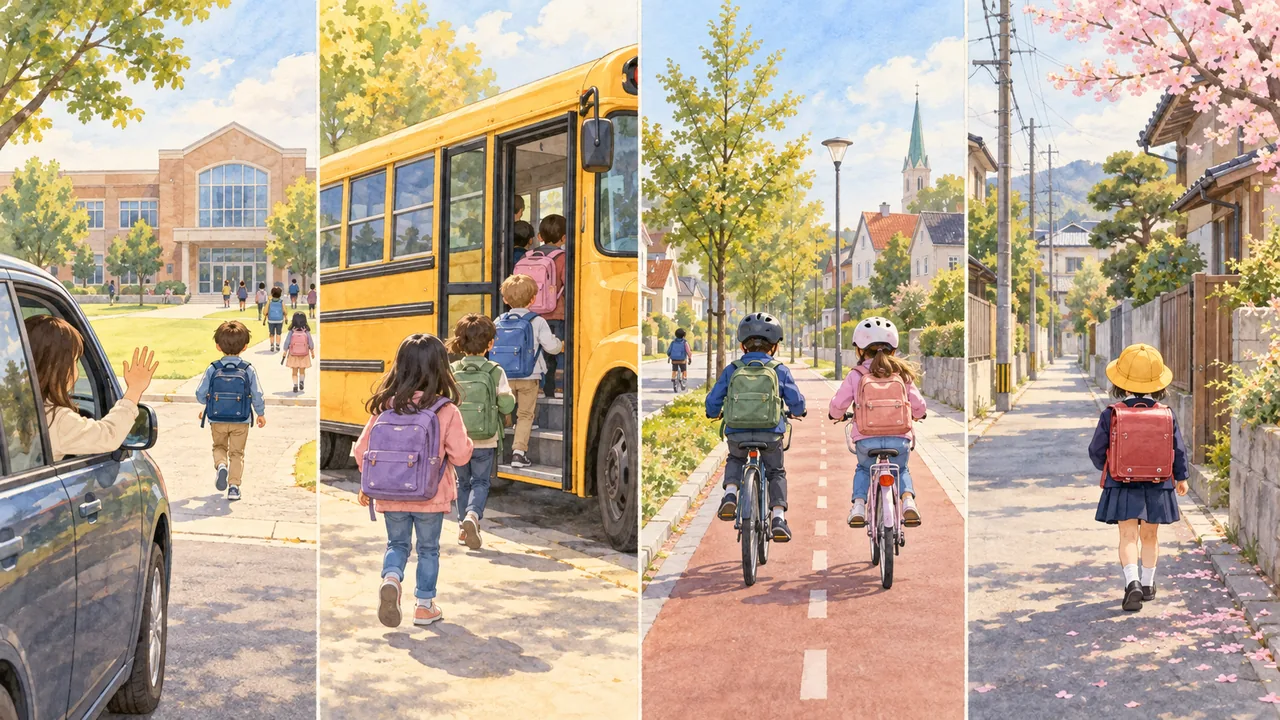
And in recent years, a growing number of US states have passed laws making clear that letting children do age-appropriate things on their own — like walking to school — is not neglect. I think people everywhere know how valuable it is for a child to be able to get around alone. What differs is whether the roads and the distances support it.
Japan may just be a country where that support happened to survive. And as I wrote earlier, even here, schools are closing and the children who now live far away ride a bus. When the distance changes, the way kids get to school changes. I think that is true in every country.
I imagine the people reading this come from all over — Europe, the United States, Asia, Australia. How do children get to school where you live? And how did you get to school when you were a kid?
Heading to Cram School After Dark
The other thing that surprised the American teachers was children heading to cram school alone at night.
In Japan, more and more children attend juku — private after-school cram schools — as they move up through the grades. In the evening, on platforms, on trains, and on streets as it gets dark, you see kids who are clearly on their way to or from juku. Most are junior high students, but some are in elementary school. Sometimes they are alone, sometimes with friends. Getting home close to 9 p.m. is not unusual.
To Japanese people, this too is a familiar sight. To visitors, it apparently looks just as strange as the first grader on the morning train.
There are reasons kids can walk around alone at night here.
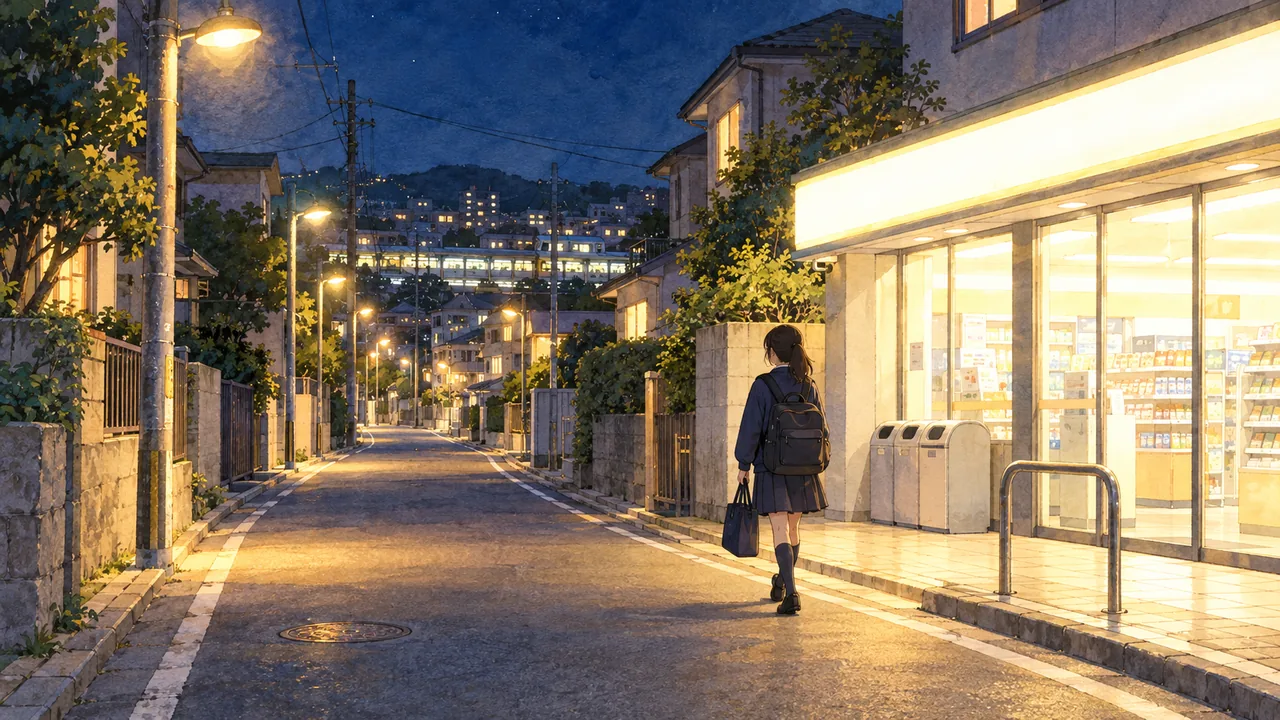
First, the streets are bright at night. Almost every neighborhood in Japan has a convenience store, and most of them are open 24 hours. The lights are on in the middle of the night, and there is someone working inside. Convenience stores also serve as places women and children can run into if they feel unsafe — the industry has taken on that role nationwide. Just knowing there is a convenience store on the way home makes a dark walk feel far less lonely.
Did you know: convenience stores are official safe spots
Since 2005, convenience stores belonging to Japan's franchise chain association have run a nationwide "Safety Station" program. Staff are prepared to take in women and children who feel threatened, and stores help keep an eye on kids in the neighborhood. The bright shop on the corner is, quite deliberately, a refuge.
Second, the streetlights are bright. Even narrow residential lanes have streetlights, so at night you can still see the ground in front of you and the faces of people passing by.
And third, there is simply very little crime. Japan is often described as a low-crime country, and living here, you feel it. A junior high student walking alone past a station at 9 p.m. is not something anyone considers unusual.
Bright shops, bright streets, and little crime. With all three in place, parents can send a child out into the evening with nothing more than "Come straight home when class is over."
If You See a Child Alone in Japan
If you are visiting Japan, there is one thing I would like you to know.
If you see a child alone on a train or in the street and feel worried, it is generally best not to speak to them. Japanese children are taught to be careful when a stranger talks to them. Even with the kindest intentions, you might frighten the child.
If a child really does seem to be in trouble, tell a station attendant or someone working in a nearby shop. That is the most natural way to help in Japan. It is also what was behind the advice the American teachers received: "people here will think you are the suspicious one."
That said, if you speak Japanese and you come across a situation that is truly urgent, then please — help that child.
Now I'm the One Sending Them Off
And then I became a parent myself. Today I have a 13-year-old son and a 5-year-old daughter.
My son, of course, had his own first day of walking to school alone. It just came a little late. He missed the entrance ceremony, and couldn't go to school for several days after that.
It was spring, right in the middle of the early COVID-19 outbreak. There had been infections at a relative's workplace, we had been visiting that relative's home, and so we were classed as close contacts and had to isolate at home.
So his first day came late. But I did not worry about it for a second.
Because our house is right next door to the school.
Even on a six-year-old's legs, it is two minutes from our front door to the school gate. I could send him off without a single worry.
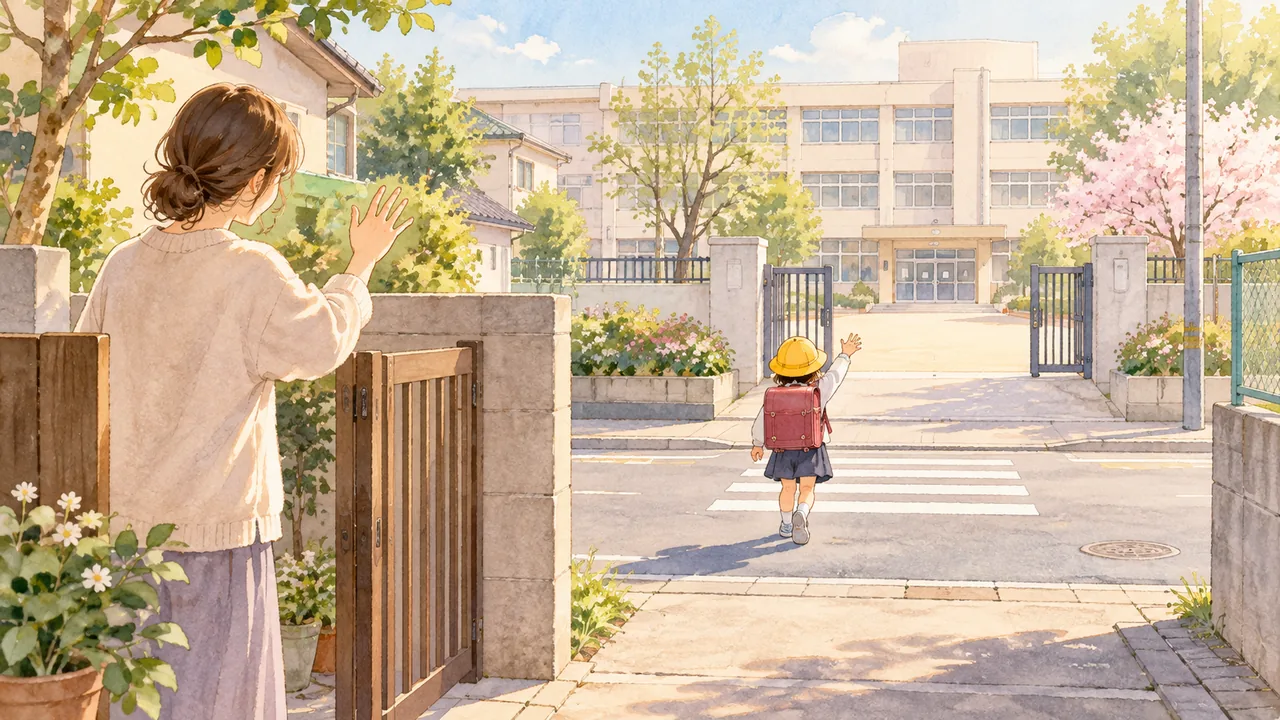
There is a reason for that. I still have that bittersweet memory of crying my way home along a 25-minute road. So when we were looking for a house, I looked near the school, so that my son would not have to go through the same thing. As luck would have it, the house right next to the school was for sale, and I decided to buy it on the spot.
Thanks to that, I have never once had to worry about his walk to school.
Frequently Asked Questions
Why do Japanese kids walk to school alone?
Because the school is close, the route is watched, and children are prepared for it. Public elementary schools serve areas a child can cover on foot, parents and volunteers stand along the route in the morning and after school, and kids often walk with friends. Japan's low crime rate helps, but it is only part of the story.
At what age do Japanese children start going to school alone?
Usually from the first year of elementary school, at age six. A parent often walks with the child on the first day, and from then on the child goes alone or with friends.
Do Japanese kids really ride the train alone?
Yes — mostly children at private schools some distance from home, in big cities. They are not the majority, but they are a common sight. Schools and families prepare them in stages, often with teachers riding along at first, rules about which trains to take, and train manners practiced at home.
Is it safe for children to walk alone in Japan?
Japan has little crime, and its streets are well lit even at night. But the safety children enjoy also rests on many small things: adults watching the school route, homes and shops that act as places to run to, and 24-hour convenience stores that will take in a child who feels unsafe.
What should I do if I see a child alone in Japan?
Generally, don't approach the child — tell a station attendant or shop staff instead. Japanese children are taught to be wary of strangers who talk to them. If you speak Japanese and the situation is truly urgent, though, please help.
Is Old Enough! on Netflix real?
It is a shortened international version of a long-running Japanese TV show, Hajimete no Otsukai ("My First Errand"), which has aired since the early 1990s. The children are very young, and a film crew follows them, so it is an extreme version of everyday life. But the idea behind it — sending a child out alone, with adults quietly watching — is familiar to every Japanese family.
Final Thoughts: Something Not Yet Lost
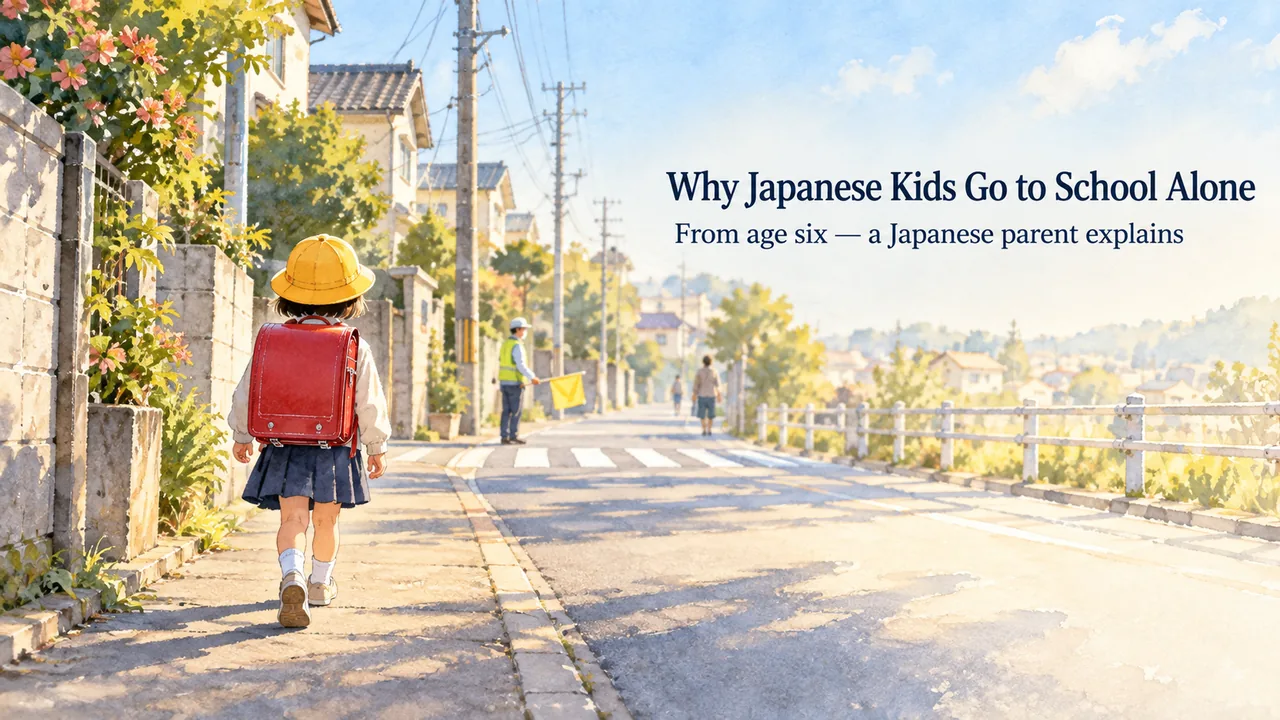
In this series, I want to write down the things in Japan that are slowly being lost. The sight of a child walking to school alone has not been lost yet. But as schools close, it is starting to change shape. That is why I wanted to write it down now.
I don't think it is laws or programs that keep it alive. It is a school within walking distance. A parent standing at a crosswalk with a yellow flag — the way my mother once stood, and the way I have stood since. And a parent who hugs a child who came home in tears, then sends them out the door again the next morning. Small things, one on top of another, keep this scene going.
So if you are ever in Japan and you see a small child with a randoseru walking alone, before you worry, think of all the adults standing quietly behind them.
Randoseru: The Japanese School Bag, and the Adult Version

Randoseru Brands: The Five Workshops That Matter